Chicago Workers Compensation Attorney: 2026 Deadlines, Settlement Ranges, and How to Choose the Right Lawyer
Quick Answer
- A Chicago workers compensation attorney handles claims against employers for workplace injuries under Illinois law.
- Settlements vary widely. Most cases resolve through negotiated lump sums, not jury verdicts or class funds.
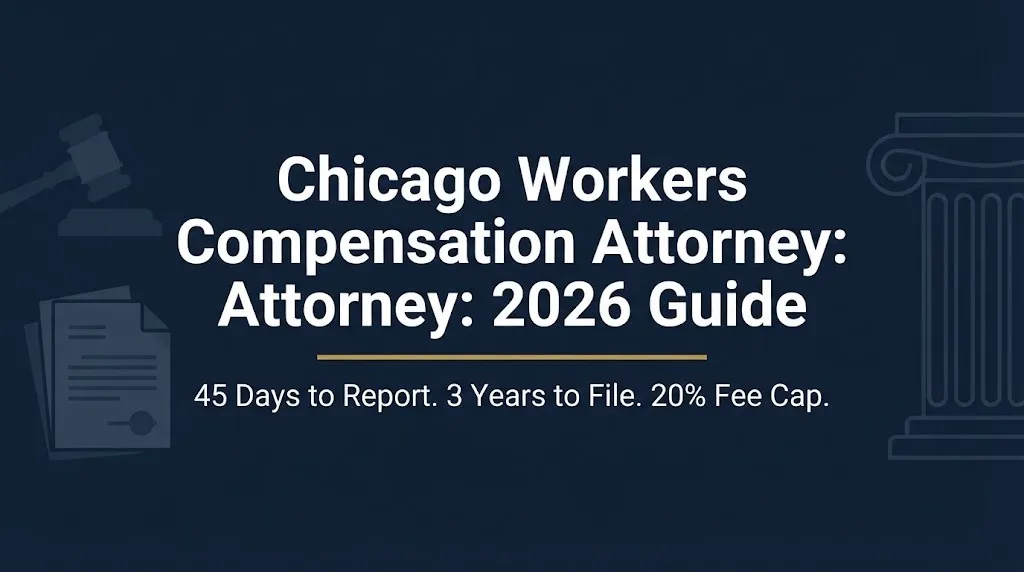
- The most important deadline is 45 days to notify your employer. The claim filing window is 3 years.
You searched “Chicago workers compensation attorney” because you got hurt at work, or someone you know did, and now the bills are piling up. Here is the direct answer: Illinois law requires employers to carry workers compensation insurance. That insurance pays for medical care and part of your lost wages after a work injury.
But the system is not automatic. Insurance companies deny claims. Employers dispute whether injuries happened at work. Deadlines pass. That is where an attorney comes in.
This article explains what a Chicago workers compensation attorney actually does, what it costs, what settlements look like in 2026, and the traps that cost injured workers real money. One fact matters most: you have 45 days to report the injury and 3 years to file a claim. Miss those windows and your case can die before it starts.
The Facts
| Detail | Verified Information |
| Governing Law | Illinois Workers’ Compensation Act |
| Reporting Deadline | 45 days from injury or discovery |
| Claim Filing Deadline | 3 years from injury or 2 years from last compensation payment |
| Attorney Fee Cap | 20% of recovery, set by Illinois law |
| Average Settlement Range | Varies by injury type and wage loss, not a fixed amount |
| Forum | Illinois Workers’ Compensation Commission |
| Class Action or Fund | No. Claims are individual, not class-based |
Is a Chicago Workers Compensation Attorney Worth It?
Yes, in most cases. The data backs this up.
A workers compensation attorney handles the legal process while you focus on recovery. Insurance companies have adjusters and lawyers on their side from day one. You should have someone who knows the system too.
The Illinois Workers’ Compensation Commission reports that represented workers often secure better medical care approvals and higher settlement amounts. That does not guarantee a better outcome. But it does mean an attorney can push back when an insurer denies a treatment or delays a check.
The fee structure makes hiring an attorney low-risk. Illinois caps attorney fees at 20% of recovery. You pay nothing upfront in most cases. If you lose, you owe no fee.
What Does a Chicago Workers Compensation Lawyer Do?
A workers compensation lawyer handles every stage of the claim process.
Here is what that looks like in practice:
- Files your claim with the Illinois Workers’ Compensation Commission
- Gathers medical records and work restrictions
- Communicates with the insurance adjuster
- Negotiates a settlement or takes the case to hearing
- Ensures deadlines are met
- Calculates your full benefit entitlement
- Represents you at arbitration or trial
A good attorney also tells you what not to do. That matters. One wrong statement to an adjuster can sink a legitimate claim.
What Is the Difference Between a Chicago Workers Compensation Attorney and a Personal Injury Lawyer?
They handle different types of cases.
Workers compensation covers injuries that happen at work, regardless of fault. You do not need to prove your employer was negligent. You only need to show the injury arose out of and in the course of employment.
Personal injury law covers injuries caused by someone else’s negligence, like a car accident or a slip and fall at a store. Fault matters. You must prove the other party caused your injury.
Some workers compensation attorneys also handle personal injury cases. But the legal rules and deadlines are different. Make sure your attorney focuses on workers compensation if that is what you need.
Key Takeaway: Workers compensation is a no-fault system. You do not need to prove your employer did something wrong. You only need to prove the injury happened at work.
How Much Does a Chicago Workers Compensation Attorney Cost?
Illinois law sets the fee at 20% of your recovery.
That means if you settle for $50,000, your attorney receives $10,000. You keep $40,000. Medical bills and liens may reduce your net amount further.
Here is how the fee structure works:
| Recovery Amount | Attorney Fee (20%) | Your Net Before Liens |
| $25,000 | $5,000 | $20,000 |
| $50,000 | $10,000 | $40,000 |
| $100,000 | $20,000 | $80,000 |
| $200,000 | $40,000 | $160,000 |
You pay nothing upfront. The fee comes out of your settlement or award. If you lose, you owe no attorney fee.
What Is the Average Workers Compensation Settlement in Chicago?
There is no single average settlement figure that is meaningful.
Settlements depend on your injury, your wages, your medical needs, and whether you can return to work. A minor sprain might settle for a few thousand dollars. A spinal injury requiring surgery might settle for six figures.
What you can verify is the structure of settlements. Illinois workers compensation settlements are typically paid as a lump sum. The amount includes compensation for permanent partial disability, medical care, and sometimes wage loss.
Permanent partial disability is calculated using a formula based on your average weekly wage and the body part injured. The Illinois Workers’ Compensation Commission publishes a schedule of benefits.
How Much Will I Get for My Workers Comp Claim in Illinois?
Your benefit amount depends on three verified factors.
First, your average weekly wage. This determines your temporary total disability rate, which is two-thirds of your average weekly wage, subject to a state maximum.
Second, the nature and extent of your injury. Permanent partial disability awards vary by body part and impairment rating.
Third, your ability to return to work. Cases involving permanent restrictions often settle higher than cases with full recovery.
The Illinois Workers’ Compensation Commission sets the maximum weekly benefit rate. For 2026, that rate is adjusted annually. Check the Commission’s website for the current figure.
What Are the Deadlines for Filing a Workers Comp Claim in Illinois?
Two deadlines matter most.
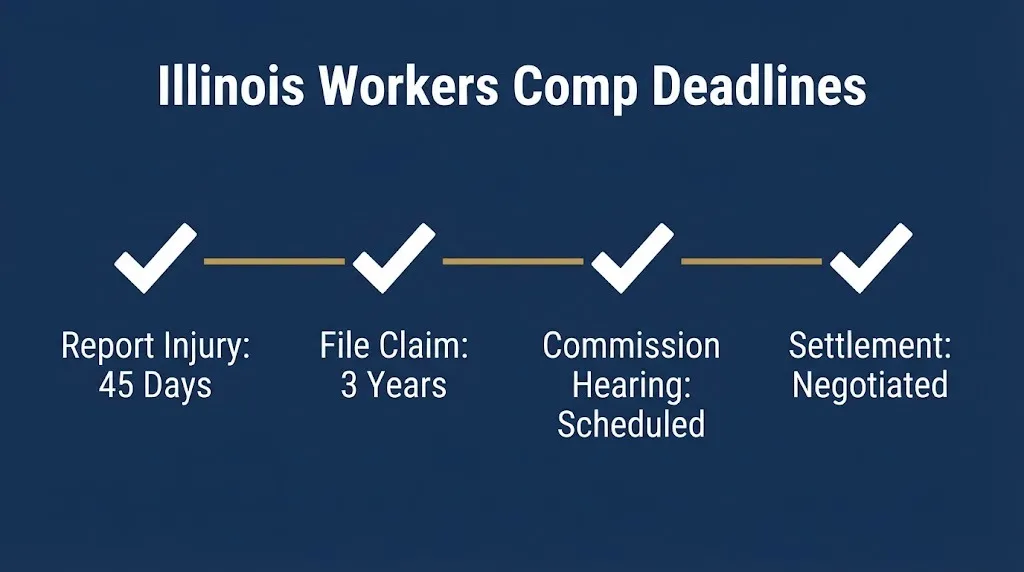
The first is 45 days. You must notify your employer within 45 days of the injury. If you miss this deadline, your claim may be barred unless you can show a valid reason for delay.
The second is 3 years. You must file an Application for Adjustment of Claim with the Illinois Workers’ Compensation Commission within 3 years of the injury date. If you received compensation payments, the deadline may be 2 years from the last payment.
These deadlines are strict. Do not rely on your employer to file for you. Do not assume the insurance company is handling it. Confirm everything in writing.
Key Takeaway: Report your injury within 45 days. File your claim within 3 years. Missing either deadline can destroy your case no matter how serious the injury.
Reality Check: No legitimate workers compensation attorney will guarantee a specific settlement amount. Anyone promising a set payout before reviewing your medical records is not being honest. Illinois law caps fees at 20%. If an attorney asks for more, walk away.
How Do I File a Workers Comp Claim in Chicago?
Filing a claim follows a clear sequence.
- Report the injury to your supervisor or employer immediately.
- Seek medical treatment. Your employer may direct you to an approved provider.
- Document everything: injury details, witnesses, medical visits, and time off.
- Confirm your employer filed an accident report.
- File an Application for Adjustment of Claim with the Illinois Workers’ Compensation Commission.
- Keep copies of all correspondence with your employer and the insurer.
- Contact a workers compensation attorney if your claim is denied or delayed.
The filing itself is simple. The process that follows is not.
What If My Workers Comp Claim Is Denied in Illinois?
Denial is common. It is not the end of the road.
Insurance companies deny claims for many reasons: late reporting, disputed causation, pre-existing conditions, or incomplete paperwork. A denial letter must state the reason.
You have the right to request a hearing before an arbitrator at the Illinois Workers’ Compensation Commission. An attorney can file the necessary forms and represent you at that hearing.
Many denied claims settle after an attorney gets involved and builds the medical evidence. Do not accept a denial as final.
What Types of Injuries Qualify for Workers Compensation in Chicago?
Any injury that arises out of and in the course of employment qualifies.
That includes:
- Repetitive motion injuries, like carpal tunnel syndrome
- Back and neck injuries from lifting or falls
- Broken bones and fractures
- Burns and chemical exposures
- Occupational illnesses, like respiratory conditions
- Mental health conditions caused by work trauma, in limited cases
- Aggravation of pre-existing conditions
The key is proving the work connection. That is where medical evidence and attorney guidance matter most.
How Long Does a Chicago Workers Comp Case Take?
Most cases resolve in 12 to 24 months.
Simple cases with clear liability and moderate injuries may settle within 6 to 12 months. Cases involving surgery, permanent restrictions, or disputed liability can take 2 to 3 years or longer.
The Illinois Workers’ Compensation Commission has a backlog in some regions. Hearings may be scheduled months out. Your attorney can push for faster resolution when the medical evidence is clear.
Key Takeaway: A workers comp case is a marathon, not a sprint. Expect months, not weeks. The quality of your medical evidence matters more than your impatience.
What Is the Illinois Workers’ Compensation Commission?
It is the state agency that administers workers compensation claims.
The Illinois Workers’ Compensation Commission handles disputes between injured workers and employers. It has arbitrators who hear cases, and commissioners who review decisions.
The Commission does not represent workers. It is a neutral adjudicator. You can file a claim with the Commission on your own, but the process is technical and deadlines are unforgiving.
An attorney who practices regularly before the Commission knows the arbitrators, the procedures, and the tactics insurers use.
How Do I Choose a Chicago Workers Compensation Attorney?
Choosing the right attorney matters more than choosing the biggest billboard.
Here is a checklist:
- Verify the attorney practices workers compensation law, not just personal injury.
- Ask how many Illinois workers comp cases they handle per year.
- Ask for examples of recent settlements or awards in similar cases.
- Confirm the fee is 20% and there are no upfront costs.
- Ask who will handle your case: the named attorney or a junior associate.
- Check the Illinois Attorney Registration and Disciplinary Commission for any discipline history.
- Read client reviews on independent platforms, not just the firm’s website.
A good attorney will answer these questions directly. If they deflect, keep looking.
What Are Common Mistakes That Hurt Chicago Workers Comp Claims?
Most mistakes are preventable with basic knowledge.
- Waiting too long to report the injury
- Saying “I’m fine” when you are not
- Posting about your injury on social media
- Failing to follow medical restrictions
- Missing doctor appointments
- Settling before you know your full medical needs
- Not reading the settlement contract
These mistakes give insurance companies ammunition. They use your own words and actions against you. Stay disciplined.
How Does a Workers Comp Settlement Work in Illinois?
A settlement is a contract that closes your claim in exchange for payment.
Most Illinois workers comp cases settle through a settlement contract. The contract typically waives your right to future benefits in exchange for a lump sum.
You must approve the settlement. The Illinois Workers’ Compensation Commission reviews it for fairness. Once approved, the insurer pays within a set time frame.
Here is the settlement process in simple terms:
| Step | What Happens |
| Negotiation | Your attorney and the insurer exchange settlement demands and offers |
| Documentation | Medical records, wage statements, and disability ratings are gathered |
| Settlement Contract | Both sides sign a written agreement |
| Commission Approval | An arbitrator reviews and approves the contract |
| Payment | The insurer issues payment, typically within 30 days of approval |
Key Takeaway: A settlement closes your claim permanently. Once you sign and it is approved, you cannot ask for more money later. Make sure your medical condition is stable first.
What Happens If I Am Fired After Filing a Workers Comp Claim?
Illinois law prohibits retaliation for filing a workers compensation claim.
Your employer cannot legally fire you, demote you, or harass you because you filed a claim. That is retaliation and it is illegal.
But proving retaliation is difficult. Employers often give other reasons for termination. An attorney can evaluate whether you have a separate claim for retaliatory discharge.
Document everything. Keep emails, text messages, and notes about any changes in how you are treated after filing.
Do I Need an Attorney for a Minor Work Injury?
Maybe not. But you should still know your rights.
Minor injuries with quick recovery and no lost time may not require an attorney. You can report the injury, get treatment, and return to work.
But if the insurer denies treatment, if you miss time from work, or if you have permanent restrictions, get legal help. The insurance company is not looking out for you.
A consultation is usually free. It costs nothing to find out where you stand.
What Happens Next in a Chicago Workers Comp Case
Here is the typical timeline for a workers compensation claim in Illinois:
- Day 1 to 45: Report the injury and seek medical care.
- Weeks 1 to 12: Medical treatment and temporary disability payments begin, if approved.
- Months 2 to 6: Claim evaluation, medical records review, and settlement discussions.
- Months 6 to 18: Negotiation or hearing, depending on whether the case settles.
- Final stage: Settlement contract signed, Commission approval, and payment issued.
Each case is different. Yours may move faster or slower depending on the facts.
Frequently Asked Questions
What is the deadline to report a work injury in Illinois?
You have 45 days from the injury date to notify your employer.
How long do I have to file a workers comp claim in Illinois?
You must file with the Illinois Workers’ Compensation Commission within 3 years of the injury.
How much does a workers comp attorney cost in Chicago?
Illinois law caps attorney fees at 20% of your recovery, with no upfront payment.
What is the maximum workers comp settlement in Illinois?
There is no fixed maximum settlement. Amounts depend on wages, injury severity, and medical needs.
Can I be fired for filing a workers comp claim in Illinois?
No. Retaliation for filing a claim is illegal, though proving it can be difficult.
Do I need a lawyer for a workers comp claim in Chicago?
Not always. But if your claim is denied, delayed, or involves permanent injury, an attorney helps.
How long does a workers comp settlement take in Illinois?
Most cases settle in 12 to 24 months, though simpler cases may resolve faster.
What if my employer does not have workers comp insurance?
Illinois requires coverage. If your employer lacks insurance, you may have a claim against a state fund or a personal injury lawsuit.
Here is the bottom line. A Chicago workers compensation attorney can help you navigate a system that is built for employers and insurers, not for injured workers.
Report your injury within 45 days. File your claim within 3 years. Talk to an attorney before you sign anything. Those three steps protect everything else.