Workers Compensation Attorney Atlanta: What to Expect in 2026
Quick Answer
- Workers compensation attorneys in Atlanta handle claims under Georgia law, not federal law.
- Most attorneys work on contingency, taking about 25% of your settlement or award .
- You have 30 days to report a work injury and 1 year to file a formal claim in Georgia.
If you got hurt on a job site in Atlanta, you do not have to figure out the workers compensation system alone. Georgia law gives you the right to hire an attorney, and the data shows it usually pays off. Injured workers with legal representation received 15% to 20% more in benefits than those without, according to a Workers’ Compensation Research Institute study .
The system is not designed to be easy. Employers and their insurers have lawyers. You should too. This article covers what an Atlanta workers compensation attorney actually does, how much they cost, when you need one, and what your case might be worth in 2026.
The Facts
Case Type | Georgia Workers’ Compensation Claim (state system, not a class action)
Governing Agency | Georgia State Board of Workers’ Compensation (SBWC)
Max Weekly Benefit (2026) | $675 per week
Typical Attorney Fee | 25% of settlement, approved by the SBWC
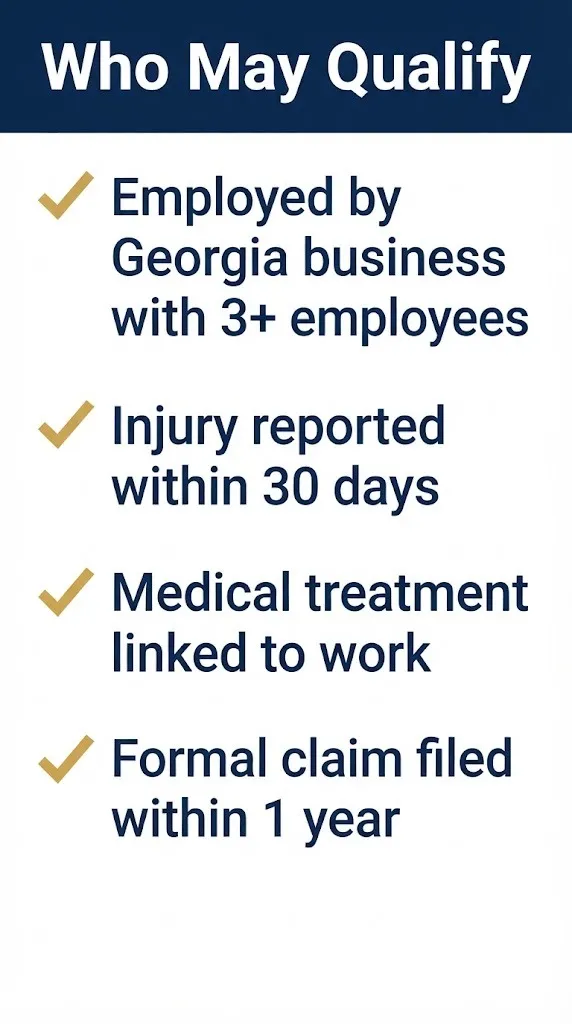
Reporting Deadline | 30 days from injury or knowledge of injury
Claim Filing Deadline | 1 year from injury (2 years for death claims)
Coverage Requirement | Employers with 3+ employees must carry coverage
Settlement Approval | All settlements must be approved by the SBWC
Do You Really Need a Workers Compensation Attorney in Atlanta?
You do not legally need an attorney to file a Georgia workers compensation claim. You can file the forms yourself and negotiate directly with the insurance adjuster. But the numbers say you probably should not.
A 2021 Workers’ Compensation Research Institute study found that injured workers with attorneys received 15% to 20% more in benefits than unrepresented workers . That gap exists because insurers make their first offer low, and they count on you not knowing what your case is really worth.
Think of it like a store return without a receipt. You can ask for your money back, and the store can say no. With a receipt, you have proof. An attorney is your proof that you know the rules.
Here is what an Atlanta attorney actually does for you:
- Calculates your true average weekly wage, including overtime and bonuses
- Challenges low impairment ratings from company doctors
- Projects future medical costs the insurer wants to ignore
- Files the correct forms before deadlines expire
- Negotiates a settlement that accounts for what you are giving up
The fee is usually 25% of your settlement, and the State Board must approve it . If you recover nothing, you typically owe nothing.
How Much Does a Workers Compensation Attorney Cost in Atlanta?
Most Atlanta workers compensation attorneys work on contingency, meaning they get paid only if you get a settlement or award. The standard fee is 25% of the recovery, approved by the Georgia State Board of Workers’ Compensation .
That means if your case settles for $40,000, your attorney gets $10,000 and you keep $30,000. If your case recovers nothing, you owe no attorney fee.
Some attorneys handle specific tasks on an hourly basis instead. That is more common for simple issues like a single hearing or a mediation. The hourly rate for an Atlanta workers comp attorney typically ranges from $250 to $450 per hour, but most injured workers never pay hourly because they hire on contingency.
Free consultations are standard. You can meet with an attorney, get an assessment of your case, and decide whether to hire them without paying anything upfront.
What Is the Average Workers Compensation Settlement in Atlanta?
There is no single average settlement for Atlanta workers compensation cases. Every claim depends on your injury, your wages, and whether the insurer disputes liability. But published data gives you a range to work with.
ConsumerShield research found these settlement ranges for Georgia workers compensation cases in 2026 :
| Injury Severity | Typical Settlement Range |
|---|---|
| Minor injuries | $5,000 to $10,000 |
| Moderate injuries or impairment | $20,000 to $40,000 |
| Severe or catastrophic injuries | $50,000 to $200,000+ |
A more granular look at national data shows the median workers comp settlement is about $21,800, with roughly 55% of injured workers receiving between $2,000 and $20,000 .
The high end exists. A Brookhaven warehouse worker with a back injury settled for $110,000 after his attorney rejected a $20,000 initial offer and proved the insurer was understating his impairment rating and future medical needs .
Your mileage will vary. The biggest factors are whether you had surgery, whether you have permanent restrictions, and whether you can return to your old job.
Key Takeaway: Atlanta workers comp settlements range from a few thousand dollars for minor injuries to over $200,000 for catastrophic ones, and the presence of an attorney is one of the strongest predictors of where your case lands.
What Is the Deadline to File a Workers Compensation Claim in Georgia?
You must report your work injury to your employer within 30 days and file a formal claim with the State Board within one year . Miss either deadline and you can lose your right to benefits entirely.
The 30-day rule is strict. If you do not tell your employer about the injury within that window, the insurer can deny your claim. Report it in writing, even if it seems minor at first. Injuries that get worse over time still count, and the clock starts when you know or should know the injury is work-related.
The one-year deadline is for filing a Form WC-14 with the State Board. That form officially starts your claim if your employer or their insurer is not paying benefits voluntarily.
For death claims, the deadline extends to two years from the date of death .
Do not wait. If you are getting medical treatment and weekly checks without a problem, you may not need to file. But if the checks stop or the insurer denies your claim, file immediately.
How Do You Choose the Right Workers Compensation Attorney in Atlanta?
Choosing an attorney is not about finding the biggest billboard. It is about finding someone who handles Georgia workers comp cases regularly and will actually answer your calls.
Here is what to look for:
- Georgia workers comp focus. Some attorneys handle every type of injury case. Workers comp has its own rules, deadlines, and fee structures.
- State Board approval history. The SBWC must approve all settlements and attorney fees. Ask how many settlements they have handled.
- Willingness to go to hearing. Some attorneys settle everything quickly. Others will fight at a hearing before an Administrative Law Judge if the offer is too low.
- Clear communication. You should understand what is happening in your case without a law degree.
- Free consultation. You should not pay to find out if you have a case.
Martindale-Hubbell lists several Atlanta workers comp firms with strong peer ratings. Hansford McDaniel has a 4.9/5.0 peer rating, and The Law Offices of T. Andrew Miller has a 4.7/5.0 rating . Sadow & Froy reports settling workers comp cases totaling more than $230 million over its career .
That does not mean you must hire one of those firms. It means you should check credentials and reviews before signing anything.
What Happens If Your Georgia Workers Comp Claim Is Denied?
A denial is not the end. You have the right to file a Form WC-14 with the State Board and request a hearing before an Administrative Law Judge . Many denied claims get reversed or settled after a lawyer gets involved.
The most common reasons insurers deny Georgia workers comp claims are:
- Late reporting. You did not tell your employer within 30 days.
- Causation dispute. The insurer says your injury is not work-related.
- Independent contractor claim. Your employer says you were not an employee.
- No medical evidence. Your doctor did not tie the injury to your job.
If you get a denial letter, do not wait. The one-year filing deadline still applies. Get the letter in writing and talk to an attorney.
Reality Check: No one texts you a workers comp settlement out of nowhere. If someone contacts you claiming they can get you money for a fee, that is a scam. Filing a claim with the Georgia State Board is free. Attorneys work on contingency, not upfront payments.
What Are the Maximum Workers Compensation Benefits in Georgia for 2026?
The maximum weekly benefit for Georgia workers compensation in 2026 is $675 per week . That is the highest amount you can receive for temporary total disability, permanent partial disability, or death benefits.
The number is lower than some neighboring states. South Carolina’s maximum is $1,189.94 for 2026. Georgia’s cap reflects the state’s average weekly wage and its employer-friendly system.
Your actual benefit is two-thirds of your average weekly wage, capped at $675. If you made $1,500 per week before the injury, two-thirds is $1,000, but you would only receive $675. If you made $600 per week, two-thirds is $400, and you would receive $400.
For permanent partial disability, the state assigns a specific number of weeks to each body part. The loss of an arm is 225 weeks, a hand is 160 weeks, and a foot is 135 weeks . Your impairment rating determines what percentage of those weeks you receive.
What Happens Next in Your Atlanta Workers Compensation Case?
The timeline for a Georgia workers comp case depends on whether the insurer disputes your claim and how long your medical treatment lasts.
Immediately: Report your injury to your employer in writing and get medical treatment.
Within 30 days: Confirm your employer filed a First Report of Injury with the State Board.
Within 1 year: File Form WC-14 if benefits are denied or stop.
Expected 6 to 18 months: Most straightforward claims settle or reach maximum medical improvement.
Expected 18 months to 2+ years: Disputed cases with hearings or appeals.
A settlement is not final until the State Board approves it. That approval process typically takes a few weeks after you sign the paperwork .
Key Takeaway: The two deadlines that matter most in Georgia are the 30-day reporting rule and the one-year filing deadline, and missing either one can end your claim before it starts.
Frequently Asked Questions
How much does a workers compensation attorney cost in Atlanta?
Most Atlanta workers comp attorneys charge a 25% contingency fee, approved by the State Board. You pay nothing upfront, and if you recover nothing, you owe no attorney fee.
What is the maximum workers comp benefit in Georgia for 2026?
The maximum weekly benefit is $675 for 2026 injuries. That is two-thirds of the state’s average weekly wage, and it applies regardless of how much you earned before the injury.
How long do I have to report a work injury in Georgia?
You have 30 days to report the injury to your employer. Waiting longer can give the insurer grounds to deny your claim entirely.
Can I file a workers comp claim without a lawyer in Georgia?
Yes. You can file Form WC-14 yourself and negotiate directly with the insurer. But data shows unrepresented workers receive 15% to 20% less in benefits than those with attorneys.
What is the average settlement for a workers comp case in Atlanta?
There is no single average. Published ranges show minor injuries settling for $5,000 to $10,000, moderate injuries for $20,000 to $40,000, and severe injuries for $50,000 to $200,000 or more.
Do I have to pay taxes on workers comp settlement in Georgia?
No. Workers compensation benefits, including lump-sum settlements, are generally not taxable as income. You should confirm with a tax professional for your specific situation.
What happens if my employer does not have workers comp insurance in Georgia?
You can still file a claim with the State Board, but collecting from an uninsured employer is harder. The State Board can penalize the employer, and you may need to pursue the case through the courts.
How long does it take to settle a workers comp case in Atlanta?
Simple cases with clear medical records often settle in 6 to 12 months. Disputed cases with hearings or appeals can take 18 months to 2 years or longer.
What Happens Next
Ongoing 2026: State Board continues to enforce the $675 weekly maximum and approve all settlements.
Expected late 2026: Annual review of the Statewide Average Weekly Wage, which sets the 2027 maximum.
Pending: No major legislative changes to Georgia workers comp law were confirmed as of this update.