Abbott Spinal Cord Stimulator Lawsuit 2026: Full Update
Quick Answer
- The Abbott spinal cord stimulator lawsuit is real and active, involving 15 confirmed federal cases as of the September 24, 2026 JPML hearing.
- No settlement or verdict has been reached against Abbott, so any specific payout amount is not yet determined.
- There’s no claim deadline yet, since this isn’t a class action; individual state statutes of limitations apply to your specific injury date.
If you’re searching for the Abbott spinal cord stimulator lawsuit, here’s what’s actually confirmed right now: 15 lawsuits are pending against Abbott in seven federal districts, and a panel of judges just heard arguments on whether to combine them.
That hearing happened September 24, 2026, in Chicago, just two days before this update. No ruling has come down yet, and no settlement exists with Abbott for any spinal cord stimulator claim. That distinction matters, because Abbott’s competitor Boston Scientific already has an active MDL, and some searchers confuse the two.
This guide separates confirmed fact from speculation: what Abbott’s devices are accused of, why the company hasn’t been folded into an existing MDL, and what evidence actually matters if you’re considering a claim. One detail most competitors bury: Abbott holds the only Class I recall of any spinal cord stimulator manufacturer, issued back in 2023.
The Facts
| Category | Verified Status |
|---|---|
| Case | Individual lawsuits against Abbott Laboratories, including Furia et al. v. Abbott Laboratories, Case No. 3:26-cv-01945 (N.D. Cal., filed March 2026) |
| Court | Currently scattered across seven federal district courts, no consolidated Abbott MDL exists yet |
| Status | Active litigation. JPML heard oral arguments September 24, 2026 on centralizing Abbott cases; written ruling not yet issued |
| Fund Size | None, no settlement has been reached with Abbott in any spinal cord stimulator case |
| Est. Per Person | Not yet determined, no verdicts or settlements exist for Abbott SCS claims |
| Claim Deadline | No formal deadline exists; this is individual litigation, not a class action, so your state’s statute of limitations applies |
| Administrator | Not applicable, no settlement administrator has been appointed |
| Proof Needed | Not applicable to a claims process yet; individual lawsuits require implant records and medical documentation of injury |
Is the Abbott Spinal Cord Stimulator Lawsuit Real?
Yes, the Abbott spinal cord stimulator lawsuit is a real, active body of federal litigation, not a rumor or a scam. As of the September 24, 2026 hearing before the Judicial Panel on Multidistrict Litigation, there are 15 confirmed Abbott spinal cord stimulator lawsuits spread across seven different U.S. District Courts.
Abbott, which acquired St. Jude Medical and its neurostimulation device line in early 2017, is named as a defendant in individual product liability lawsuits filed by patients who say the company’s implanted devices caused injuries or failed to work as promised.
What’s confirmed right now:
- 15 Abbott SCS lawsuits pending across seven federal districts, per the JPML’s August 14, 2026 hearing notice.
- One named case, Furia et al. v. Abbott Laboratories, was filed March 2026 in the Northern District of California.
- No verdict or settlement has been reached against Abbott in any of these cases.
Key Takeaway: The Abbott lawsuit is real, active, and still in early pretrial stages, with no money paid out to anyone yet.
Is There an Abbott Spinal Cord Stimulator Recall?
Yes. Abbott holds the only Class I recall issued for any spinal cord stimulator manufacturer, announced July 18, 2023, covering 155,028 devices in the United States.
The recall addressed an MRI-mode exit failure, meaning affected devices could fail to properly exit a special mode used during MRI scans. According to recall data, this issue was associated with 186 reported incidents and 73 injuries, with no deaths reported.
This recall predates most of the current lawsuits and is frequently cited in complaints as evidence Abbott knew about device reliability problems. A Class I recall is the FDA’s most serious designation, reserved for situations where using the product could cause serious injury or death.
Key Takeaway: Abbott’s 2023 Class I recall, covering over 155,000 devices, is the single most serious documented safety issue tied to the company’s spinal cord stimulators.
How Much Is the Average Abbott Spinal Cord Stimulator Lawsuit Settlement Worth?
Not yet determined. No settlement or jury verdict has been reached in any Abbott spinal cord stimulator case, so there’s no confirmed average payout to report.
This matters because online estimates claiming a specific average payout for Abbott SCS claims aren’t based on actual case outcomes. The litigation is still in the pretrial stage, well before the point where settlement negotiations typically begin.
| Manufacturer | Settlement Status |
|---|---|
| Abbott | No settlement or verdict; MDL centralization decision pending |
| Boston Scientific | No settlement or verdict; MDL-3181 established June 5, 2026, discovery ongoing |
| Nevro | No settlement or verdict; MDL centralization decision pending, same September 24, 2026 hearing |
| Medtronic | No settlement or verdict; litigation building following additional recall actions |
Settlement values in device injury litigation typically only start taking shape after bellwether trials, test cases used to gauge how juries respond. None have occurred yet against any spinal cord stimulator manufacturer.
Is There an Abbott Spinal Cord Stimulator MDL or Class Action?
No, not yet. There is currently no established MDL specifically for Abbott spinal cord stimulator cases, and this litigation is not structured as a class action.
The JPML’s June 5, 2026 order created MDL-3181 in the Central District of California, but that consolidation covers Boston Scientific cases only. Abbott’s four cases before the panel at that time were all pending in the Northern District of Illinois, and the federal centralization statute requires cases across different districts, so the panel couldn’t centralize an Abbott-only proceeding on those facts.
Reality Check: That June denial was procedural, not a ruling on the merits of the Abbott claims. A fresh centralization petition against Abbott was filed shortly after, and it’s the subject of the September 24, 2026 hearing described above.
If the JPML eventually grants Abbott centralization, it would function like the Boston Scientific MDL: individual cases transferred to one judge for coordinated pretrial proceedings, with each plaintiff still required to prove their own injury and damages.
Who Qualifies to File an Abbott Spinal Cord Stimulator Lawsuit?
You may qualify to file if you had an Abbott spinal cord stimulator implanted and experienced complications such as shocks, lead migration, worsening pain, or required revision surgery. Eligibility ultimately depends on your specific medical history and your state’s statute of limitations.
Common eligibility signals reported in filed complaints:
- You had an Abbott device implanted, including Proclaim, Infinity, or Eterna systems.
- You experienced electrical shocks, burns, or stimulation in the wrong area of the body.
- Your pain worsened rather than improved after implantation.
- You needed a revision or removal surgery due to device failure or poor performance.
- You experienced rapid battery depletion requiring unexpected replacement.
- Confirm the exact model and manufacturer of your implanted device.
- Request your full implant and surgical records from your treating physician.
- Document every complication with dates and medical visits.
- Check whether your device falls within the July 2023 recall window.
- Consult an attorney handling Abbott SCS cases to evaluate your specific timeline and state deadline.
How Do I File an Abbott Spinal Cord Stimulator Lawsuit?
Filing starts with gathering your medical and device records, then consulting an attorney who can evaluate whether your case fits within your state’s filing deadline. There’s no shortcut around this documentation step.
- Collect your implant records showing the exact Abbott device model and implant date.
- Gather medical records documenting any complications or revision surgeries.
- Confirm your state’s statute of limitations for product liability claims.
- Consult a law firm actively handling Abbott spinal cord stimulator litigation.
- Provide your attorney with a full timeline of symptoms and treatment.
- File your individual complaint in the appropriate federal or state court.
- Track whether your case gets transferred if an Abbott MDL is eventually created.
Key Takeaway: Since this is individual litigation, not a class action, filing means starting your own lawsuit, not signing onto an existing claim.
What Evidence Do I Need for an Abbott Spinal Cord Stimulator Claim?
You need documented proof of your device implant, the specific complications you experienced, and medical records connecting those complications to the device. Strong cases rely on paper trails, not just personal accounts.
Core evidence categories:
- Implant records confirming the Abbott device model and surgery date.
- Medical records documenting shocks, pain changes, infections, or other complications.
- Records of any revision, removal, or replacement surgeries.
- Communication with your doctor about device-related concerns.
- Proof the device falls within the recalled population, if applicable.
Ten of the Abbott SCS lawsuits referenced in the June 2026 centralization motion also included claims against the FDA, according to court filings, which adds a layer of complexity some plaintiffs’ attorneys are still navigating.
What’s the Latest Update on the Abbott Spinal Cord Stimulator MDL?
The most recent confirmed development is the September 24, 2026 JPML hearing in Chicago, where the panel heard oral arguments on whether to centralize Abbott’s 15 pending cases. No written ruling has been issued as of this update.
The hearing, held at Northwestern Pritzker School of Law, also covered a parallel request to centralize 17 Nevro cases pending across six federal districts. Abbott and Nevro both formally opposed centralization, arguing their cases lack a sufficiently common defect theory to justify coordinated proceedings.
Timeline of confirmed 2026 developments:
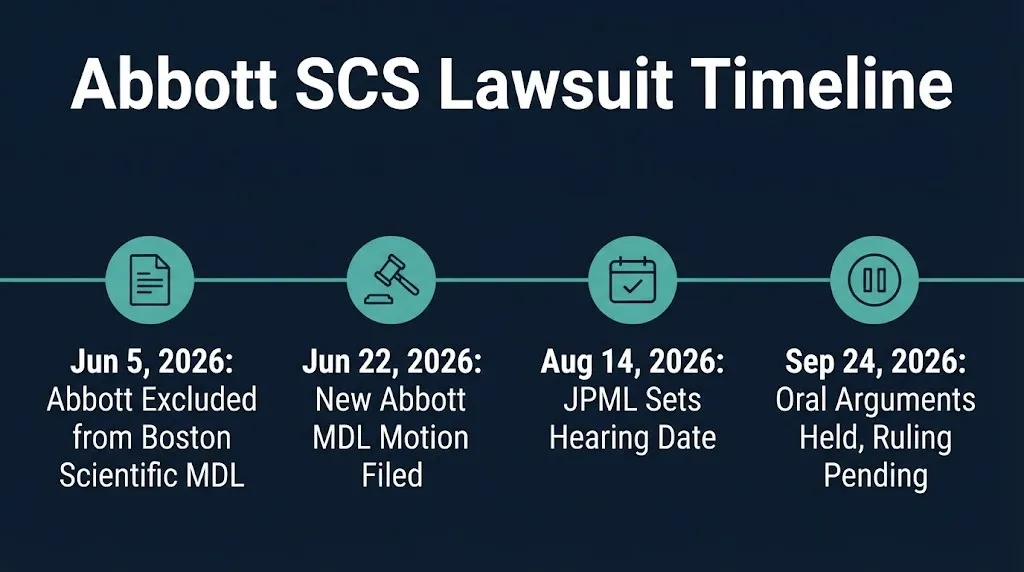
| Date | Development |
|---|---|
| June 5, 2026 | JPML creates MDL-3181 for Boston Scientific cases only, declines to include Abbott |
| June 22, 2026 | Fresh motion filed seeking a separate Abbott-specific MDL |
| August 4, 2026 | Abbott files opposition, states it faces 23 spinal cord stimulator claims |
| August 14, 2026 | JPML issues Notice of Hearing Session for September 24 |
| September 24, 2026 | JPML hears oral arguments on Abbott and Nevro centralization in Chicago |
A written ruling typically follows weeks after oral argument, though the JPML gives no fixed timeline.
Key Takeaway: The September 24 hearing is the most significant procedural event in the Abbott litigation to date, but the outcome is still unknown.
Why Didn’t Abbott Get Included in the Boston Scientific MDL?
Abbott wasn’t included because the four Abbott cases pending before the JPML in June 2026 were all filed in the same federal district, which fails a basic legal requirement for centralization. The federal statute governing MDLs, Section 1407, requires cases pending in different districts.
The JPML’s June 5, 2026 order specifically noted that centralizing Abbott alongside Boston Scientific would likely complicate case management rather than simplify it, given the differences between the companies’ devices and alleged defects.
That procedural denial was issued without prejudice, meaning plaintiffs could refile once more cases existed across more districts. That’s exactly what happened: by the time of the September 2026 hearing, Abbott faced 15 cases across seven different federal courts, clearing the multi-district threshold.
What Is the Abbott Spinal Cord Stimulator Lawsuit About?
The Abbott spinal cord stimulator lawsuit centers on claims that the company’s implanted pain-management devices failed to work as promised and caused new injuries instead. Plaintiffs allege Abbott didn’t adequately warn patients that pain relief might be short-lived or that devices could fail.
Spinal cord stimulators are surgically implanted systems that use electrical pulses to interrupt pain signals before they reach the brain, typically offered to chronic pain patients after other treatments failed. Abbott’s device line came from its 2017 acquisition of St. Jude Medical.
Plaintiffs in filed complaints describe a pattern: initial pain relief that fades, followed by device malfunction, unexpected shocks, or the need for surgical revision or removal. Some allege they cannot find a doctor willing to remove a deactivated but still-implanted device, leaving hardware in place even after it stops functioning.
Which Abbott Spinal Cord Stimulator Devices Are Named in Lawsuits?
The Abbott devices named in current litigation include the Proclaim XR, Proclaim Plus, Proclaim DRG, and Eterna systems. These device lists come directly from manufacturer product lines referenced in filed complaints.
Confirmed devices referenced in Abbott SCS litigation:
- Proclaim XR
- Proclaim Plus
- Proclaim DRG
- Eterna
- Infinity
These systems share the same basic design purpose, implanted pulse generators paired with leads that deliver electrical stimulation, but differ in battery type and specific features. The July 2023 Class I recall covered devices across this product family due to the MRI-mode exit failure.
What Injuries Are Linked to Abbott Spinal Cord Stimulators?
Patients in filed lawsuits report injuries including unintended electrical shocks, nerve damage, infections, lead migration, and the need for revision or removal surgery. Some plaintiffs also describe worsening pain rather than the relief the device was implanted to provide.
Injuries described across filed Abbott SCS complaints:
- Electrical shock sensations, sometimes delivered to the wrong part of the body
- Lead migration requiring surgical correction
- Rapid battery depletion requiring premature replacement surgery
- New or worsening chronic pain after implantation
- Difficulty finding a physician willing to remove a failed or deactivated device
That last point deserves attention. It’s similar to being stuck with a broken appliance under an expired warranty: the device is still physically present, but nobody wants to take responsibility for removing it, leaving the patient to manage the fallout.
How Does the Abbott Lawsuit Compare to Boston Scientific and Nevro Cases?
Abbott’s litigation trails Boston Scientific’s in formal organization but currently involves more pending cases than Nevro’s centralization request, with 15 Abbott cases compared to 17 Nevro cases as of the September 2026 hearing, and 24 to 29 cases already active in the established Boston Scientific MDL.
| Manufacturer | MDL Status | Case Count (as of Sept 2026) |
|---|---|---|
| Boston Scientific | Active MDL-3181, Central District of California, established June 5, 2026 | 24 to 29 pending actions reported across sources |
| Abbott | No MDL yet; JPML heard centralization arguments September 24, 2026 | 15 cases across seven federal districts |
| Nevro | No MDL yet; heard alongside Abbott at the same September 24, 2026 session | 17 cases across six federal districts |
| Medtronic | No MDL and no centralization motion identified in current filings | Case count not confirmed |
Boston Scientific’s cases are furthest along procedurally, with a docket management order in place and a status conference scheduled for October 7, 2026. Abbott and Nevro remain in the earlier stage of seeking that same coordinated structure.
How Long Does an Abbott Spinal Cord Stimulator Lawsuit Take?
Device injury litigation like this typically takes a year or more from filing to any bellwether trial, and settlement talks usually don’t begin until after those early test trials establish how juries respond to the evidence.
If the JPML grants Abbott centralization following the September 24, 2026 hearing, the next steps would mirror the Boston Scientific process: assignment of a transferee judge, appointment of leadership counsel, then a discovery phase before any bellwether cases get selected.
Typical mass tort timeline, based on the Boston Scientific MDL’s pace:
- MDL creation and judge assignment
- Discovery and case management order phase (months to a year)
- Bellwether case selection (roughly a year or more after centralization)
- Bellwether trials
- Settlement negotiations, if trial results indicate liability
Nothing about this timeline is guaranteed, and individual case duration varies based on court schedules and case complexity.
What Happens Next
September 24, 2026: JPML heard oral arguments in Chicago on centralizing Abbott and Nevro spinal cord stimulator cases.
Expected, fall 2026: JPML issues a written ruling on whether to create Abbott and Nevro MDLs. No confirmed date.
If approved: A transferee court and judge get assigned, and leadership counsel gets appointed, following the Boston Scientific MDL model.
October 7, 2026 (Boston Scientific MDL only): Next status conference scheduled in the existing Boston Scientific spinal cord stimulator MDL.
Not yet scheduled: Any bellwether trials, settlement talks, or verdicts against Abbott.
Frequently Asked Questions
Is the Abbott spinal cord stimulator lawsuit legit?
Yes, it’s a real, active body of federal litigation with 15 confirmed cases as of September 2026.
The cases are pending across seven federal district courts.
A JPML hearing on consolidating these cases occurred September 24, 2026.
How much money can I get from an Abbott spinal cord stimulator lawsuit?
There’s no confirmed payout amount, because no settlement or verdict has been reached against Abbott.
Any specific dollar figure you see online for this case isn’t based on an actual outcome yet.
Settlement values typically only take shape after bellwether trials, which haven’t occurred.
Is there an Abbott spinal cord stimulator recall?
Yes, Abbott issued a Class I recall on July 18, 2023, covering 155,028 devices due to an MRI-mode exit failure.
It’s the only Class I recall issued for any spinal cord stimulator manufacturer.
The recall was linked to 186 reported incidents and 73 injuries, with no deaths.
Is Abbott part of the Boston Scientific spinal cord stimulator MDL?
No, Abbott is not included in MDL-3181, which covers Boston Scientific cases only.
Abbott’s own cases weren’t eligible for centralization in June 2026 due to a procedural technicality involving where they were filed.
Abbott is instead the subject of a separate centralization request heard September 24, 2026.
What is the deadline to file an Abbott spinal cord stimulator lawsuit?
There’s no universal deadline, since this is individual litigation, not a class action with one filing window.
Each state has its own statute of limitations for product liability and personal injury claims.
Consult an attorney promptly to confirm your specific state’s deadline based on your injury date.
Which Abbott devices are involved in the lawsuits?
The Proclaim XR, Proclaim Plus, Proclaim DRG, Eterna, and Infinity systems are named in current litigation.
These devices came from Abbott’s 2017 acquisition of St. Jude Medical’s neurostimulation line.
Some of these models were included in the 2023 Class I recall.
Will Abbott get its own MDL like Boston Scientific?
That’s not yet decided, since the JPML has not issued a written ruling following the September 24, 2026 hearing.
Legal analysts tracking the case expect a ruling sometime in fall 2026, though timing isn’t guaranteed.
If granted, Abbott’s MDL would function similarly to the existing Boston Scientific consolidation.
Bottom Line
The Abbott spinal cord stimulator lawsuit is real, growing, and still waiting on a major procedural decision. Fifteen cases, one recent JPML hearing, and zero settlements define where things stand today.
If you believe you were harmed by an Abbott device, start by pulling your implant records and confirming your state’s filing deadline. Watch for the JPML’s written ruling on Abbott centralization, expected sometime in fall 2026.