Purdue Pharma Settlement 2026: Sackler Family Payouts, Claim Deadlines, and Opioid Fund Distribution
Quick Answer:
- The Purdue Pharma settlement is a real, court-approved bankruptcy resolution requiring the Sackler family to pay up to $6 billion for opioid abatement.
- Individuals do not file claims directly against this settlement; funds go to states, tribes, and local governments.
- No consumer claim deadline applies; the personal injury trust for individual victims has a separate process with its own deadlines.
The Purdue Pharma bankruptcy settlement is one of the largest and most legally complex resolutions in American corporate history. If you searched this term, you may be someone who lost a family member to opioid addiction, a local government official tracking abatement funds, or a taxpayer who wants to know where billions of settlement dollars are actually going. This article answers each of those questions using the verified court record, not press releases.
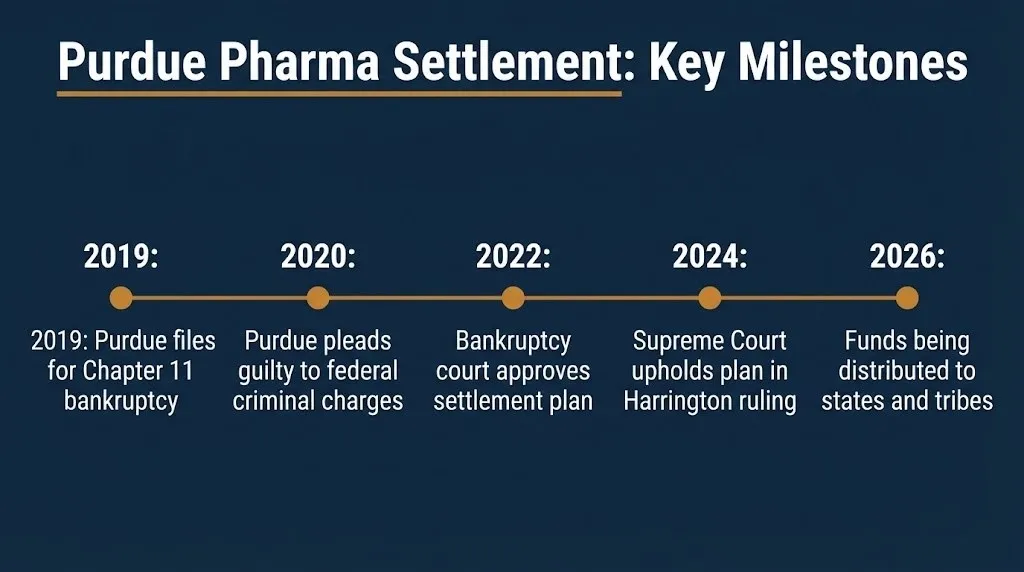
Purdue Pharma pleaded guilty to federal criminal charges in 2020 for its role in the opioid crisis. The company filed for Chapter 11 bankruptcy in 2019. After years of litigation, appeals, and a Supreme Court ruling, the settlement framework is now operational. The Sackler family agreed to contribute up to $6 billion, relinquish control of Purdue, and accept a permanent bar on future opioid marketing.
One fact that surprises many: individual victims do not receive money directly from the main settlement. The funds flow to state, tribal, and local governments for treatment, prevention, and education. A separate personal injury trust exists for individual claimants, but the process for those claims is distinct, slower, and subject to its own eligibility rules.
| The Facts | |
|---|---|
| Case | In re: Purdue Pharma L.P., U.S. Bankruptcy Court, Southern District of New York |
| Bankruptcy Case Number | 19-23649 (RDD) |
| Supreme Court Case | Harrington v. Purdue Pharma L.P., 603 U.S. _ (2024) |
| Current Status | Settlement effective; funds being distributed to states and tribes |
| Total Settlement Value | Up to $6 billion from Sackler family; total plan value estimated over $10 billion including insurance |
| Est. Per Person | No individual consumer payout; funds distributed to government entities |
| Claim Deadline for Government Entities | Varies by state and subfund; initial deadlines have largely passed |
| Personal Injury Trust | Separate entity; claim deadlines and eligibility rules not yet confirmed |
| Administrator | Multiple trustees and administrators; state-specific allocation entities |
| Proof Required for Government Claims | Opioid-related expenditure documentation; varies by state allocation program |
Is the Purdue Pharma Settlement Real?
Yes. The Purdue Pharma settlement is one of the most heavily litigated and scrutinized settlements in American legal history. The Supreme Court of the United States issued a ruling on the case in June 2024, upholding the bankruptcy plan and the Sackler family’s release from future civil liability. The settlement is effective, funded, and operational.
The settlement resolves thousands of lawsuits filed by states, tribes, hospitals, and individuals against Purdue Pharma and the Sackler family. The lawsuits alleged that Purdue aggressively and deceptively marketed OxyContin, downplaying its addiction risk while encouraging doctors to prescribe it for chronic pain. The resulting opioid crisis has claimed hundreds of thousands of American lives.
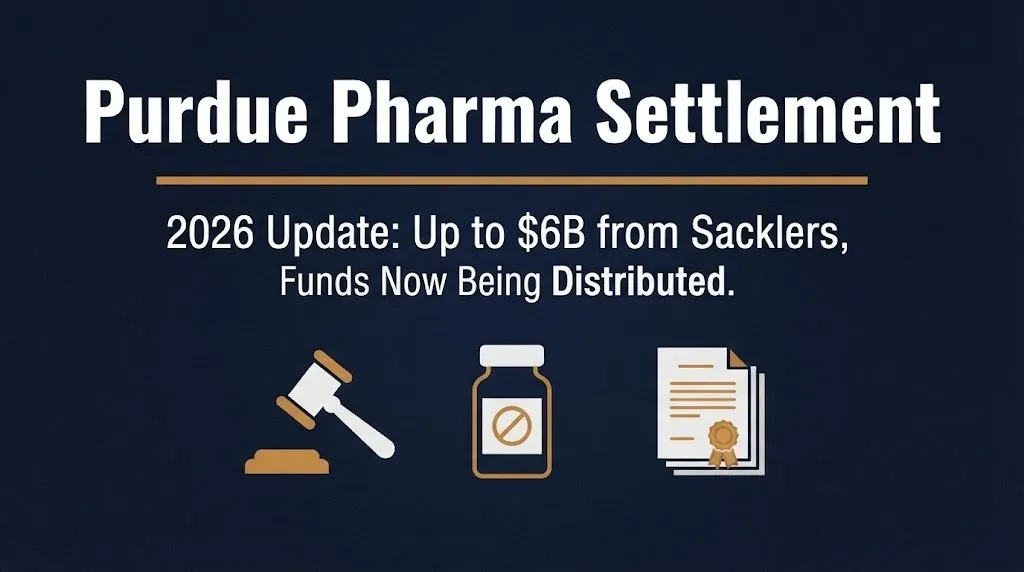
The bankruptcy plan approved by the court requires the Sackler family to pay up to $6 billion over 18 years. Purdue Pharma was dissolved and its assets were transferred to a new public benefit company called Knoa Pharma LLC, which will manufacture opioid addiction treatment medications and provide them at low or no cost. The Sacklers are permanently barred from the opioid business and must remove their name from philanthropic institutions.
The settlement is not a rumor, not a proposal, and not contingent on future legislation. The funds are being distributed. Governments have begun receiving allocations. The legal fight over whether the Sacklers could be released from civil liability without the consent of every individual claimant is over. The Supreme Court answered yes, by a 5-4 vote.
How Much Is the Purdue Pharma Settlement Worth?
The total settlement value exceeds $10 billion when combining the Sackler family cash contribution, insurance proceeds, and the value of drugs to be provided by the new public benefit company. The headline figure that matters most is the up to $6 billion in cash from the Sackler family, paid over an 18-year period.
The payout structure is not a lump sum. The Sackler contribution schedule is spread across nearly two decades. The present value of the future payments is less than the nominal $6 billion figure. States and tribes are receiving installments, not a single check. This payment structure was a point of contention during the litigation, with critics arguing that a longer payout period reduces the real value of the settlement.
The breakdown of where the money goes is specified in the bankruptcy plan:
- States, tribes, and local governments receive the largest share for opioid abatement programs.
- A personal injury trust was established for individual victims and families, though the funding level for this trust is a fraction of the government allocation.
- Attorney fees and administrative costs are paid from the settlement proceeds, not added on top. The exact fee percentage has been approved by the bankruptcy court.
- The new public benefit company provides addiction treatment medications valued at billions at market prices, though these are not cash to governments.
Key Takeaway: The $6 billion Sackler contribution is real but paid over 18 years; the present value is lower than the headline figure, and most funds go to government abatement programs, not individual checks.
Who Gets Money from the Purdue Pharma Settlement?
The settlement distributes funds to three broad categories of recipients. Understanding who is in each category determines whether you or someone you know will see any money.
The first and largest category is state, tribal, and local governments. These entities receive funds through a court-approved allocation formula based on population, opioid overdose rates, and the volume of OxyContin distributed in each jurisdiction. Every state except one (the terms for which state opted out are confirmed in the bankruptcy record) participates in the settlement. Funds must be spent on opioid abatement: treatment, prevention, education, and related public health programs.
The second category is the personal injury trust for individual victims and their families. This trust is separate from the government allocation. Individuals who were prescribed OxyContin and developed opioid use disorder, or the families of those who died from OxyContin-related overdoses, may be eligible to file claims with this trust. The funding for individual claims is significantly smaller than the government allocation. The claim process, deadlines, and eligibility criteria are administered by a trustee whose identity and procedures are available on the official Purdue bankruptcy claims website.
The third category is hospitals, insurers, and other third-party payers who incurred costs treating opioid-related conditions. These entities have their own claims process and allocation from the settlement.
Individuals cannot file a claim against the state allocation. The money going to your state government will be spent according to your state’s opioid settlement spending plan, not distributed as checks to residents.
Reality Check: You will not receive a check in the mail just because you were affected by the opioid crisis. The settlement compensates governments and, through a separate trust, individuals who meet specific medical and legal criteria. Anyone who contacts you claiming to fast-track your Purdue Pharma settlement check for a fee is running a scam.
What Role Did the Sackler Family Play in the Lawsuit?
The Sackler family owned Purdue Pharma and controlled its board of directors. The lawsuits alleged that family members personally directed the marketing strategy that downplayed OxyContin’s addiction risk while the company extracted billions in profits. The family denied wrongdoing but agreed to the settlement.
The Sacklers are not a single household. The family includes multiple branches with dozens of members. The settlement negotiations involved representatives from the Raymond Sackler branch and the Mortimer Sackler branch, the two sides of the family that controlled Purdue. The $6 billion contribution comes from family members individually, not from a single family trust.
The legal issue that reached the Supreme Court was whether the bankruptcy court could release the Sackler family from future civil liability even though the family members themselves did not file for bankruptcy. This is called a third-party release, and it was the most contested provision of the settlement. The Supreme Court held that the release was permissible under the Bankruptcy Code in this specific context, a ruling that has implications for other mass tort bankruptcies.
The settlement requires the Sacklers to permanently exit the opioid business worldwide. They cannot market, manufacture, or promote opioids. They must remove the Sackler name from museums, universities, and other institutions, though many institutions had already removed the name before the settlement required it.
The Department of Justice pursued criminal charges against Purdue Pharma as a corporation, which pleaded guilty. Individual Sackler family members were not criminally charged, though this remains a point of public controversy. The civil settlement resolved the government’s civil claims and the private lawsuits, but it did not grant criminal immunity.
How Do I File a Claim in the Purdue Pharma Settlement?
There are two claim processes, and they are completely separate. Which one applies to you depends on who you are.
For state and local governments, the allocation process is managed through the court-approved allocation formula. If you are a government official, contact your state attorney general’s office or the official bankruptcy claims agent. Initial deadlines for government claims have largely passed, but second-tier allocations and specific subfunds may have their own timelines.
For individuals, the process runs through the personal injury trust. Here are the steps for an individual considering a claim:
- Determine whether you or your family member was prescribed OxyContin and suffered opioid use disorder or a fatal overdose directly linked to Purdue’s marketing.
- Gather medical records, prescription records, and, in the case of a deceased family member, a death certificate listing opioid overdose as the cause of death.
- Visit the official Purdue Pharma bankruptcy claims website to find the personal injury trust claim form and instructions.
- Complete the claim form with exact dates of prescription, prescribing physician information, and medical documentation.
- Submit the form by the trust’s deadline. The deadline is set by the trustee, not by this article. Check the official site.
- Expect a review period that may last months or longer. The trust must verify medical records before approving any claim.
- If approved, the payment amount will depend on the tier system the trust establishes and the total number of approved claims.
This process is not like filing a data breach class action claim with a $25 payout. The medical documentation standard is high. The review is adversarial. The payout, if any, will not be fast.
What Is the Status of Purdue Pharma Settlement Payments in 2026?
The settlement is in the active distribution phase. Payments to states and tribes began after the Supreme Court ruling in mid-2024 and the subsequent administrative setup period. The distribution timeline spans years.
State and tribal governments have begun receiving their first installments from the Sackler contribution and insurance proceeds. Each state manages its own opioid abatement fund with its own spending plan. Some states have begun disbursing grants to local health departments, treatment providers, and prevention programs. Others are still setting up their administrative infrastructure.
The personal injury trust is at an earlier stage. The trustee has been appointed, and the claims process is operational, but the number of claims, the approval rate, and the average payout amount are not yet publicly confirmed. Individual victims who filed claims should check the trust’s website for status updates. The trust’s annual report, when published, will provide the first comprehensive data on individual payouts.
Insurance proceeds that are part of the settlement continue to be collected and distributed on their own timeline, separate from the Sackler payments.
Key Takeaway: Government payments are flowing; individual victim payments through the personal injury trust are in an earlier phase, and no comprehensive payout data has been published yet.
What Happened to Purdue Pharma Itself?
Purdue Pharma no longer exists as a profit-seeking pharmaceutical company. The bankruptcy plan dissolved the company and transferred its assets to a new entity. This is one of the most significant structural consequences of the settlement.
The new entity, Knoa Pharma LLC, is a public benefit company. Its mission is to manufacture opioid addiction treatment medications, including generic versions of buprenorphine and naloxone, and distribute them at low or no cost to communities. The company is owned by a trust that operates for the benefit of the settlement’s public health goals.
Purdue’s remaining drug portfolio, apart from the addiction treatment medications, was sold or licensed to other pharmaceutical companies. The proceeds of those sales went into the settlement fund. The Purdue name, once one of the most recognized in pharmaceuticals, has been retired.
The dissolution of Purdue does not erase the criminal record. Purdue Pharma pleaded guilty to three felony counts in 2020, including conspiracy to defraud the United States and violations of the Anti-Kickback Statute. The company paid $225 million in criminal fines. The guilty plea remains on the corporate record.
What Other Opioid Settlements Are Related?
The Purdue Pharma settlement is one piece of a much larger opioid litigation landscape. Understanding what else is out there helps explain why the Purdue funds are only part of the money flowing to communities.
Teva Pharmaceutical Industries agreed to a $4.25 billion nationwide settlement, which is now in the distribution phase. Johnson & Johnson’s $5 billion settlement is also being distributed. AmerisourceBergen, Cardinal Health, and McKesson, the three largest pharmaceutical distributors, settled for a combined $21 billion. Pharmacy chains including CVS, Walgreens, and Walmart have also reached multibillion-dollar settlements.
Each of these settlements has its own allocation formula, its own distribution timeline, and its own restrictions on how funds can be spent. State and local governments are receiving money from multiple opioid settlements simultaneously. The total opioid settlement funds flowing to governments exceed $50 billion.
For individuals, the situation is more fragmented. The Purdue personal injury trust is one of the only mechanisms for individual victims to receive direct compensation. Most opioid settlements are structured to compensate government entities, not individuals. This is a frequent source of confusion and frustration for families affected by the opioid crisis.
What Happens Next
The Purdue Pharma settlement is no longer a litigation story. It is a distribution story. Here is what the next few years look like:
- 2026 to 2027: Sackler installment payments continue. State and tribal governments receive scheduled distributions. State opioid abatement programs expand.
- 2027 to 2028: The personal injury trust expected to publish its first comprehensive claims report, including the number of claims filed, approved, denied, and the average payout.
- Ongoing through 2042: Sackler payments continue on the 18-year schedule. The public benefit company continues manufacturing addiction treatment medications.
- No specific date: State spending audits and public reports will begin to show how opioid settlement funds are being used, which will likely generate public debate and potential litigation over whether states are complying with the abatement requirement.
Frequently Asked Questions
Will I get a check from the Purdue Pharma settlement?
Probably not. Most settlement funds go to state and local governments for opioid abatement programs.
Individuals may qualify for the personal injury trust if they have documented OxyContin-related injuries.
There is no general fund that pays all residents affected by the opioid crisis.
How much will individual victims receive from Purdue Pharma?
The individual payout amount is not yet publicly confirmed.
The personal injury trust is processing claims, but no average payout data has been released.
Payments will depend on the injury tier, the number of approved claims, and the trust’s funding level.
Are the Sacklers protected from criminal charges?
The settlement resolves civil liability, not criminal liability.
No Sackler family member has been criminally charged.
The Department of Justice could theoretically bring criminal charges, but no such case has been filed.
What is Knoa Pharma?
Knoa Pharma is the public benefit company created from Purdue Pharma’s assets after bankruptcy.
It manufactures opioid addiction treatment medications at low or no cost.
It is owned by a trust and operates for public health purposes, not private profit.
How is my state spending Purdue settlement money?
Each state publishes an opioid settlement spending plan.
Contact your state attorney general’s office or health department for specific information.
States must spend the funds on opioid abatement, not general budget items.
Can I sue the Sacklers individually now?
No. The Supreme Court upheld the third-party release that bars future civil claims against Sackler family members.
The release applies even to individuals who did not consent to it.
This was the central legal question resolved by the Supreme Court in 2024.
What opioid settlements besides Purdue are paying out?
Teva, Johnson & Johnson, and the three major distributors have settlements in the distribution phase.
Pharmacy chains including CVS, Walgreens, and Walmart also reached multibillion-dollar settlements.
Total opioid settlement funds exceed $50 billion nationwide.
Did Purdue Pharma go out of business?
Yes. Purdue Pharma was dissolved through the bankruptcy process.
Its assets were transferred to Knoa Pharma, a public benefit company.
The Purdue name has been retired permanently.
What You Should Do Now
If you are a state or local government official, your primary point of contact is your state attorney general’s office, which is managing the allocation and distribution of Purdue settlement funds under the court-approved formula. If you are an individual who was harmed by OxyContin, check the official personal injury trust website for claim forms and deadlines. Gather medical records and prescription documentation now, even if you are not yet ready to file.
If you are a concerned citizen, your influence on these funds is at the state level. Learn where your state is spending its opioid settlement money. Public meetings on abatement spending are held in most states, and the allocation decisions are being made now.