Spinal Cord Stimulator Lawsuit 2026: MDL Status, Nevro Update and Eligibility
Quick Answer
- Real litigation, not a scam: four device makers (Boston Scientific, Abbott, Medtronic, Nevro) face active product liability lawsuits over spinal cord stimulator injuries.
- Payout amount: not yet determined. No settlements or jury verdicts exist against any manufacturer as of September 2026.
- Most important date: September 24, 2026, when the JPML heard arguments on creating separate Nevro and Abbott MDLs. A written ruling is expected this fall.
If you searched “spinal cord stimulator lawsuit,” you probably had one of these devices implanted and something went wrong. Maybe you needed revision surgery. Maybe you’re wondering if this is even a real legal case or another internet rumor.
It’s real. Four manufacturers, Boston Scientific, Abbott, Medtronic, and Nevro, are currently defending spinal cord stimulator injury lawsuits in federal court. As of September 2026, none of them have paid a settlement or lost a verdict tied to device defects.
This article breaks down where each manufacturer’s cases actually stand, what a “spinal cord stimulator lawsuit” can realistically get you, and what happened at the September 24 hearing that could reshape the Nevro and Abbott cases. One detail most trackers bury: a federal judge in Minnesota already threw out most of a Medtronic case on a technicality that could affect your filing window.
The Facts
| Case | Separate product liability litigation against Boston Scientific, Abbott, Medtronic, and Nevro over SCS devices |
| Status | Boston Scientific consolidated in MDL 3181 (active); Nevro and Abbott MDL requests pending JPML decision; Medtronic cases proceeding individually |
| Fund Size | None. No settlement fund exists for any manufacturer |
| Est. Per Person | Not yet determined. No settlements or verdicts against manufacturers as of September 2026 |
| Claim Deadline | No single deadline. State statutes of limitations apply case by case |
| Administrator | Not yet appointed. No settlement exists |
| Proof Needed | Medical records showing device manufacturer, model, implant date, and documented complication |
Is the Spinal Cord Stimulator Lawsuit Real?
Yes, the spinal cord stimulator lawsuit is a real, active area of product liability litigation, not a scam or a rumor.
Courts have confirmed dozens of individual cases. The JPML created MDL No. 3181 for Boston Scientific claims on June 5, 2026, centralizing them before U.S. District Judge Josephine L. Staton in the Central District of California. That’s a real federal order, not a marketing claim.
Separately, plaintiffs filed centralization requests for Nevro (proposed MDL 3195) and Abbott (proposed MDL 3194) cases in late June 2026. Both companies opposed consolidation, arguing their cases don’t share enough common facts.
Key fact: no company has admitted wrongdoing, and no court has ruled that any SCS device is defective. Lawsuits are allegations until proven or settled.
Is the Nevro Spinal Cord Stimulator Lawsuit Legit?
Yes, the Nevro spinal cord stimulator lawsuit involves real, pending federal cases, but it is not yet consolidated into an MDL.
As of the JPML’s August 14 hearing notice, 17 Nevro lawsuits were pending across six federal districts. Plaintiffs allege injuries tied to Nevro’s Senza-line and HFX systems, including shocks, lead migration, and complications requiring revision surgery.
Nevro filed a formal opposition on August 6, 2026, arguing the claims are too varied to justify one combined court. The JPML heard both sides on September 24, 2026, at Northwestern Pritzker School of Law in Chicago. No written ruling had been issued as of this writing.
Nevro has operated as a wholly owned subsidiary of Globus Medical since Globus completed its acquisition in April 2025.
How Much Is the Spinal Cord Stimulator Settlement Amount?
Not yet determined. No manufacturer has settled or lost a spinal cord stimulator product liability case as of September 2026.
Some legal marketing sites publish projected ranges, commonly $50,000 to $500,000 or more, based on outcomes in unrelated device litigation. Treat these as rough attorney estimates, not confirmed figures.
One real, verified payout exists, but it’s a different kind of case: a New Jersey man received a $1.25 million settlement in 2024 after a spinal cord stimulator compressed his spine and caused partial paralysis. That case was medical malpractice against his healthcare provider, not a product defect claim against a manufacturer.
| Case Type | Confirmed Amount | Against |
|---|---|---|
| Medical malpractice (2024) | $1.25 million | Treating provider, not manufacturer |
| Manufacturer product liability | Not yet determined | Boston Scientific, Abbott, Medtronic, Nevro |
Any number you see for manufacturer settlements right now is a projection, not a payout.
What Is the Average Spinal Cord Stimulator Settlement Amount Right Now?
There is no average yet, because there are zero completed settlements against SCS manufacturers to average.
Settlement figures typically emerge only after bellwether trials test how juries respond to the strongest and weakest cases in a consolidated docket. The Boston Scientific MDL hasn’t reached that stage.
Key Takeaway: No spinal cord stimulator manufacturer has paid a settlement or lost a verdict as of September 2026, so any dollar figure you see online for a product liability claim is a projection, not a confirmed payout.
Who Qualifies for a Spinal Cord Stimulator Lawsuit?
You may qualify if you received an SCS device from Abbott, Boston Scientific, Medtronic, or Nevro and suffered a documented complication.
Commonly cited qualifying injuries include:
- Painful or shocking electrical stimulation
- Lead wire migration or fracture
- Device infection or electrical burns
- Loss of bowel or bladder control
- Worsening pain instead of relief
- Revision or removal surgery
- Nerve damage or paralysis
Having the device alone doesn’t create a claim. You generally need a documented complication and proof the device, not an unrelated condition, caused it.
How Do I File a Spinal Cord Stimulator Lawsuit?
Filing means bringing an individual product liability claim, which can then join an existing MDL if one covers your manufacturer.
- Confirm your device manufacturer and model from surgical records or your implant card.
- Gather medical records documenting your complication and any revision surgery.
- Get your implant and explant operative reports if the device was removed.
- Consult a product liability attorney who handles SCS cases.
- The attorney files your complaint in the appropriate federal or state court.
- If your manufacturer has an active MDL, your case may transfer for coordinated pretrial proceedings.
- Discovery and expert review follow, often for a year or more before any settlement talk.
This isn’t a class action with a claim form. It’s an individual lawsuit that may be managed alongside others.
What Is the Deadline to File a Spinal Cord Stimulator Lawsuit?
There is no single nationwide deadline. Each state sets its own statute of limitations, and the clock usually starts when you knew or should have known the device caused your injury.
That timing question just got sharper. On July 14, 2026, U.S. District Judge Patrick Schiltz in Minnesota dismissed three of four consolidated Medtronic cases as time-barred. He ruled the limitations clock started when a doctor advised the patient to turn the device off, not when the patient later filed suit.
Reality Check: No legitimate settlement fund exists for spinal cord stimulator claims right now, so anyone contacting you by text or email promising a guaranteed payout is not part of any real court process. Filing a lawsuit through an attorney costs you nothing upfront in these cases. Third-party “claim checkers” charging a fee to confirm eligibility are not necessary and are not affiliated with any court.
What Is the Latest Spinal Cord Stimulator Lawsuit Update?
The most recent major development is the September 24, 2026 JPML hearing on the proposed Nevro and Abbott MDLs, held in Chicago.
The panel heard oral arguments but had not issued a written ruling as of September 25, 2026. A decision is expected sometime this fall, though the JPML has not committed to a specific date.
Meanwhile, the Boston Scientific MDL keeps moving. Judge Staton held an initial scheduling conference in August 2026 and appointed plaintiffs’ leadership counsel. A docket management order now governs what information new plaintiffs must submit, and the next status conference is set for October 7, 2026.
Did the JPML Rule on the Nevro MDL Yet?
No, as of September 25, 2026, the JPML has not issued a written decision on whether to create MDL No. 3195 for Nevro cases.
The panel heard arguments on September 24. If it grants the motion, a transferee judge and plaintiffs’ leadership counsel would be appointed, similar to how the Boston Scientific MDL was structured. If denied, Nevro’s 17 known federal cases continue separately in their original courts.
Nevro’s opposition centers on one argument: that patients’ injuries and alleged defects vary too much to justify one combined proceeding.
What Is MDL 3181 and Why Does It Matter?
MDL 3181 is the federal docket that consolidates Boston Scientific spinal cord stimulator lawsuits before one judge for coordinated pretrial handling.
It’s the only spinal cord stimulator MDL that actually exists right now, not just proposed. Cases are centralized in the Central District of California before Judge Josephine L. Staton.
| Detail | Status |
|---|---|
| Created | June 5, 2026 |
| Judge | Josephine L. Staton, Central District of California |
| Pending actions | 29 as of the September 2026 JPML report |
| Next conference | October 7, 2026 |
| Settlements to date | None |
Key Takeaway: MDL 3181 is the only spinal cord stimulator proceeding that’s actually consolidated and moving through scheduled court dates, everything against Nevro and Abbott is still a request, not a ruling.
What Is the Boston Scientific Spinal Cord Stimulator Lawsuit About?
The Boston Scientific lawsuits allege the company’s SCS devices can fail to relieve pain, deliver painful shocks, migrate, or malfunction in ways that require removal surgery.
The JPML found enough shared factual questions across these claims to justify one judge managing pretrial discovery and expert evidence. That’s different from ruling the devices are defective, which hasn’t happened.
What Is the Nevro Spinal Cord Stimulator Lawsuit About?
Nevro lawsuits center on the company’s Senza-line and HFX spinal cord stimulation systems, alleging device malfunction, shocks, and complications requiring revision surgery.
Plaintiffs argue these cases share enough common ground to warrant one federal court managing them together. Nevro disagrees, and that dispute is exactly what the JPML weighed on September 24.
What Is the Abbott Spinal Cord Stimulator Lawsuit About?
Abbott lawsuits involve devices including the Proclaim and Infinity systems, inherited when Abbott acquired St. Jude Medical in 2017.
Plaintiffs allege Abbott failed to warn that relief from these devices is often short-lived, and that devices are frequently removed due to poor performance. A separate April 2026 filing alleged unlicensed Abbott sales representatives adjusted patient device settings without proper medical training, a claim that goes beyond a standard defect theory.
An earlier Abbott centralization request was denied for a technical reason: all pending Abbott cases sat in the same federal district, and consolidation law requires cases spread across different districts. A new petition addressing that issue is now pending.
What Is the Medtronic Spinal Cord Stimulator Lawsuit About?
Medtronic lawsuits involve devices including the Intellis and Intellis LT systems, alleging similar malfunction and inadequate warning claims.
Medtronic cases are not part of any MDL. They’re proceeding individually, and one federal ruling already shows how tough these cases can be. On July 14, 2026, Judge Schiltz in Minnesota rejected the plaintiffs’ core legal theory on the merits and dismissed three of four cases as time-barred, denying them a chance to amend.
That ruling isn’t binding nationwide, but it signals how a skeptical judge might treat similar claims elsewhere.
What Injuries Qualify for a Spinal Cord Stimulator Lawsuit?
Qualifying injuries generally involve a documented medical complication tied directly to the device, not just dissatisfaction with pain relief.
Injuries most commonly cited in filed cases:
- Electrical burns at the implant site
- Lead wire fracture or migration requiring correction
- Infection at the implant or battery site
- Loss of bladder or bowel control
- Partial paralysis or significant nerve damage
- Device malfunction requiring emergency removal
A comparison helps here: qualifying for one of these lawsuits works a bit like a warranty claim on a major appliance. You need proof of the defect, proof you used it as intended, and paperwork showing what it cost you to fix.
What Happens Next
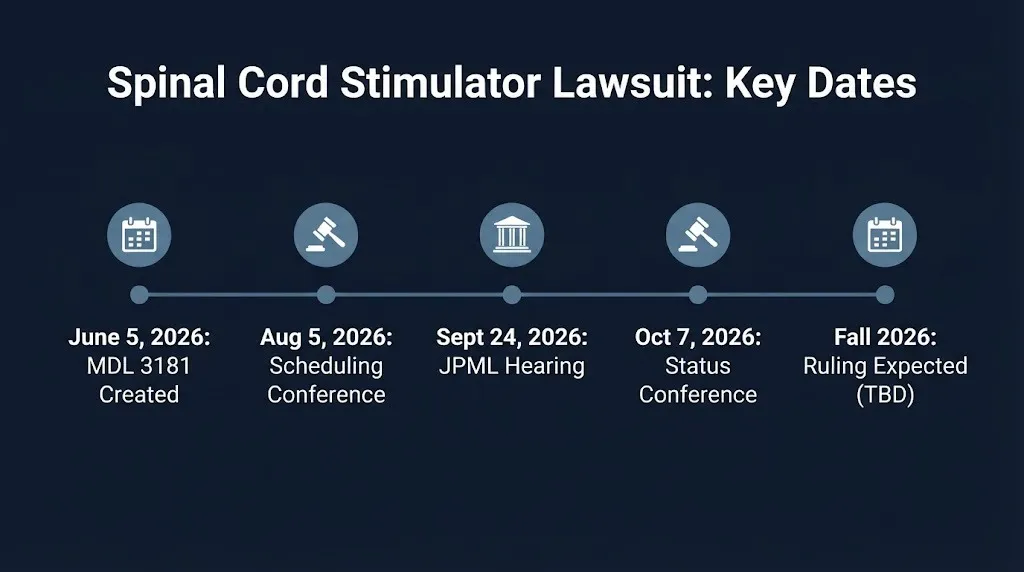
June 5, 2026: JPML creates MDL 3181 for Boston Scientific cases.
August 5, 2026: Initial scheduling conference held in the Boston Scientific MDL, leadership counsel appointed.
September 24, 2026: JPML hears oral arguments on proposed Nevro and Abbott MDLs.
October 7, 2026: Next scheduled status conference in the Boston Scientific MDL.
Expected fall 2026: JPML written ruling on Nevro and Abbott consolidation requests. Timing is not guaranteed.
TBD: Bellwether case selection, any settlement talks, and any trial dates. None have been scheduled in any manufacturer’s litigation.
Frequently Asked Questions
Is there a spinal cord stimulator class action lawsuit?
No, these are not class actions.
They’re individual product liability lawsuits, some of which are consolidated in an MDL for shared pretrial handling.
Each plaintiff still has to prove their own injury and damages.
Has anyone won a spinal cord stimulator lawsuit against a manufacturer?
Not yet, as of September 2026.
The only confirmed large payout, $1.25 million in 2024, came from a medical malpractice case against a treating provider, not a device manufacturer.
No verdicts or settlements exist against Boston Scientific, Abbott, Medtronic, or Nevro over device defects.
How long will the spinal cord stimulator lawsuit take?
There’s no fixed timeline, and cases like this typically take years.
The Boston Scientific MDL, the most advanced proceeding, is still in early discovery with no bellwether trials scheduled.
Settlement talks usually don’t begin until after early trial results give both sides a read on their exposure.
Do I need a lawyer to file a spinal cord stimulator lawsuit?
You’re not legally required to hire one, but most plaintiffs in this litigation do.
Product liability cases against device manufacturers require detailed medical evidence and technical expert testimony.
An attorney can also tell you your specific state’s filing deadline, which varies.
What if I don’t remember my spinal cord stimulator’s manufacturer?
Check your implant card, surgical records, or contact the implanting facility’s medical records department.
Your model and manufacturer determine which litigation, if any, applies to your case.
This single detail often decides whether your claim fits an active MDL or proceeds separately.
Is Nevro part of the Boston Scientific MDL?
No, Nevro is not part of MDL 3181.
The JPML declined to combine multiple manufacturers into one industry-wide proceeding.
Nevro cases would only consolidate if the JPML grants the separate, proposed MDL 3195.
Will there be a spinal cord stimulator settlement in 2026?
Not confirmed. No settlement talks have been publicly reported for any manufacturer as of September 2026.
Litigation is still in early consolidation and discovery stages across all four companies.
Watch official court filings rather than settlement estimate calculators for real updates.
What does it mean if the JPML denies the Nevro or Abbott MDL request?
It means those cases keep proceeding separately in whichever federal courts they were originally filed.
Denial doesn’t dismiss the claims or comment on their merit.
It only affects whether the cases are managed together or apart.
If you had a spinal cord stimulator implanted and experienced a serious complication, the most useful thing you can do today is pull your medical and device records. Filing deadlines vary by state and can run out faster than people expect, as the Minnesota Medtronic ruling shows.
Watch for the JPML’s written ruling on the Nevro and Abbott MDL requests, expected sometime this fall, and treat any settlement dollar figure you see online as a projection until a court or administrator confirms it.