Asbestos Lung Cancer Lawsuit: 2026 Settlement Updates, Claim Deadlines, and What You May Qualify For
Quick Answer
- Asbestos lung cancer lawsuits are real, with billions in active settlement trust funds available to qualifying claimants.
- Per-person payouts typically range from $100,000 to over $1 million depending on diagnosis, exposure proof, and the defendant company.
- Key deadlines vary by trust fund, but many require filing within 2 to 3 years of diagnosis.
If you or someone in your family received an asbestos lung cancer diagnosis, you have likely seen ads, gotten mailers, or heard from relatives about lawsuit money. The first question is always the same: is this real?
Yes. Asbestos lung cancer lawsuits are among the longest-running mass tort claims in United States legal history. Over $30 billion has been set aside in asbestos bankruptcy trusts since the 1980s. That money is still being paid out in 2026.
You may qualify if you were diagnosed with lung cancer and have a documented history of asbestos exposure. The most important date is your diagnosis date. Many trusts require filing within two to three years of that date.
What most articles will not tell you is this: you do not need to have worked directly with asbestos. Secondhand exposure from a spouse’s work clothes, living near an asbestos plant, or serving in certain military roles can all support a claim.
The Facts
| Case | Multiple active asbestos lung cancer lawsuits and trust fund claims |
| Status | Actively accepting claims and paying qualifying claimants |
| Fund Size | Over $30 billion across all active asbestos trusts |
| Est. Per Person | $100,000 to over $1 million depending on multiple factors |
| Claim Deadline | Varies by trust fund, typically 2 to 3 years from diagnosis |
| Administrator | Individual trust administrators, varies by company |
| Proof Needed | Medical records confirming lung cancer diagnosis, exposure history documentation |
Is an Asbestos Lung Cancer Lawsuit Legit or a Scam?
Asbestos lung cancer lawsuits are legitimate legal claims, not scams. They are filed against companies that manufactured, sold, or used asbestos products and failed to warn workers and consumers about the known cancer risks.
The legal system has handled these claims for decades. The first major asbestos lawsuit was filed in the 1960s. Since then, hundreds of companies have faced liability and dozens have declared bankruptcy specifically to create trust funds for victims.
What makes this confusing is the volume of aggressive advertising around these claims. You see late-night commercials, Facebook ads, and direct mail. Some of that marketing is from legitimate law firms. Some is from lead-generation companies selling your information to multiple firms.
The Federal Trade Commission has warned consumers about third-party “claim helpers” that charge fees for services you can get free from a lawyer. Filing a claim never requires an upfront payment. Legitimate asbestos attorneys work on contingency, meaning they only get paid if you receive money.
The real risk is not the lawsuit itself. It is waiting too long to file. Statutes of limitations apply, and they differ by state. Some states give you as little as one year from diagnosis.
How Much Can You Get from an Asbestos Lung Cancer Lawsuit?
Asbestos lung cancer lawsuit settlement amounts range from $100,000 to over $1 million per claim. The exact figure depends on several verified factors that every attorney and trust fund evaluates.
Your payout is not random. It follows a formula based on documented factors.
| Factor | How It Affects Your Payout |
|---|---|
| Diagnosis type | Mesothelioma typically pays more than non-small cell lung cancer |
| Smoking history | Non-smokers often receive higher settlements |
| Exposure duration | Longer documented exposure generally means higher payouts |
| Defendant company | Different trusts have different payment percentages |
| Number of claims filed | You can file against multiple trusts if multiple exposures exist |
| State where filed | Some jurisdictions historically award more |
The highest payouts go to claimants who can document both heavy asbestos exposure and a clear diagnosis without significant smoking history. This is not a moral judgment. It is how the trust funds calculate risk and causation.
Claimants with smoking history can still file. Asbestos exposure combined with smoking greatly increases lung cancer risk. Many trusts have separate categories for smokers, with reduced but still substantial payouts.
You can file against multiple asbestos trusts. A railroad worker exposed to one company’s insulation and another company’s brake linings can file with both. This is called multi-trust filing and it can significantly increase total compensation.
Key Takeaway: Multiple trust claims can stack, which is why total payouts for some claimants exceed $1 million even when no single settlement is that large.
Cancer Lawsuit Settlements: What Has Actually Been Paid Out?
Cancer lawsuit settlements involving asbestos have resulted in verified payments across every state and most major industries. Shipyard workers, construction trades, factory employees, and military veterans consistently receive the largest settlements.
The largest asbestos trusts publish payment schedules. These are public documents showing exactly what each claim type pays.
For example, the Manville Trust, one of the oldest and largest, has paid over $5 billion since its creation. The Owens Corning Fibreboard Trust has paid billions more. These are not estimates. They are audited figures published in trust annual reports.
A typical non-mesothelioma lung cancer claim from a major trust might receive between $15,000 and $75,000. That sounds low compared to the $1 million figures in headlines. But again, multiple claims stack.
A career construction worker with exposure from 10 different product manufacturers can file 10 claims. Even at $25,000 average per trust, that is $250,000 total. More severe diagnoses with clear documentation push those numbers higher.
The key is thorough exposure documentation. Attorneys specializing in asbestos claims maintain databases of products, job sites, and co-worker testimony going back decades.
Asbestos Lung Cancer Compensation: Who Is Eligible?
You may qualify for asbestos lung cancer compensation if a doctor diagnosed you with lung cancer and you have a documented history of asbestos exposure. The exposure can be occupational, environmental, or secondhand.
Specific groups with the highest documented claim rates include:
- Navy veterans who served before 1980 on ships with asbestos insulation
- Construction workers in trades like insulation, drywall, roofing, and demolition
- Factory workers in textile, automotive, and chemical plants
- Power plant and refinery workers
- Railroad employees working with brakes and engine parts
- Family members with secondhand exposure from work clothes
- Residents near asbestos mining or manufacturing sites
Mesothelioma has the clearest link to asbestos and the highest payouts. But regular lung cancer qualifies too, especially non-small cell lung cancer. The key distinction is proving the asbestos exposure contributed to the cancer.
You do not need to prove asbestos was the sole cause. Most jurisdictions follow a “substantial factor” standard. If asbestos exposure significantly increased your cancer risk, it counts.
Your work history matters more than your memory. Pay stubs, union records, tax documents, and co-worker affidavits all build a case. If you served in the Navy, your service records can document ship assignments where asbestos was present.
Key Takeaway: Eligibility is broader than most people assume, including veterans and family members with no direct workplace exposure.
Lung Cancer Lawsuit Settlements: How the Process Works
Filing a lung cancer lawsuit settlement claim follows a structured process that typically takes 6 to 18 months from start to payout. Understanding this timeline helps you plan and avoid frustration.
The process is more like a tax refund than a TV drama. No courtroom confrontation for most claimants. Most resolutions happen through administrative claims, not trials.
Here are the steps:
- Gather medical records confirming your lung cancer diagnosis.
- Document your work history, including job sites, employers, and years of service.
- Contact a law firm that specifically handles asbestos claims.
- The firm identifies which trusts or defendants match your exposure history.
- Your attorney files claims with each relevant trust or court.
- Trusts review your claim and medical evidence, often requesting additional documentation.
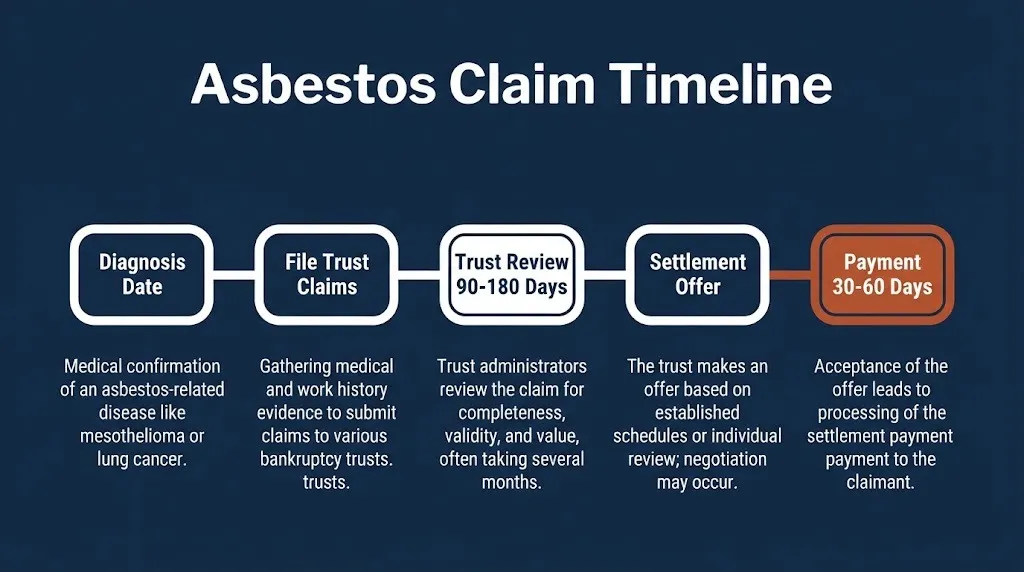
- Settlement offers or denials arrive, typically within 90 to 180 days per trust.
- Accepted settlements are paid, usually within 30 to 60 days after approval.
The longest delays come from missing documentation. Medical records requests can take weeks. Social Security records showing your full employment history take months if you do not have your own copies.
Cases that go to actual trial are rare. Less than 5 percent of asbestos lung cancer lawsuits reach a courtroom verdict. Most settle before trial or proceed through trust fund administration.
Key Takeaway: Most claims resolve without a trial, but documentation quality determines both speed and payout amount.
Asbestos Lung Cancer Lawsuit Update: What Changed in 2026?
The asbestos lung cancer lawsuit landscape in 2026 has shifted in ways that affect both new and pending claims. Several trusts announced updated payment percentages, and courts issued rulings affecting filing deadlines.
The biggest change this year involves digital filing systems. Multiple major trusts now accept fully electronic claims, reducing processing time by weeks. Attorneys report faster initial responses in 2026 than in previous years.
Trust payment percentages fluctuate. When a trust pays out more than expected, it reduces its payment percentage to preserve funds. Several large trusts adjusted percentages downward in late 2025 and early 2026. This means new claimants may receive less per claim than earlier filers.
One positive development: courts in several states clarified that secondhand exposure claims meet the legal threshold for filing. This helps spouses and children of workers who brought asbestos home on clothing.
No major new settlement classes opened in 2026 that rival the historic trusts. But ongoing litigation against talc companies, building material manufacturers, and automotive parts suppliers continues. Some of these cases could create new settlement funds in the next two to three years.
What Proof Do You Need for an Asbestos Claim?
Proof requirements for asbestos claims fall into two categories: medical proof and exposure proof. Missing either one means a denied claim, no matter how legitimate your case feels.
Medical proof requires a clear lung cancer diagnosis. This means pathology reports, biopsy results, imaging studies, and physician statements. Your medical records must show the diagnosis date, which starts the clock on your filing deadline.
Exposure proof documents where and when you encountered asbestos. This is where many claims get weak.
Accepted exposure proof includes:
- Employment records showing you worked at specific job sites
- Union records placing you in relevant trades
- Military service records for veterans
- Social Security earnings statements showing employers
- Affidavits from former co-workers confirming asbestos use
- Company documents, product invoices, or safety records
- Photographs of you at job sites with asbestos materials
The stronger your documentation, the higher your potential payout. A claim with only a diagnosis and a vague memory of “working around insulation” will likely receive a low offer or denial. A claim with decades of employment records, union verification, and co-worker testimony commands serious attention.
Your attorney handles most of this investigation. Good asbestos law firms employ investigators who search historical records, union archives, and company documents. This is why choosing an experienced firm matters more than choosing a local one.
Reality Check: No legitimate settlement administrator, trust fund, or law firm will call, text, or email you out of the blue saying you have been approved for asbestos settlement money. Filing is free. Attorneys work on contingency. Anyone charging upfront fees for “claim processing” is running a scam or charging for something you can do free.
How Long Does an Asbestos Lung Cancer Lawsuit Take?
An asbestos lung cancer lawsuit takes between 6 and 18 months for most claimants from filing to first payment. Cases with documentation gaps take longer. Cases with serious medical urgency can move faster.
Expedited reviews exist for claimants with terminal diagnoses or severe financial hardship. Many trusts prioritize these cases. If your doctor certifies a life expectancy under one year, your claim moves to the front of the line.
The slowest part is usually documentation gathering, not the trust review itself. Requesting 40-year-old employment records takes time. Social Security can take six months to return full earnings histories.
Once a complete claim is submitted, trust reviews typically take 90 to 180 days. If approved, payment follows within 30 to 60 days. That is the standard timeline for major trusts.
Court-filed lawsuits move at a different pace. Active litigation can take two to three years or longer, especially if the defendant fights liability. But most defendants settle rather than face asbestos plaintiffs at trial. Their insurance and settlement calculus favors negotiated resolution.
How to File an Asbestos Lung Cancer Claim
Filing an asbestos lung cancer claim requires methodical documentation and an experienced attorney. You can file on your own, but the success rate drops significantly without legal representation.
Here are the exact steps:
- Collect all medical records related to your lung cancer diagnosis.
- Write down every job you ever held, including company names, locations, and years.
- Note any products you remember that contained asbestos, even if you are unsure.
- Contact two or three asbestos-focused law firms for free case evaluations.
- Choose a firm with specific experience in your industry or exposure type.
- Sign the contingency fee agreement, which means no money upfront.
- Allow the firm to order records and investigate your exposure history.
- File claims with all identified trusts or defendants.
The contingency fee matters. Most asbestos firms charge 25 to 40 percent of your recovery. Some also deduct case expenses. Understand the fee structure before signing anything.
You do not need to pay for any of this upfront. If an attorney asks for money before filing, walk away. That is not how legitimate asbestos claims work.
What Happens Next in the Asbestos Lawsuit Landscape
The asbestos litigation system keeps evolving. Here is what to expect over the next few years.
September 2026: Multiple trust fund payment percentage reviews scheduled for quarterly updates.
Late 2026: Several talc and building material asbestos cases expected to reach settlement discussions.
Early 2027: Potential new trust funds from ongoing manufacturer bankruptcies.
2027 to 2028: Some older trusts may announce depleted funds and reduced payment percentages.
Ongoing: Digital filing expansion continues across remaining paper-based trusts.
If you have a diagnosis, file sooner rather than later. Trust funds can and do run out of money. Payment percentages decline over time. Every month you wait potentially reduces your recovery.
Frequently Asked Questions
Is asbestos lung cancer lawsuit money taxable?
Most asbestos lawsuit settlements for personal injury are not taxable under IRS rules.
Compensation for physical injury or illness is excluded from income.
Interest earned on delayed payments may be taxable.
Can you file an asbestos claim for a deceased family member?
Yes, surviving spouses, children, and estate representatives can file wrongful death claims.
The statute of limitations for wrongful death varies by state, typically one to three years from death.
Payouts go to the estate or surviving family members.
What is the average payout for asbestos lung cancer?
The average payout for non-mesothelioma asbestos lung cancer ranges from $100,000 to $500,000 total across multiple trusts.
Mesothelioma claims average higher, often exceeding $1 million when filed against multiple defendants.
Individual trust payments are smaller, but they stack.
Do you need a lawyer to file an asbestos claim?
You can file without a lawyer, but trust fund forms are complex and documentation requirements are strict.
Attorneys charge no upfront fees and typically recover more money even after their percentage.
Pro se claimants often receive lower offers due to incomplete documentation.
How long do you have to file after an asbestos cancer diagnosis?
Most states give two to three years from diagnosis to file a personal injury lawsuit.
Trust fund deadlines vary, with some as short as one year.
Wrongful death claims have separate deadlines from the date of death.
Can you sue for asbestos exposure without getting cancer?
No, you generally cannot sue for asbestos exposure without a related illness.
Pleural plaques or asbestosis may qualify in some jurisdictions as compensable conditions.
A cancer diagnosis remains the strongest basis for a claim.
Are asbestos trust fund payouts guaranteed?
No, filing a claim does not guarantee payment.
Trusts review each claim against medical and exposure criteria.
Many legitimate claims are denied or receive reduced offers.
What is the difference between a lawsuit and a trust fund claim?
A trust fund claim is filed against money set aside by a bankrupt company for asbestos victims.
A lawsuit is filed against a company still operating and able to defend itself.
Most asbestos compensation comes through trust fund claims because so many defendants went bankrupt.
The Bottom Line
If you have an asbestos-related lung cancer diagnosis, the money is real and the system works. But it works best for people who file early with strong documentation.
Your first call should be to an experienced asbestos law firm for a free case evaluation. Your second step should be gathering every employment and medical record you can find.
The most important number is your diagnosis date. Every deadline flows from it. If you are within two years of diagnosis, you have time but should not wait.