Dog Bite Lawsuit 2026: Settlements, Liability, and Filing Deadlines
Quick Answer:
- A dog bite lawsuit is a personal injury claim against the dog owner or a responsible party.
- Settlement amounts vary widely, from a few thousand dollars to six figures for severe injuries.
- The filing deadline is your state’s statute of limitations, typically one to three years.
If a dog bit you or your child, you are probably searching for how much the case is worth and whether you need a lawyer. A dog bite lawsuit is a real legal claim, and in 2026 it remains one of the most common personal injury cases filed in state courts across the country. The claim is against the dog’s owner or keeper, not against the dog.
The people searching this term include delivery drivers attacked on the job, children bitten by a neighbor’s pet, and joggers who were chased and knocked down. The single most important number is not an average settlement. It is your state’s statute of limitations, the legal deadline to file your lawsuit.
This article covers how dog bite laws work, what your case may be worth, how to prove liability, and how to find the right lawyer. One surprising detail: in most states, you do not need to prove the dog had bitten anyone before. The owner is liable simply for owning the animal.
| The Facts | |
|---|---|
| Claim Type | Personal injury lawsuit against dog owner |
| Legal Standard | Strict liability or negligence, varies by state |
| Statute of Limitations | 1 to 3 years, varies by state |
| Settlement Range | Varies widely, often $5,000 to $100,000+ |
| Insurance Source | Homeowners or renters insurance typically |
| Proof Needed | Medical records, photos, witness statements |
| Deadline | Your state’s filing deadline |
Is a Dog Bite Lawsuit Legitimate?
Yes, a dog bite lawsuit is a legitimate personal injury claim. It is not a class action, not a mass tort, and not a government program. It is a civil lawsuit filed by an injured person against the dog’s owner or the person responsible for the dog at the time of the attack.
Every state recognizes some form of dog bite liability. The legal standard varies. Some states apply strict liability, meaning the owner is responsible regardless of whether they knew the dog was dangerous. Other states apply a negligence standard, meaning you must prove the owner failed to act reasonably.
The claim is usually paid by the dog owner’s homeowners or renters insurance. Most insurance policies cover dog bite liability. Some policies exclude certain breeds or require the owner to disclose the dog. If no insurance exists, you can still sue the owner directly, but collecting may be harder.
This is a real legal path with real recoveries. Courts routinely award damages for medical bills, lost wages, scarring, and pain and suffering in dog bite cases.
How Much Is a Dog Bite Lawsuit Worth?
A dog bite lawsuit can be worth anywhere from a few thousand dollars to over $100,000. The value depends on the severity of the injury, the permanence of scarring, and the insurance coverage available.
Minor bites that heal without scarring may settle for $5,000 to $15,000. Bites requiring surgery, leaving visible scars, or causing nerve damage may settle for $30,000 to $75,000. Severe attacks involving permanent disability or disfigurement can exceed $100,000.
| Injury Severity | Typical Settlement Range |
|---|---|
| Minor puncture wounds, no scarring | $5,000 to $15,000 |
| Lacerations requiring stitches | $15,000 to $35,000 |
| Visible scarring on face or hands | $35,000 to $75,000 |
| Nerve damage or permanent impairment | $75,000 to $150,000 |
| Disfigurement or disability | $150,000 or more |
These ranges are not guarantees. They reflect general patterns in settled dog bite cases. Your case value depends on your specific medical records, the insurance policy limits, and your lawyer’s negotiation skill.
Insurance policy limits matter more than injury severity in many cases. If the dog owner has a $100,000 liability policy, that is the practical ceiling for most settlements. If the owner has no insurance, recovering anything becomes difficult.
Who Is Liable in a Dog Bite Lawsuit?
The dog’s owner is liable in most dog bite lawsuits. In some situations, a landlord, property manager, or employer may share liability. The specific legal rule depends on your state.
Strict liability states make the owner responsible for any bite, regardless of the dog’s history. The owner cannot defend the case by saying they did not know the dog was aggressive. The fact of the bite is enough.
Negligence states require proof that the owner failed to act reasonably. You might show the owner let the dog run loose, ignored a known aggressive history, or violated a leash law. A negligence claim is harder to prove but still very winnable.
| Responsible Party | When They May Be Liable |
|---|---|
| Dog owner | Nearly always, under strict liability or negligence |
| Landlord | If they knew a tenant’s dog was dangerous and did nothing |
| Employer | If a worker was bitten on the job and a third party was at fault |
| Dog walker or sitter | If they had control of the dog at the time |
The one-bite rule still exists in some states. Under that rule, the owner is liable only if they knew the dog had bitten before or showed aggressive tendencies. Most states have moved away from the one-bite rule toward strict liability.
What Should You Do After a Dog Bite?
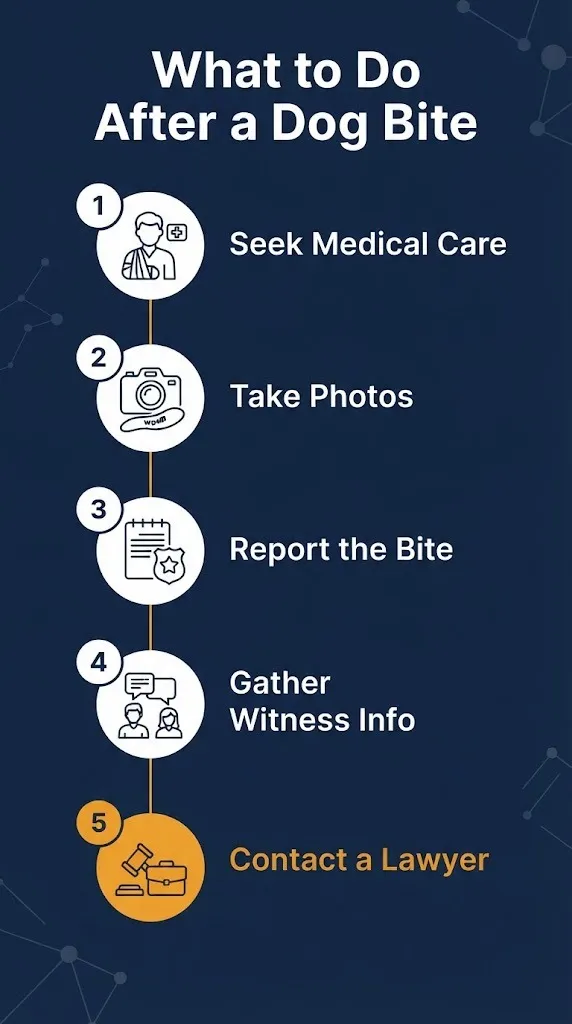
What you do in the hours after a dog bite can make or break your lawsuit. The first priority is medical care. The second is documentation. The third is speaking to a lawyer before you talk to the insurance company.
Here are the verified steps to take:
- Seek medical treatment immediately, even if the wound looks minor.
- Take photos of the wound, the location, and the dog if possible.
- Get the dog owner’s name, address, and insurance information.
- Report the bite to animal control or the local health department.
- Gather witness names and contact information.
- Keep all medical records, bills, and receipts.
- Consult a personal injury lawyer before giving a recorded statement.
Infection is a serious risk with dog bites. Even a small puncture can develop into a deep infection requiring surgery. Delaying treatment hurts both your health and your claim.
Do not sign anything from the dog owner or their insurance company without legal review. Early settlement offers are often far below what the case is worth.
How Long Do You Have to File a Dog Bite Lawsuit?
The deadline to file a dog bite lawsuit depends on your state’s statute of limitations. Most states give you one to three years from the date of the bite. Some states allow longer if the victim is a minor.
The clock usually starts on the date of the injury. For a child bitten at age five, the clock may not start until the child turns 18. That means parents often have time, but waiting still carries risks.
| State Category | Typical Filing Window |
|---|---|
| One-year states | 1 year from bite date |
| Two-year states | 2 years from bite date |
| Three-year states | 3 years from bite date |
| Minor victims | Clock may pause until age 18 |
Do not guess your deadline. A lawyer can tell you the exact date for your state and your situation. Once the deadline passes, your case is barred. Courts do not extend the time because you were busy or unsure.
Key Takeaway: Dog bite lawsuits are legitimate personal injury claims, and most states hold owners strictly liable, meaning you do not need to prove the dog bit before.
What Evidence Do You Need for a Dog Bite Lawsuit?
Evidence in a dog bite lawsuit falls into four categories: medical, photographic, witness, and documentary. The more you have, the stronger your settlement position.
Medical evidence is the foundation. Emergency room records, follow-up treatment notes, and plastic surgery consultations all document the injury. A doctor’s note linking the wound to the dog bite is essential.
Photographic evidence shows the injury over time. Take photos the day of the bite, during healing, and after scarring forms. Scar photos are powerful because juries and adjusters respond to visual proof.
| Evidence Type | What to Collect |
|---|---|
| Medical records | ER reports, treatment notes, prescriptions |
| Photos | Wound, healing stages, scar, dog, location |
| Witness statements | Names and contact info for anyone who saw it |
| Documentary | Animal control report, insurance letters, lost wage records |
The animal control report is often overlooked. When you report the bite, the agency creates a record that can establish the dog’s identity, the owner’s name, and whether the dog had prior incidents. That report is gold in settlement negotiations.
Reality Check: No One Is Tracking You Down to Pay You
Reality Check: After a dog bite, the insurance company is not on your side. The adjuster may call quickly, sound sympathetic, and offer a check. That check is almost always less than the case is worth. You do not have to accept it. You do not have to give a recorded statement. Consult a lawyer first. The insurance company has lawyers. So should you.
Does Homeowners Insurance Cover Dog Bite Lawsuits?
Most homeowners and renters insurance policies cover dog bite liability. The coverage is part of the personal liability section of the policy. Typical limits range from $100,000 to $300,000, though higher limits exist.
Some insurance companies exclude certain dog breeds from coverage. Pit bulls, Rottweilers, and German shepherds appear on many exclusion lists. If the dog’s breed is excluded, the policy may not pay, leaving the owner personally responsible.
Some insurers require dog owners to disclose the dog and pay an additional premium. Failing to disclose the dog can void the liability coverage. That creates a difficult situation where the owner has insurance but the carrier denies the claim.
| Insurance Factor | Impact on Your Case |
|---|---|
| Standard liability policy | Usually covers dog bites |
| Breed exclusion | May eliminate coverage |
| Undisclosed dog | Carrier may deny the claim |
| Policy limits | Practical ceiling on recovery |
| Umbrella policy | Additional coverage above base limits |
Your lawyer will investigate the available insurance early. The insurance source matters because it determines whether a settlement is collectible. A large verdict against an uninsured owner may be worth nothing.
What Are Common Dog Bite Injuries?
Dog bite injuries range from minor punctures to catastrophic disfigurement. The most common claims involve puncture wounds, lacerations, infections, and permanent scarring. Children suffer the most severe injuries because dogs often bite their faces.
Puncture wounds may look small but can be deep. Dog teeth drive bacteria below the skin. Without proper cleaning and antibiotics, the wound can become a serious infection requiring hospitalization.
Lacerations from a dog attack often require stitches or surgery. Torn skin, damaged muscle, and severed nerves are common in severe attacks. Plastic surgery may be necessary to repair the damage.
| Injury Type | Medical Response |
|---|---|
| Puncture wounds | Cleaning, antibiotics, tetanus shot |
| Lacerations | Stitches, possible surgery |
| Infections | Antibiotics, possible hospitalization |
| Nerve damage | Surgical repair, possible permanent impairment |
| Scarring | Plastic surgery, laser treatment |
Psychological injuries are also compensable. Dog attack victims, especially children, often develop post-traumatic stress disorder. Nightmares, fear of dogs, and anxiety around animals can last for years.
How Do Dog Bite Laws Differ by State?
Dog bite laws vary significantly by state. Some states impose strict liability. Others follow the one-bite rule or a negligence standard. The difference determines what you must prove to win.
Strict liability states make the owner liable for any bite, regardless of the dog’s history. California and Florida are examples. You do not need to prove the owner knew the dog was dangerous.
One-bite rule states require proof that the owner knew the dog had bitten before or showed aggressive tendencies. Texas and Virginia are examples. The first bite may be free, but the second one is not.
| Legal Standard | What You Must Prove |
|---|---|
| Strict liability | The dog bit you, and the defendant owned it |
| Negligence | The owner failed to act reasonably |
| One-bite rule | The owner knew the dog was dangerous |
Some states mix standards. A state may apply strict liability to bites but negligence to non-bite injuries like knockdowns. A lawyer in your state can explain which standard applies to your case.
Key Takeaway: Your state’s statute of limitations and liability standard control your dog bite case, and the insurance coverage available often sets the practical settlement ceiling.
Can You Sue a Landlord for a Dog Bite?
You can sue a landlord for a dog bite in limited circumstances. The landlord must have known the dog was dangerous and failed to take reasonable action. Simply owning the property is not enough.
Landlord liability claims often involve apartment complexes where a tenant’s dog attacked another tenant or a guest. If prior complaints about the dog existed and the landlord did nothing, liability may attach.
The claim against the landlord is a negligence claim. You must prove the landlord had a duty, breached it, and the breach caused your injury. That is harder than a strict liability claim against the dog owner.
| Landlord Situation | Liability Potential |
|---|---|
| No knowledge of dangerous dog | No liability |
| Received complaints about the dog | Possible liability |
| Knew dog was banned by breed policy | Possible liability |
| Owned the dog themselves | Direct liability |
Landlord claims are worth pursuing when the dog owner lacks insurance or assets. The landlord’s commercial insurance policy may provide a deeper pocket.
What If the Dog Owner Has No Insurance?
If the dog owner has no insurance, you can still sue. The question is whether you can collect. A judgment against an uninsured owner may be uncollectible if the owner has no assets.
Uninsured owner cases require a realistic assessment. If the owner rents an apartment and works a minimum-wage job, a lawsuit may produce a judgment you can never collect. Your lawyer should be honest about this.
Some victims turn to their own insurance. Your health insurance covers medical treatment. Your uninsured motorist coverage does not apply to dog bites. Your homeowners or renters insurance may cover your injuries if the bite happened at your home under certain circumstances.
| Collection Source | Likelihood of Recovery |
|---|---|
| Owner’s insurance | High, if coverage exists |
| Owner’s personal assets | Depends on assets |
| Your health insurance | Covers medical bills only |
| Landlord’s insurance | Only if landlord liability exists |
A lawyer can investigate the owner’s assets and insurance before you file. Filing a lawsuit with no chance of collection wastes time and money.
What Happens Next in a Dog Bite Lawsuit
| Expected Timing | Milestone |
|---|---|
| Immediately | Report the bite and seek medical care |
| Within days | Contact a personal injury lawyer |
| Within weeks | Lawyer sends demand letter to insurance company |
| Months later | Settlement negotiations or lawsuit filing |
| If filed | Discovery and possible trial |
| Resolution | Settlement or verdict, typically 6 to 18 months |
The timeline varies. Simple cases with clear liability and insurance settle in months. Contested cases with disputed liability can take over a year. Your lawyer will keep you informed at each stage.
The most important action is the first one. Report the bite. Get treatment. Take photos. Call a lawyer. The case builds from there.
Frequently Asked Questions
Is it worth suing for a dog bite?
It may be worth suing if the injury required medical care.
Settlement amounts often exceed $10,000 for moderate injuries.
A lawyer can evaluate your specific case.
How long does a dog bite lawsuit take?
Most dog bite cases settle in six to eighteen months.
Cases that go to trial can take two years or more.
The timeline depends on liability disputes and insurance cooperation.
Can I sue if the dog bit my child?
Yes, parents can file a lawsuit on behalf of a minor child.
The statute of limitations may be extended for minors.
Settlements for child victims often require court approval.
What if the dog was provoked?
Provocation can reduce or eliminate the owner’s liability in some states.
The definition of provocation varies.
Teasing, hitting, or cornering the dog may count as provocation.
Do I need a lawyer for a dog bite claim?
You can file a claim without a lawyer, but it is not recommended.
Insurance adjusters negotiate daily and know how to minimize payouts.
A lawyer levels the playing field.
How much does a dog bite lawyer cost?
Most dog bite lawyers work on contingency.
You pay nothing upfront.
The lawyer takes 33% to 40% of the settlement.
Can I sue for a dog bite that did not break the skin?
You may still have a claim for bruising, emotional distress, or a knockdown injury.
The damages will be lower without broken skin.
A lawyer can assess whether the claim is worth pursuing.
What if the dog that bit me is a stray?
You cannot sue an owner if no owner exists.
Report the bite to animal control.
Your health insurance covers your medical treatment.
A dog bite lawsuit is a serious legal claim, not a lottery ticket. The value depends on your injury, your state’s laws, and the insurance available. The first step is medical care. The second step is a lawyer. The third step is refusing to accept the insurance company’s first offer. August 25, 2026 is the date this information was verified. The date that matters most to you is your state’s statute of limitations, and only a lawyer can tell you exactly when that clock runs out.