Medical Negligence Lawsuit 2026: Payouts, Deadlines and Hospital Liability
Quick Answer
- A medical negligence lawsuit claims a provider’s substandard care harmed you. You must prove it.
- Paid claims averaged about $420,000 in 2023, but your result depends on your facts and state.
- Most states allow roughly one to four years to file. Check your state’s deadline now.
You came here asking whether a medical negligence lawsuit is real, what it pays, and how fast you must act. Here’s the direct answer. It’s a real civil claim, it pays only when you prove the care fell below the accepted standard, and the clock starts sooner than most people think.
This isn’t a class action with a claim form. Each case is filed one patient at a time, state by state. Your deadline comes from your state’s law, not from a settlement website.
This guide covers payouts, caps, hospital liability, filing steps, and 2026 developments. One surprise: the federal database most articles quote misses hospital-only payments entirely.
The Facts
| Case | No single case. Individual claims filed in state or federal court |
| Status | Open to new claims. Deadlines vary by state |
| Fund Size | Not applicable. No class settlement fund |
| Est. Per Person | Not yet determined. 2023 paid claims averaged about $420,000 |
| Claim Deadline | Varies by state, commonly 1 to 4 years |
| Administrator | None. Claims run through courts and insurers |
| Proof Needed | Medical records, expert opinion, proof of harm and costs |
Is a medical negligence lawsuit the same as a medical malpractice lawsuit?
A medical negligence lawsuit and a medical malpractice lawsuit are the same thing in practice. Both claim a healthcare provider failed to give the standard of care a reasonably skilled peer would have given. Courts and insurers use the terms interchangeably.
The difference is mostly vocabulary. “Negligence” is the legal theory. “Malpractice” is the label for negligence by a licensed professional.
Think of it like a warranty claim. The product failed (the harm), and you have to show the maker didn’t meet the promised standard (the duty and breach). A bad result alone doesn’t win the claim.
You’ll see “hospital negligence lawsuit” used when the claim targets the facility. We cover that split in a moment.
Does a bad outcome mean you have a valid medical negligence claim?
No. A bad outcome alone doesn’t make a valid claim, because medicine carries risk even when providers do everything right. You need proof of four things: a duty of care, a breach, harm, and a link between them.
Courts ask a narrow question. Did the provider act the way a competent peer would have under the same conditions?
Here’s where your claim gets tested:
- Duty: a provider-patient relationship existed.
- Breach: the care fell below the accepted standard.
- Causation: that breach, not your underlying illness, caused the harm.
- Damages: you suffered losses you can document.
Causation trips up more people than any other element. If you were already very sick, the defense will argue the illness caused your decline. An independent medical expert usually settles that fight.
Can you file a hospital negligence lawsuit, or only sue the doctor?
You can file a hospital negligence lawsuit directly, and often the hospital is the main defendant. A hospital can be liable in two ways: for its own failures, and for the failures of the people it employs.
Direct negligence covers facility-level problems. Think unsafe staffing, poor credential checks, broken equipment, or weak safety rules.
Vicarious liability covers staff mistakes. If a nurse or employed physician errs inside their job, the hospital can answer for it.
Court records show how technical this gets. New Jersey courts have examined whether a facility can be sued vicariously and what expert paperwork that requires.
Independent contractor physicians add a wrinkle. Many doctors who work in hospitals aren’t hospital employees, so who can be sued depends on state law and the facts. A lawyer reviewing your records can sort that out.
Key Takeaway: A bad outcome isn’t enough; you need to prove a breach of the standard of care that caused your harm, against the right defendant.
How much does a medical negligence lawsuit pay?
Medical negligence lawsuits don’t pay a fixed amount, and no one can promise you a number. The best public benchmark is federal data on paid claims.
In 2023, 11,440 payments totaling roughly $4.8 billion were reported to the National Practitioner Data Bank. That works out to about $420,000 per paid claim.
Read that number with suspicion. It’s an average of claims that already succeeded, and a few huge awards pull it up. Your case could land far lower or far higher.
One analysis puts 2024 at about 11,600 cases and more than $5.04 billion in payouts. That source is a secondary summary, so treat it as a rough signal, not a final figure.
| Data point | Figure | Year |
|---|---|---|
| Paid claims reported | 11,440 | 2023 |
| Total paid | About $4.8 billion | 2023 |
| Average per paid claim | About $420,000 | 2023 |
Payouts come from three buckets: medical bills and lost income (economic damages), pain and suffering (non-economic damages), and in rare cases punitive damages. Which bucket is capped depends on your state.
Do damage caps limit a medical negligence settlement?
Yes, in many states damage caps limit the non-economic part of a medical negligence settlement. One 2026 tracker counts 28 states with some form of malpractice cap and 22 with no statutory limit.
Caps usually target pain and suffering, not medical bills or lost wages. Your documented economic losses are typically not capped in the same way.
A few verified examples show the range:
| State | Non-economic cap | Note |
|---|---|---|
| Alaska | $250,000 | Per 2026 tracker |
| Montana | $350,000 | Per 2026 tracker |
| North Dakota | $500,000 | Set by legislators in 1995 |
| Maryland | $920,000 | For injuries arising in 2026 |
California changes yearly. The original 1975 cap was $250,000, and 2026 figures now run higher. Sources disagree on exact current numbers, so confirm the figure with your state’s statute.
Also note that Maryland’s cap follows the year of injury, not the year you file. Caps can lock in at the date you were hurt.
Reality Check: Nobody legitimate texts you first with a guaranteed malpractice payout. Anyone demanding an upfront fee to “release” your settlement is a red flag. Most injury lawyers work on contingency, meaning no fee unless you recover, but confirm terms in writing.
Which states see the most medical negligence payouts?
New York leads the country by a wide margin in medical negligence payouts. Payouts in New York totaled nearly $7 billion over the past decade.
Raw totals favor big states, so population matters. New York recorded 19.03 payouts per 10,000 residents and Georgia 8.06, in one 2012 to 2022 comparison. Wisconsin sat near the bottom at 1.01.
Small states look quiet for a reason. Wyoming had just 10 cases and about $1.59 million in 2024.
Why the gap? Caps, filing windows, and procedural hurdles all shape how many claims survive. Wisconsin’s low rate was partly tied to its shorter limitations window, according to that report.
Don’t pick a lawyer or a state by these numbers. Pick based on where your treatment happened. That location controls which law applies.
Key Takeaway: Average payouts hide huge swings, and your state’s caps and rules can change what you actually collect.
How do you file a medical negligence lawsuit?
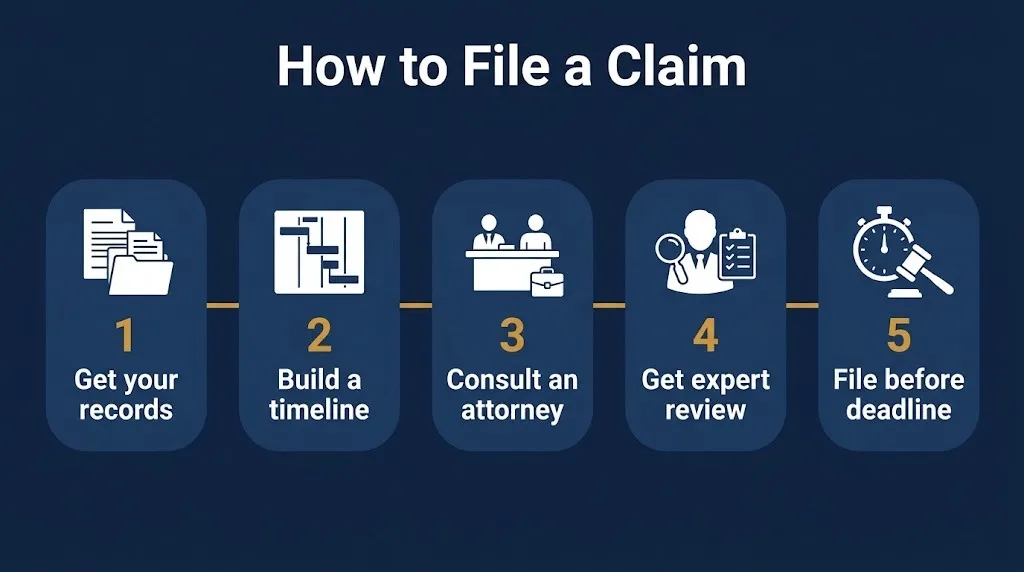
You file a medical negligence lawsuit by gathering records, getting an expert review, and filing a complaint in the right court before your deadline. Most people hire a lawyer first, because the expert step is hard to do alone.
- Request your complete medical records, including nursing notes and imaging.
- Write a timeline of every visit, symptom, and conversation.
- Consult a malpractice attorney for a free or low-cost case review.
- Get a qualified medical expert to review whether care fell short.
- Meet any pre-suit steps your state requires, such as notice or an affidavit.
- File the complaint in the correct state or federal court.
- Exchange evidence and take depositions during discovery.
- Negotiate, mediate, or go to trial.
Most cases settle before trial. Insurers pay when they judge the risk of a jury verdict as too high.
Filing is where you lose cases on paperwork. Missing a pre-suit notice or an expert filing can end a claim before anyone reviews the facts.
How long do you have to file a medical negligence lawsuit?
You typically have between one and four years to file a medical negligence lawsuit, depending on your state. Most states also apply a discovery rule that can start the clock when you learn of the injury and its link to negligence.
The discovery rule helps in cases like a missed diagnosis found months later. It doesn’t give unlimited time, though.
Some states add a statute of repose, a hard outer limit that applies no matter when you discover the harm. Others pause the clock for minors or fraud.
California, for example, can pause the clock in cases involving fraud or collusion tied to a child’s claim. The rules for children differ widely by state.
Here’s the practical rule. Treat the date of the bad outcome as day one and work backward from the shortest window your state might allow. Waiting to “see how it goes” is the most expensive mistake patients make.
Do you need an affidavit of merit to sue a hospital?
In many states you need an affidavit of merit, or a similar expert statement, to sue a hospital or doctor for negligence. It’s a sworn statement from a qualified professional that your claim has a reasonable basis.
Missing it can end your case early. In New Jersey, failing to deliver a proper affidavit within the statutory time is treated as failing to state a cause of action.
Rules vary by claim type. New Jersey’s Supreme Court held that a facility sued only for vicarious liability over an unlicensed employee’s conduct didn’t need one.
A 2025 ruling also eased a common worry. A New Jersey appeals court said a nurse’s affidavit referring to a hospital’s “nursing staff” satisfied the requirement without naming individuals.
Don’t assume those results apply in your state. They’re New Jersey decisions, and other states set their own tests. Ask your attorney which pre-suit filings apply where your treatment happened.
Key Takeaway: Your filing deadline and expert paperwork rules come from your state, and missing either can end a valid claim.
What evidence proves a hospital negligence lawsuit?
A hospital negligence lawsuit is proved with medical records, expert testimony, and documented losses. Records show what happened. An expert explains why it fell below the standard of care.
Build your file around these items:
- Complete chart, orders, nursing notes, and medication logs
- Imaging, lab results, and discharge paperwork
- Billing statements and proof of lost income
- Photos, journals, and messages that show your recovery
- Names of staff who treated you
Hospital cases add facility evidence. That can include staffing levels, internal policies, incident reports, and credential files, which usually come out during discovery.
Never alter or “fix” your own copy of anything. Request records through the hospital’s official process, and keep every original.
Think of it like a store return with no receipt. Without paperwork, you rely on memory, and the other side has a full file. Your documents level that gap.
Are medical negligence payouts rising or falling in 2026?
Payout frequency is falling while severity is rising. A July 29, 2026 presentation to Maryland insurance regulators said physician malpractice payment frequency has dropped sharply over the last three years, based on federal data through March 31, 2026.
That same presentation flagged record verdicts. It cited a Guy Carpenter and Transatlantic Re report from June 2026 on large awards nationwide.
One headline number deserves a flag. A $951 million Utah award was a judge’s directed award, not a jury verdict.
So what does this mean for you? Fewer claims get paid, but the ones that do can be very large. Insurers are fighting harder on average cases and paying more on severe ones.
Be careful with industry presentations. They come from insurers and reinsurers, who have a stake in how premiums are framed. Use the trend, but don’t treat it as a forecast for your claim.
What is the latest 2026 news on hospital negligence claims?
The latest news centers on court rulings about vicarious liability, expert affidavits, and a regulator hearing on insurance costs. None of it creates a new fund or deadline for patients.
Here’s what’s verified:
- July 29, 2026: Maryland regulators heard a presentation on malpractice insurance availability and affordability.
- November 2025: A New Jersey appeals court allowed a hospital claim to proceed on a nurse’s affidavit.
- 2025: An Ohio Supreme Court opinion, 2025-Ohio-1157, examined whether a hospital’s vicarious liability survives when the statute of limitations on individual employees expires.
The Ohio case carries a warning. The hospital argued its liability depended on the employees’ claims, which had already expired. Read the full opinion before relying on how it came out.
Be skeptical of ads claiming a “new malpractice settlement program.” No national program exists. If a company says otherwise, it’s selling lead generation, not compensation.
Key Takeaway: 2026 news shows fewer paid claims, bigger verdicts, and tougher paperwork fights, but no new national payout program.
Which medical errors lead to the most paid claims?
Treatment errors, diagnostic failures, and surgical mistakes are the most common and costly categories of paid malpractice claims. An analysis of 124,317 payouts from 2015 to 2025 reached that conclusion.
That study came from a law firm and a research partner, so view it as industry analysis. It does use public federal data.
Here’s how those categories show up in real claims:
- Diagnostic failures: a missed or late diagnosis of cancer, stroke, or infection.
- Surgical errors: wrong-site surgery, retained instruments, or organ injury.
- Treatment errors: wrong medication, wrong dose, or poor monitoring.
- Birth injuries: delivery mistakes with lifelong consequences.
Birth injury claims stand out in the data. Nurse midwives carried the highest average payout at $860,497 per case. A big share of those payouts topped $1 million.
High averages reflect long lifetimes of care costs. When a child needs decades of support, the damages grow accordingly.
How often do medical negligence victims actually get paid?
Rarely, compared with how often medical harm happens. Federal data logged about 3,100 paid wrongful death malpractice claims in 2023, a small slice of deaths tied to medical error.
One legal analysis estimates only about 5% of deaths caused by medical errors lead to a malpractice payout. That figure is an estimate, not an official statistic.
The same source adds context. Malpractice makes up less than 5% of all pending personal injury cases nationwide, according to National Center for State Courts data.
Why so few? These cases are expensive to build, expert-heavy, and hard to prove. Many lawyers decline cases where damages don’t justify the cost.
There’s also a blind spot in the numbers. The federal database records only payments made on behalf of individual practitioners, so it misses dismissed cases and hospital-only payments. Real payouts are likely larger than the headline totals suggest.
Which doctors get sued most?
Surgeons and OB/GYNs get sued most often over a career. Survey data suggests roughly 90% of surgeons and 85% of OB/GYNs report at least one lawsuit, far above psychiatry or dermatology.
Those are self-reported career figures, not annual rates. A doctor who’s been sued once isn’t necessarily a bad doctor.
Specialty tells you about risk, not fault. High-stakes procedures and emergency decisions create more chances for harm and for disputes.
What should you take from that? Don’t judge a provider by a lawsuit count alone. Check your state medical board for disciplinary records instead, since those show findings, not just accusations.
If you’re considering a claim, specialty matters for a different reason. Cases against specialists often need an expert in that exact field, which raises cost and shapes how lawyers screen your case.
Key Takeaway: Most medical harm never becomes a paid claim, so strong records and early expert review decide whether yours does.
What Happens Next
Here’s the usual path of a medical negligence claim. Timing depends on your state, court, and case facts, and no stage has a fixed national date.
Now: Request your full medical records and write your timeline.
Within weeks, expected: Consult attorneys and get an expert review of the care.
Before your state deadline: File the complaint and any required affidavit or notice.
After filing, expected: Discovery, depositions, and expert reports build the evidence.
Later, expected: Mediation or settlement talks, with trial only if talks fail.
Frequently Asked Questions
How much can you get from a medical negligence lawsuit?
It depends on your injuries, costs, and state law, and no amount is guaranteed.
Federal data showed paid claims averaged about $420,000 in 2023.
That average includes a few very large awards.
Can you sue a hospital for medical negligence?
Yes, you can sue a hospital for its own failures or for its employees’ mistakes.
Direct claims cover staffing, safety rules, and credentialing.
Vicarious claims cover errors by employed staff acting within their jobs.
How long do you have to file a hospital negligence lawsuit?
Most states allow about one to four years, often starting at discovery of the harm.
Some states add a hard outer limit called a statute of repose.
Check your state’s rule immediately.
Do I need a lawyer for a medical negligence lawsuit?
You aren’t required to hire one, but these cases are very hard to handle alone.
You need expert testimony and strict paperwork.
Many attorneys offer free case reviews.
Is there a class action for medical negligence?
Medical negligence claims are almost always individual lawsuits, not class actions.
Each patient’s care and injuries differ.
Beware any site promising a “malpractice settlement fund” you can join.
What is a damage cap in a medical malpractice case?
A damage cap is a legal limit on what a court can award, usually for pain and suffering.
Roughly 28 states have some version, per one 2026 tracker.
Medical bills and lost wages are often treated differently.
Does a medical mistake always mean negligence?
No, an error only counts as negligence if care fell below the accepted standard.
You must also prove it caused your harm.
An expert review decides this.
Closing
Start with your records. Request your full chart, write your timeline, and book a case review before waiting turns a valid claim into an expired one.
Then find your state’s exact deadline and expert-filing rule. That date, not the settlement size, is the number that matters most.