Vaccine Injury Compensation in 2026: Claim Status, Lawsuits, and Payment Updates
Quick Answer
- The National Vaccine Injury Compensation Program is real and still accepts claims for covered vaccines.
- COVID vaccine injury claims are mostly blocked from that program, but a separate Countermeasures Injury Compensation Program exists.
- No universal COVID vaccine class action settlement has been approved as of April 2026.
If you searched for vaccine injury compensation, you likely saw a mix of government program pages, lawyer ads, and alarming headlines about COVID shot lawsuits. The truth sits in court records and federal dockets, not in ads.
You may have a claim path depending on which vaccine is involved, when the injury appeared, and whether the vaccine is covered by the traditional program or the pandemic-era countermeasures program. Deadlines are strict and differ by program.
This article breaks down what is verified, what is still pending in court, how much compensation has actually been paid in past years, and how to check if you have a claim. One surprising fact: the traditional vaccine program has paid out more than $4 billion over its lifetime, but COVID shot claims mostly do not go through it.
| The Facts | |
|---|---|
| Case | National Vaccine Injury Compensation Program and pending COVID vaccine lawsuits |
| Status | Program active; COVID civil suits mostly pending, no class settlement approved |
| Fund Size | VICP funded by vaccine excise tax; CICP is a separate federal fund |
| Est. Per Person | VICP has paid from a few thousand to several million dollars per case, no flat amount |
| Claim Deadline | VICP is generally 3 years from first symptom, but exceptions apply |
| Administrator | VICP is run by the Health Resources and Services Administration and the U.S. Court of Federal Claims |
| Proof Needed | Medical records, vaccination record, and a physician statement linking injury to vaccine |
Is the Vaccine Injury Compensation Program Legit?
The National Vaccine Injury Compensation Program, usually called VICP, is a real federal program created in 1986 by the National Childhood Vaccine Injury Act. It is not a scam and filing a claim does not cost you anything.
The program covers most routine vaccines, including influenza, hepatitis B, tetanus, measles, mumps, rubella, and others on the Vaccine Injury Table. It does not cover most COVID vaccines.
When a claim succeeds, money comes from the Vaccine Injury Compensation Trust Fund, which is funded by a 75-cent excise tax on each covered vaccine dose. The U.S. Department of Justice represents the government, and special masters at the U.S. Court of Federal Claims decide the cases.
For many people, this program replaced the normal civil lawsuit route. The idea was simple: make it faster for injured people to get money, while protecting vaccine makers from endless litigation.
What Is the COVID Vaccine Lawsuit Status in 2026?
Most COVID vaccine injury lawsuits are not class actions. They are individual civil cases, and the majority remain pending or have been dismissed at early stages.
The key legal barrier is the Public Readiness and Emergency Preparedness Act, or PREP Act. It shields COVID vaccine makers from most civil liability except in cases of willful misconduct. That is a very high legal bar.
Some lawsuits allege willful misconduct, claiming manufacturers hid safety data or misled regulators. As of April 2026, no federal court has certified a class action for COVID vaccine side effects, and no global settlement has been announced.
The federal government set up a separate no-fault program for COVID countermeasures called the Countermeasures Injury Compensation Program, or CICP. It covers COVID vaccines, COVID treatments, and certain pandemic devices. But its payout record is much smaller than VICP.
Key Takeaway: COVID vaccine civil lawsuits exist but face the PREP Act shield, while the traditional VICP route is mostly closed to COVID shot claims.
How Does the Vaccine Injury Compensation Program Work?
VICP works like a special court process without a jury. You file a petition with the U.S. Court of Federal Claims, and a special master reviews the medical evidence.
There are two main ways to win. The first is a table injury, meaning your injury matches a listed condition and occurred within the listed time window after vaccination. The second is an off-table claim, where you prove the vaccine actually caused your injury.
You do not need to prove negligence. You only need to show the vaccine likely caused the injury. That standard is easier than a normal medical malpractice case.
The program pays legal fees separately, so your attorney gets paid even if you lose, as long as the claim was filed in good faith. That is why most vaccine injury lawyers take these cases on contingency with no upfront fee.
How Much Money Can You Get From the Vaccine Injury Compensation Program?
Payout amounts vary widely because they cover different categories of loss. There is no flat fee per case.
The program can pay for unreimbursed medical expenses, lost wages, pain and suffering, and in death cases, a death benefit. Pain and suffering awards are capped by law at $250,000.
Past data from the Health Resources and Services Administration shows total payouts over the program’s history above $4 billion. Individual awards have ranged from a few thousand dollars for minor injuries to multi-million dollar awards for severe brain injuries requiring lifetime care.
The exact figure depends on your medical records, your current and future care needs, and whether the government contests causation.
| Payment Category | What It Covers | Typical Range |
|---|---|---|
| Medical expenses | Unreimbursed past and future care | Varies widely |
| Lost wages | Time unable to work | Based on actual earnings |
| Pain and suffering | Non-economic harm | Up to $250,000 statutory cap |
| Wrongful death | Death benefit to estate | Up to $250,000 plus legal fees |
Is There a COVID Vaccine Class Action Lawsuit Settlement?
No COVID vaccine class action settlement has been approved as of April 2026. Any message claiming you can join a COVID vaccine class settlement and get paid is likely a scam or a misleading advertisement.
Some law firms have filed proposed class actions, but none have been certified. That is different from a certified class with a court-approved settlement fund.
You may see websites or social media posts claiming to sign you up for a COVID vaccine lawsuit. Many of those are lead generation services, not actual lawsuits. They sell your contact information to law firms.
The safest move is to check the official CICP website or consult a licensed attorney if you believe you suffered a serious vaccine injury.
What Is the CICP and How Does It Differ From VICP?
The Countermeasures Injury Compensation Program, or CICP, is the federal program for COVID vaccines and other pandemic countermeasures. It is smaller, stricter, and far less generous than VICP.
CICP pays only for serious physical injuries or death. It does not pay for pain and suffering, and it generally does not pay legal fees. The standard of proof is also higher in practice.
Congress created CICP under the PREP Act in 2005. It was designed for emergencies where normal vaccine injury compensation did not apply.
As of early 2026, the CICP had received thousands of COVID vaccine injury claims. The number approved for compensation remains a small fraction of claims filed. Exact approval rates can be checked on the Health Resources and Services Administration data page.
Key Takeaway: If your injury is linked to a routine vaccine, VICP is your path. If it is linked to a COVID vaccine, CICP is the main federal option, and it pays less.
What Is SIRVA Compensation?
SIRVA stands for Shoulder Injury Related to Vaccine Administration. It is a recognized injury type in VICP, though the government often disputes the diagnosis.
A SIRVA claim typically involves pain and limited range of motion starting within 48 hours after a vaccine injection into the shoulder. The injury is mechanical, from the needle going too high or too deep, rather than from the vaccine itself.
VICP has paid compensation in many SIRVA cases, especially for flu shots. The vaccine must be a covered vaccine under the program.
If you had a shoulder injury after a routine vaccine, document the onset date and see a doctor quickly. Medical records created close to the event are critical.
Who May Qualify for Vaccine Injury Compensation?
To qualify for VICP, four basic things must align.
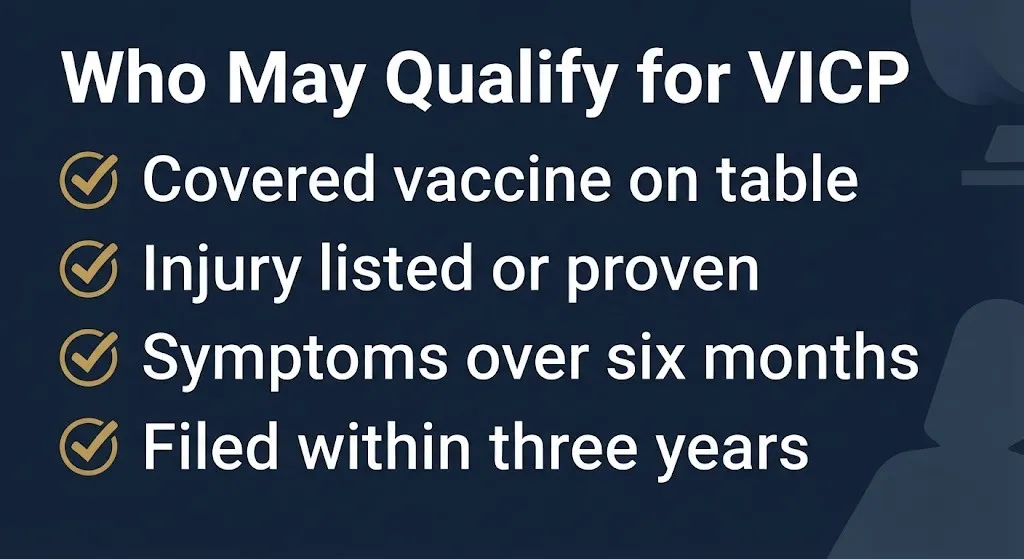
- The vaccine must be on the covered list, such as flu, Tdap, MMR, or hepatitis B.
- You must have a listed table injury or strong medical evidence of causation.
- The injury must have lasted more than six months or required surgery, or resulted in death.
- Your claim must be filed within the statute of limitations, generally three years from first symptom.
For CICP, the countermeasure must be a covered COVID vaccine or treatment. You must show a serious injury that lasted more than six months or resulted in death, and file within one year of receiving the countermeasure.
Check the official program list before assuming you qualify. An attorney can help but cannot change the deadline rules.
| Program | Covered Vaccines | Filing Deadline | Pain and Suffering |
|---|---|---|---|
| VICP | Routine vaccines on the table | Generally 3 years from first symptom | Yes, capped at $250,000 |
| CICP | COVID vaccines and pandemic countermeasures | Generally 1 year from administration | No |
Reality Check: No one from the government or a settlement administrator will text, email, or call you to collect a vaccine settlement payment first. Filing with VICP and CICP is free. Anyone charging an upfront fee to “process” your vaccine injury claim is not necessary and may be running a scam.
Is There a COVID Vaccine Lawsuit Update for 2026?
The main update for 2026 is procedural, not a settlement. Courts continue to grapple with the PREP Act and whether any claims can survive its immunity shield.
Some cases have been consolidated in multidistrict litigation. Others remain in state courts. No bellwether trial verdict has produced a broad consumer settlement.
The U.S. Supreme Court has addressed PREP Act questions in the past but has not ordered a global compensation fund for COVID vaccines. Congress would likely need to act to create one.
For ordinary people, the update is simple: the federal compensation route remains CICP, not a class action settlement.
Can You Still File a COVID Vaccine Lawsuit in 2026?
You can file a civil lawsuit if you meet strict legal standards and your claim is not time-barred. But in most cases, the PREP Act blocks suits against manufacturers.
Willful misconduct claims are the exception. That requires showing the manufacturer knew of a serious risk and hid it or intentionally caused harm. It is a very difficult standard.
Some lawsuits target employers who mandated COVID vaccination. Those claims also face hurdles, including workers’ compensation exclusive remedy rules in many states.
If you believe you have a case, consult a lawyer who has actually litigated PREP Act claims. Avoid anyone who promises a guaranteed payout.
How to File a Vaccine Injury Compensation Claim
Here are the basic steps for a VICP claim.
- Confirm the vaccine is on the VICP covered list.
- Gather your vaccination record and all medical records since the injury.
- Write down the exact date symptoms first appeared.
- Contact a vaccine injury attorney or the program for guidance.
- File a petition with the U.S. Court of Federal Claims.
- Submit all medical records and expert reports as requested.
- Attend any hearings or status conferences as scheduled.
- Wait for the special master’s decision.
For CICP, the process is a Request for Benefits form through the Health Resources and Services Administration. The deadline is generally one year from receiving the countermeasure.
What Proof Do You Need for a Vaccine Injury Claim?
Proof for VICP starts with a vaccination record showing the vaccine, date, and location. Medical records from the day symptoms began and the weeks after are essential.
You also need a physician’s statement or expert report linking the vaccine to the injury. The program will request your complete medical history, not just the injury-related records.
Missing records are a common reason claims stall. Request copies from every provider you saw after the injury.
For CICP, similar proof applies, but the agency applies a stricter causation standard and requires proof of serious injury lasting more than six months.
How Long Does a Vaccine Injury Claim Take?
Most VICP claims take two to three years from filing to decision, though simple table injury cases can resolve faster. Complex off-table claims with disputed causation can take longer.
The program has deadlines for responses, but each side needs time to gather experts and medical opinions. Settlement negotiations often occur after medical records are complete.
CICP claims have historically moved more slowly, with some claims pending for years. The program has been criticized for its low approval rate and slow pace.
Treat the timeline like a delayed tax refund. You file, you wait, and you check the status rather than expecting a quick check.
Key Takeaway: VICP is a real no-fault path with billions paid out historically, but it is not fast, and COVID vaccine claims mostly sit outside it.
What Happens Next
April to June 2026: Courts continue ruling on PREP Act immunity motions in pending COVID vaccine lawsuits.
Mid-2026: CICP publishes updated claims data on receipt, review, and compensation numbers.
Late 2026: Any proposed legislation to add COVID vaccines to VICP would likely be introduced in this window.
Early 2027: Expected decisions in several long-pending COVID vaccine individual injury cases.
Frequently Asked Questions
Is the vaccine injury compensation program real?
Yes. VICP is a federal program created in 1986 that has paid billions to people injured by covered vaccines.
Can I get money from a COVID vaccine lawsuit?
Maybe, but no class action settlement exists as of April 2026, and individual suits face the PREP Act shield.
What is the deadline to file a vaccine injury claim?
For VICP, generally three years from the first symptom of the injury. For CICP, generally one year from vaccine administration.
Does CICP pay pain and suffering?
No. CICP does not pay pain and suffering or most legal fees. VICP does pay pain and suffering up to $250,000.
Is SIRVA a real vaccine injury?
Yes. SIRVA is a shoulder injury from improper injection technique and can qualify for VICP compensation if linked to a covered vaccine.
Are COVID vaccines covered by VICP?
No. COVID vaccines fall under CICP, not VICP, unless Congress changes the law.
Do I need a lawyer to file a vaccine injury claim?
You can file without one, but most successful VICP claims use an experienced vaccine injury attorney paid separately by the program.
Can I get compensation for a vaccine injury that happened years ago?
It depends on the filing deadline. VICP allows three years from first symptom, with limited exceptions for death cases.
The single most important step is to check the official program website for the vaccine you received. If you have the vaccination record and a clear symptom onset date, you can determine quickly whether a claim is still possible.
The statute of limitations is unforgiving. If you think you have a claim, do not wait for a class action that may never come.