Navient Settlement 2026: Claim Deadlines, Payout Amounts, and Who May Qualify
Quick Answer:
- The $1.85 billion Navient settlement is real, finalized in 2022, with most payments already distributed.
- Individual restitution checks averaged about $260, but many borrowers received private loan cancellation instead.
- No new claim deadline exists for the restitution fund, but the private loan discharge program has a July 1, 2027 deadline to apply.
If you had a Navient student loan, you’ve probably heard about the settlement. Maybe you got a postcard, an email, or saw a headline about cancellation. The short answer: the settlement is real, but most of the money has already been paid out.
The $1.85 billion agreement resolved lawsuits brought by 39 state attorneys general. It covered predatory lending allegations against Navient, one of the largest student loan servicers in the country. Some borrowers got cash restitution. Others got private loan cancellation. Some got both.
This article explains what the settlement covers, who may still qualify for relief, and how to check if you’re owed money. One surprising verified detail: more than 350,000 federal loan borrowers received restitution checks, but millions of others got nothing because they didn’t meet the eligibility criteria.
The Facts
| Case | Navient multistate settlement (39 state attorneys general) |
|---|---|
| Status | Finalized, payments distributed, loan discharge program active |
| Fund Size | $1.85 billion total relief package |
| Est. Per Person | $260 average restitution check, up to $16,000 in loan cancellation |
| Claim Deadline | None for restitution, July 1, 2027 for private loan discharge |
| Administrator | BrownGreer PLC (claims administrator) |
| Proof Needed | None for automatic restitution, application for loan discharge |
Is the Navient Settlement Real?
The Navient settlement is real. It’s not a scam, and it’s not a future possibility. It’s a finalized legal agreement that has already distributed most of its benefits.
The settlement resolved lawsuits filed by 39 state attorneys general against Navient, one of the largest student loan servicers in the United States. The states alleged Navient steered struggling borrowers into costly forbearance plans instead of income-driven repayment plans.
Under the agreement, Navient paid $95 million in restitution to approximately 350,000 federal loan borrowers. Each borrower received about $260. The company also agreed to cancel $1.7 billion in private student loan debt for about 66,000 borrowers.
The settlement was finalized in 2022. The restitution checks were mailed in 2022 and 2023. The private loan cancellation process is still ongoing, with a final deadline of July 1, 2027 for eligible borrowers to apply.
This isn’t a class action settlement in the traditional sense. It’s a multistate enforcement action brought by state attorneys general. That distinction matters because it means there’s no claim form for the restitution portion. Eligible borrowers were identified automatically and received checks without filing anything.
What Was the Navient Settlement About?
The Navient settlement resolved allegations that the company engaged in predatory lending and servicing practices. The state attorneys general claimed Navient put its own profits ahead of struggling borrowers.
The core allegations were:
- Navient steered struggling borrowers into costly forbearance plans
- Forbearance allowed interest to accumulate while borrowers made no progress toward paying down principal
- Navient failed to inform borrowers about income-driven repayment plans that could have lowered their payments
- Navient originated private loans for students at for-profit schools with low graduation rates
- Navient knew many of those private loans would likely never be repaid
The settlement resolved these claims without Navient admitting wrongdoing. The company agreed to the financial terms but denied the allegations.
This matters because it means the settlement isn’t a finding of guilt. It’s a negotiated resolution. But for borrowers, the practical result is the same: some people got money, and some people got debt cancellation.
Key Takeaway: The settlement resolved predatory lending claims from 39 states, with Navient paying $1.85 billion in total relief without admitting wrongdoing.
How Much Did the Navient Settlement Pay Per Person?
The per-person payout varied dramatically depending on whether you were a federal loan borrower or a private loan borrower.
Federal loan borrowers received restitution checks. The average check was about $260. The exact amount varied based on how long you spent in forbearance and whether Navient’s practices actually harmed you financially.
Private loan borrowers received something much more valuable: cancellation of their remaining private loan balance. The average cancellation was about $25,000 per borrower.
Here’s the breakdown:
| Borrower Type | Relief Type | Average Amount | Number of Borrowers |
|---|---|---|---|
| Federal loan borrowers | Restitution check | $260 | 350,000 |
| Private loan borrowers | Loan cancellation | $25,000 | 66,000 |
| Total | Combined | $1.85 billion | 416,000 |
The $260 average check was underwhelming to many borrowers. Some reported receiving less than $100. A few received more than $500. The amount depended on the harm Navient allegedly caused.
The private loan cancellation was far more meaningful. Borrowers with high private loan balances got the biggest benefit. Some saw $50,000 or more in debt erased.
Can You Still Get Navient Settlement Money?
The answer depends on which part of the settlement you’re asking about.
For the federal loan restitution checks, the window has closed. The $95 million restitution fund was distributed in 2022 and 2023. Eligible borrowers were identified automatically and received checks without filing a claim. If you didn’t receive a check by now, you probably weren’t in the eligible group.
For the private loan cancellation, the program is still active. Eligible borrowers have until July 1, 2027 to apply. This applies to private education loans originated by Sallie Mae between 2002 and 2014 and later charged off.
The private loan discharge program covers loans that were in default or charged off as of June 30, 2021. If you have a private Navient loan that meets those criteria, you may still be eligible for cancellation.
The process is simple. You fill out a form on the official settlement website. Navient reviews your eligibility. If you qualify, your loan is canceled.
Reality Check: No One Is Calling You About Navient Settlement Money
Scammers have used the Navient settlement to target borrowers with fake calls, texts, and emails. They claim you’re owed money and ask for your bank account details or a processing fee. Here’s the reality: the Navient settlement never requires a fee. If you were owed restitution, you already got a check in the mail. No one from the settlement calls you first to ask for personal information. The private loan discharge application is free and available only on the official settlement website. If someone wants you to pay to get Navient settlement relief, it’s a scam.
Who Qualified for the Navient Settlement?
Eligibility depended on which type of loan you had and how Navient allegedly harmed you.
For the federal loan restitution checks, you may have qualified if:
- You had federal student loans serviced by Navient
- You were placed in forbearance for extended periods
- Navient failed to inform you about income-driven repayment options
- Your loans were originated between 2009 and 2017
For the private loan cancellation, you may qualify if:
- You have private education loans originated by Sallie Mae between 2002 and 2014
- The loans were charged off or in default as of June 30, 2021
- You attended a for-profit school or a school with low graduation rates
- You’re a resident of one of the participating states or had a mailing address in one
The private loan discharge program is the only part still accepting applications. If you think you qualify, apply before July 1, 2027.
How to Apply for Navient Loan Cancellation
The private loan cancellation program is still active. Here’s how to apply:
- Visit the official Navient settlement website.
- Look for the private loan discharge application form.
- Enter your personal information, including your name and date of birth.
- Provide your Navient account number or Social Security number.
- Answer questions about your loans and the school you attended.
- Submit the application electronically.
- Wait for Navient to review your eligibility.
- Receive a decision letter by mail or email.
The application is free. You don’t need a lawyer. You don’t need to pay anyone to help you file.
The deadline is July 1, 2027. After that date, the program closes. Loans that haven’t been discharged by then won’t be eligible.
What Is the July 1, 2027 Deadline?
The July 1, 2027 deadline applies to the private loan discharge program. This is the date by which eligible borrowers must submit their application for loan cancellation.
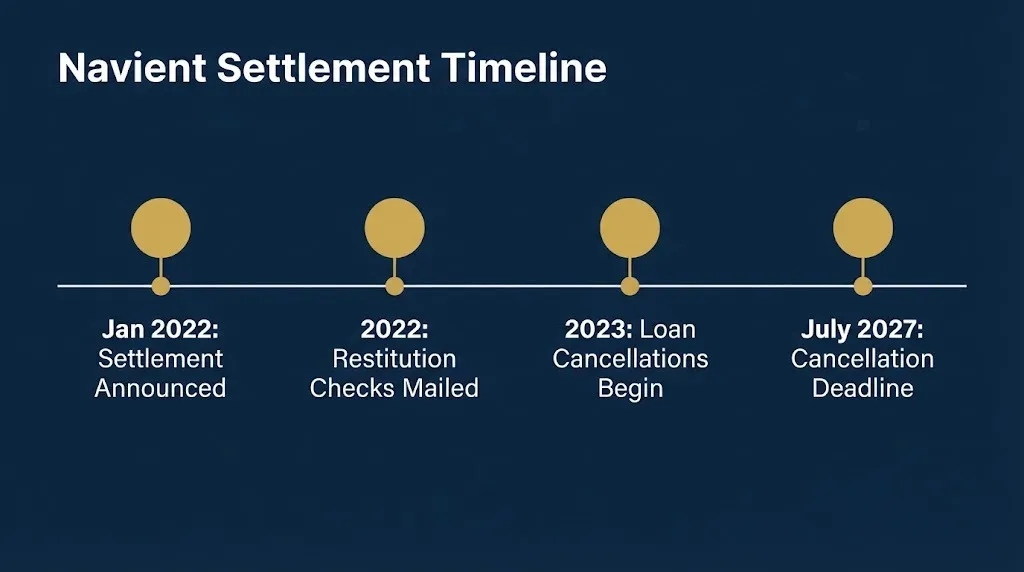
The deadline was set in the settlement agreement. It gives borrowers several years to find out about the program and apply. But the deadline is firm. If you miss it, you lose your chance at cancellation.
The restitution portion of the settlement had no deadline. Eligible borrowers were identified automatically and received checks without filing anything. That process is complete.
The July 1, 2027 deadline only applies to the private loan discharge program. If you have a private Navient loan that was charged off by June 30, 2021, you should apply before this date.
Think of it like a warranty claim. You have a window to act. Once the window closes, you can’t reopen it.
Key Takeaway: The only active deadline is July 1, 2027 for private loan cancellation. The restitution checks have already been distributed.
What Is the Navient Multistate Settlement?
The Navient multistate settlement is a legal agreement between Navient and 39 state attorneys general. It resolved claims that Navient engaged in predatory lending and servicing practices.
The settlement was announced in January 2022. The final approval came later that year. The agreement required Navient to:
- Pay $95 million in restitution to federal loan borrowers
- Cancel $1.7 billion in private loan debt
- Reform its servicing practices
- Provide additional disclosures to borrowers
The settlement was the largest student loan servicing settlement in U.S. history at the time. It involved state attorneys general from both political parties, which was unusual and gave the settlement more political weight.
The Consumer Financial Protection Bureau filed a separate lawsuit against Navient. That case had a different outcome and is worth understanding if you’re following Navient litigation.
What Happened in the CFPB Lawsuit Against Navient?
The Consumer Financial Protection Bureau filed its own lawsuit against Navient in 2017. The CFPB’s claims overlapped with the multistate settlement but were filed separately.
The CFPB case was active for years. In 2022, the CFPB announced a settlement that required Navient to pay $20 million in penalties and provide additional borrower relief. But the CFPB case did not provide direct payments to individual borrowers.
If you’re looking for money from a Navient settlement, the multistate settlement is the one that matters. The CFPB case was about penalties and policy changes, not individual restitution.
The CFPB settlement is sometimes confused with the multistate settlement. They’re different cases with different outcomes. The multistate settlement is the one that paid money to individual borrowers.
What If You Didn’t Receive a Navient Settlement Check?
If you think you should have received a Navient restitution check but didn’t, there are a few steps you can take.
First, check your eligibility. The restitution checks went to about 350,000 federal loan borrowers. If your loans were not serviced by Navient during the covered period, you weren’t eligible. If your loans were in repayment rather than forbearance, you may not have been eligible.
Second, contact the settlement administrator. BrownGreer PLC handled the distribution. They can confirm whether you were in the eligible group.
Third, check your records. The checks were mailed in 2022 and 2023. If you moved and didn’t update your address, your check might have been returned. The administrator may be able to reissue it.
If you weren’t eligible for restitution, you might still be eligible for private loan cancellation. That program is separate and doesn’t require that you received a restitution check.
How Do You Check Your Navient Settlement Status?
You can check your status by contacting the settlement administrator or visiting the official settlement website.
For restitution checks, the distribution is complete. If you didn’t receive a check by now, you’re probably not in the eligible group. But you can contact BrownGreer to confirm.
For private loan cancellation, you can check the status of your application by:
- Logging into the official settlement website
- Calling the settlement administrator’s toll-free number
- Contacting Navient directly about your loan status
The private loan discharge process takes time. Navient reviews applications on a rolling basis. Some borrowers receive decisions within weeks. Others wait months.
If you applied and haven’t heard back, contact the administrator. Don’t assume your application was denied. Sometimes it’s just sitting in a queue.
What Is the Navient Forbearance Steering Claim?
Forbearance steering is the central allegation in the Navient settlement. The state attorneys general claimed Navient pushed struggling borrowers into forbearance instead of income-driven repayment plans.
Forbearance allows borrowers to pause payments temporarily. Interest continues to accrue. When the forbearance period ends, the borrower owes more than before. It’s a short-term fix that creates long-term problems.
Income-driven repayment plans are different. They base monthly payments on income and family size. For low-income borrowers, payments can be as low as $0 per month. And after 20 or 25 years, the remaining balance is forgiven.
The states claimed Navient steered borrowers into forbearance because it was easier for Navient. Income-driven repayment plans require paperwork and ongoing certification. Forbearance is simpler to process.
Navient denied the allegations. The company said it provided information about all repayment options. But the settlement resolved the claims without a trial.
Key Takeaway: Forbearance steering was the core allegation. The states claimed Navient pushed borrowers into costly payment pauses instead of affordable repayment plans.
What Should You Do If You Have Navient Loans Now?
If you still have Navient loans, the most important thing is to understand what type of loan you have and what relief options are available.
For federal loans, Navient transferred its federal loan servicing to Aidvantage in 2022. If you have federal loans, you’re now dealing with Aidvantage or another servicer. The Navient settlement doesn’t change your federal loan balance unless you received restitution.
For private loans, Navient still services some loans. If your private loan was charged off by June 30, 2021, you may be eligible for cancellation under the settlement. Apply before July 1, 2027.
If your private loan is still in repayment, the settlement doesn’t cancel it. You still owe the balance. But you may have other options, including refinancing, settlement, or bankruptcy in extreme cases.
The best action is to review your loan documents. Know what you owe, who you owe it to, and what relief programs apply.
What Happens Next With the Navient Settlement?
The Navient settlement is in its final stages. Here’s the remaining timeline:
- Already completed: $95 million in restitution checks distributed
- Already completed: First round of private loan cancellations processed
- Ongoing: Private loan discharge applications reviewed on rolling basis
- July 1, 2027: Deadline to apply for private loan cancellation
- After July 1, 2027: Program closes, no new applications accepted
The settlement doesn’t have any remaining court hearings. The final approval happened in 2022. The only remaining action is the private loan discharge program, which has a firm deadline.
If you think you qualify for private loan cancellation, the time to act is now. Don’t wait until the deadline approaches.
Frequently Asked Questions
Is the Navient settlement real?
Yes, the Navient settlement is real and finalized.
It was announced in January 2022 and approved later that year.
The settlement provided $1.85 billion in total relief.
How much did people get from the Navient settlement?
Federal loan borrowers received an average of $260 in restitution.
Private loan borrowers received an average of $25,000 in cancellation.
The total relief package was $1.85 billion.
Can I still file a Navient settlement claim?
No claim form exists for the restitution portion.
The private loan discharge program accepts applications until July 1, 2027.
Apply only through the official settlement website.
Is the Navient settlement a scam?
The settlement itself is real and was negotiated by state attorneys general.
But scammers have used it to target borrowers with fake calls and emails.
Never pay a fee for settlement relief.
When is the Navient settlement deadline?
The restitution portion had no deadline and is complete.
The private loan discharge deadline is July 1, 2027.
After that date, no new applications will be accepted.
How do I apply for Navient loan cancellation?
Visit the official settlement website.
Complete the private loan discharge application.
Submit before July 1, 2027.
What loans qualify for Navient cancellation?
Private education loans originated by Sallie Mae between 2002 and 2014.
Loans must have been charged off or in default by June 30, 2021.
Federal loans are not eligible for cancellation under this program.
Do I need a lawyer for the Navient settlement?
No lawyer is needed for the private loan discharge application.
The application is free and available online.
Beware of companies charging fees for settlement help.
The Navient settlement provided real relief to hundreds of thousands of borrowers. Some got restitution checks. Others got private loan cancellation. The restitution portion is complete, but the private loan discharge program remains active through July 1, 2027.
If you have a private Navient loan that was charged off by June 30, 2021, apply for cancellation now. The application is free, the deadline is firm, and the relief could eliminate your remaining balance. Don’t wait until the window closes.