Trademark Litigation in 2026: What the Dockets Show, Who Actually Pays, and Where Consumers Fit In
Quick Answer
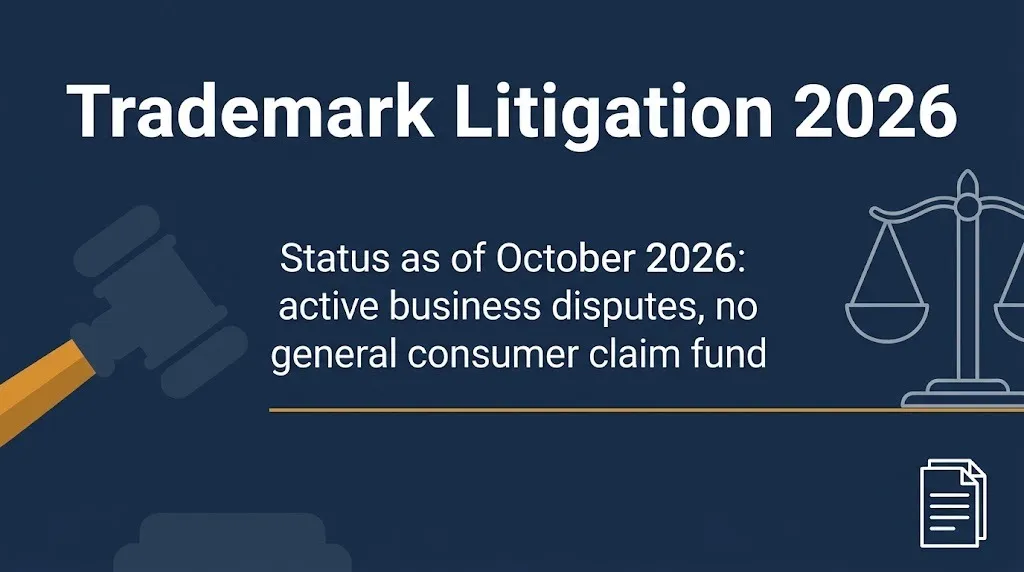
- Trademark litigation is a business dispute over brand names, logos, or confusingly similar marks, not a class action payout program.
- There is no verified per-person settlement amount for consumers in trademark litigation as a category.
- If you received a notice about a specific trademark case, the only deadline that matters is the one printed on that official notice.
Trademark litigation is a civil lawsuit filed when one party claims another is using a mark that causes confusion, dilution, or infringement. The remedy is typically an injunction, damages paid between the businesses, or a negotiated settlement that often involves the defendant changing its name or transferring rights .
You are probably reading this because you searched for trademark litigation and expected a claim form. You may have seen a headline about a brand suing another brand, or you got a letter mentioning trademark infringement. This article covers how the process actually works in 2026, what the recent dockets show, and where ordinary people sometimes get pulled in without realizing it.
The surprise is this: the biggest trademark story of 2026 is not a giant verdict. It is a procedural fight over whether plaintiffs can use trademark law to freeze the bank accounts of thousands of online sellers at once, and Amazon is now challenging that practice .
The Facts
| Item | Verified Detail |
|---|---|
| Case Type | Civil trademark infringement, unfair competition, dilution |
| Common Courts | Federal district courts, TTAB, EUIPO, Federal Court of Australia |
| Typical Plaintiff | Brand owner or trademark registrant |
| Typical Defendant | Competitor, reseller, or online seller |
| Consumer Claim Form | None for trademark litigation as a category |
| Per-Person Payout | Not applicable |
| Claim Deadline | Not applicable unless a specific settlement notice is issued |
| Proof Needed | Not applicable for general public |
Is trademark litigation real or a scam?
Trademark litigation is real, but it is not a consumer compensation program. It is a lawsuit between businesses, filed in federal court or before a trademark office, and the money usually moves between the parties or their lawyers, not to a public claims fund.
Scams do exist around the edges. People may receive fake notices claiming they owe money for trademark infringement, or third-party services may charge fees to “help” with a claim that does not exist. The legitimate process always starts with a court docket, an official trademark office proceeding, or a letter from an attorney of record.
How much can you get from trademark litigation?
There is no per-person payout in trademark litigation because it is not a class action settlement for consumers. The money in these cases is damages, disgorgement of profits, or attorney fees awarded to the winning business, or a confidential settlement paid by one company to another .
Some trademark disputes do produce public numbers. A Texas federal judge awarded Gibson more than $4 million in fees and costs in a guitar shape infringement case . Impossible Foods was hit with a $1.5 million judgment and is appealing . Those numbers go to the businesses involved, not to shoppers who bought a product.
Key Takeaway: If a page promises you a trademark litigation payout, it is almost certainly describing a different kind of case, or it is not legitimate.
Who qualifies for money in a trademark lawsuit?
The parties who qualify are the plaintiff brand owner and, in rare counterclaim situations, a defendant who proves the plaintiff acted improperly. Consumers generally do not qualify for a share of a trademark judgment or settlement.
There is one narrow exception. If a trademark dispute is settled as part of a broader consumer class action, and the settlement creates a fund for purchasers, then consumers might qualify under that separate settlement’s rules. But the trademark claim itself is not what pays them. The class action notice would name the product, the class period, and the claim deadline.
How do you file a trademark claim?
You do not file a consumer claim for trademark litigation as a category. If you believe you have been harmed by a specific product’s branding, you need to look for a consumer class action notice tied to that product, not a trademark docket.
If you are a business owner who received a cease-and-desist letter or a lawsuit, the steps are different:
- Read the document and identify the court and case number.
- Calendar every deadline printed on the document.
- Do not ignore a temporary restraining order; it can freeze accounts quickly.
- Contact a trademark attorney licensed in the relevant jurisdiction.
- Gather your own trademark registrations, sales records, and communications.
- Respond through counsel before the deadline.
When will trademark litigation pay out?
Trademark litigation does not have a payout date for the public because there is no public fund. Individual cases resolve on their own schedules, and settlements are often confidential.
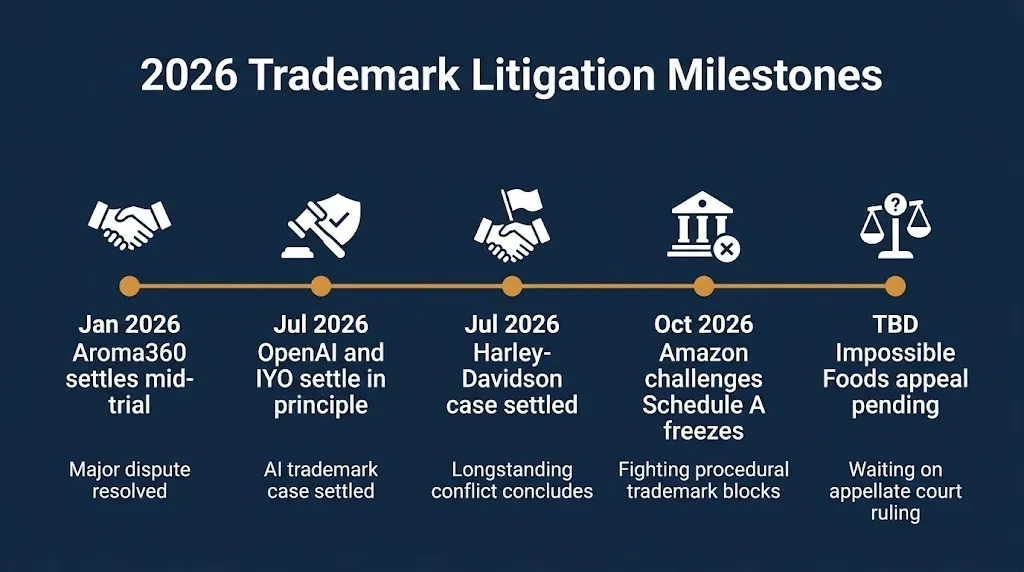
Some cases settle mid-trial. Aroma360 and Scentiment reached a deal during a jury trial in January 2026 . Harley-Davidson’s case against a defendant was settled in principle by July 30, 2026 . OpenAI and IYO reached a settlement in principle in their “IO” name dispute in July 2026 . None of those settlements created a consumer claim process.
Reality Check: No court texts you trademark settlement money. Filing a trademark claim as an individual consumer is not a thing unless a specific class action notice says it is. Anyone charging you a fee to “release” trademark settlement funds is running a scam.
What is the Schedule A trademark litigation problem?
Schedule A litigation is a trademark enforcement strategy where a plaintiff sues dozens or hundreds of online sellers at once, often naming them only in a sealed schedule, and asks the court for an ex parte restraining order that freezes their marketplace funds before they can respond .
Amazon has now challenged this practice in 2026, arguing that some plaintiffs may be using the procedure to access funds Amazon had already frozen for unrelated policy reasons, rather than to resolve genuine trademark disputes . The Northern District of Illinois has been a hub for these cases, and the outcome could affect thousands of small sellers.
If you sell online and receive a Schedule A notice, treat it as urgent. The freeze can happen fast, and the deadline to respond may be very short.
What happened in the biggest trademark disputes of 2026?
The 2026 trademark docket is busy but fragmented. There is no single “trademark litigation settlement” because the disputes are separate cases with separate parties.
Some notable verified matters:
- OpenAI v. IYO: Settlement in principle reached in July 2026 over the “IO” name for AI hardware .
- Columbia Pictures v. GHOST BUSTER mark: Columbia failed to block a Dutch inventor’s mark for lighting products in the EU .
- Lacoste v. EUIPO: Lacoste filed an appeal at the EU General Court in August 2026 over a TULEDUN opposition decision .
- Harley-Davidson v. Gallo: Settled in principle in the Southern District of New York in July 2026 .
- Casio, Bulgari, and other Schedule A filings: New complaints filed in the Northern District of Illinois in October 2026 against unidentified online sellers .
How long does trademark litigation take?
Trademark litigation can take months to years depending on the court, the complexity, and whether the parties settle. A case that goes to trial and appeal can run well past two years.
The TTAB timeline in one 2026 case shows discovery closing in December 2026, trial periods extending into 2027, and briefing continuing into late 2027 . Federal court cases vary widely. A case filed in April 2026 was still in motion practice by October 2026 . A settlement can happen at any point, including during trial .
Key Takeaway: Trademark litigation is a business dispute with a business timeline. If you are waiting for a consumer payment from a trademark case, you are likely watching the wrong docket.
What happens next in 2026?
The next stages depend on which case you are following. For the category as a whole, these are the verified or expected milestones to watch:
Expected late 2026: Rulings on Amazon’s challenge to Schedule A fund freezes in Chicago federal court .
Expected late 2026: Further activity in the Lacoste EU General Court appeal, Case T-569/26 .
Expected 2027: TTAB trial periods in L-Nutra v. iHerb extend into mid-2027 .
Ongoing: New Schedule A complaints continue to be filed in the Northern District of Illinois, with Bulgari and Casio among the October 2026 filers .
Pending: The Impossible Foods appeal to the Ninth Circuit over the $1.5 million judgment .
Frequently Asked Questions
Is trademark litigation the same as a class action settlement?
No. Trademark litigation is a business dispute over brand rights. A class action settlement is a separate legal mechanism that can create a consumer claims fund. The two can overlap in rare cases, but they are not the same thing.
Can I join a trademark lawsuit as a consumer?
Generally no. You are not a party to a business’s trademark dispute unless you were named as a defendant or the case was certified as a class action covering your purchases.
What does “settled in principle” mean in a trademark case?
It means the parties have agreed to the main terms but have not yet signed the final settlement agreement or asked the court to dismiss the case. The terms are usually confidential.
Why did I get a letter about trademark infringement?
If you received a direct letter, it is likely a cease-and-desist notice or a litigation hold. Check whether it names a court, a case number, and an attorney. If it does, treat it seriously and get legal advice.
Does a trademark lawsuit pay damages to affected shoppers?
Not directly. Damages in trademark cases are awarded to the plaintiff business for lost sales, confusion, or harm to the brand. Shoppers are not typically compensated through the trademark claim itself.
What is a Schedule A defendant?
A Schedule A defendant is an online seller named in a sealed list attached to a trademark complaint, often without knowing they were sued until their marketplace funds are frozen. The practice is controversial and facing new challenges in 2026 .
Where can I check if a trademark case is real?
Use the public court docket for the court named in any notice. In federal cases, the docket number and court name are the starting point. For trademark office proceedings, the TTAB or EUIPO record is the source.
Trademark litigation in 2026 is active, but it is not a consumer payout event. If you are a business owner facing a notice, the date that matters is the response deadline on your court document. If you are a consumer who saw a headline, the number to remember is zero: there is no general trademark settlement fund waiting for you to claim.