Class Action Attorney St Louis: The 2026 Roundup Settlement Is Rewriting the Rules
Quick Answer
- Is it legit? Yes. A Missouri judge granted preliminary approval in March 2026 to a $7.25 billion nationwide settlement over Roundup cancer claims.
- How much? Payouts range from $10,000 to $165,000 depending on cancer severity, age at diagnosis, and exposure type.
- Key deadline? The opt-out deadline passed June 4, 2026. If you didn’t exclude yourself, you’re bound by the settlement.
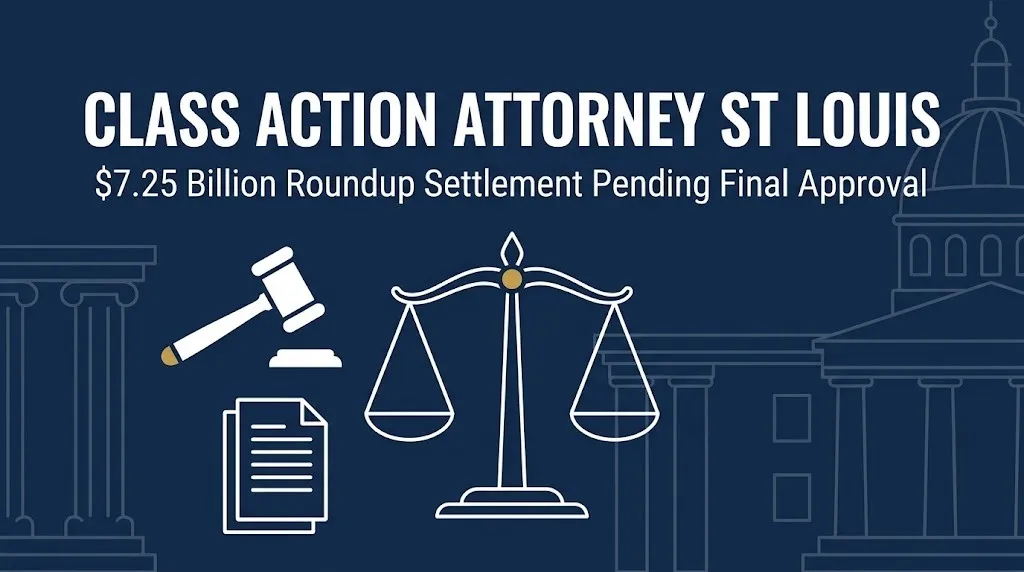
If you’re searching for a class action attorney in St. Louis, the biggest case on the docket right now is the $7.25 billion Roundup settlement. This isn’t a generic lawyer directory question anymore. It’s a specific, time-sensitive legal matter affecting roughly 65,000 people nationwide.
The case is King v. Monsanto, filed in the 22nd Judicial Circuit Court for the City of St. Louis. Judge Timothy Boyer is overseeing it. Bayer’s Monsanto unit agreed to settle nearly all existing and future Roundup cancer claims through this class action framework.
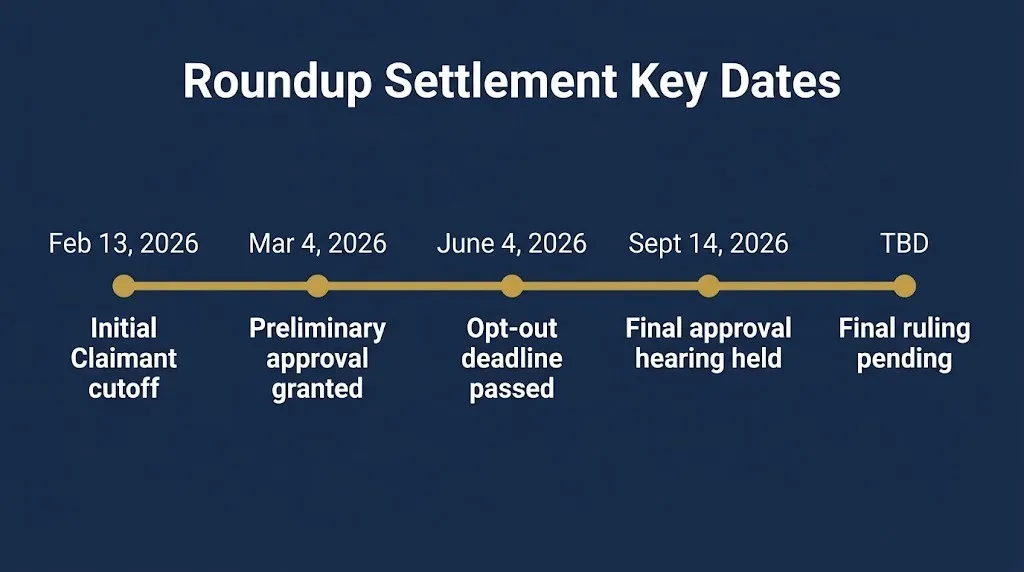
The single most important date has already passed: June 4, 2026, was the deadline to opt out. If you filed a Roundup lawsuit or signed a tolling agreement before February 13, 2026, and you didn’t opt out, you are likely an “Initial Claimant” in Subclass 1.
What makes this case unusual is the sheer scale. It’s one of the largest class-action payouts in U.S. history. It’s also being litigated right here in St. Louis, which means local attorneys are directly involved in shaping how it plays out. The case has already survived an attempt to move it to federal court, which tells you the stakes are high enough that objectors tried to derail the process.
The Facts
| Case | King v. Monsanto (Roundup/Glyphosate Settlement) |
|---|---|
| Status | Preliminary approval granted March 4, 2026. Final approval pending. |
| Fund Size | $7.25 billion |
| Est. Per Person | $10,000 to $165,000 (depends on tier and factors) |
| Claim Deadline | Registration opens after final approval. Watch official site. |
| Administrator | Not yet confirmed in public records |
| Proof Needed | Check the official court-authorized notice for claim form details |
Is the St. Louis Roundup Class Action Settlement Legitimate?
Yes. A Missouri circuit court judge granted preliminary approval on March 4, 2026, and the case has proceeded through federal remand challenges .
This isn’t a phishing email or a pop-up ad. The settlement was negotiated by leading plaintiff law firms and is being overseen by Judge Timothy Boyer in the Civil Courts Building in downtown St. Louis. Bayer’s own corporate website confirms the settlement framework and the preliminary approval date .
The case number is 2622-CC00325 in the 22nd Judicial Circuit Court. You can look it up. The official settlement website is WeedKillerClass.com. That’s where the court-authorized notice lives.
What should make you skeptical? Any text message, email, or social media ad claiming you can “claim your Roundup money now” before final approval. That’s not how this works. Registration doesn’t even open until 180 days after final approval is granted. The court controls the timeline, not third-party claim aggregators.
How Much Can You Get from the Roundup Settlement?
Payouts range from $10,000 to $165,000, depending on your cancer severity, age at diagnosis, and whether your exposure was residential or occupational .
The settlement uses a tiered system. Higher tiers go to people with more aggressive forms of non-Hodgkin lymphoma, those diagnosed at younger ages, and those exposed to Roundup through their jobs. Lower tiers cover less severe diagnoses and older claimants.
| Factor | Impact on Award |
|---|---|
| Cancer subtype | Aggressive NHL pays more than indolent NHL |
| Age at diagnosis | Younger claimants generally receive higher awards |
| Exposure type | Occupational exposure (farming, landscaping) vs. residential use |
| Quick-Pay option | Available for some tiers, but pays less than standard award |
A “Quick-Pay” option exists for certain claimants, particularly those in tiers 5 through 9 or residential claimants aged 78 or older at diagnosis. It pays sooner but at a reduced amount . You can’t take both. You choose one path.
The $675 million in attorneys’ fees sought by class counsel is separate from the $7.25 billion fund. Objectors have challenged both the payout amounts and the fee request, arguing that few claimants will qualify for the top $165,000 figure . The court heard those arguments on September 14, 2026, and has not yet issued a final ruling.
Reality Check: No legitimate settlement administrator will ever text you asking for your Social Security number or bank account to “release your funds.” Filing a claim is free. The official notice lists a phone number (1-888-403-8201) and a website. Anything else asking for payment upfront is a scam.
How Do You File a Roundup Settlement Claim?
You must wait for final approval, then register within 180 days of that approval date .
Here are the steps as outlined in the court-authorized notice:
- Wait for final approval. Judge Boyer has not yet ruled. Registration doesn’t open until he does.
- Check the official website. WeedKillerClass.com will post registration instructions once the window opens.
- Register as a class member. This confirms you’re participating in the settlement.
- Submit a Program Award application. This is the standard claim. You’ll need documentation of your NHL diagnosis and exposure history.
- Or submit a Quick-Pay application. Only if you’re in an eligible tier. Faster payment, lower amount.
- Agree to stay your lawsuit. If you filed an individual Roundup lawsuit, you must pause and eventually dismiss it to receive settlement money.
- Wait for payment processing. Timelines depend on how many claims are filed and validated.
The registration window is 180 days from final approval. Missing it could mean losing your right to payment under the settlement.
What’s the Difference Between Subclass 1 and Subclass 2 in This St. Louis Case?
Subclass 1 is “Initial Claimants” who filed a lawsuit or tolling agreement before February 13, 2026. Subclass 2 is “Futures” who were exposed but haven’t been diagnosed with NHL yet .
If you already had a lawyer and a filed claim before that February cutoff, you’re in Subclass 1. You get priority in the payment queue and access to the standard Program Award process.
If you used Roundup for years but don’t have an NHL diagnosis, you’re in Subclass 2. You can’t claim money now, but you’re bound by the settlement unless you opted out. The trade-off is that Subclass 2 members get a “back-end exit right.” If you’re later diagnosed with NHL, you can apply for an award, and if you reject it, you can leave the class and sue in tort court .
That’s an unusual feature. Most class actions don’t give future claimants an exit ramp. It reflects the unique nature of this case: Bayer wanted to resolve future liability, but courts have been skeptical of binding people who aren’t sick yet.
Key Takeaway: If you filed a Roundup lawsuit before February 13, 2026, you’re likely in Subclass 1 and eligible for payment. If you were exposed but have no diagnosis, you’re in Subclass 2 with limited rights now but a potential exit later.
What Happened at the September 14 Final Approval Hearing?
Bayer urged Judge Boyer to approve the settlement. Objectors argued it’s not enough. No ruling has been issued yet .
The hearing lasted hours. Monsanto attorney James Bennett told the judge: “This is the settlement. There is not another settlement.” He made clear that if the deal falls apart, Bayer will fight every case in court.
Supporters included Hunter Shkolnik, an attorney representing 3,000 Roundup plaintiffs. He said 800 to 900 of his clients initially wanted to opt out but changed their minds after the U.S. Supreme Court sided with Monsanto in June 2026 on a key preemption issue. That ruling cut off failure-to-warn claims, which weakened many cases .
Opponents like T. Roe Frazer argued the payouts are inadequate. He pointed out that Roundup is still on the market, studies suggest 80% of Americans have been exposed to glyphosate, and future claims could dwarf the $7.25 billion fund.
Judge Boyer listened without asking many questions. He invited additional filings by the end of that week. He has not indicated when he’ll rule.
Why Is a St. Louis Court Handling a Nationwide Roundup Settlement?
Because the case was filed here, and a federal judge ruled it belongs here .
St. Louis has become a hub for Roundup litigation. The 22nd Judicial Circuit Court has handled high-profile Monsanto cases before, including a $1 million verdict that went to the U.S. Supreme Court on preemption grounds.
In June 2026, U.S. District Judge Henry Edward Autrey rejected an attempt by objecting plaintiffs to move the case to federal court. He ruled that only the defendant has the right to remove a case to federal court, and Bayer wanted it to stay in state court where the deal was being fast-tracked .
That’s unusual. Normally, defendants try to remove cases to federal court. Here, Bayer fought to keep it in state court because Judge Boyer was already moving the settlement forward. The objecting plaintiffs appealed Autrey’s ruling, but the case remained in St. Louis.
For readers searching for a “class action attorney St Louis,” this matters. The local court is the venue. Local attorneys are involved in the case. If you have questions about your rights under this settlement, an attorney admitted to practice in Missouri is the right starting point.
What Happens If You Missed the Opt-Out Deadline?
If you didn’t opt out by June 4, 2026, you’re bound by the settlement .
That means you can’t sue Monsanto individually for compensatory damages related to your NHL claim covered by the settlement. Your only path to recovery is through the class settlement process.
If you did opt out, you preserved your right to pursue an individual lawsuit. But that path just got harder. The Supreme Court’s June 2026 ruling on FIFRA preemption knocked out failure-to-warn claims, which were a core theory in many Roundup cases . Design defect and negligence claims can still proceed, but the legal landscape has shifted.
For Subclass 2 members (the “Futures”), the opt-out deadline worked differently. You had the same June 4 deadline if you wanted out. If you stayed in, you retained the back-end exit right after an NHL diagnosis.
Key Takeaway: If you missed the June 4 opt-out deadline and filed a claim before February 13, 2026, your path to payment runs through the class settlement. Individual lawsuits are no longer an option.
What Should You Do If You Think You Qualify?
Check the official settlement website and gather your medical records now .
You can’t file a claim yet. Final approval hasn’t been granted. But you can prepare.
Here’s what to collect:
- Your NHL diagnosis records. Date of diagnosis, subtype, and treating physician information.
- Proof of Roundup exposure. Purchase receipts, work records, or sworn statements about how and when you used the product.
- Your prior lawsuit or tolling agreement. If you filed before February 13, 2026, locate that paperwork.
- Your contact information. The settlement administrator will need to reach you when registration opens.
Watch WeedKillerClass.com for updates. The court-authorized notice says registration opens within 180 days of final approval. That clock hasn’t started yet because final approval hasn’t been granted.
When Will Roundup Settlement Checks Be Mailed?
Not yet determined. Final approval hasn’t been granted, and payment timelines depend on how many claims are filed and validated .
Here’s the sequence:
- Now: Final approval pending. Judge Boyer heard arguments September 14, 2026.
- After final approval: Registration window opens for 180 days.
- After registration: Claim submission and review period.
- After review: Payment processing begins.
The settlement agreement includes provisions for annual payment installments over multiple years for certain tiers. It’s not a single lump-sum distribution to everyone at once. The structure is designed to ensure the fund lasts as claims are validated.
If you’re in Subclass 2 and don’t have cancer yet, you won’t receive payment now. Your claim eligibility starts if and when you’re diagnosed with NHL.
What Happens Next in the St. Louis Roundup Settlement?
Expected Q4 2026: Judge Boyer issues a final approval ruling after considering post-hearing filings .
If approved: Registration opens within 180 days. The official settlement website will post instructions.
180 days after approval: Registration deadline. You must sign up by this date if you’re an Initial Claimant.
After registration: Claim review and validation process.
After validation: Payment distribution begins, potentially in installments.
Ongoing: Appeals by objectors could delay implementation if they challenge final approval.
Frequently Asked Questions
Is the Roundup class action settlement real or a scam?
It’s real. A Missouri judge granted preliminary approval on March 4, 2026, and Bayer’s own website confirms the $7.25 billion settlement framework . The official website is WeedKillerClass.com.
How much money will each person get from the Roundup settlement?
Payouts range from $10,000 to $165,000, depending on cancer severity, age at diagnosis, and exposure type . The exact amount for any individual isn’t determined until claims are reviewed.
When is the deadline to file a Roundup claim?
The registration deadline hasn’t been set yet. It will be 180 days after final approval is granted. Final approval is still pending .
Can I still file a Roundup lawsuit if I missed the opt-out deadline?
No. If you didn’t opt out by June 4, 2026, and you filed a claim before February 13, 2026, you’re bound by the class settlement. Your recovery path is through the settlement process .
What’s the difference between a Program Award and a Quick-Pay Award?
A Program Award is the standard claim, reviewed under the full settlement criteria. A Quick-Pay Award is available for certain tiers and pays less but may process faster. You can only choose one .
Do I need a St. Louis class action attorney to file a claim?
No. The settlement process is designed for class members to file directly. The official notice provides instructions and a phone number (1-888-403-8201) for assistance . You don’t need to hire a lawyer to submit a claim.
What if I was exposed to Roundup but don’t have non-Hodgkin lymphoma?
You’re likely in Subclass 2 (“Futures”). You can’t claim money now. If you’re later diagnosed with NHL, you can apply for an award and, if you reject it, exit the class to sue individually .
Has Judge Boyer ruled on final approval yet?
No. The final approval hearing was held September 14, 2026. Judge Boyer has not issued a ruling. Check the official settlement website for updates .
Key Takeaway: The $7.25 billion Roundup settlement is real, it’s being handled in St. Louis, and the opt-out deadline has passed. Your next move is to prepare your records and watch for the registration window to open.
If you think you qualify as an Initial Claimant, start gathering your NHL diagnosis records and proof of Roundup exposure now. Don’t wait for the registration window to open. The clock starts after final approval, and 180 days goes faster than you’d expect.
The most important date to remember is the registration deadline, 180 days from final approval. Check WeedKillerClass.com regularly for that date. It hasn’t been set yet, but it’s coming.