Bike Accident Compensation 2026: Payout Ranges, Fault Rules, and Filing Deadlines
Quick Answer
- Settlement values depend on injury severity, insurance limits, and your state’s negligence rules .
- Pure comparative negligence states let you recover even if you’re 90% at fault; contributory negligence states bar recovery entirely .
- Statute of limitations is typically 1 to 3 years, but government claims can have shorter deadlines .
Bike accident compensation is money paid to a cyclist injured by a negligent driver, defective bike part, or unsafe road condition. There’s no single average payout because every case turns on injury severity, available insurance, and where you crashed .
What most people don’t realize is that your state’s negligence framework can matter more than how badly you were hurt. Four states still bar recovery entirely if you share any fault. Thirty-three states cut off recovery at 50% or 51% fault. The rest let you recover proportionally no matter what .
This article breaks down realistic payout ranges by injury type, how fault rules work state-by-state, the insurance policies that actually pay claims, filing deadlines you can’t miss, and the mistakes that tank otherwise solid cases.
The Facts
| Detail | Status |
|---|---|
| Typical minor injury settlement | $10,000 to $50,000 |
| Moderate injury range | $50,000 to $200,000 |
| Catastrophic injury range | $500,000 to $10,000,000+ |
| Pure comparative negligence states | 13, including California and New York |
| Modified comparative threshold | 50% or 51% fault bar |
| Contributory negligence states | Alabama, Maryland, North Carolina, Virginia, DC |
| Typical statute of limitations | 1 to 3 years |
What is a typical bike accident settlement amount?
There is no single average for bike accident settlements. Minor injury cases often settle between $10,000 and $50,000, while catastrophic injuries can exceed $500,000 or reach into the millions .
Real settlement examples show the range:
| Injury Scenario | Settlement Amount |
|---|---|
| Cyclist struck in hit-and-run (policy max) | $250,000 |
| Truck right-turn collision | $805,500 |
| Dooring accident | $1,000,000 |
| Spinal cord injury from trail bollard | $10,000,000 |
| Traumatic brain injury (jury award) | $9,100,000 |
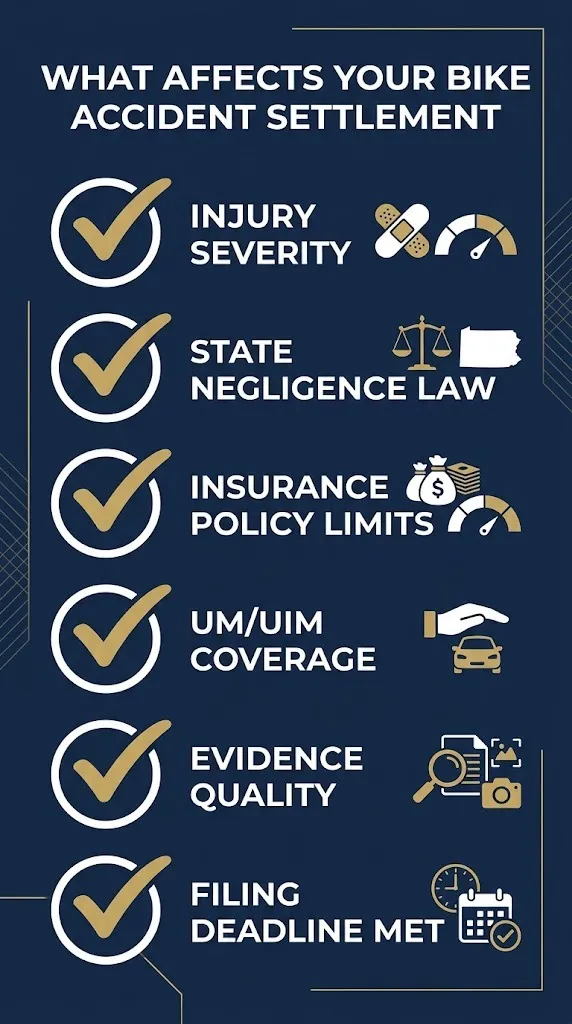
The biggest factor isn’t injury severity alone. It’s the available insurance coverage. If the at-fault driver carries only $25,000 in liability coverage, that caps your recovery from them unless you have uninsured/underinsured motorist coverage .
Medical costs drive settlement values upward. Nationally, bicycle injuries generated approximately $3.1 billion in medical costs in 2023, with average work-loss costs near $18,000 per injured cyclist .
Key Takeaway: Settlement amounts range from $10,000 to millions, but the at-fault driver’s insurance policy limits often cap what you can actually collect.
How does your state’s negligence law affect bike accident compensation?
Your state’s negligence framework determines whether you can recover anything if you share fault in the crash. The three systems produce dramatically different outcomes .
Pure comparative negligence (13 states including California, New York, Arizona): You recover damages reduced by your fault percentage. If you’re 40% at fault with $150,000 in damages, you collect $90,000 .
Modified comparative negligence (33 states): You recover if your fault is below a threshold (50% or 51% depending on state). Above that threshold, you get nothing .
Contributory negligence (Alabama, Maryland, North Carolina, Virginia, DC): Any fault attributed to you, no matter how minor, eliminates your right to compensation entirely .
| Negligence System | Fault Threshold | Example Outcome |
|---|---|---|
| Pure comparative | None | 40% fault, $150K damages = $90K recovery |
| Modified comparative (50%) | 50% | 49% fault = recovery; 51% fault = nothing |
| Contributory | 0% | 5% fault = nothing |
The practical impact is massive. The same crash with the same injuries can produce a six-figure settlement in California and zero in Virginia .
Reality Check
Insurance adjusters will call you within days of a bike accident with a “quick settlement” offer. Do not accept it. Those first offers are calculated to close the claim before you know the full extent of your injuries or the true value of your case. Some injuries, like traumatic brain injuries and spinal damage, don’t show their full impact for weeks or months. Once you sign a release, you cannot reopen the claim, even if your medical bills later exceed the settlement .
What insurance pays a bike accident claim?
Bike accident claims can be paid by multiple insurance policies depending on the circumstances. The at-fault driver’s liability coverage is the primary source, but it’s often not enough .
Auto liability insurance: The at-fault driver’s bodily injury liability coverage pays your medical bills, lost wages, and pain and suffering. State minimums vary widely: California requires $15,000 per person, New York requires $25,000 .
Uninsured/Underinsured Motorist (UM/UIM): If the at-fault driver has no insurance or too little, your own auto policy’s UM/UIM coverage steps in. This is critical for cyclists because hit-and-run crashes are common in urban areas .
No-fault/PIP coverage: In no-fault states like New York, the driver’s Personal Injury Protection pays your medical bills and lost income up to policy limits, regardless of fault. New York’s minimum is $50,000 .
Homeowners insurance: If the crash involved another cyclist or a pedestrian, their homeowners policy may cover your damages. Your own homeowners policy can also cover damage you cause to others .
Key Takeaway: The at-fault driver’s liability policy is the first source, but UM/UIM coverage on your own auto policy is often the difference between a fair recovery and a capped one.
How long do you have to file a bike accident claim?
The statute of limitations for bike accident claims is typically one to three years from the date of the crash. Missing the deadline almost always bars your claim permanently .
California, Nevada, and Texas all use a two-year deadline for personal injury claims . Other states vary. If a government entity is involved (poorly maintained bike lane, defective road design), the deadline can be much shorter, sometimes as little as six months .
The clock starts on the date of the accident for most claims. For injuries that develop over time, it may start when you knew or should have known about the condition.
Do not wait to contact an attorney. Evidence disappears. Skid marks fade. Surveillance footage gets overwritten. Witness memories blur. Insurance companies move fast to build their defense, and you need someone building yours .
What damages can you recover in a bike accident case?
You can recover economic damages (medical bills, lost wages, property damage) and noneconomic damages (pain and suffering, emotional distress) in most states. Punitive damages may apply in extreme negligence cases .
| Damage Category | What It Covers |
|---|---|
| Medical expenses | ER visits, surgery, rehab, future care |
| Lost wages | Time missed from work, diminished earning capacity |
| Pain and suffering | Physical pain, emotional trauma, loss of enjoyment |
| Property damage | Bicycle repair or replacement |
| Punitive damages | Drunk driving, hit-and-run, extreme recklessness |
Bicycle damage has unique challenges. Carbon fiber frames can crack internally without visible damage, and you don’t want to ride a compromised fork at 30 mph. Some shops X-ray frames to check for hidden cracks, but it’s expensive .
What should you do immediately after a bike accident?
The steps you take in the first hours and days after a crash directly affect the value of your claim. Here’s what matters most :
- Call 911 and report the accident. A police report creates an official record.
- Seek medical attention immediately. Some injuries don’t show symptoms right away.
- Document everything. Photograph the scene, vehicle damage, road conditions, and your injuries.
- Get witness information. Names, phone numbers, and statements.
- Exchange insurance information with the driver.
- Do not admit fault. Even saying “I’m sorry” can be used against you.
- Do not give a recorded statement to the other driver’s insurance company.
- Contact a bike accident attorney before accepting any settlement offer.
The insurance adjuster’s job is to minimize what they pay you. They’ll ask for a recorded statement hoping you’ll say something that shifts fault or downplays your injuries. You’re not required to give one .
What happens next
Immediate: Seek medical care, document the scene, and preserve evidence.
Days after: Insurance adjusters will make contact. Do not give recorded statements or accept early offers.
Weeks to months: Gather medical records, police reports, and witness statements to build your claim.
1 to 3 years (varies by state): File your personal injury lawsuit before the statute of limitations expires.
TBD: Settlement or trial, depending on negotiations and whether the insurance company makes a fair offer.
Frequently Asked Questions
What is the average bike accident settlement?
There is no single average. Minor injuries settle for $10,000 to $50,000. Catastrophic injuries can exceed $500,000 .
Can I recover compensation if I was partially at fault?
It depends on your state. Pure comparative states let you recover proportionally. Contributory negligence states bar recovery if you share any fault .
Who pays if the driver who hit me has no insurance?
Your own uninsured motorist coverage (UM) on your auto policy may pay. If you don’t have UM, options become limited .
How long do I have to file a bike accident lawsuit?
Typically one to three years from the accident date. Government claims may have shorter deadlines .
What if the driver left the scene?
Hit-and-run crashes are common. Your uninsured motorist coverage is often the only path to compensation .
Do I need a lawyer for a bike accident claim?
You can file a claim yourself. But insurance companies have teams working to minimize payouts, and having a lawyer improves your chance of fair compensation .
What damages can I claim?
Medical bills, lost wages, pain and suffering, property damage, and in extreme cases, punitive damages .
What should I do first after a bike crash?
Call 911, seek medical attention, document the scene, and do not give recorded statements to insurance adjusters .
Bike accident compensation depends on your injuries, your state’s negligence rules, and the insurance policies available. The single most important number to remember: your statute of limitations is likely one to three years, but government claims can expire in months. Document everything, don’t accept early settlement offers, and know your state’s fault rules before you negotiate.