False Accusations Lawsuit 2026: Can You Sue Someone and Win Money?
Quick Answer
- A false accusations lawsuit is usually a defamation or malicious prosecution claim filed in civil court.
- No fixed payout exists. Courts can award compensatory, nominal, or punitive damages based on proof.
- Many states allow one year to sue, others two. Your filing window may already be running.
Yes, you can sue someone who falsely accuses you, but only if the lie fits a recognized legal claim. In most cases that means a lawsuit for defamation, or malicious prosecution if the lie triggered a case against you.
This isn’t a settlement you claim with a form. You file your own case, and the clock is short. Many states give just one year.
Below you’ll find what you must prove, how damages work, where lies to police stand, and how anti-SLAPP laws can flip a case. One surprise: a false police report is often legally privileged.
The Facts
| Item | Detail |
|---|---|
| Case | Not a single case. A general civil claim (defamation, malicious prosecution, false light) |
| Status | No class action or settlement exists |
| Fund Size | Not applicable |
| Est. Per Person | Not yet determined. Varies by case and evidence |
| Claim Deadline | Set by your state. Often one to two years |
| Administrator | None. You file your own lawsuit |
| Proof Needed | False statement, publication to others, fault, and harm |
Is a false accusations lawsuit a real legal claim?
Yes, a false accusations lawsuit is real, but most states have no single law with that name. Courts sort these disputes into other claims.
Legal publishers describe defamation of character and malicious prosecution as the most common lawsuits based on a false accusation. Which one fits depends on what your accuser actually did.
Here’s the quick sort:
- They told other people the lie: that’s usually defamation. Written defamation is libel, and spoken defamation is slander.
- Their lie led to charges or a case against you: that points toward malicious prosecution.
- They painted you in a false light publicly: that may be a false light claim.
Don’t pick the label first. Start with the facts: who said what, to whom, and what happened next.
A lawyer will usually plead more than one theory, because a judge may toss one and keep another.
Is a lawsuit for defamation the same as suing over a false accusation?
Not exactly. A lawsuit for defamation is one tool, and a false accusation is one kind of statement it can cover.
Defamation means a false and harmful statement about a person or business that injures reputation. A false accusation fits when it was spread to others and damaged your standing.
Different claims fit different harms:
| Claim | Fits when | Main hurdle |
|---|---|---|
| Defamation | A lie spread to others hurt your reputation | Prove falsity, fault, and harm |
| Malicious prosecution | The lie led to a case against you | Usually need the case to end in your favor |
| False light | The lie created a false public impression | New Jersey’s top court held the one-year defamation deadline applies (decided August 7, 2025) |
| False police report (criminal) | The accuser knowingly lied to police | Prosecutors handle false report or perjury charges, not you |
The last row matters. Reporting a liar to police isn’t the same as suing one.
What do you have to prove in a lawsuit for defamation?
You must prove four things, and missing any one can sink the case. Courts generally look for a false statement of fact, publication to others, fault, and harm to reputation.
The core checklist:
- A false statement of fact. Opinion usually doesn’t count. Truth is a defense.
- Publication. The statement reached at least one third party.
- Fault. Private people generally need to show negligence, while public figures must show actual malice.
- Harm. Either real damage to reputation, or a statement serious enough that harm is presumed.
Notice what’s missing: proof the accuser was cruel. Courts care whether the statement was false and damaging, not whether it felt unfair.
State rules differ on fault and damages. Some states let you plead without proving specific damages for certain categories of statements.
Key Takeaway: A false accusations lawsuit turns on proof of a false statement of fact that reached other people and caused harm, not on proof that the accuser acted badly.
How much is a false accusations lawsuit worth?
Not yet determined. No fixed value exists, and legal publishers say it’s impossible to predict what a given false accusation suit is worth.
Courts do recognize categories of damages:
| Damages type | What it covers |
|---|---|
| Compensatory | Actual harm caused by the defamation |
| Special | Losses to property, trade, profession, or occupation |
| Nominal | A small symbolic sum when harm is hard to prove |
| Punitive | Extra damages to punish a defendant who acted with actual malice |
The number depends on evidence: lost jobs, lost clients, medical or therapy costs, and how widely the lie spread.
Big verdicts can also vanish. In a 2017 San Bernardino County case, a jury found a falsified police report accusing someone of forging a check, and a $450,000 judgment followed. The judge later set the verdict aside, ruling the report was privileged.
A jury win isn’t money in your account until appeals and privilege fights are over.
What is defamation per se, and does a false accusation of a crime count?
Defamation per se means the statement is so damaging that harm is presumed, and a false accusation of a crime commonly fits. Most per se cases involve falsely accusing someone of a crime or of being unfit for their profession.
That matters because it can ease your burden on damages. You may not need to document every lost dollar to get into court.
The contrast is defamation per quod. There, you must allege and prove actual financial losses such as lost business, employment, or contracts.
Per se rules vary by state. California, for example, defines libel per se in Civil Code section 45a.
Per se doesn’t mean you win. It means a court may presume damage once the statement itself qualifies. You still must prove it was false, published, and made with the required fault.
Reality Check: No court, agency, or claims administrator mails settlement money for a personal defamation case. Anyone who texts you a payout, or charges a fee to guarantee a win, isn’t a verified source. Filing your own lawsuit means paying court costs, and legitimate lawyers will explain the risks of dismissal.
Can public figures win a lawsuit for defamation?
Yes, but public officials and public figures must prove actual malice, a far higher bar. That means showing the speaker knew the statement was false or acted with reckless disregard for the truth.
The rule comes from the Supreme Court’s New York Times Co. v. Sullivan decision (376 U.S.). It protects heated public debate.
Think of it like a faulty product claim. A private person only has to show the seller was careless. A public figure has to show the seller knew it was broken and sold it anyway.
Even private people can face this higher standard if the statement involves a matter of public concern, in some states.
Practical effect: a celebrity, politician, or business owner with a public profile may find the claim much harder to win. Private individuals usually have the easier path on fault, though not on privilege or anti-SLAPP defenses.
Key Takeaway: Public figures must prove the accuser knew the claim was false or ignored obvious doubt, which is why many high-profile false accusation suits fail early.
How long do you have to sue for a false accusation?
Your window is set by state law, and in many states it is one year. One state list shows one year in Arizona, California, Colorado, Georgia, and Illinois.
The same list shows two years in Alabama, Alaska, Connecticut, Delaware, Florida, Hawaii, and Idaho. New York also uses a one-year period, and a complaint filed a day late typically gets dismissed.
| State group | Defamation filing window |
|---|---|
| AZ, CA, CO, GA, IL, NY | One year |
| AL, AK, CT, DE, FL, HI, ID | Two years |
| All other states | Not covered here. Check your state’s statute |
Think of it as a store return window. Miss the last day, and the receipt doesn’t help.
Related claims may share the clock. New Jersey’s Supreme Court ruled on August 7, 2025 that false light claims follow the same one-year deadline.
Publication, not discovery, is generally what starts the clock. Some limits can be tolled in certain situations, so ask a lawyer before assuming you’re out of time.
How do you file a lawsuit for defamation, step by step?
You file a complaint in the proper civil court, but the real work happens before that. Most winnable cases are built in the first few weeks.
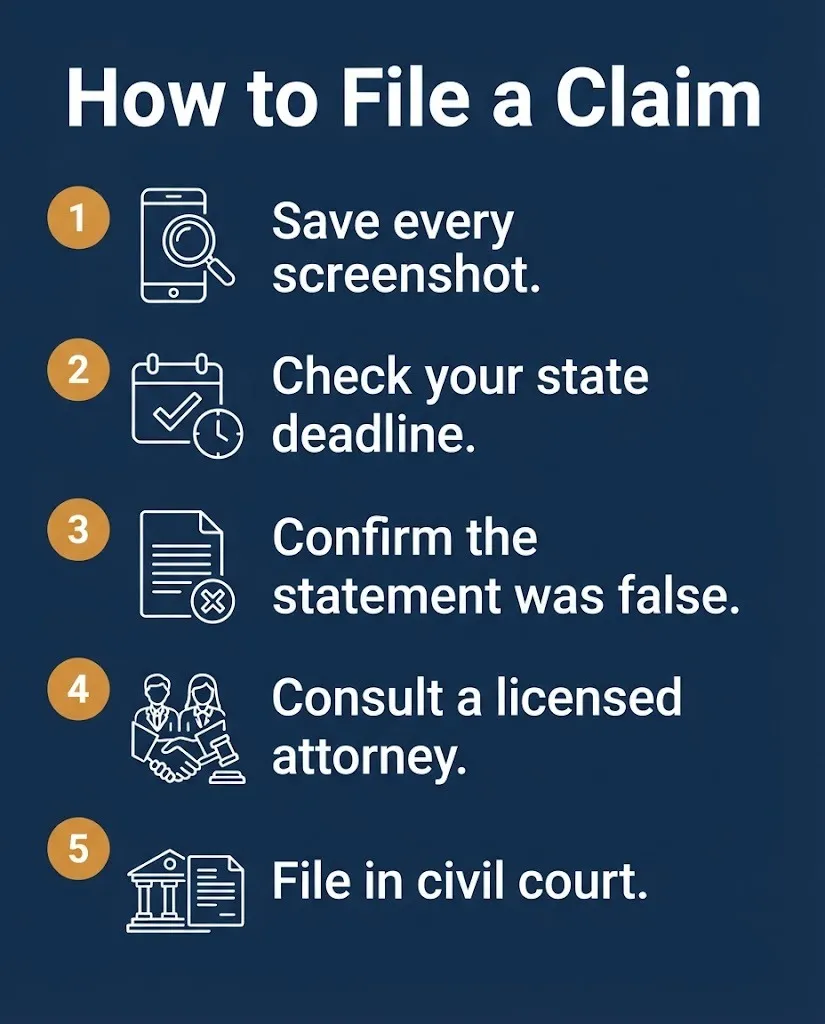
- Save every post, message, email, and recording of the accusation.
- Write down the date you first saw or heard it.
- Check your state’s defamation filing deadline.
- Ask a licensed attorney about privilege and anti-SLAPP exposure.
- Consider a cease and desist or retraction demand first.
- File a complaint in the correct civil court.
- Serve the defendant and track every response deadline.
- Prepare for an early motion to dismiss.
Step 5 can be strategic. Settlement talks can fail, and a credible threat to file only works while the deadline hasn’t passed.
Step 8 is not optional thinking. Many defamation claims get dismissed at the pleading stage.
This is information, not instruction. A local attorney knows your court’s rules.
What evidence do you need to prove a false accusation?
You need proof the statement was made, proof it was false, and proof it hurt you. Evidence is where most claims are won or lost.
Start with the statement itself:
- Dated screenshots with the account name and URL visible
- Recordings or written notes made as soon as you heard a spoken lie
- Names of people who saw, heard, or received it
Then prove it was false. That could be records, a dismissed charge, or documents that contradict the claim. You will probably have to litigate the accusation itself, so the truth needs paper behind it.
Finally, prove harm:
- Termination notices or lost contract emails
- Customer cancellations tied to the lie
- Lost business, employment, or contracts count as special damages
- Medical or counseling bills for emotional distress
Keep originals. Don’t edit, crop, or reply in ways that change the record.
Key Takeaway: Evidence you collected in the first week, with dates attached, often decides whether a false accusations lawsuit survives its first motion.
Can you sue someone who lied to the police about you?
Sometimes, but statements to police are usually privileged, so a lawsuit for defamation over a police report faces a steep wall. Most states give only a qualified privilege for statements to police.
Qualified privilege can be lost. Florida’s Supreme Court held you can overcome it by proving the statements were false and made with express malice.
California has a statutory twist. Its Civil Code section 47 says the privilege doesn’t cover reports made knowing they were false or with reckless disregard for the truth.
| Rule | Effect on you |
|---|---|
| Absolute privilege | Even a malicious lie can’t be sued over |
| Qualified privilege | You can sue if you prove bad faith or malice |
| Knowingly false report (California statute) | Privilege withheld, but other defenses may remain |
Making a false police report is also a criminal act. That path runs through prosecutors, not your complaint.
Can you sue before your criminal case ends?
Usually you should wait. Legal guidance says if you haven’t been cleared of wrongdoing, you generally can’t sue the person who made the allegation.
One criminal defense firm recommends waiting for a favorable resolution of the criminal case first. That fits how malicious prosecution works: the case against you generally has to end in your favor.
Suing the government is harder still. Malicious prosecution claims are difficult, especially against district attorneys and officials who often have governmental immunity.
Think of it like a delayed tax refund. You can’t claim it until the original return is fully processed.
Timing creates risk. Your filing window for defamation may keep running while the criminal case is pending. A lawyer can tell you whether your state pauses that clock.
Don’t contact your accuser during a pending case. Talk to your criminal defense counsel first.
What is an anti-SLAPP motion, and can it backfire on you?
An anti-SLAPP motion is an early request to dismiss a suit aimed at speech on public issues, and losing can mean paying the other side’s legal fees. Some states let a defendant shift attorney fees to the plaintiff when a suit appears meant to chill speech.
More than 30 states, including New York and California, have anti-SLAPP statutes. They let defendants challenge the basis of a suit and often win quick dismissal.
Think of it as a bouncer at the door. Your claim has to show real merit before it gets inside the courtroom.
The risk isn’t theoretical for accusation cases. One California firm warns that defamation, abuse of process, and malicious prosecution suits can draw anti-SLAPP motions, and a granted motion can mean paying the accuser’s fees.
Before you file, ask your attorney two questions. Does the statement touch a public issue? And does the accuser’s speech qualify as protected petitioning, such as a report to police?
Key Takeaway: Anti-SLAPP laws can turn a false accusations lawsuit into a fee exposure, so check this risk before you file, not after.
Can you sue over a false accusation posted online or reposted?
Yes. Internet defamation commonly takes the form of a blog post, comment, review, or video or audio statement. The same elements apply: falsity, publication, fault, and harm.
Republishing creates timing questions. The prevailing view is that passive republication by automated systems doesn’t restart the limitations clock. A fresh post by the same person may be treated differently, so document each one.
Whether a website can be sued is a separate issue. Federal law often shields platforms, and the speaker is usually the target. Ask an attorney who handles online cases.
Practical steps for online lies:
- Capture the page with date and URL before it’s deleted
- Record view counts, shares, and comments if visible
- Note who reposted and when
- Don’t engage the poster in a public argument
Deleting a post doesn’t erase your claim, and screenshots are your proof.
Is it worth suing for a false accusation?
Sometimes, but weigh cost, dismissal risk, and fee exposure first. Some attorneys argue suing can recover losses and deter others from repeating the lie.
A fair scorecard:
| Reasons to sue | Risks |
|---|---|
| Restore your reputation on the record | Many claims are dismissed early |
| Recover lost income or contracts | Anti-SLAPP motions can shift fees to you |
| Create leverage for a retraction | Privilege can bar police-report claims |
Alternatives exist. Demand letters, including cease and desist letters, are a common first step in online defamation disputes. A retraction or settlement can end the harm without a trial.
Also consider the personal cost. Litigation keeps the accusation in the public eye longer, and you’ll relive it in depositions.
There’s no official payout program to compare against. Your own evidence is the whole case.
What happens next if you decide to move forward?
A false accusations lawsuit follows a predictable path, though dates depend on your court and state.
Now: Preserve evidence and calendar the date the statement was first published.
Within days: Consult a licensed attorney in your state about your claim, privilege, and anti-SLAPP risk.
Before your deadline (often one to two years): File the complaint in the correct civil court.
Expected after filing: The defendant may file a motion to dismiss or an anti-SLAPP motion. Timing isn’t confirmed and varies by court.
Expected later: Discovery, settlement talks, or trial, depending on how the early motions come out.
Frequently Asked Questions
Can I sue someone for making false accusations against me?
Yes, if the accusation fits a recognized claim like defamation or malicious prosecution.
You must prove falsity, publication, fault, and harm.
Privilege and anti-SLAPP laws can still block the case.
How long do I have to file a lawsuit for defamation?
It depends on your state, and many states allow one year.
Some list two years, including Florida and Connecticut.
Check your state’s statute immediately, because one day late can end the case.
What’s the difference between defamation and a false accusation?
Defamation is the legal claim. A false accusation is one example of a statement that may qualify.
Spoken lies are slander, and written lies are libel.
Can I sue for a false police report?
Often not for defamation, because most states give statements to police at least a qualified privilege.
Some states allow suits if you prove bad faith or malice.
Malicious prosecution may apply if the report led to charges against you.
Do I have to prove the person meant to hurt me?
Private individuals generally must show negligence, not intent.
Public figures must show actual malice, meaning knowledge of falsity or reckless disregard.
How much money can I win in a false accusations lawsuit?
Not yet determined, because no standard amount exists.
Courts can award compensatory, nominal, or punitive damages depending on evidence and state law.
What happens if I lose a defamation lawsuit?
You may owe costs, and in anti-SLAPP cases you could owe the defendant’s attorney fees.
Dismissal at the pleading stage is common.
Ask a lawyer about fee exposure before filing.
Is there a class action settlement for false accusations?
No class action settlement exists for this topic.
Each person files an individual civil case.
Be cautious of any site or text claiming otherwise.
If you think you have a claim, check your state’s deadline first. Then gather dated screenshots, records, and witness names before anything gets deleted.
Talk to a licensed attorney in your state about privilege and anti-SLAPP exposure. The clock generally starts when the statement was first published.