Estate Litigation Attorney: How to Hire and Vet One in 2026
Quick Answer
- Estate litigation attorneys handle will contests, trust disputes, fiduciary breach claims, and elder abuse cases.
- Fees typically run 300 to 600 dollars per hour, with some firms offering contingency arrangements.
- Probate deadlines in most states range from 30 days to 6 months after notice, so acting quickly matters.
If you are searching for an estate litigation attorney, you likely suspect something went wrong with a will, trust, or estate. Maybe a sibling is contesting your parent’s will. Maybe a trustee is not accounting for assets. Maybe someone isolated an aging relative and changed documents.
This article explains what estate litigation attorneys do, what they charge, and how to verify a lawyer before hiring. You need facts, not marketing.
One thing most people do not know: probate disputes have unusually short deadlines. In some states, you have as little as 30 days after receiving notice to contest a will. Waiting can cost you the case.
The Facts
| Case | Estate litigation, general practice area |
| Status | Active and growing across all state probate courts |
| Fund Size | Case-specific, no standard amount |
| Est. Per Person | Contingency fees range 25 to 40 percent if offered |
| Claim Deadline | State-specific, typically 30 days to 6 months after notice |
| Administrator | Not applicable to hiring an attorney |
| Proof Needed | Will, trust documents, financial records, medical evidence |
Are Estate Litigation Attorneys Legitimate?
Estate litigation attorneys are real, licensed lawyers who specialize in disputes over wills, trusts, estates, guardianships, and fiduciary conduct. The practice area is well-established in every state.
The legal framework comes from state probate codes and the Uniform Trust Code, which most states have adopted in some form. These laws govern how estates are administered and how disputes are resolved.
Estate litigation attorneys appear in probate court, which is a specialized division of state trial courts. In larger counties, dedicated probate judges handle these cases. In smaller jurisdictions, general jurisdiction judges oversee them.
Not every lawyer who advertises estate litigation experience has meaningful courtroom time. Checking a lawyer’s actual case history and bar record is essential before hiring.
Key Takeaway: Estate litigation attorneys are legitimate specialists, but their courtroom experience varies widely, and verification is on you.
How Much Does an Estate Litigation Attorney Cost?
Estate litigation attorneys typically charge hourly rates ranging from 300 to 600 dollars per hour for experienced counsel. Senior partners at large firms may charge 700 dollars or more.
Some estate litigation matters are handled on contingency. Contingency means the lawyer receives a percentage of what they recover, usually 25 to 40 percent, and nothing if the case loses.
Contingency arrangements are more common in elder financial abuse cases where money was taken and can be recovered. Will contests and trust disputes are usually hourly because the outcome is not purely monetary.
You should receive a written fee agreement before the lawyer begins work. The agreement must explain the hourly rate, retainer amount, and how costs are billed. Never accept a verbal fee arrangement.
| Fee Structure | Typical Range | Common Use |
|---|---|---|
| Hourly rate | 300 to 600 dollars per hour | Will contests, trust disputes |
| Contingency | 25 to 40 percent of recovery | Elder abuse, asset recovery |
| Flat fee | Case-specific | Uncontested probate matters |
| Retainer plus hourly | 5,000 to 25,000 dollars upfront | Complex litigation |
When Do You Need an Estate Litigation Attorney?
You need an estate litigation attorney when a dispute arises over a will, trust, estate administration, or fiduciary conduct that cannot be resolved through negotiation.
Common triggers include a family member contesting a will, a trustee refusing to provide accountings, suspicious changes to estate documents made when someone was ill, and disputes between beneficiaries.
You may also need one if you are a trustee or executor accused of wrongdoing. Defending against fiduciary breach claims requires experienced counsel.
If you are simply the executor of an uncontested estate, you likely need a probate attorney, not a litigator. Estate litigation attorneys are for disputes, not routine administration.
What Is a Will Contest?
A will contest is a legal challenge to the validity of a will. The person contesting argues that the will should not be admitted to probate because it was not properly signed, the person lacked mental capacity, or someone exerted undue influence.
Grounds for contesting a will vary by state. Undue influence is the most common claim in family disputes. It means someone pressured or manipulated the person making the will into changing it.
Lack of testamentary capacity means the person did not understand what they owned, who their heirs were, or what the document did. Medical records and witness testimony are critical evidence.
Will contests have strict deadlines. In many states, you must file within a few months after the will is admitted to probate. Missing the deadline bars the contest permanently.
Key Takeaway: Will contests rest on undue influence or lack of capacity, and the deadlines are unforgiving.
What Is a Trust Dispute?
A trust dispute is litigation over the validity, interpretation, or administration of a trust. Trust disputes are often more complex than will contests because trusts can hold assets for years.
Common trust disputes involve a trustee who is not distributing assets, investing poorly, favoring one beneficiary, or charging excessive fees. Beneficiaries may sue to remove the trustee or recover losses.
Some trust disputes challenge the trust’s creation. The person alleging problems may claim the trustmaker was defrauded, lacked capacity, or was unduly influenced.
Trust litigation often involves accountings. A trustee must provide an accounting of all income, expenses, and distributions. Failure to do so can be grounds for removal.
What Is a Fiduciary Breach Claim?
A fiduciary breach claim alleges that a person in a position of trust, like a trustee, executor, or power of attorney agent, violated their legal duties.
Fiduciaries owe duties of loyalty, care, and full disclosure. They must act in the best interest of the beneficiaries, not themselves. Self-dealing, mismanagement, and hiding assets are breaches.
Remedies include removal of the fiduciary, recovery of misappropriated funds, and sometimes punitive damages. Courts take fiduciary breaches seriously.
If you suspect a fiduciary is stealing or mismanaging estate assets, document everything. Bank statements, communications, and accountings are evidence.
What Is Elder Financial Abuse in Estate Litigation?
Elder financial abuse is the illegal or improper use of an older person’s money or property. It often surfaces after the person dies and heirs discover assets were transferred or wills were changed.
Estate litigation attorneys handle elder abuse cases by suing the person who took the assets. They seek to recover the money for the estate or the rightful heirs.
Many states have enhanced remedies for elder financial abuse. California, for example, allows recovery of attorney fees and sometimes double damages in proven elder abuse cases.
These cases often overlap with will contests and trust disputes. The same person who isolated the elder may have changed the will and drained the accounts.
Key Takeaway: Elder financial abuse cases allow for asset recovery and sometimes enhanced damages, making them a significant part of estate litigation.
How Do I Find a Reputable Estate Litigation Attorney?
Finding a reputable estate litigation attorney requires more than reading online reviews. You need to verify court experience and professional standing.
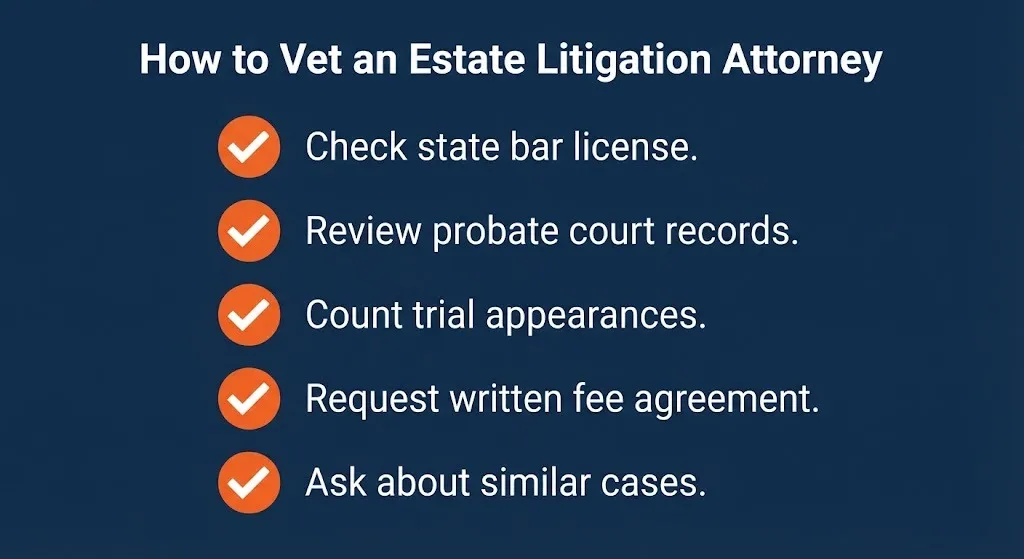
Start with your state bar association. Every state bar has an online attorney directory showing license status, admission date, and any disciplinary history.
Search court records. Many probate courts have online dockets. Look for cases where the attorney appeared in estate litigation matters. Count the number of appearances, not just filings.
Ask for references from other professionals. Certified public accountants, financial advisors, and other lawyers often know which estate litigators have strong reputations.
Interview at least two or three attorneys. Ask how many estate cases they have tried to verdict, not just settled. Trial experience matters if your case cannot be resolved.
What Questions Should You Ask an Estate Litigation Attorney?
The questions you ask in an initial consultation determine whether you hire the right lawyer. Most consultations are free or low cost.
Ask how many years they have practiced estate litigation specifically. Ask how many will contests or trust disputes they have handled in the last two years.
Ask who will actually work on your case. Large firms may assign junior associates to handle routine matters while the partner only appears in court.
Ask for a realistic assessment of your case. A good lawyer tells you the weaknesses, not just the strengths. If every lawyer says you have a slam dunk, be suspicious.
Reality Check
No estate litigation attorney can guarantee you will win a will contest or recover money. Anyone who promises a specific outcome before reviewing all documents is not being honest. Fee disputes are common, so get every fee term in writing before signing. If a lawyer asks for a large upfront payment and promises a quick resolution, get a second opinion.
What Happens Next
Day 1: You identify the dispute and gather all relevant documents, including wills, trusts, and financial records.
Week 1 to 2: You interview estate litigation attorneys and request fee agreements.
Week 2 to 4: You hire counsel and file the necessary pleadings before any deadline expires.
Months 1 to 12: Discovery proceeds, including document production and depositions.
TBD: Trial or settlement occurs depending on the case and the court’s schedule.
Frequently Asked Questions
What does an estate litigation attorney do?
They handle disputes over wills, trusts, estates, guardianships, and fiduciary conduct.
They represent clients in probate court and negotiate settlements.
How much does estate litigation cost?
Hourly rates run 300 to 600 dollars for experienced attorneys.
Some cases are handled on contingency, usually 25 to 40 percent.
How long do I have to contest a will?
Deadlines vary by state but are often 30 days to 6 months after notice.
Missing the deadline usually bars the contest permanently.
Can I sue a trustee for stealing?
Yes, a fiduciary breach claim can seek recovery of misappropriated funds.
You may also ask the court to remove the trustee.
What is undue influence in a will contest?
Undue influence means someone pressured or manipulated the person making the will.
It is the most common ground for challenging a will.
Do I need a lawyer for a trust dispute?
Yes, trust disputes involve legal and procedural rules that are difficult to navigate alone.
An experienced attorney can assess your claim and meet deadlines.
What is the difference between a probate attorney and an estate litigator?
A probate attorney handles routine estate administration.
An estate litigator handles disputes, contested hearings, and trials.
Can I contest a will after probate is closed?
It is very difficult and often impossible after the estate is closed.
Some states allow late challenges only for fraud or newly discovered wills.
Your next step is to gather every document you can find and meet with at least two estate litigation attorneys. The deadlines in probate court do not wait for you to feel ready.
The single most important date is the deadline to contest or object. In many states, that clock starts the day you receive notice. Do not let it run out.