What Is Compensation? The 2026 Guide to How It Works in Law, Work, and Injury Claims
Quick Answer
- Compensation means payment for work performed or for harm suffered, according to Cornell Law School’s Wex legal dictionary.
- There’s no single dollar amount, since compensation ranges from a paycheck to a multimillion-dollar injury verdict.
- There’s no universal deadline either, since filing windows depend entirely on which type of compensation claim you’re pursuing.
You’ve probably landed here after seeing the word “compensation” in a job offer, an injury settlement, or a legal notice, and wondering what it actually means in that specific context. It’s one word doing a lot of different jobs.
At its core, compensation is payment for something, either work you did or harm you suffered. That single idea shows up in your paycheck, a workers’ comp claim, an eminent domain case, and a personal injury lawsuit, all at once.
This guide breaks down what compensation means in each of those settings, how much you might actually see, and how filing deadlines work. One thing that surprises people: the U.S. Constitution has its own specific version of this word, called “just compensation.”
The Facts
| Term | Compensation (general legal and financial term, not a specific case or lawsuit) |
| Status | Ongoing legal concept, applies across employment law, injury law, and constitutional law |
| Fund Size | Not applicable, compensation amounts are set case by case, not from a shared fund |
| Est. Per Person | Not applicable, ranges from a regular paycheck to a multimillion-dollar jury award |
| Claim Deadline | Varies by claim type and state, no single universal deadline exists |
| Administrator | Depends on context: employer, insurer, court, or government agency |
| Proof Needed | Varies by claim type, generally documentation of work performed or harm suffered |
What Does Compensation Mean, in Plain Terms?
Compensation means payment or remuneration for work performed, or for harm you’ve suffered. That’s the exact definition Cornell Law School’s Legal Information Institute uses in its Wex legal dictionary.
It’s a broad umbrella term, not a single fixed benefit. Your salary is compensation. A jury verdict after a car accident is compensation. A payout from a government taking your land is compensation too.
Federal statutes define it slightly differently depending on the law involved. One federal code section defines compensation as any payment of money or anything of current or potential value connected to employment, while another ties it specifically to money remuneration for services rendered.
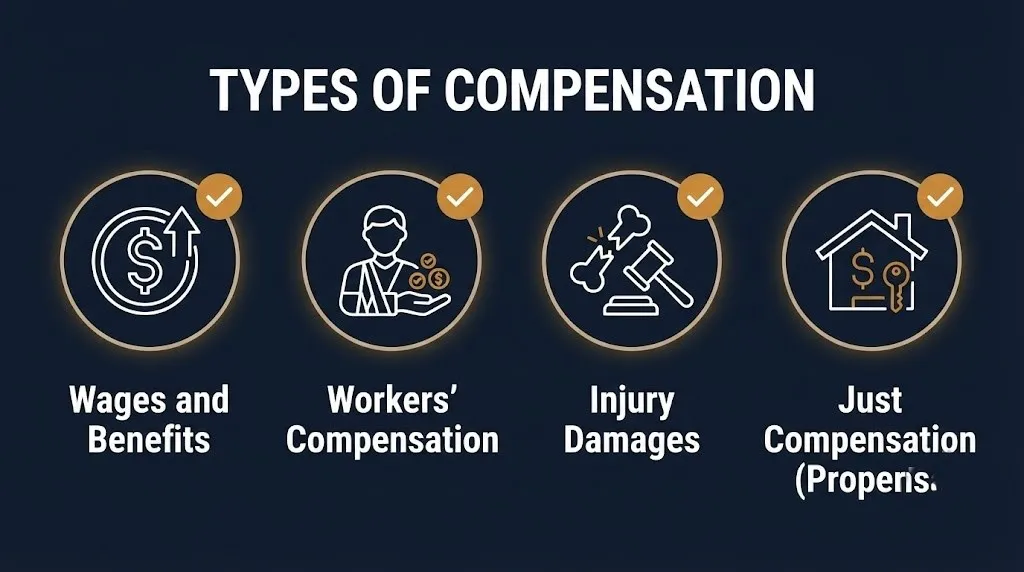
Key contexts where “compensation” shows up:
- Regular employment pay and benefits
- Workers’ compensation after a job injury
- Personal injury damages after an accident
- Government payments under eminent domain
Is “Compensation” the Same Thing as a “Settlement” or “Damages”?
No, compensation is the broader category, while settlement and damages are two of the specific ways compensation gets paid out. Settlement is an agreement to resolve a dispute, and damages are a court-ordered payment after a verdict.
Think of it like the word “vehicle.” A car, a truck, and a motorcycle are all vehicles, but they’re not interchangeable words for the same thing. Compensation works the same way with settlements and damages.
A settlement is compensation you agree to accept, usually before or instead of a trial. Damages are compensation a judge or jury orders after hearing a case. Both are forms of compensation, but they arrive through different legal paths.
Key Takeaway: Compensation is the umbrella term, and settlements, damages, wages, and benefits are all specific types of compensation, not separate concepts.
How Much Compensation Can Someone Receive in a Lawsuit?
There’s no fixed compensation amount for a lawsuit, since payouts depend entirely on the type of harm, the evidence, and the jurisdiction involved. Anyone promising you a guaranteed number before reviewing your specific case isn’t being straight with you.
Courts generally divide lawsuit compensation into two broad categories: compensatory damages, meant to cover actual losses, and in some cases punitive damages, meant to punish especially harmful conduct. Compensatory damages themselves split further into economic losses (medical bills, lost wages) and non-economic losses (pain and suffering).
Not yet determined is the honest answer for any specific dollar figure, because no two cases share identical facts, injuries, or state laws.
| Compensation Type | What It Covers |
|---|---|
| Economic damages | Medical bills, lost wages, property damage |
| Non-economic damages | Pain, suffering, emotional distress |
| Punitive damages | Punishment for especially reckless or intentional conduct |
What Are the Different Types of Compensation in a Lawsuit?
Lawsuit compensation generally falls into economic damages, non-economic damages, and, in limited cases, punitive damages. Each type serves a different legal purpose.
Economic damages cover losses you can put a specific number on, like medical bills or missed paychecks. Non-economic damages cover harder-to-quantify harm, like ongoing pain or loss of enjoyment of life.
Punitive damages are different from both. They aren’t about compensating you directly, they’re meant to punish a defendant for particularly reckless or intentional behavior, and courts award them far less often than the other two types.
Quick breakdown:
- Economic damages: bills, wages, and other documented costs.
- Non-economic damages: pain, suffering, emotional harm.
- Punitive damages: rare, tied to punishing bad conduct, not covering your losses.
What Is Workers’ Compensation, Specifically?
Workers’ compensation is a state-run insurance system that pays injured employees fixed benefits without requiring a lawsuit against their employer. Cornell’s Wex dictionary describes it as a system designed to eliminate the need for litigation over workplace injuries.
Every state runs its own workers’ compensation program, so specific benefit amounts and rules vary widely depending on where you work. Federal employees fall under a separate law, the Federal Employees’ Compensation Act, administered by the U.S. Department of Labor.
That federal act pays a disabled employee two-thirds of their normal monthly salary during disability, with adjustments for permanent injuries or dependents. State programs follow a similar two-thirds structure in many cases, but the exact percentage and weekly caps differ by state.
Reality Check: No workers’ compensation or injury settlement administrator will text you out of nowhere asking for a fee to “release” your compensation. Filing a legitimate claim is always free, and paid “claim helpers” contacting you first are a warning sign, not a shortcut.
What Is “Just Compensation” Under the Constitution?
Just compensation is the payment the government must make under the Fifth Amendment when it takes private property for public use. This comes from the Takings Clause, a specific constitutional rule separate from ordinary lawsuit compensation.
The amount is generally set at the property’s fair market value, based on what a willing buyer would pay a willing seller. The Supreme Court has described this as providing a full and perfect equivalent for what was taken.
Courts measure this by the owner’s loss, not by any benefit the government gains from taking the property. Attorney’s fees and expenses generally aren’t included in that just compensation figure, according to Supreme Court precedent.
What Is Deferred Compensation?
Deferred compensation is a type of pay, similar to a pension, where an employee receives part of their earnings later, often at retirement, instead of right away. Cornell’s legal dictionary describes it as a way employees often use to delay taxes on part of their earnings.
Unlike regular wages, deferred compensation isn’t taxed the moment it’s earned. It’s taxed later, typically when the employee actually receives it, which is one reason employers and workers use these arrangements.
This is a completely different concept from injury or lawsuit compensation. It sits entirely within employment and tax law, not personal injury or workers’ comp law.
Key Takeaway: “Compensation” changes meaning entirely depending on context, covering everything from a delayed retirement payout to a constitutional property-taking rule.
How Do I Know If I Qualify for Compensation After an Injury or Accident?
Qualifying for compensation after an injury generally depends on proving someone else’s fault caused your harm, or, for workers’ comp, simply proving the injury happened on the job. The exact standard depends on which type of claim you’re pursuing.
For a personal injury lawsuit, you typically need to show another party was negligent or otherwise legally responsible. For workers’ compensation, most state systems are no-fault, meaning you don’t need to prove your employer did anything wrong, only that the injury happened at work.
General eligibility factors across most claim types:
- Clear documentation connecting the harm to a specific incident or exposure
- Evidence of actual losses, whether medical, financial, or both
- Filing within your state’s applicable deadline
How Do I File a Claim for Compensation?
Filing a compensation claim generally starts with reporting the harm, gathering documentation, and submitting the correct form to the right party, whether that’s an employer, insurer, or court. The exact process depends heavily on the type of claim.
General steps that apply across most compensation claims:
- Report the injury, incident, or loss immediately to the relevant party.
- Seek any required medical treatment or documentation right away.
- Gather receipts, records, or other proof of your loss.
- Identify the correct form or filing process for your specific claim type.
- Submit your claim within the applicable deadline.
- Keep copies of everything you send.
- Follow up in writing if you don’t hear back within a reasonable time.
Because this varies so much by claim type, always check with the specific court, agency, or insurer handling your situation rather than relying on generic instructions.
What Proof Do You Need to Receive Compensation?
The proof required for a compensation claim depends on what kind of compensation you’re seeking, but documentation of the underlying harm or work performed is almost always required. A paycheck claim needs pay records, while an injury claim needs medical records.
For lawsuit-based compensation, that typically means medical bills, wage records, and sometimes expert testimony connecting your losses to the incident. For workers’ compensation, it typically means an authorized physician’s diagnosis and a completed claim form with your employer or state board.
There’s no single universal document that unlocks compensation across every context. Check the specific rules for your claim type before assuming any generic checklist applies to your situation.
How Long Do You Have to File a Claim for Compensation?
There’s no single deadline for filing a compensation claim, since time limits, called statutes of limitations, vary by state and by the type of claim involved. Personal injury deadlines and workers’ comp deadlines often differ even within the same state.
Some states give injury victims a few years to file a lawsuit, while workers’ compensation programs often require reporting an injury within days or weeks, with a separate window to file a formal claim. Missing either deadline can mean losing your right to compensation entirely, regardless of how strong your case is.
Treat any specific deadline you read for “compensation” in general as unreliable, since the real deadline always depends on your state and your specific type of claim.
Key Takeaway: Always confirm your exact filing deadline with your state’s specific agency or court rules, since “compensation” itself has no single universal clock.
What’s the Difference Between Compensatory and Punitive Damages?
Compensatory damages are meant to cover your actual losses, while punitive damages are meant to punish a defendant for especially reckless or intentional conduct. They serve two entirely different legal purposes.
Compensatory damages try to make you financially whole again, covering things like medical bills, lost income, and pain and suffering. Punitive damages go further, adding an extra penalty on top, and courts reserve them for conduct that goes beyond ordinary negligence.
Not every case involves punitive damages. Many states also cap how large punitive awards can be, and those caps vary widely depending on where the case is filed.
Where Does the Word “Compensation” Come From and How Is It Used in Employment?
In employment, compensation refers to any payment of money or anything of value connected to your job, according to federal statute. That includes wages, but it also includes benefits, bonuses, and deferred pay arrangements.
This employment definition is broader than most people assume. It’s not limited to your hourly wage or salary, it covers essentially anything of value tied to your work.
The word itself comes from a much older, general legal idea: making someone whole, or balancing out a loss with a payment. That same root idea threads through every specific use of the word, from paychecks to court judgments to constitutional takings.
Is Compensation Taxable?
Whether compensation is taxable depends entirely on the type of compensation and how it’s structured. Regular wages are taxable income, while some injury-related compensation can be tax-free under federal law.
Deferred compensation is specifically structured to delay taxation until the money is actually received, often at retirement. Personal injury settlements for physical injuries are often excluded from federal taxable income, though emotional distress or punitive damages portions can be treated differently.
This is a tax question, not a general legal one, and the specific answer depends on your situation. Consult a tax professional or accountant for anything beyond this general overview, since this article covers general information, not tax or legal advice.
What Happens Next
Ongoing: “Compensation” remains an active, everyday legal and financial term across employment, injury, and constitutional law, with no expiration or single case tied to it.
If you’re pursuing a specific claim: Confirm which type of compensation applies to your situation, since the rules, proof, and deadlines differ completely by category.
Expected, ongoing: Courts, employers, and insurers will continue using this same broad term across very different legal contexts throughout 2026 and beyond.
Frequently Asked Questions
What is compensation, in simple terms?
Compensation is payment for work performed or for harm someone has suffered.
It covers everything from a regular paycheck to a court-ordered injury award.
What does compensation mean in a lawsuit?
In a lawsuit, compensation usually refers to damages awarded to cover a plaintiff’s losses.
That can include economic damages, non-economic damages, and in rare cases, punitive damages.
Is compensation the same as a settlement?
No, a settlement is one specific way compensation gets paid, through an agreement rather than a trial verdict.
Compensation is the broader category that includes settlements, court judgments, and even regular wages.
What is workers’ compensation?
Workers’ compensation is a state-run insurance system paying injured employees fixed benefits without a lawsuit.
Rules and benefit amounts vary significantly from state to state.
What is just compensation?
Just compensation is the payment the government must make when it takes private property under the Fifth Amendment.
It’s generally set at the property’s fair market value.
How much compensation can I expect from a claim?
There’s no fixed amount, since payouts depend entirely on the type of claim, your losses, and your state’s laws.
Anyone guaranteeing a specific number without reviewing your case should be treated with caution.
Is compensation always money?
Usually yes, but federal law also defines some compensation as anything of current or potential value connected to employment.
That can include benefits or other non-cash items tied to a job.
Before assuming any dollar figure or deadline applies to your situation, confirm which specific type of compensation you’re dealing with, since the rules differ sharply between workers’ comp, personal injury, and employment law. Gather your documentation early and check your state’s specific filing deadlines rather than relying on a general definition.