How to File a Lawsuit Against a Company in 2026: Steps, Costs, and Deadlines
Quick Answer
- Filing a lawsuit against a company is a real legal process, not a scam, but it requires specific steps and evidence.
- Costs vary widely: small claims filing fees run $30 to $200, while civil court fees can exceed $400.
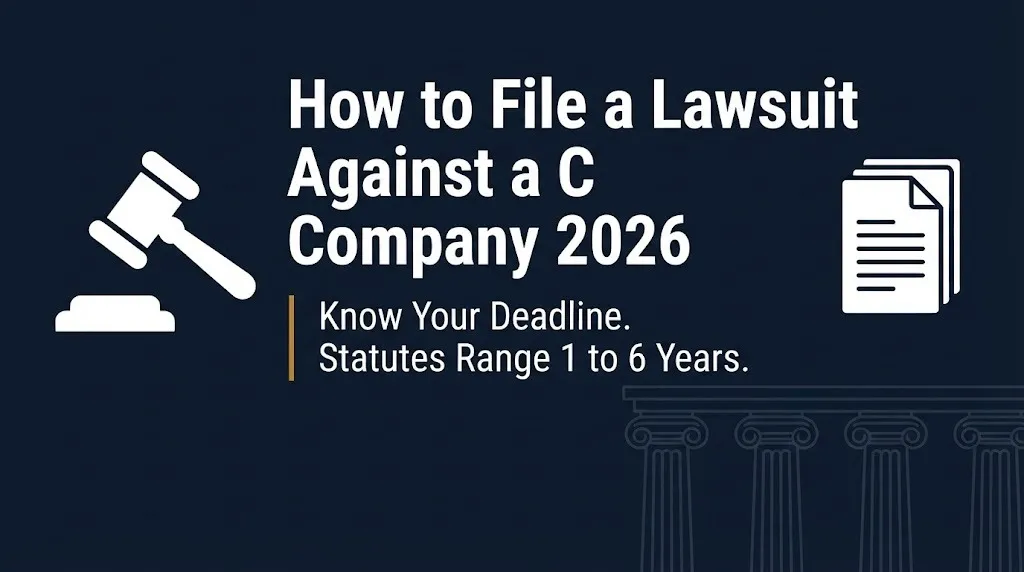
- The most important deadline is the statute of limitations, which can be as short as one year for some claims.
You want to sue a company. Maybe they sold you a defective product. Maybe they failed to pay you. Maybe they discriminated against you at work. You typed “how to file a lawsuit against a company” because you want to know if you can actually do it and what it will take.
Here is the direct answer. Yes, you can file a lawsuit against a company. The process involves drafting a complaint, filing it with the correct court, paying a filing fee, and serving the company with legal papers. It is not instant, and it is not free.
This guide walks through every step, from deciding whether you have a case to understanding what happens after you file. One surprising verified fact: most lawsuits against companies never reach trial. They settle or get dismissed long before a jury ever hears them.
The Facts
| Item | Detail |
|---|---|
| Process | Civil lawsuit filed in state or federal court |
| Small Claims Limit | Varies by state, typically $3,000 to $12,500 |
| Filing Fees | $30 to $200 small claims; $200 to $500+ civil court |
| Statute of Limitations | 1 to 6 years depending on claim type |
| Attorney Cost | $200 to $600 per hour or contingency fee |
| Trial Rate | Under 3 percent of civil cases reach trial |
| Service Required | Formal delivery of complaint to defendant |
| Appeal Window | Typically 30 days after judgment |
Is Filing a Lawsuit Against a Company Worth It?
Whether filing a lawsuit against a company is worth it depends on your damages, your evidence, and the company’s willingness to settle. A strong case with clear evidence and significant damages may be worth pursuing. A weak case with minimal damages may cost more than it recovers.
Lawsuits are expensive in both money and time. Even a simple small claims case takes weeks or months. A complex civil case can take years. You need to weigh the potential recovery against the filing fees, attorney costs if you hire one, and the hours you will spend on the process.
Most people who sue companies do so because they have exhausted every other option. They tried customer service. They tried a demand letter. They tried a government complaint. When those fail, court is the remaining path.
Think of it like a warranty claim. You can call the company first. If they refuse, you read the fine print and decide if the fight is worth it.
How Much Does It Cost to File a Lawsuit Against a Company?
Filing fees for a lawsuit against a company range from about $30 in small claims court to over $400 in federal civil court. The exact amount depends on your court and claim type.
Small claims court is designed for lower-dollar disputes. Filing fees are low, and you do not need a lawyer. The tradeoff is a cap on how much you can recover. Most states cap small claims between $3,000 and $12,500.
Here is a typical cost breakdown:
| Expense | Small Claims | Civil Court |
|---|---|---|
| Filing fee | $30 to $200 | $200 to $500+ |
| Service of process | $50 to $150 | $50 to $150 |
| Attorney fees | None required | $200 to $600 per hour |
| Court reporter | Not required | $300 to $1,000 per day |
| Expert witnesses | Not typical | $2,000 to $10,000+ |
If you hire an attorney on contingency, you pay no upfront fee. The lawyer takes a percentage of your recovery, typically 30 to 40 percent. Contingency is common for personal injury and employment cases against companies.
Key Takeaway: Small claims court is the cheapest path, but the recovery cap may force you into civil court for larger claims.
Can I File a Lawsuit Against a Company Without a Lawyer?
Yes, you can file a lawsuit against a company without a lawyer. This is called proceeding pro se. Small claims court is specifically designed for self-represented litigants.
In civil court, representing yourself is legal but risky. Companies almost always have lawyers. The rules of evidence and procedure are complex. A procedural mistake can get your case dismissed before you ever present your facts.
If your claim is small and straightforward, small claims court without a lawyer makes sense. If your claim is large or legally complex, a lawyer becomes almost essential.
You are not required to hire a lawyer to file. You are required to follow the same rules as a lawyer if you represent yourself.
What Types of Lawsuits Can I File Against a Company?
You can file a lawsuit against a company for several categories of legal claims. The most common are breach of contract, personal injury, employment discrimination, consumer fraud, and property damage.
Each claim type has different elements you must prove and different statutes of limitations. Knowing which category your situation fits helps you choose the right court and the right form.
Here are common claim types and their typical statutes of limitations:
| Claim Type | Common Deadline |
|---|---|
| Breach of written contract | 4 to 6 years |
| Personal injury | 1 to 3 years |
| Property damage | 2 to 6 years |
| Consumer fraud | 2 to 6 years |
| Employment discrimination | 180 days to 2 years |
| Defamation | 1 to 2 years |
These deadlines vary by state. Check your state’s specific rules before relying on any of these ranges.
How Do I Know If I Have a Case Against a Company?
You may have a case against a company if you can prove four things: the company owed you a legal duty, the company breached that duty, you suffered actual harm, and the breach caused your harm.
Duty means the company had a legal obligation to you. A contract creates a duty. A product creates a duty to be reasonably safe. An employer has a duty not to discriminate.
Breach means the company failed to meet that duty. They did not pay what they owed. The product was defective. The workplace was hostile.
Harm means you lost something measurable: money, health, property, or legal rights. Causation means the breach directly led to the harm.
If you cannot prove all four elements, you likely do not have a winnable case.
Key Takeaway: A winnable case requires duty, breach, harm, and causation. Missing any element weakens your claim.
What Is the First Step to File a Lawsuit Against a Company?
The first step to file a lawsuit against a company is sending a demand letter. This is a formal written notice that explains your claim and asks for a specific resolution.
A demand letter does several things. It tells the company you are serious. It documents your attempt to resolve the issue before going to court. It may produce a settlement offer without any filing fees.
Your demand letter should include the facts, the legal basis for your claim, the damages you suffered, and a deadline for response, typically 10 to 30 days. Keep a copy and send it by certified mail with return receipt requested.
Some courts require a demand letter before you can file. Others do not. But even when not required, a demand letter is the standard first move.
How Do I Choose the Right Court to Sue a Company?
You choose the right court based on the amount of money at stake, the type of claim, and where the company operates. Small claims court handles lower-dollar disputes. State civil court handles larger claims. Federal court handles specific types of claims, including some discrimination and consumer protection cases.
Small claims court is limited to a maximum dollar amount, typically between $3,000 and $12,500 depending on your state. If your damages exceed that cap, you must file in civil court or waive the excess.
Federal court requires either a federal question, meaning your claim arises under federal law, or diversity jurisdiction, meaning you and the company are from different states and the amount in dispute exceeds $75,000.
Most individual lawsuits against companies start in state court unless a specific federal law applies.
Reality Check
No legitimate lawyer will guarantee a specific outcome before reviewing your evidence. No legitimate court will ask you to pay filing fees by wire transfer or gift card. No legitimate company will offer to settle a lawsuit via text message. If someone contacts you claiming to “process” your lawsuit for an upfront fee, that is a scam. Court filing fees go to the court clerk, never to a third party.
How Do I Draft a Complaint Against a Company?
A complaint is the legal document that starts a lawsuit. It states the facts, names the parties, identifies the legal claims, and asks for a specific remedy.
The complaint must be filed with the court clerk and served on the company. It does not need to be written in legal jargon, but it must meet the court’s formatting rules and include the required elements.
Here is a basic complaint structure:
- Caption: court name, case number if assigned, party names
- Jurisdiction and venue statement
- Factual allegations in numbered paragraphs
- Legal claims, each stated separately
- Prayer for relief: what you want the court to order
- Signature and date
Many courts provide fill-in-the-blank complaint forms for common claim types. Using those forms reduces the chance of a procedural rejection.
How Do I Serve a Company with a Lawsuit?
Serving a company with a lawsuit means delivering the complaint and summons through a legally acceptable method. You cannot just mail the papers yourself in most cases.
The company must be served through its registered agent for service of process. Every corporation in the United States designates a registered agent in each state where it operates. You can find the agent through the secretary of state’s business records.
Service options typically include:
- Personal delivery by a process server or sheriff
- Certified mail in some states and courts
- Publication if the company cannot be located
After service, the process server files a proof of service with the court. This confirms the company was legally notified and the lawsuit can proceed.
Key Takeaway: Proper service is mandatory. A lawsuit can be dismissed if the company was not served correctly, even if the case has merit.
What Happens After I File a Lawsuit Against a Company?
After you file and serve the lawsuit, the company has a limited time to respond, typically 20 to 30 days. The response is usually an answer that admits or denies each allegation.
The next phase is discovery. Both sides exchange documents, answer written questions called interrogatories, and may take depositions. Discovery is where most of the time and cost accumulates.
After discovery, either side can file a motion for summary judgment. This asks the judge to decide the case without a trial because the facts are not disputed. If that motion fails, the case proceeds to trial.
Most cases settle at some point in this process. Settlement can happen before filing, after filing, during discovery, or even mid-trial.
How Long Does a Lawsuit Against a Company Take?
A lawsuit against a company takes anywhere from a few months in small claims court to two or more years in civil court. The timeline depends on the court, the complexity, and whether the company fights the case.
Small claims cases often resolve within 30 to 90 days from filing to hearing. The hearing itself is informal, and many cases are decided the same day.
Civil court cases follow a slower path. Discovery alone can take six to twelve months. Motions add more time. If trial is necessary, the case can stretch to two or three years.
If you settle, the timeline shortens considerably. A settlement can happen at any stage, from the demand letter through trial.
What Damages Can I Recover in a Lawsuit Against a Company?
You can recover several types of damages in a lawsuit against a company, depending on the claim. The most common are compensatory damages, which repay you for actual losses.
Compensatory damages include:
- Medical bills for injury claims
- Lost wages for employment claims
- Repair or replacement costs for property damage
- Refund or recovery for breach of contract
- Out-of-pocket expenses caused by the company’s actions
Some claims allow punitive damages, which punish the company for egregious behavior. Punitive damages are not available in every case and are typically capped by state law.
The amount you can recover is limited by the evidence. You must prove every dollar of damages with receipts, bills, or expert testimony.
Key Takeaway: Damages must be proven with evidence. Speculative amounts are rarely awarded.
What Is the Statute of Limitations to Sue a Company?
The statute of limitations is the legal deadline to file a lawsuit. It varies by claim type and state, ranging from one to six years for most civil claims.
Missing the statute of limitations is fatal to your case. The court will dismiss it regardless of how strong your evidence is. This is the single most important deadline in any lawsuit.
Here are general ranges for common claims:
- Personal injury: 1 to 3 years
- Breach of written contract: 4 to 6 years
- Consumer fraud: 2 to 6 years
- Defamation: 1 to 2 years
- Employment discrimination: 180 days to 2 years
Some claims require filing with a government agency before you can sue. Employment discrimination claims, for example, often require a charge with the Equal Employment Opportunity Commission or a state agency first.
What Happens Next
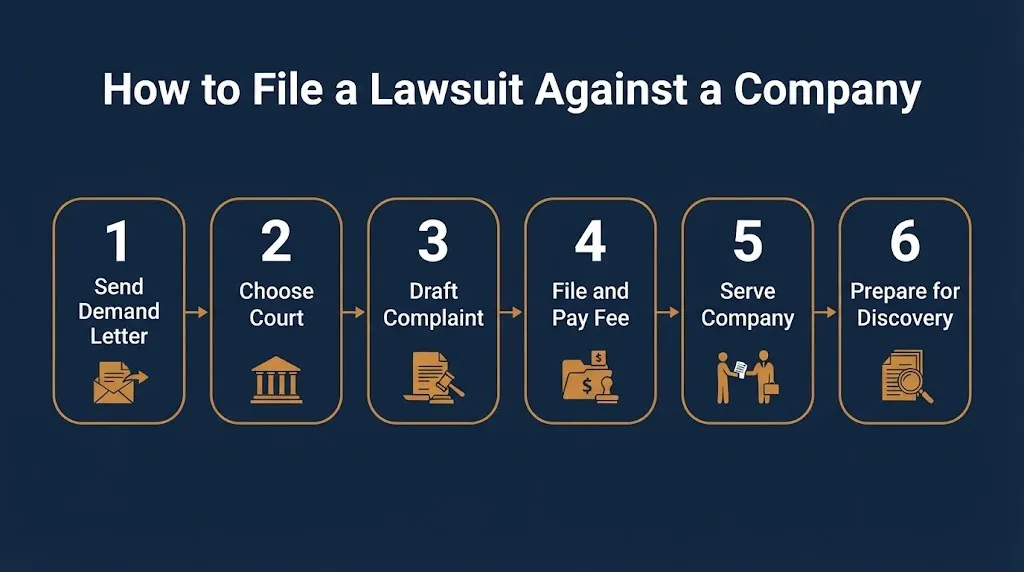
Here is the typical timeline for a lawsuit against a company:
- Before filing: Send a demand letter and attempt resolution.
- Filing: Draft and file the complaint, pay the filing fee.
- Service: Formally notify the company within the required time.
- Response: The company answers within 20 to 30 days.
- Discovery: Both sides exchange evidence over 6 to 12 months.
- Pretrial motions: Either side may seek summary judgment.
- Settlement or trial: Most cases settle; a minority reach trial.
- Appeal: Either side may appeal within 30 days of judgment.
Frequently Asked Questions
Can I sue a company for bad customer service?
No, bad customer service alone is not a legal claim.
You need actual damages, like money lost or a contract breach.
Being treated rudely does not create a lawsuit.
How much can I sue a company for in small claims?
The limit varies by state, typically $3,000 to $12,500.
Check your state’s small claims court website for the exact cap.
You can waive the excess and sue only up to the limit.
Do I need a lawyer to sue a company?
No, you can represent yourself, especially in small claims court.
Civil court is harder to navigate alone.
A lawyer is worth it if your damages are substantial.
What if the company ignores the lawsuit?
If the company ignores a properly served lawsuit, you may win a default judgment.
A default judgment means the court rules in your favor because the company did not respond.
Collecting the judgment is a separate challenge.
Can I sue a company for emotional distress?
Yes, in some cases, but emotional distress claims are difficult to prove.
You typically need to show severe distress with medical evidence.
Emotional distress is usually added to other claims, not filed alone.
How do I find a company’s registered agent?
Search the secretary of state website in the state where the company operates.
The registered agent’s name and address are public records.
This is who you serve with the lawsuit.
What if I cannot afford the filing fee?
You can ask the court for a fee waiver.
If you meet income guidelines, the court may waive filing and service costs.
Fee waiver forms are available from the court clerk.
Start with a Demand Letter and Know Your Deadline
The most practical first step is not filing a lawsuit. It is sending a demand letter and checking your statute of limitations. Those two actions tell you whether a lawsuit is necessary and whether you still have time to file one.
If the company responds and settles, you saved yourself the cost and stress of court. If they ignore you, you have a documented record that strengthens your case.
The single most important date to remember: your statute of limitations deadline. Miss it, and no lawyer, no evidence, and no amount of righteous anger can revive the case.