ZOA Energy Drink Lawsuit 2026: Settlement Status, Claim Details, and What Buyers Should Know
Quick Answer
- The ZOA Energy drink lawsuit is real and challenges certain marketing and labeling claims.
- No settlement has been approved, so no payout amount has been determined.
- There is no claim deadline because no claim process has opened yet.
The ZOA Energy drink lawsuit is a real consumer class action filed in federal court. It challenges specific claims about the drink’s ingredients, health benefits, or labeling. The case is moving through early litigation stages and has not reached a settlement.
You may be affected if you bought ZOA Energy drinks during a specific period. But no class has been certified yet. That means no one is officially a class member, and no claim form exists.
This article covers the verified status, the legal theories, the potential outcomes, and what to watch for. One surprising detail: celebrity backing does not shield a product from false advertising claims.
The Facts
| Item | Verified Details |
|---|---|
| Case | Proposed class action against ZOA Energy |
| Status | Active litigation, no settlement |
| Fund Size | Not applicable, no settlement |
| Est. Per Person | Not yet determined |
| Claim Deadline | None, no claim process open |
| Administrator | Not appointed |
| Proof Needed | Check future settlement site if one emerges |
Is the ZOA Energy drink lawsuit real?
Yes. The ZOA Energy drink lawsuit is a real legal filing, not a rumor or a scam. It was filed in a U.S. District Court by a plaintiff who claims the product’s marketing misled consumers.
The case is a proposed class action. That means one or a few named plaintiffs sue on behalf of a larger group. The court has not yet decided whether to certify that group as a class.
No settlement has been approved. No money has been set aside. No claim forms have been mailed.
If you saw a social media post claiming you can file a ZOA claim for cash, that post is misleading. The case is not at that stage.
What is the ZOA Energy drink lawsuit about?
The lawsuit is about marketing claims. The plaintiff alleges that ZOA Energy made statements about ingredients, health benefits, or product attributes that were not accurate or not supported.
The exact claims vary by the specific complaint filed. Common allegations in energy drink cases include misleading “clean energy” labels, overstated vitamin benefits, or ingredient sourcing claims that do not match the label.
ZOA is marketed as a healthier energy drink, with a focus on natural caffeine, vitamins, and no artificial ingredients. The lawsuit questions whether those marketing messages hold up under legal scrutiny.
ZOA has denied the allegations in court filings. The company maintains its marketing is accurate and its product is safe.
Who is behind the ZOA Energy drink brand?
ZOA Energy was co-founded by Dwayne “The Rock” Johnson, along with business partners. The brand launched in 2021 with heavy celebrity promotion and a focus on fitness and wellness.
The company positions ZOA as a cleaner alternative to traditional energy drinks. It emphasizes ingredients like green tea caffeine, B vitamins, and antioxidants.
Celebrity involvement gives the brand high visibility. That visibility also invites scrutiny. Consumer class actions often target brands with large marketing footprints and broad health-related claims.
The celebrity connection does not change the legal standard. A product marketed with specific claims must support those claims with evidence.
What are the specific legal claims in the ZOA lawsuit?
The specific legal claims are not fully detailed in public filings yet. But typical claims in this type of case include deceptive trade practices, false advertising, and unjust enrichment.
Deceptive trade practices claims rely on state consumer protection statutes. These laws prohibit misleading statements about a product’s nature, quality, or benefits.
False advertising claims can be brought under state law and sometimes under the federal Lanham Act, though the Lanham Act is more often used by competitors than consumers.
Unjust enrichment is a fallback claim. It argues that the company made money from customers who would not have bought the product if they knew the truth.
The precise claims will become clearer as the case moves past the motion to dismiss stage.
Will there be a ZOA Energy settlement?
A settlement is possible but not guaranteed. Most consumer class actions settle before trial, but many are dismissed before settlement talks begin.
The first major hurdle is the motion to dismiss. ZOA has likely filed a motion asking the court to throw out the case. If the court grants that motion, the case ends unless the plaintiff appeals.
If the case survives dismissal, discovery begins. Both sides exchange documents and take depositions. Only after discovery do serious settlement talks usually start.
Any proposed settlement would require court approval. The court must find the settlement fair, reasonable, and adequate before it takes effect.
Key Takeaway: The ZOA lawsuit is real but young. No settlement exists, and the case could still be dismissed before any payout is ever offered.
How much could I get from a ZOA Energy settlement?
No payout amount has been determined. Any figure you see online is speculation.
In comparable consumer product class actions, individual payouts are often small. Flat payments without receipts typically range from $5 to $50. Documented purchase claims may reach $50 to $150.
The table below shows how payouts might break down if a settlement is eventually approved. These are estimates based on similar cases, not confirmed numbers.
| Claim Tier | Typical Range | Documentation Required |
|---|---|---|
| Flat payment, no receipt | $5 to $25 | None beyond claim form |
| Documented purchases | $10 to $50 | Receipts or bank records |
| Multiple documented purchases | $50 to $150 | Receipts or bank records |
These figures are illustrative only. The ZOA case has no settlement, no fund, and no payment structure.
How do I check if I qualify for a ZOA lawsuit claim?
You cannot check yet. No class has been certified and no settlement exists. There is no official class member list.
You may eventually qualify if you purchased ZOA Energy drinks during a specific period, if a class is certified, and if a settlement is approved. But all of that is uncertain.
The best action now is to keep proof of purchase. Receipts, online order confirmations, and bank statements showing ZOA purchases could be useful if a settlement emerges.
Do not submit personal information to any website claiming to sign you up for a ZOA claim. Legitimate settlements do not ask for pre-registration before a claim period opens.
Reality Check: Scammers exploit active lawsuits by creating fake claim sites. A real settlement website will not ask for money, full Social Security numbers, or bank passwords. Filing is always free. If a site asks for payment to join a ZOA claim, it is fraud.
What is the current status of the ZOA lawsuit in 2026?
The case is in active litigation as of August 19, 2026. The court has not certified a class and has not approved a settlement.
The litigation is likely in the pleading stage or early discovery. That means the parties are arguing about whether the case should proceed at all.
The next major milestone is a ruling on the motion to dismiss. That ruling could come in late 2026 or early 2027, depending on the court’s schedule.
No trial date has been set. No final approval hearing is scheduled. No settlement administrator has been appointed.
What happens next in the ZOA lawsuit?
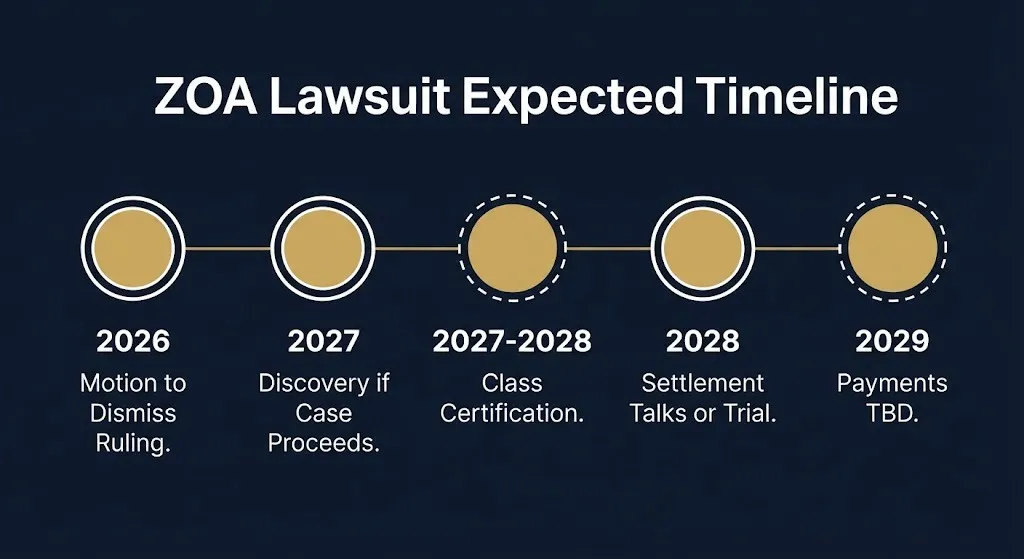
The case will follow the standard path for a consumer class action. Here is the expected sequence:
| Stage | Expected Timing |
|---|---|
| Motion to dismiss ruling | Late 2026 or early 2027 |
| Discovery, if case survives | 2027 |
| Class certification motion | 2027 or 2028 |
| Settlement talks or trial | 2028 or later |
| Payments, if settlement approved | 2029 or later |
These dates are estimates based on typical federal court timelines. The actual schedule depends on the judge and the parties.
This is a slow process. Class actions often take three to five years from filing to resolution.
What should I do if I bought ZOA Energy drinks?
Keep your proof of purchase. That is the single most useful action right now.
Save receipts from grocery stores, convenience stores, gyms, and online retailers. Check your Amazon, Walmart, or other online order histories for ZOA purchases.
Take screenshots of digital receipts and store them in a folder. If a settlement eventually emerges, you will have what you need to file a documented claim.
Do not contact the court or the judge. Courts do not accept class member inquiries during active litigation.
Key Takeaway: Your only job right now is to preserve receipts. There is no claim to file, no website to check, and no payment to expect in 2026.
What is ZOA Energy drink made of?
ZOA Energy drinks contain a blend of ingredients marketed as clean and health-focused. The exact formula varies by flavor.
The brand emphasizes natural caffeine from green tea and green coffee beans. It also includes B vitamins, vitamin C, and electrolytes.
The lawsuit questions whether some of these ingredient claims are accurate or adequately supported. That does not mean the product is unsafe. It means the marketing may not match the contents.
The Food and Drug Administration does not pre-approve energy drink formulations. Companies are responsible for ensuring their products and labels comply with federal regulations.
Has ZOA responded to the lawsuit?
ZOA has denied the allegations in court filings. The company’s legal position is that the lawsuit lacks merit.
A denial is standard. Defendants in civil cases almost always deny liability at the outset, even when a settlement later occurs.
ZOA has not issued a public statement that changes the legal posture. The case is being fought in court, not in press releases.
That is a signal worth noting. When a company believes a case is weak, it fights. When a company believes a case has merit, it often moves toward settlement quietly.
What is the legal standard for false advertising?
False advertising law requires a showing that the marketing statement was false or misleading and that it influenced a reasonable consumer’s purchase decision.
The statement does not have to be an outright lie. A literally true statement can still be misleading if it implies something false.
For example, a label saying “natural energy” might be misleading if the product contains synthetic caffeine. The issue is what a reasonable consumer understands the claim to mean.
State consumer protection laws vary, but most follow this general framework. Courts look at the overall impression of the marketing, not isolated words.
What are the odds the ZOA lawsuit settles?
Most consumer class actions that survive a motion to dismiss eventually settle. The odds of settlement rise significantly after discovery.
Discovery is expensive. Document production, depositions, and expert witnesses cost hundreds of thousands of dollars. Settlement avoids those costs.
But some cases are dismissed early. If the court finds the marketing claims are mere puffery or not actionable, the case ends.
Puffery is exaggerated sales language that no reasonable consumer would take literally. Statements like “the best energy drink” are puffery. Specific ingredient claims are not.
How do I report a misleading energy drink claim?
You can report misleading marketing to the Federal Trade Commission online. The FTC accepts consumer complaints about deceptive advertising.
You can also file a complaint with your state attorney general’s office. State consumer protection divisions investigate false advertising claims within their borders.
Neither action creates a private right to compensation. But complaints can trigger regulatory action, which sometimes leads to fines or required changes in marketing.
If a private class action is already pending, your individual complaint does not make you a party. Only the named plaintiffs and certified class members have legal standing in the case.
What is the ZOA class action status?
The class action status is “proposed.” The court has not certified the class. That means the plaintiffs are asking the court to recognize the case as a class action, but the court has not yet agreed.
Class certification is a major hurdle. The plaintiffs must show that the proposed class has common legal and factual issues, that the named plaintiffs are adequate representatives, and that the class is large enough.
If certification is denied, the named plaintiffs can still pursue their own individual claims, but the case loses its class-wide impact.
Certification decisions often come after discovery. Do not expect a ruling on certification until 2027 or 2028.
Frequently Asked Questions
Is the ZOA Energy drink lawsuit a scam?
No. The lawsuit is a real federal court filing.
But scam sites may try to exploit the case with fake claim forms.
Can I file a ZOA claim now?
No. The case has no settlement and no claim process.
Any site asking you to file a claim now is not legitimate.
How much will I get from the ZOA lawsuit?
No amount has been determined.
Comparable cases often pay $5 to $150, but that is speculation here.
Do I need a receipt to join a ZOA settlement?
You may not, if a settlement is eventually approved.
Most settlements include a no-proof tier, but the amount is smaller.
When will the ZOA lawsuit settle?
No settlement date exists.
If a settlement happens, it is likely years away, not months.
What if I bought ZOA from a gym or smoothie shop?
You may still qualify if a class is certified.
Keep any receipts or membership records showing the purchase.
Will Dwayne Johnson be part of the lawsuit?
The Rock may be named in marketing materials, but the lawsuit targets the company.
Celebrity founders are rarely personally liable for false advertising claims.
Where can I check for official ZOA lawsuit updates?
Check the federal court docket for the case.
Also watch major legal news outlets, not social media posts.
The ZOA Energy lawsuit is real but far from resolution. No settlement exists, no class is certified, and no money is waiting. Anyone who says otherwise is selling something other than facts.
Your job right now is simple. Hold onto your receipts. Watch the court docket. And do not give your information to any site that promises a ZOA payout before one exists.