Average Settlement for Unpaid Wages in 2026: Real Numbers, Real Ranges, and What You Can Expect
Quick Answer
- No universal average exists. DOL administrative recoveries average about $1,465 per worker; private lawsuits settle far higher.
- Individual unpaid wage lawsuits often settle near $40,000. Small violations can land between $6,000 and $50,000.
- Fiat Chrysler workers received about $100 each in a 2026 class settlement covering 68,000 employees.
You searched for the average settlement for unpaid wages because someone owes you money. Maybe overtime went missing. Maybe breaks were skipped. Maybe the last paycheck never arrived.
The honest answer is that the average depends entirely on which door you walk through. A Department of Labor complaint recovers modest amounts fast. A private lawsuit recovers more but takes longer. A class action spreads a large fund across thousands of workers, which can mean a small check per person.
This guide breaks down the verified 2026 numbers by route, explains what doubles or triples your recovery, and walks through the steps to file. The figures are real. The ranges are wide.
The Facts
| Route | Verified Average or Range |
|---|---|
| DOL Wage and Hour Division recovery | $1,465 per worker (FY2025) |
| DOL recovery, FY2024 comparison | $1,333 per worker |
| Individual private lawsuit | ~$40,000 average |
| Small-scale violations | $6,000 to $50,000 |
| Mid-range systematic violations | $50,000 to $300,000 |
| Fiat Chrysler class action (2026) | ~$100 per worker, 68,000 workers |
| Coway USA consent judgment (2026) | $800,000 for 339 workers, about $2,360 each |
Is there a real average settlement for unpaid wages?
No single average settlement for unpaid wages exists across all cases. The figure swings by orders of magnitude depending on whether you file individually, join a class, or accept a DOL resolution.
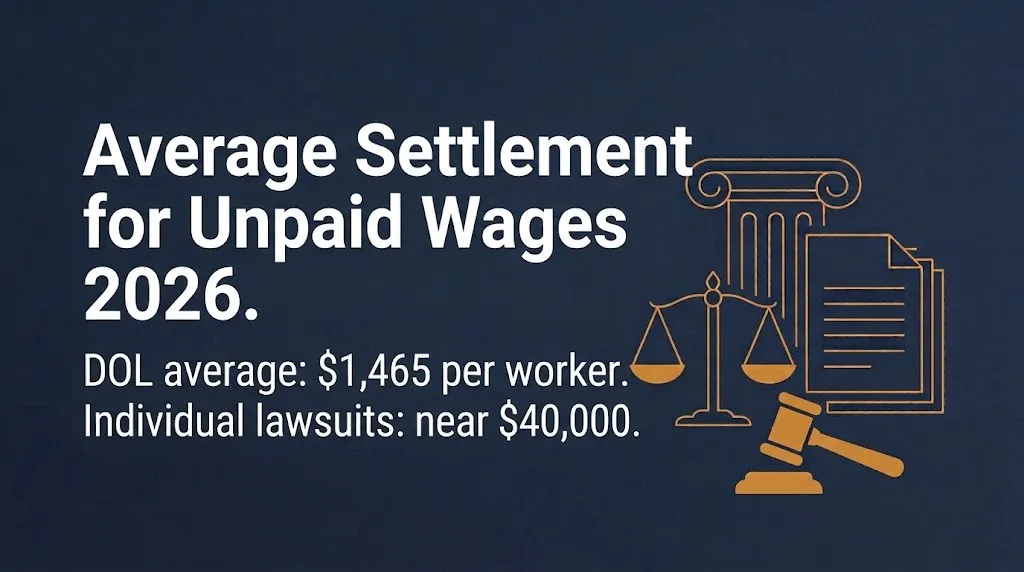
The DOL number is the most concrete. In fiscal year 2025, the Wage and Hour Division recovered $259 million for 176,957 workers, averaging about $1,465 each . The prior year averaged about $1,333 per worker .
That average reflects volume, not value. The DOL resolves many small claims quickly. It is not built for large individual recoveries.
Private litigation tells a different story. Individual unpaid wage lawsuits typically settle around $40,000, according to employment law data . That figure assumes documented wages, a clear violation, and an employer with the ability to pay.
How much can you get from an unpaid wage lawsuit?
Individual lawsuits can recover far more than a DOL complaint, but the range is wide. Small violations settle between $6,000 and $50,000. Systematic violations over longer periods land between $50,000 and $300,000 .
Here is how the verified ranges compare:
| Case Size | Typical Settlement Range |
|---|---|
| Minor underpayment, short period | $6,000 to $50,000 |
| Chronic overtime or misclassification | $50,000 to $300,000 |
| Multi-plaintiff or egregious conduct | $300,000 and up |
The base number is unpaid wages. The multiplier comes from liquidated damages.
Under the Fair Labor Standards Act, workers who win unpaid wage or overtime claims are generally entitled to liquidated damages equal to the back pay owed, effectively doubling the recovery . Some states go further. Massachusetts allows treble damages in certain cases, meaning three times the unpaid wages .
Key Takeaway: The “average” unpaid wage settlement is meaningless without context, because a $1,465 DOL recovery and a $40,000 individual lawsuit are both real outcomes under the same law.
What is the Reality Check on unpaid wage settlement averages?
Reality Check: No one texts you a settlement check. The DOL does not charge a filing fee, and a private wage lawsuit costs you nothing upfront if an attorney takes it on contingency. If a “claims processor” asks for payment to recover your unpaid wages, it is a scam. The real money comes from the employer, through the DOL or a court, not from your wallet.
What factors increase an unpaid wage settlement?
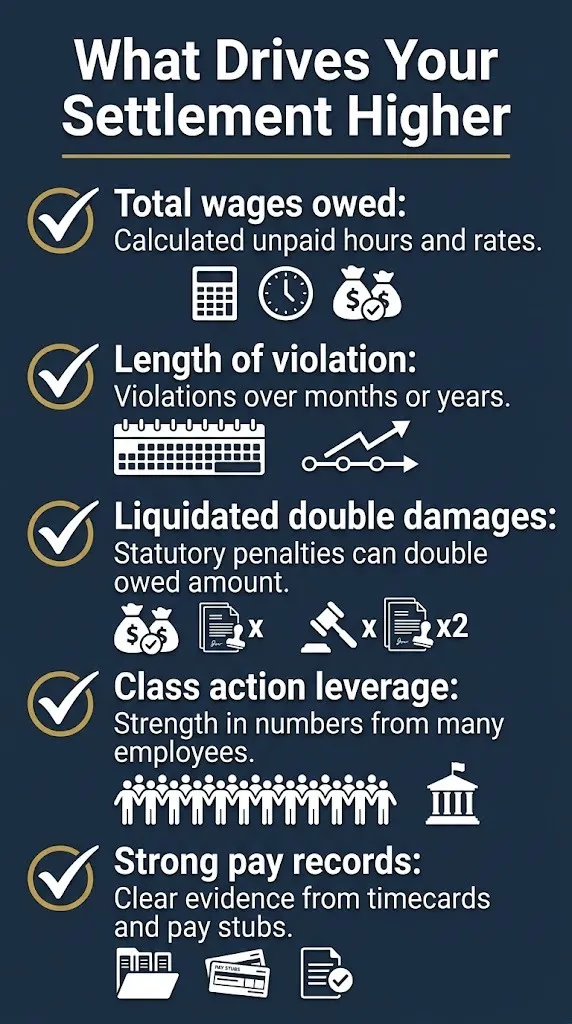
The factors that move a settlement number are documented, not mysterious. The size of the violation, the length of time, and the strength of your records do most of the work.
The verified drivers are:
- Total wages owed. The gap between what you were paid and what the law required is the foundation .
- Duration. Underpayment over three years is worth far more than underpayment over two months .
- Liquidated damages. The FLSA’s double-damages provision can double your recovery unless the employer proves good faith .
- Class or collective action. Pooling claims creates leverage, though per-person payouts shrink as the class grows .
- Employer size. Larger employers settle faster and higher because reputational risk is bigger .
- Evidence quality. Pay stubs, time records, schedules, and coworker testimony strengthen the claim .
How do you file an unpaid wage claim in 2026?
You have two main routes: an administrative complaint with the DOL or your state labor agency, or a private lawsuit. Each has trade-offs.
Here are the steps for the DOL route:
- Gather your records. Pay stubs, timecards, schedules, and any written communication about pay.
- Calculate what you are owed. Multiply unpaid hours by your regular rate, plus overtime at 1.5 times for hours over 40.
- Contact the Wage and Hour Division. Call 866-4US-WAGE or file online.
- Cooperate with the investigation. The DOL interviews you and your employer.
- Review the DOL’s findings. The agency may recover back wages on your behalf.
- Understand the trade-off. Accepting a DOL settlement generally ends your right to sue for the same claims .
For a private lawsuit, consult an employment attorney. Most work on contingency, meaning no upfront cost and a percentage of the recovery.
How do class action unpaid wage settlements pay out?
Class action settlements pay per person based on a formula, not a flat amount. The total fund is divided across all eligible workers, and individual checks can be small even when the total is large.
The Fiat Chrysler case shows the math. The company agreed to pay approximately $3.8 million to about 68,000 workers over unpaid overtime claims involving shift differentials and bonuses . That works out to roughly $100 per worker before fees and deductions .
Compare that to the Coway USA consent judgment from September 2026. The company paid $800,000 to 339 employees for unpaid overtime and damages, averaging about $2,360 per worker . Fewer workers, bigger checks.
The lesson: class size and fund size both matter. A huge class can dilute individual payouts. A smaller, well-documented class can pay more per person.
What happens next in an unpaid wage case?
The timeline depends on the route. DOL investigations can move faster than lawsuits, but private litigation often recovers more.
Weeks 1 to 4: You file a DOL complaint or consult an attorney. Evidence gathering begins.
Months 1 to 6: The DOL investigates or the attorney sends a demand letter. Many individual cases settle at this stage.
Months 6 to 18: If no settlement, a lawsuit is filed. Discovery follows, including payroll records and depositions.
Months 18 to 36: Class certification, mediation, or trial. FLSA settlements require court approval, which adds time .
After settlement approval: The administrator distributes payments, often within 60 to 90 days.
Frequently Asked Questions
What is the average settlement for unpaid wages?
There is no single average. DOL recoveries average about $1,465 per worker, individual lawsuits often settle near $40,000, and class action payouts can range from $100 to thousands per person.
How much can I sue for unpaid wages?
You can sue for the unpaid wages owed, plus liquidated damages equal to the same amount under the FLSA. Some states add penalties that can triple the recovery.
Is it worth suing for unpaid wages?
It depends on the amount owed. Small claims under a few thousand dollars may not justify litigation costs, though contingency attorneys can evaluate the case for free. Larger or documented violations are usually worth pursuing.
How long does an unpaid wage lawsuit take?
Individual cases can settle in months. Litigated cases often take 12 to 24 months, and class actions can take longer because court approval is required.
What is the statute of limitations for unpaid wages?
Under the FLSA, the limit is generally two years, or three years for willful violations. State laws vary, so check your state’s deadline.
Do I need a lawyer to file an unpaid wage claim?
No. You can file a DOL complaint without an attorney. A private lawsuit is more complex, and most workers use contingency attorneys.
Can I file a class action for unpaid wages?
Yes, if multiple workers were affected by the same policy or practice. A collective action under the FLSA requires other workers to opt in.
Closing
The number you recover depends on the door you choose. DOL complaints are fast and free but average about $1,465. Private lawsuits recover more but take longer.
If you are owed wages, gather your pay stubs and time records now. The FLSA clock is running, and the two-year limit comes faster than most workers expect.