Hostile Work Environment Lawsuit 2026: Grounds, Payouts, and How to File
Quick Answer:
- A hostile work environment lawsuit is real and legally recognized, but you must clear a “severe or pervasive” legal standard tied to a protected trait, not just a bad boss.
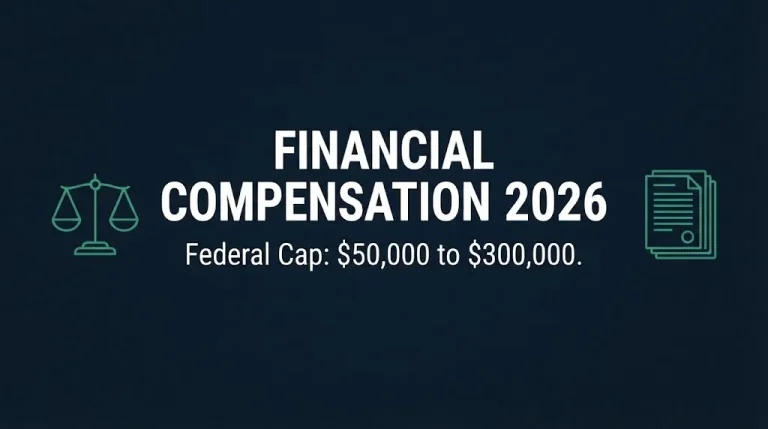
- Federal law caps combined compensatory and punitive damages at $50,000 to $300,000 based on employer size, though back pay, front pay, and state law claims are not capped.
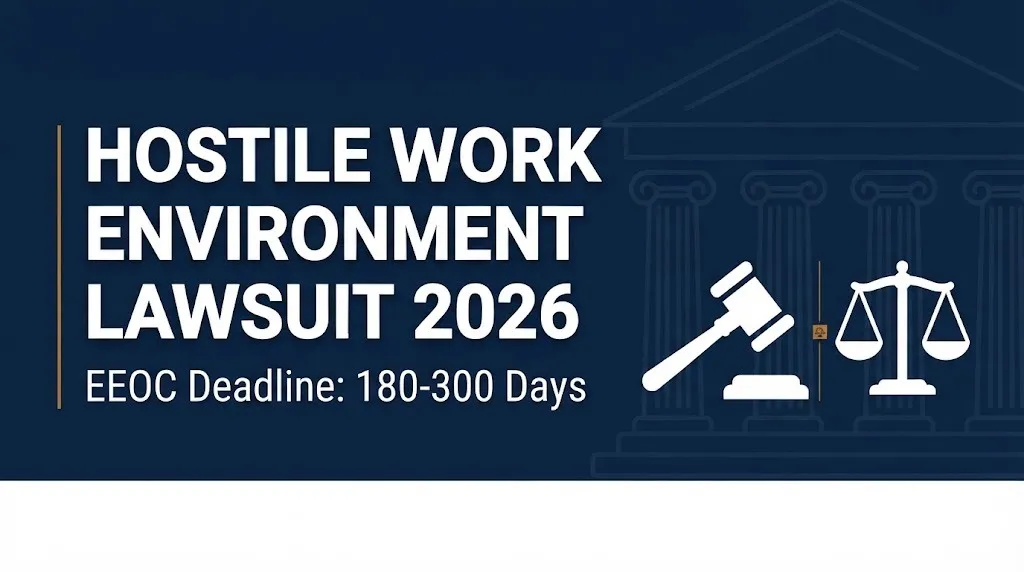
- You generally must file an EEOC charge within 180 days, or 300 days in most states, before you can sue at all.
Yes, a hostile work environment lawsuit is a real, filable legal claim, but only if the conduct is tied to a protected characteristic and is severe or pervasive enough to meet a specific legal test. A bad boss, unfair scheduling, or a manager who plays favorites usually does not qualify on its own. What does qualify: repeated harassment based on race, sex, religion, disability, age, or another protected class that a reasonable person would find abusive.
This affects millions of workers a year, and the single number that matters most right now is the 180 to 300 day window to file an EEOC charge before you lose your right to sue in federal court. Miss that window and the claim is usually gone, no matter how strong your evidence is.
This guide covers what counts as illegal harassment, what these lawsuits actually pay in 2026, and the exact steps to file, plus one detail most articles bury: federal damage caps have not moved since 1991, so state law often matters more than people think.
The Facts
| Case type | Individual EEOC charge and civil lawsuit, not a single class action or settlement fund |
| Status | Ongoing legal process, available nationwide under Title VII of the Civil Rights Act of 1964 |
| Typical settlement range | $75,000 to $300,000 for moderate cases; $500,000 to $1 million+ for severe cases with strong documentation |
| Federal damage cap | $50,000 to $300,000, based on employer size, for compensatory and punitive damages combined |
| EEOC filing deadline | 180 days, extended to 300 days in states with a matching fair employment agency |
| Right to sue window | 90 days from the date you receive your EEOC Right to Sue letter |
| Administrator | Not applicable, this is not a class settlement; each worker files their own EEOC charge |
| Proof needed | Documentation of incidents, dates, witnesses, HR reports, and any medical or financial impact |
Is a Hostile Work Environment Lawsuit Real and Can You Actually Win One?
A hostile work environment lawsuit is a real, recognized legal claim under federal and state law, and workers win them every year. In January 2026, a federal jury in the Northern District of Georgia awarded a former security guard $5.5 million after she reported a hostile work environment based on her sex and sexual orientation, followed by retaliation. A former security guard for a private security firm in Atlanta sued for hostile work environment claims in a case that ended in a $5.5 million verdict on January 16, 2026.
Winning requires more than proving your workplace felt unpleasant. Courts look at frequency, severity, and whether the conduct interfered with your ability to do your job.
Key Takeaway: A hostile work environment lawsuit is legally real and winnable, but only when the conduct is tied to a protected trait and is severe or pervasive, not just unpleasant management.
What Are the Grounds for a Harassment Lawsuit?
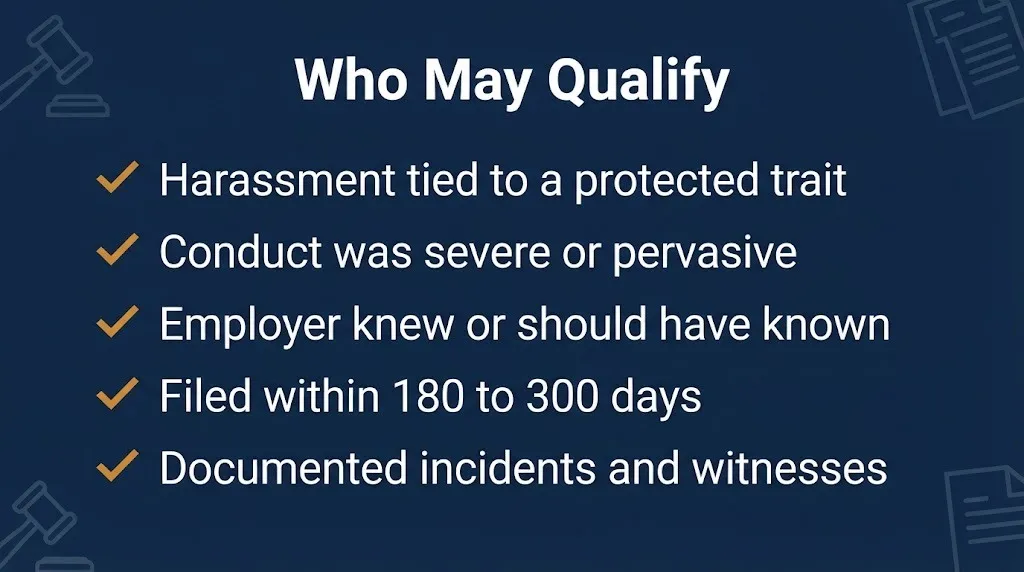
Grounds for a harassment lawsuit require two things: conduct tied to a protected characteristic, and conduct severe or pervasive enough to alter your working conditions. Protected characteristics include race, color, religion, sex, national origin, age, disability, and genetic information.
Conduct that commonly supports a claim includes:
- Slurs or repeated offensive jokes tied to a protected trait
- Unwanted touching, sexual propositions, or threats
- Retaliation after you report harassment internally
- A pattern of exclusion or hostility a reasonable person would find abusive
A single rude comment usually is not enough on its own. Courts want a pattern, or one incident severe enough to stand alone, like a physical threat or a slur.
What Are the Grounds for Suing Your Employer?
You can sue your employer if the harassment was severe or pervasive, tied to a protected class, and your employer knew or should have known and failed to act. Employer liability differs depending on who did the harassing.
If a supervisor harassed you and it led to a “tangible employment action” like firing or demotion, the employer is generally liable automatically. If a coworker harassed you, you typically need to show the employer knew and failed to fix it.
Is a Toxic Work Environment Lawsuit the Same as a Hostile Work Environment Lawsuit?
A toxic work environment lawsuit is not automatically the same as a hostile work environment lawsuit, and the distinction matters for whether you can sue at all. “Toxic” is a workplace culture description, not a legal standard.
A workplace can be genuinely toxic, with poor communication, favoritism, or high stress, without ever becoming illegal. It only becomes a hostile work environment claim once the toxicity is tied to a protected characteristic and meets the severe-or-pervasive bar.
Key Takeaway: “Toxic” describes a bad workplace, but “hostile work environment” is a specific legal claim tied to a protected characteristic and a severe-or-pervasive standard.
How Much Can You Get From a Hostile Work Environment Lawsuit?
Settlement amounts for hostile work environment lawsuits typically range from $75,000 to $300,000 for moderate cases, with severe cases reaching $500,000 to over $1 million. California average hostile work environment lawsuit settlements typically range from $75,000 to $300,000 for moderate cases, with severe cases involving sexual harassment, racial harassment, or wrongful termination reaching $500,000 to $1 million or more.
Value depends on the severity and length of the harassment, your documented evidence, lost wages, emotional distress, and whether retaliation is part of the claim. There is no fixed formula, and no reliable source will hand you a guaranteed number before reviewing your specific facts.
| Case Severity | Typical Settlement Range |
|---|---|
| Moderate (isolated incidents, weaker documentation) | $75,000 to $300,000 |
| Severe (long-term, well-documented, retaliation present) | $500,000 to $1,000,000+ |
| Jury verdict, egregious facts | Multiple millions (case-specific) |
Two 2026 verdicts show the range at the top end. Dr. Anissa Rogers was awarded $6 million in emotional distress damages in a gender discrimination, harassment, and retaliation lawsuit against California State University, reported May 12, 2026. Attorneys involved called it one of the largest employment discrimination judgments against that university system.
What Are the Federal Damage Caps and Why Do They Matter?
Federal law caps combined compensatory and punitive damages in Title VII harassment cases based on how many people your employer has, from $50,000 up to $300,000. Employers with 15 to 100 employees face a $50,000 cap, 101 to 200 employees face a $100,000 cap, 201 to 500 employees face a $200,000 cap, and employers with more than 500 employees face a $300,000 cap. That ceiling has not increased since Congress set it in 1991.
These caps do not touch everything you can recover. Back pay, front pay, and attorneys’ fees and costs fall outside these caps. A large verdict often includes uncapped back pay stacked on top of a capped emotional distress award, which is why total numbers can look inconsistent from case to case.
State law can matter more than federal law here. Some states, including California under FEHA, impose no cap at all on compensatory or punitive damages, so a strong state law claim filed alongside a federal one can preserve the full jury award. Section 1981a caps the combined sum of compensatory and punitive damages, but the cap does not touch back pay, front pay, prejudgment interest, or attorneys’ fees, and states like California with no statutory cap leave the full verdict intact on the state claim.
Reality Check: No government agency or settlement fund sends unsolicited texts or emails offering you harassment settlement money. Filing an EEOC charge is always free, and a legitimate employment attorney does not charge upfront fees to evaluate your case.
Can You Sue Your Boss Directly in an Abusive Boss Lawsuit?
You can generally sue an abusive boss only if the abuse is tied to a protected characteristic, not simply because they are difficult to work for. In most states, individual supervisors are not personally liable under Title VII, the employer is.
Some state laws, however, allow individual liability against a supervisor who personally engaged in harassment. If your boss’s abuse is not connected to a protected trait, your legal options usually run through other avenues, like wrongful termination or intentional infliction of emotional distress, not a harassment claim.
Key Takeaway: Federal damage caps top out at $300,000, but back pay, front pay, and uncapped state claims can push total recovery well beyond that number.
How Do You File a Workplace Harassment Lawsuit?
You cannot go straight to court in most cases. You must first file a charge with the EEOC or your state’s fair employment agency and receive a Right to Sue letter before filing in federal court. Before you can file a lawsuit for harassment under a hostile work environment theory, you need to file a discrimination charge with the Equal Employment Opportunities Commission, or a similar charge with your state agency.
Here is the general sequence:
- Report the harassment internally through HR, in writing, creating a paper trail.
- Save evidence: emails, messages, notes on incidents, and witness names.
- File an EEOC charge (or your state agency’s equivalent) within your deadline.
- Complete the EEOC intake questionnaire, which staff review to confirm coverage and deadlines before drafting a formal charge for your signature.
- Cooperate with the EEOC investigation, which can include mediation if both sides agree.
- Wait for a determination and, if the case is not resolved, your Right to Sue letter.
- File your lawsuit in federal or state court within 90 days of receiving that letter.
Filing with the EEOC is free and does not require a lawyer, though many workers hire one once the case moves toward litigation. Filing is simple, does not require a lawyer, and the EEOC will send a copy of your charge to your employer, who then provides a response.
What Is the EEOC Deadline to File a Harassment Claim?
You must file an EEOC charge within 180 days of the last incident, extended to 300 days if your state has its own fair employment agency covering the same conduct. A charge must be filed with the EEOC within 180 days from the date of the alleged violation, extended to 300 days if a state or local anti-discrimination law covers the location of the alleged harm and the basis for the charge.
Most states qualify for the longer window. States commonly cited with only 180 days include Alabama, Arkansas, Georgia, Louisiana, Mississippi, and North Carolina, though local rules can shift this.
Once you get your Right to Sue letter, the clock resets to a hard 90 days to actually file suit in court. The EEOC issues a Notice of Right to Sue, and you then have exactly 90 days to file a lawsuit in federal court. Miss that 90-day window and courts almost never grant an extension.
Think of it like a warranty claim with a strict return window. Waiting to “see if things get better” before filing does not pause the clock, and it is the most common reason strong cases get thrown out before a judge ever hears the facts.
What Proof Do You Need for a Toxic Work Environment Lawsuit?
You need documented evidence connecting the harassment to a protected trait, showing it was severe or pervasive, and showing your employer knew or should have known. Verbal accounts alone rarely carry a case.
Checklist of evidence that strengthens a claim:
- Dated written notes on every incident, including what was said and who was present
- Saved emails, texts, or messages containing harassing language or images
- Names and contact information for witnesses
- A copy of your internal HR complaint and any employer response
- Medical or counseling records connecting the harassment to health effects
- Pay stubs or records showing lost wages, demotion, or denied promotion tied to the harassment
The strength of this file often decides whether a case settles quickly or drags through a year of investigation.
How Long Does a Hostile Workplace Lawsuit Take?
A hostile workplace lawsuit typically takes several months to over a year just for the EEOC investigation, before any court case even begins. Investigations can take several months to over a year, and during this time your complaint is somewhat confidential, though your employer will know you filed.
If the case proceeds to litigation after a Right to Sue letter, add months to years more depending on whether it settles, goes through mediation, or reaches a jury trial. Complex cases with multiple claims, like the Georgia case that combined harassment, retaliation, and wrongful discharge, can take well over a year from filing to verdict.
What Is Happening With Hostile Work Environment Cases in 2026?
2026 has already produced multiple large jury awards and at least one appellate ruling reshaping how damage caps get applied. In late May 2026, the Eleventh Circuit ruled that an employer waived its right to a smaller-employer damage cap by failing to raise it early enough in the case. On May 28, 2026, the Eleventh Circuit issued an opinion in Khatabi v. Car Auto Holdings, LLC, holding that an employer waived its ability to request a damages cap under Title VII because it failed to plead the size damages cap as an affirmative defense.
That ruling matters beyond one case. The court reversed a district ruling that had applied the statutory cap to a sexual harassment claim, and confirmed that employers must plead the cap as an affirmative defense or risk losing it after a jury verdict.
Key Takeaway: Courts in 2026 are actively narrowing how employers can use damage caps as a defense, which can raise the practical value of a strong harassment claim.
What Is a Hostile Work Environment, Legally?
A hostile work environment is unlawful only when harassment tied to a protected characteristic is severe or pervasive enough to alter the conditions of employment. A hostile work environment isn’t just about a boss who yells or coworkers who gossip, it legally requires severe or pervasive harassment tied to a protected characteristic such as race, sex, religion, national origin, disability, age, or genetic information.
Courts weigh frequency, severity, whether it was physically threatening or humiliating, and whether it unreasonably interfered with your work performance. A single crude joke rarely qualifies. A pattern of slurs, threats, or unwanted touching usually does.
Who Can Be Held Liable in a Hostile Workplace Lawsuit?
Your employer is almost always the primary defendant, with liability rules shifting based on whether a supervisor or a coworker did the harassing. If your organization had a working anti-harassment policy that you failed to use, your employer may raise it as a defense to reduce their liability, known as the Ellerth-Faragher defense.
That defense generally does not apply in small, family-run businesses or when the harasser is the person responsible for enforcing the policy. This is why documenting your internal report matters just as much as documenting the harassment itself.
What Happens Next
Filed EEOC charge: Agency reviews intake, confirms deadlines, and drafts a formal charge for your signature.
During investigation (months to over a year): EEOC may offer mediation, gathers evidence, interviews witnesses.
Determination: EEOC issues either a finding of cause or no cause.
Right to Sue letter issued: You have a hard 90-day window to file suit in federal or state court.
Litigation or settlement: Case proceeds toward mediation, settlement negotiation, or trial, timeline varies by court and complexity.
Frequently Asked Questions
Is a hostile work environment lawsuit hard to win?
It can be, because you must prove the conduct was tied to a protected trait and was severe or pervasive, not simply unpleasant.
Strong documentation, witnesses, and a clear HR complaint history significantly improve the odds.
Can I sue for a hostile work environment without an EEOC charge?
No, in most cases you must file an EEOC charge and receive a Right to Sue letter before filing in federal court.
There are narrow exceptions, but they are rare and should not be relied on without legal advice.
How much does it cost to file an EEOC complaint?
Filing an EEOC charge is free.
You do not need a lawyer to file, though many workers hire one before or during litigation.
What is the average settlement for a hostile work environment lawsuit?
Moderate cases typically settle between $75,000 and $300,000, while severe, well-documented cases can reach $500,000 or more.
Jury verdicts in egregious cases have exceeded a million dollars in 2026 alone.
Can I get fired for filing a harassment complaint?
Firing someone in retaliation for filing a harassment complaint is illegal under federal law.
Retaliation claims are often filed alongside the original harassment charge and can significantly increase total damages.
What is the EEOC deadline to file a harassment charge?
The deadline is 180 days from the last incident, extended to 300 days in most states with a matching state agency.
Missing this window generally ends your ability to sue, regardless of how strong the underlying case is.
Does a hostile work environment claim cap how much I can recover?
Federal law caps compensatory and punitive damages between $50,000 and $300,000 based on employer size.
Back pay, front pay, and many state law claims are not subject to that cap.
Do I need a lawyer to file a hostile work environment lawsuit?
You do not need a lawyer to file the initial EEOC charge, but most workers hire one once the case heads toward litigation.
An attorney can help value the claim, gather evidence, and navigate strict filing deadlines.
If you believe you are living through a hostile work environment right now, your most urgent task is not deciding how much your case is worth. It is calendaring your EEOC deadline before it runs out.
Document every incident today, in writing, with dates. Then confirm your exact filing window, either 180 or 300 days, with the EEOC or your state fair employment agency before you do anything else.