Financial Compensation in Employment Lawsuits 2026: What You Can Actually Recover
Quick Answer
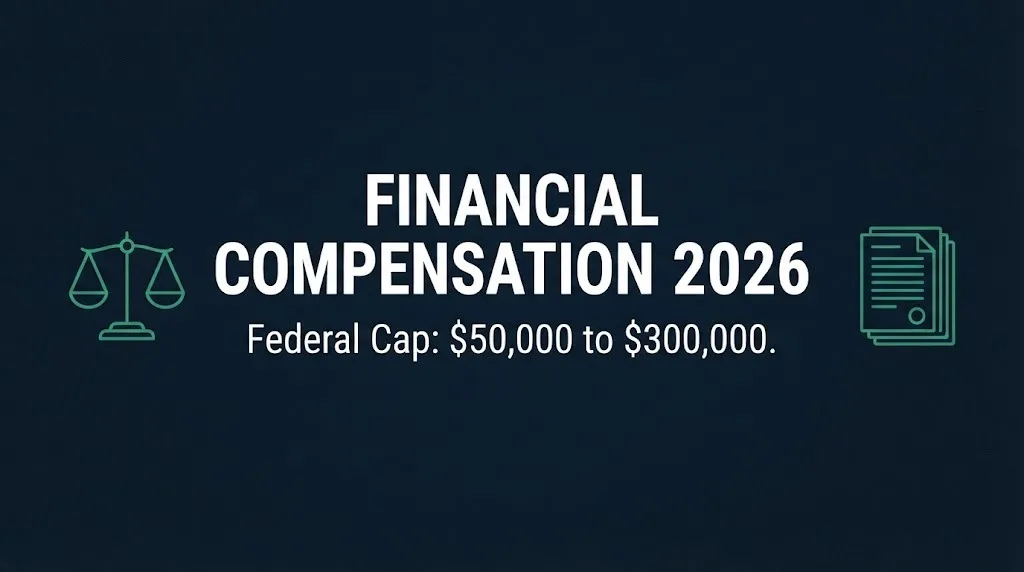
- Federal law caps combined compensatory and punitive damages in discrimination cases between $50,000 and $300,000, based on employer size.
- Back pay and front pay are not subject to that cap, so total financial compensation can run higher.
- There is no single deadline. EEOC charges generally must be filed within 180 or 300 days of the incident.
If you’re researching financial compensation after a workplace problem, here’s the direct answer: what you can recover depends heavily on which law applies, and federal caps haven’t moved since 1991.
That matters because two employees with nearly identical discrimination claims can walk away with very different totals, purely based on their employer’s size and which state’s laws apply. The single most important number to know is the federal cap range: $50,000 to $300,000 for combined compensatory and punitive damages.
This article breaks down what actually counts as financial compensation, what’s capped, what isn’t, and real 2026 examples showing how these numbers play out in practice. One detail that surprises a lot of people: back pay and front pay don’t count toward that federal cap at all.
The Facts
| Category | Detail |
|---|---|
| Topic | Financial compensation available in U.S. employment discrimination cases |
| Federal Damages Cap | $50,000 to $300,000 combined compensatory and punitive, based on employer size (Title VII, ADA, GINA) |
| Back Pay and Front Pay | Not subject to the federal cap, calculated separately under 42 U.S.C. § 1981a(b)(2) |
| State Law Caps | Vary by state. California’s FEHA, for example, imposes no cap on compensatory or punitive damages |
| 2026 EEOC Recovery Total | $660 million recovered for workers in fiscal year 2025, per EEOC performance data |
| Notable 2026 Example | Columbia University’s $21 million EEOC settlement, with its claims process closing June 2026 |
| Cap Reform Status | A proposal to eliminate federal caps remains pending in Congress, not yet law as of August 2026 |
What Counts as Financial Compensation in an Employment Lawsuit?
Financial compensation in an employment lawsuit generally means back pay, front pay, compensatory damages, and sometimes punitive damages. Each category is calculated differently, and not all of them are capped.
Back pay covers wages you would have earned had the discrimination or wrongful action not occurred. Front pay covers future lost earnings when reinstatement to your job isn’t practical.
Compensatory damages cover out-of-pocket costs like job search expenses, relocation, and medical bills tied to emotional distress. Punitive damages, when available, are meant to punish intentional or reckless misconduct rather than simply compensate you.
Key Takeaway: Financial compensation isn’t one number, it’s several separate categories that get calculated and capped differently under the law.
Is There a Cap on the Financial Compensation You Can Recover Under Federal Law?
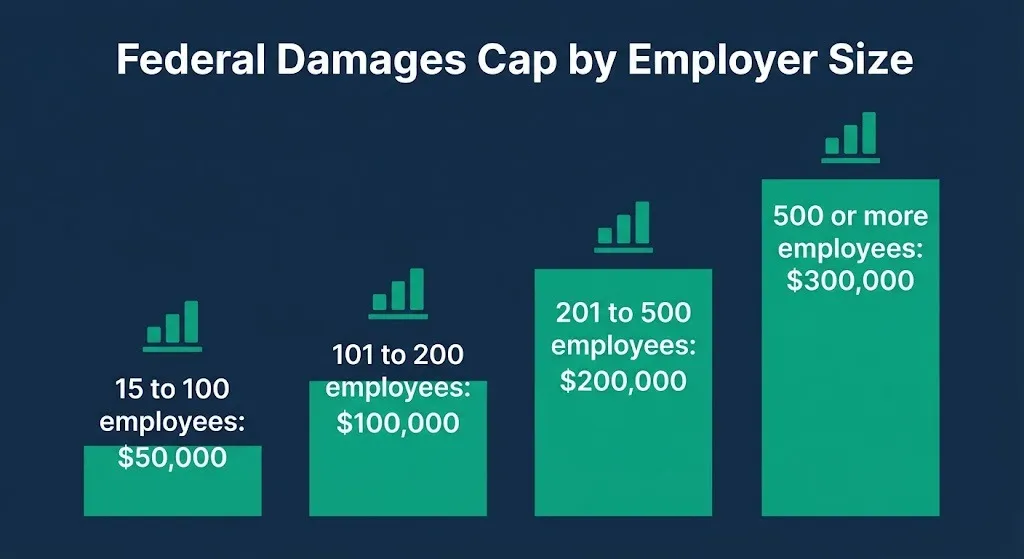
Yes, but only on certain categories. Title VII, the Americans with Disabilities Act, and the Genetic Information Nondiscrimination Act cap combined compensatory and punitive damages, based on employer size.
| Employer Size | Combined Cap |
|---|---|
| 15 to 100 employees | $50,000 |
| 101 to 200 employees | $100,000 |
| 201 to 500 employees | $200,000 |
| 500 or more employees | $300,000 |
These caps were set by the Civil Rights Act of 1991 and have not increased since. They apply per complaining party, not per individual claim, so filing multiple legal theories doesn’t multiply your capped recovery.
Not yet determined: whether Congress will raise or eliminate these caps, since reform proposals remain pending as of August 2026.
How Much Financial Compensation Have Workers Actually Recovered in 2026?
Workers recovered a combined $660 million through EEOC enforcement in fiscal year 2025, according to the agency’s own performance data. That figure spans settlements, conciliations, and litigation across all discrimination categories the EEOC handles.
The EEOC resolved 90,743 charges that same fiscal year, a 4% increase over the prior year, while also reducing its private-sector charge backlog. Some individual settlements have run into eight figures.
Notable recent examples include:
- Columbia University: $21 million EEOC settlement, with its claims process closing in June 2026
- A $15 million public conciliation in March 2026, tied to COVID-19 vaccine religious accommodation claims
- HCL America: approximately $500,000 EEOC settlement obtained in April 2026
- Planned Parenthood: $500,000 public conciliation settled in March 2026
Reality Check: No legitimate settlement fund contacts you out of the blue asking for payment to release your share, and no one can guarantee a specific compensation amount before your case is actually evaluated.
What Is the Difference Between Back Pay and Front Pay?
Back pay covers wages lost between the date of the discriminatory action and the date of judgment or resolution. Front pay covers future lost wages when returning to your old job isn’t a realistic option.
Courts generally calculate back pay using the shorter of two periods: the time between the discriminatory act and judgment, or two years before you filed your charge, depending on the applicable law.
Front pay becomes relevant when reinstatement would be impractical, such as when the working relationship has broken down entirely. The U.S. Supreme Court has held that front pay, like back pay, falls outside the federal damages cap, following its ruling in Pollard v. E.I. du Pont de Nemours & Co.
What Is the Difference Between Compensatory and Punitive Damages?
Compensatory damages reimburse you for actual losses like emotional distress, medical costs, and job search expenses. Punitive damages, by contrast, exist to punish an employer’s malicious or recklessly indifferent conduct, not to reimburse you directly.
Both categories fall under the same combined federal cap described earlier. A jury can award any mix of the two, but the court applies the applicable cap to their combined total, not each separately.
A real 2026 case shows how this plays out. In Khatabi v. Car Auto Holdings, decided by the Eleventh Circuit on May 28, 2026, a jury initially awarded an employee $81,028 in compensatory damages and $750,000 in punitive damages for sex discrimination and harassment claims.
Key Takeaway: Punitive damages require proving malice or reckless indifference, not just proving discrimination occurred, and both categories share the same capped pool of money.
Does California Cap Financial Compensation Differently Than Federal Law?
Yes, California’s Fair Employment and Housing Act, known as FEHA, imposes no statutory cap on compensatory or punitive damages. This makes California one of the more favorable jurisdictions for total recovery amounts.
Workers with strong discrimination or harassment claims in California often plead both Title VII and FEHA together. Federal courts hearing both claims typically apply the federal cap only to the Title VII portion, leaving the FEHA verdict intact.
That structural difference can produce dramatically different outcomes for otherwise similar cases, depending purely on which state law applies alongside the federal claim.
| Law | Damages Cap |
|---|---|
| Title VII, ADA, GINA (federal) | $50,000 to $300,000, based on employer size |
| California FEHA (state) | No statutory cap |
| Section 1981 (race discrimination, federal) | No statutory cap |
How Do You Pursue Financial Compensation for Workplace Discrimination?
You generally start by filing a charge with the EEOC or your state’s equivalent civil rights agency before you can sue in most discrimination cases. Skipping this step can bar your later lawsuit entirely.
- Document the incident in writing as soon as possible, including dates and witnesses.
- Report the issue internally through your employer’s HR process, if one exists.
- File a charge with the EEOC or your state fair employment agency.
- Wait for the agency to investigate or issue a right-to-sue letter.
- Consult an employment attorney about which state and federal claims may apply.
- Gather documentation supporting lost wages, medical costs, and other losses.
- Decide whether to pursue litigation or accept a settlement offer, with legal guidance.
Each of these steps carries its own timing rules, so missing a filing window early on can limit your options later.
How Do You File a Charge With the EEOC?
You file an EEOC charge by submitting it within 180 days of the discriminatory act, or 300 days if a state or local agency also enforces a similar law. Missing that window generally forfeits your right to sue under federal discrimination law.
The EEOC will investigate, attempt conciliation in some cases, and eventually issue a right-to-sue letter if the matter isn’t resolved administratively. You generally have 90 days after receiving that letter to file a federal lawsuit.
Think of this timeline like a warranty claim window. Miss the deadline, and it doesn’t matter how strong your underlying claim is.
What Proof Do You Need to Support a Financial Compensation Claim?
You need documentation connecting the harm you experienced to specific financial losses, not just proof that discrimination occurred. Courts and settlement negotiators both weigh this evidence heavily.
Useful supporting proof typically includes:
- Pay stubs or tax documents showing your income before and after the incident
- Termination letters, performance reviews, or internal complaints
- Medical or counseling records tied to emotional distress claims
- Job search records showing mitigation efforts, such as applications and interviews
- Witness statements corroborating the discriminatory conduct
Key Takeaway: Strong documentation of both the misconduct and its financial impact on you often matters more to your final compensation than the severity of the incident alone.
What Is the Current 2026 Status of Efforts to Raise the Federal Damages Caps?
The federal damages caps remain unchanged as of August 2026, despite ongoing legislative pressure to raise or eliminate them. The Equal Remedies Act, introduced by Representative Suzanne Bonamici, proposes removing the caps entirely, but it has not passed.
EEOC officials have publicly criticized the current cap levels. Agency leadership has noted the caps were set in 1991 and never adjusted for inflation, meaning today’s dollar value of $300,000 buys far less than it did when Congress set that figure.
Until any reform passes, the existing tiered cap structure controls how much combined compensatory and punitive damages a plaintiff can recover under Title VII, the ADA, and GINA.
What Are Recent 2026 Examples of Employment Financial Compensation Settlements?
Several sizable settlements moved through EEOC enforcement and federal courts during 2026, offering real benchmarks for how these cases resolve. These range from religious accommodation disputes to promotion-related discrimination claims.
| Case or Matter | Verified Detail |
|---|---|
| Columbia University | $21 million EEOC settlement fund, claims process closed June 2026 |
| COVID vaccine religious accommodation conciliation | $15 million settlement announced March 2026 |
| HCL America | Approximately $500,000 EEOC settlement, April 2026 |
| Khatabi v. Car Auto Holdings | Eleventh Circuit ruling May 28, 2026, addressing a $831,028 jury verdict later reduced under damages caps |
| The New York Times | EEOC lawsuit filed May 2026, alleging DEI-related discrimination, not yet resolved |
What Is a Consent Decree in an Employment Discrimination Settlement?
A consent decree is a court-approved agreement resolving a discrimination lawsuit, typically including monetary compensation and required policy changes. It carries the force of a court order, not just a private settlement contract.
These decrees often run for multiple years and include ongoing compliance monitoring. A past example illustrates the structure well: a four-year consent decree in an EEOC case against Jackson National Life Insurance Company included both direct payments to affected employees and mandated policy reforms.
Consent decrees differ from simple settlements because a judge retains authority to enforce compliance throughout the decree’s term, not just at the moment of signing.
Are Attorneys’ Fees Included in Financial Compensation Settlements?
Often yes, but they’re typically calculated and paid separately from your personal compensation, not deducted from a shared pool automatically. Many employment statutes allow prevailing employees to recover attorney fees from the employer.
This differs from typical personal injury contingency arrangements, where fees come directly out of your settlement share. In many employment cases, a court can order the employer to pay reasonable attorney fees on top of the compensation awarded to you.
Always confirm your specific fee arrangement with your attorney in writing, since practices vary by case type and firm.
What Is the Statute of Limitations for Pursuing Financial Compensation at Work?
The statute of limitations depends on which law applies, but EEOC charges generally must be filed within 180 or 300 days of the incident. Missing this window is one of the most common reasons valid claims never proceed.
State law claims, such as those under California’s FEHA, can carry different filing deadlines than federal EEOC charges. Wage and hour claims under the Fair Labor Standards Act also follow separate timing rules from discrimination claims.
Because these deadlines vary so much by claim type and state, confirming your specific filing window early protects your ability to pursue compensation later.
What Happens Next in Employment Compensation Law
- 1991: Congress sets the current federal damages cap structure, unchanged since.
- May 28, 2026: Eleventh Circuit rules on damages cap waiver in Khatabi v. Car Auto Holdings.
- June 2026: Columbia University’s $21 million EEOC settlement claims process closes.
- 2026, ongoing: Legislative proposals to eliminate federal caps remain pending in Congress.
- Expected: Continued EEOC enforcement activity, with fiscal year 2026 recovery totals to be published after the fiscal year closes.
Frequently Asked Questions
What is the maximum financial compensation you can get for workplace discrimination?
Under federal law, combined compensatory and punitive damages max out at $300,000 for employers with 500 or more employees.
Back pay and front pay are calculated separately and aren’t subject to that cap.
Does financial compensation include lost wages?
Yes, lost wages are covered through back pay and front pay, both calculated outside the federal damages cap.
These often make up the largest portion of a total compensation award.
Is there a cap on financial compensation in California?
No, California’s FEHA imposes no statutory cap on compensatory or punitive damages.
Federal claims filed alongside FEHA claims still face the federal cap, but the state claim itself does not.
How long do you have to file for financial compensation after workplace discrimination?
You generally must file an EEOC charge within 180 days, or 300 days if a state agency also covers your claim.
Missing this window typically forfeits your right to sue under federal discrimination law.
Do you need a lawyer to pursue financial compensation for a workplace issue?
You aren’t required to have one, but an employment attorney can help identify which state and federal claims apply.
Many employment attorneys offer free initial consultations before you commit to representation.
What is the difference between a settlement and a consent decree?
A settlement is a private agreement, while a consent decree is a court-approved order carrying ongoing judicial enforcement.
Consent decrees often include compliance monitoring over several years, not just a one-time payment.
Are punitive damages guaranteed in a discrimination case?
No, punitive damages require proving the employer acted with malice or reckless indifference, not just that discrimination occurred.
Many discrimination cases resolve with compensatory damages and back pay alone, without any punitive award.
Will the federal damages cap increase in 2026?
Not yet. Proposed legislation to eliminate the caps remains pending in Congress as of August 2026.
The existing 1991 cap structure still applies to Title VII, ADA, and GINA claims.
The number worth remembering here is the federal cap range, $50,000 to $300,000, which still governs combined compensatory and punitive damages in 2026. Back pay and front pay sit outside that cap entirely.
If you’re weighing a claim, start by confirming your filing deadline and documenting your financial losses now, before any window closes.