Total Quality Logistics Lawsuit 2026: TQL Class Action Status, Wage Claims, and Employee Rights
Quick Answer:
- The Total Quality Logistics lawsuit is a real employment class action over unpaid wages and misclassification claims.
- No settlement fund or per-person payout has been approved as of March 2026.
- The most important deadline for workers is the statute of limitations on wage claims, which varies by state.
If you worked for Total Quality Logistics, known as TQL, and saw a headline about a lawsuit, the answer is yes. The company faces multiple pending employment lawsuits in federal courts.
The cases center on one core accusation: that TQL misclassified workers as exempt from overtime and failed to pay wages required by law. Former employees say they worked long hours without proper compensation.
This article explains what the lawsuits claim, who may qualify, how much money could be at stake, and what current and former TQL workers should do now. One verified fact: TQL employs thousands of logistics brokers across the United States, and the proposed classes could include a significant portion of its sales workforce.
The Facts
| Case | Multiple employment class actions against Total Quality Logistics |
|---|---|
| Status | Active litigation, no settlement approved |
| Fund Size | Not yet confirmed |
| Est. Per Person | Not yet determined |
| Claim Deadline | TBD, no claim form available yet |
| Administrator | Not yet appointed |
| Proof Needed | Expected: employment records, pay stubs, time records |
Is the Total Quality Logistics lawsuit real?
The Total Quality Logistics lawsuit is real. Multiple federal cases are pending against TQL over wage and hour practices, and the litigation is active.
TQL is one of the largest freight brokerage firms in the United States. It hires thousands of logistics sales representatives who arrange freight shipments between shippers and carriers. The company has grown rapidly, and its employment practices have drawn legal scrutiny.
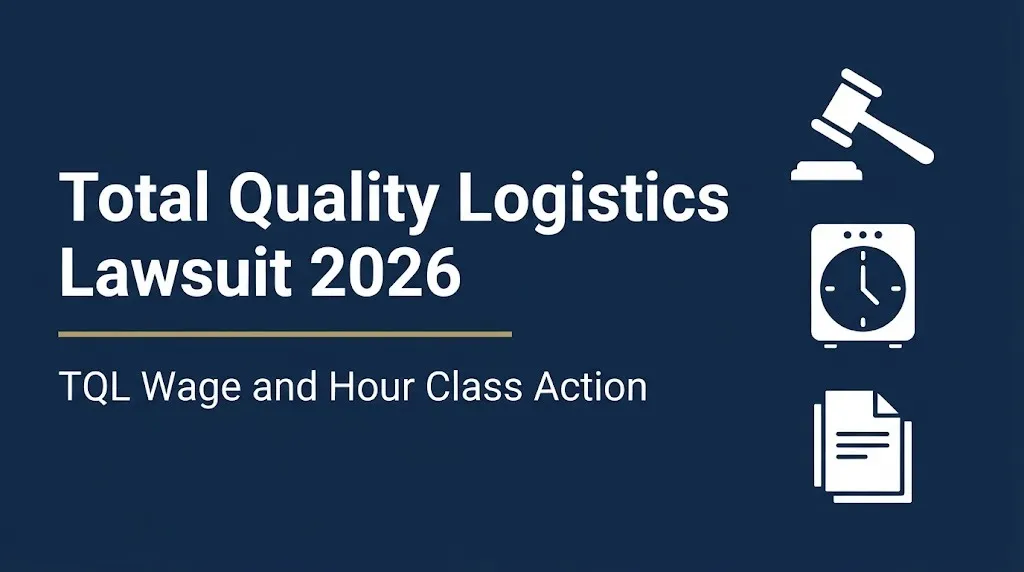
The lawsuits allege that TQL misclassified employees as exempt from overtime under the Fair Labor Standards Act. The plaintiffs say they were paid a salary but worked sixty or more hours per week without overtime pay.
The Fair Labor Standards Act requires overtime pay at one and a half times the regular rate for hours worked beyond forty in a workweek. Exemptions exist for certain administrative, executive, and professional roles. The question in the TQL cases is whether logistics sales representatives fit those exemptions.
TQL has denied the allegations. The company argues its employees are properly classified and that the lawsuits misstate the nature of the work. The courts will decide.
No settlement has been reached. No class has been formally certified in the main case as of March 2026.
Key Takeaway: The TQL lawsuit is real, active litigation over overtime misclassification, but no settlement or class certification has occurred yet.
Who is affected by the TQL lawsuit?
Current and former TQL employees who worked as logistics sales representatives, account executives, or similar roles may be affected by the lawsuit. The exact class definition remains pending court approval.
The proposed class covers employees who were paid a salary and classified as exempt from overtime. The plaintiffs argue this classification was wrong for many sales floor employees.
Based on court filings, the affected group includes:
| Role | Potential Overtime Eligibility |
|---|---|
| Logistics sales representative | Core proposed class |
| Account executive | Core proposed class |
| Sales trainee | May be included if paid salary |
| Brokerage coordinator | Disputed classification |
| Customer service representative | May be included |
The class period matters. Wage claims under federal law generally go back two years from the filing date, or three years if the violation was willful. State law claims may extend further.
If you worked for TQL in the past three years, you may fall within the proposed class period. If you left earlier, your claims may be time barred unless a state law extends the window.
The court will define the final class if it grants certification. That decision is expected in the coming months and will determine who receives notice of any eventual settlement.
Key Takeaway: TQL logistics sales employees paid on salary may fall within the proposed class, but the final class definition awaits court certification.
How much could TQL workers get from the lawsuit?
TQL workers could recover unpaid overtime, liquidated damages, and attorney fees if the class prevails. No settlement amount has been set, and per-person payments depend on individual work records.
Overtime claims under the Fair Labor Standards Act allow recovery of unpaid wages plus an equal amount in liquidated damages. That means a worker owed ten thousand dollars in overtime could recover twenty thousand dollars.
Here is how potential recovery might break down:
| Category | Potential Recovery |
|---|---|
| Unpaid overtime hours | Full amount of unpaid overtime |
| Liquidated damages | Equal to unpaid overtime under federal law |
| State law penalties | Varies by state, may exceed federal damages |
| Attorney fees | Paid by employer if plaintiffs win |
| Interest | May accrue on unpaid wages |
These figures are illustrative. Actual recovery depends on hours worked, salary paid, and the court’s findings.
The damage calculation requires detailed time records. TQL, like most employers, maintains records of employee work hours. Those records will be central to the case. If the records understate hours, plaintiffs may present their own evidence.
Class action wage claims sometimes settle for millions of dollars. The per-person payout depends on how many class members file claims and how many hours each person worked. A worker with three years of unpaid overtime could recover significantly more than a worker with six months.
Reality Check: No one can guarantee a specific TQL settlement amount. Be wary of any service offering to calculate your potential recovery for a fee. The calculation depends on records that only the court process can obtain.
What is the TQL lawsuit about?
The TQL lawsuit is about whether the company properly classified its logistics sales employees as exempt from overtime pay. The plaintiffs say the classification was wrong.
Under the Fair Labor Standards Act, employees are entitled to overtime unless they fall into a specific exemption. The most common exemptions are for executive, administrative, and professional employees. The classification depends on job duties, not job titles.
The plaintiffs argue that TQL logistics sales representatives do not perform exempt duties. They say the work is primarily sales and customer service, done under close supervision, with little independent discretion.
TQL argues the opposite. The company says its sales representatives exercise independent judgment, manage their own books of business, and qualify for the administrative exemption.
The distinction matters because logistics sales representatives often work long hours. Freight brokerage is a fast paced business, and TQL has a reputation for demanding schedules. If the workers are non exempt, those hours trigger substantial overtime liability.
Several similar lawsuits have been filed against other freight brokerages. The outcomes in those cases vary. Some settled. Some went to trial. The TQL cases will turn on the specific job duties and the evidence presented.
Key Takeaway: The core issue is overtime exemption, and the outcome depends on whether TQL sales employees performed duties that qualify as exempt under federal law.
Is there a TQL class action settlement?
There is no TQL class action settlement as of March 2026. The litigation remains in the pretrial phase, and no settlement fund has been created.
Some cases against TQL have resolved individually. Those individual settlements are confidential and do not affect the pending class claims. The class action path is separate and ongoing.
Wage and hour class actions often settle after a significant procedural event. The most important event is class certification. If the court certifies the class, the employer faces exposure across thousands of employees. That pressure often drives settlement negotiations.
If the court denies certification, the case weakens. Individual workers would then have to file their own claims, which is less efficient and less threatening to the employer.
No settlement can be approved without court review. The Fair Labor Standards Act requires judicial approval of any settlement of overtime claims. That approval process includes notice to affected workers and an opportunity to object.
Until a settlement is filed with the court, any claim that one exists is false. Watch the court docket for the actual status.
Key Takeaway: No TQL class action settlement exists as of March 2026, and any claim of one is unverified.
How do I know if I qualify for the TQL lawsuit?
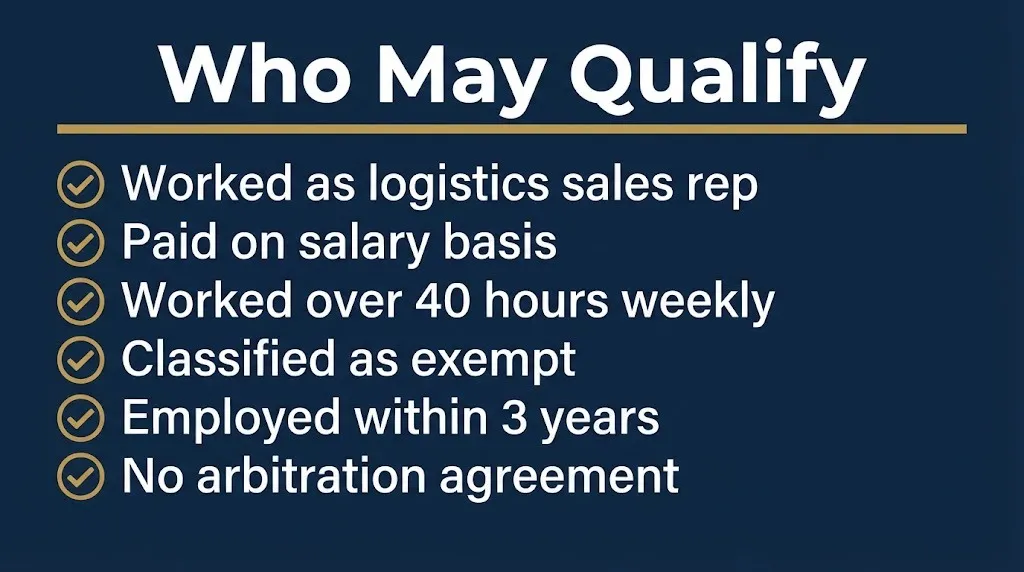
You may qualify for the TQL lawsuit if you worked as a logistics sales representative or similar role, were paid on salary, and worked more than forty hours per week without overtime pay.
Here are the factors that determine potential eligibility:
- Your job title and actual job duties at TQL.
- Whether you were classified as exempt from overtime.
- The state where you worked, since state wage laws vary.
- Your dates of employment and whether they fall within the statute of limitations.
- Whether you worked more than forty hours in any workweek.
- Whether you signed any arbitration agreement with TQL.
Arbitration agreements are a significant issue. TQL, like many employers, may require employees to sign arbitration clauses. Those clauses can prevent workers from joining a class action. The enforceability of TQL’s arbitration clause is itself being litigated.
If you signed an arbitration agreement, you may still have individual claims even if the class action does not include you. But individual arbitration is more expensive and less efficient than a class action.
The only way to know your specific situation is to review your employment documents and consult with an employment lawyer. Many wage and hour lawyers offer free consultations.
Key Takeaway: Eligibility depends on your job duties, classification, location, dates of employment, and whether you signed an arbitration agreement.
What should current TQL employees do about the lawsuit?
Current TQL employees should document their hours, save pay records, and understand their rights without taking any action that could jeopardize their employment.
Here are practical steps:
- Keep a personal log of your actual work hours, including start and end times.
- Save all pay stubs, W-2 forms, and employment contracts.
- Review your job description and compare it to your actual duties.
- Note any weeks where you worked more than forty hours.
- Check whether you signed an arbitration agreement.
- Avoid discussing the lawsuit on company communication systems.
- Consult an employment lawyer if you believe you are owed overtime.
Documentation is critical in wage and hour cases. Employers often have the records, but your personal log can corroborate or contradict those records. A simple notebook or spreadsheet tracking your daily hours is enough.
Do not rely on memory alone. Three years of weekly hours is impossible to reconstruct from recollection. A contemporaneous log is far more persuasive.
Current employees are protected from retaliation for asserting their rights under the Fair Labor Standards Act. That protection does not mean TQL cannot discipline or terminate for other reasons. Keep your own performance record clean.
Key Takeaway: Document hours, save records, and consult a lawyer privately if you believe you are owed overtime.
What is the current status of the TQL lawsuit in 2026?
The TQL lawsuit is in discovery and pre-certification motion practice as of March 2026. No class certification decision has been issued, and no settlement is pending.
The court has not yet decided whether the case can proceed as a class action. Both sides are arguing over the scope of discovery, the class definition, and the enforceability of arbitration agreements.
The arbitration issue is often decisive in wage and hour cases. If the court enforces TQL’s arbitration clause, the class action could shrink dramatically. Only workers who did not sign arbitration agreements, or whose agreements are found invalid, would remain in the class.
TQL has also filed summary judgment motions on the exemption question. The court could rule that the exemption applies, ending the case. Or it could rule that the exemption does not apply, strengthening the plaintiffs’ position.
The procedural posture means the case is at a critical juncture. The next major rulings will shape everything that follows.
For workers, the practical implication is patience. The case will not resolve quickly. Wage and hour litigation often takes three to five years from filing to resolution.
Key Takeaway: The TQL case is at a critical procedural stage, with class certification and arbitration rulings expected to shape the outcome.
What is the TQL overtime pay lawsuit timeline?
The TQL overtime pay lawsuit timeline began with the first filings and continues through 2026 with no end date confirmed. Here is the likely path forward.
- Prior years: Initial lawsuits filed against TQL in multiple federal districts.
- Ongoing 2026: Discovery continues, including document production and depositions.
- Expected 2026: Court rulings on class certification and arbitration enforceability.
- Possible 2027: If certified, settlement negotiations intensify or trial scheduling begins.
- Possible 2028: Trial or settlement approval, followed by any appeals.
These dates are estimates based on typical wage and hour class action pacing. None are confirmed.
The timeline depends heavily on the arbitration ruling. If arbitration is enforced, the class action may end and workers would need to pursue individual claims. That process is slower and less efficient for workers.
If arbitration is not enforced and the class is certified, the case gains momentum quickly. Settlement pressure builds, and a resolution becomes more likely.
The one thing that does not change is the statute of limitations. If you are owed overtime, the clock is running. Do not wait for the class action to resolve before asserting your rights. Consult a lawyer now.
Key Takeaway: The TQL case could take two or more years to resolve, and the statute of limitations on wage claims continues to run regardless of the litigation.
How do I file a TQL wage claim if there is no class action settlement?
You can file a TQL wage claim through the U.S. Department of Labor or your state labor agency, or through a private lawsuit. You do not need to wait for a class action settlement.
The Department of Labor’s Wage and Hour Division investigates overtime violations. You can file a complaint online or by phone. The agency may investigate and recover wages on your behalf. The process is free and does not require a lawyer.
State labor agencies offer similar remedies. Many states have their own wage and hour laws that provide stronger protections than federal law. California, New York, and Illinois, among others, have active enforcement programs.
A private lawsuit is another option. An employment lawyer can file an individual or collective action on your behalf. Many wage and hour lawyers work on contingency, meaning they only get paid if you recover.
The choice among these options depends on your specific situation. A federal complaint is easiest but may take time. A state complaint may be faster. A private lawsuit gives you the most control but requires finding a lawyer.
None of these options requires waiting for the class action. If you believe you are owed overtime, you can act now. The statute of limitations is two years under federal law, three years for willful violations.
Frequently Asked Questions
Is the Total Quality Logistics lawsuit real?
Yes, multiple real employment lawsuits are pending against TQL.
No settlement has been approved as of March 2026.
What is the TQL lawsuit about?
The lawsuit alleges TQL misclassified employees as exempt and failed to pay overtime.
The core issue is whether logistics sales representatives qualify for overtime exemptions.
How much could TQL workers recover?
Recovery could include unpaid overtime plus liquidated damages.
No settlement amount has been set, and per-person payouts depend on individual records.
Who qualifies for the TQL class action?
The proposed class covers salaried logistics sales employees who worked over forty hours.
The final class definition awaits court certification.
Is there a claim form for the TQL lawsuit?
No claim form exists yet.
A form will become available only if a settlement is reached and approved.
Do I need a lawyer for a TQL wage claim?
You can file a complaint with the Department of Labor without a lawyer.
A private lawsuit generally requires legal representation.
How long do I have to file a wage claim?
Federal law allows two years, or three years for willful violations.
State law deadlines may be longer.
Can I be fired for joining the TQL lawsuit?
Retaliation for asserting Fair Labor Standards Act rights is illegal.
But employers can still discipline for unrelated performance issues.
The TQL lawsuit is real and moving through federal court. But no settlement exists. No claim form is available. No checks are being mailed.
What you can do now is protect yourself. Document your hours. Save your pay records. Check whether you signed an arbitration agreement. If you believe you are owed overtime, consult an employment lawyer sooner rather than later. The clock on wage claims does not pause while the class action plays out.