Qualified Overtime Compensation 2026: What the New Tax Deduction Really Covers
Quick Answer
- Qualified overtime compensation is a real federal tax deduction under IRC Section 225, worth up to $12,500 single or $25,000 joint filers.
- It only counts if your overtime was legally required under Section 7 of the Fair Labor Standards Act, so misclassified workers can be shut out.
- The deduction phases out once your income passes $150,000 single or $300,000 joint, and it runs through the 2028 tax year.
Qualified overtime compensation isn’t a class action or a payout fund. It’s the legal term the IRS uses for the overtime premium pay that now qualifies for a new federal tax deduction, created by the One, Big, Beautiful Bill Act (OBBBA) signed into law on July 4, 2025.
If you worked overtime in 2025 or later, this deduction could shrink your tax bill, but only if your employer actually paid you the overtime the law requires. Workers denied proper overtime through misclassification lose both the wages and this deduction, which is where employment lawsuits come in.
This article breaks down what counts, what doesn’t, and what to do if your employer never paid the overtime you were owed in the first place. One detail most tax articles skip: your employer’s reporting mistakes can cost you the deduction even if you did the work.
The Facts
| Provision | Deduction for Qualified Overtime Compensation, IRC Section 225 (created by the OBBBA, P.L. 119-21) |
| Status | In effect now, tax years 2025 through 2028 |
| Fund Size | Not applicable, this is an individual tax deduction, not a shared fund |
| Est. Per Person | Up to $12,500 (single) or $25,000 (joint), subject to income phaseout |
| Claim Deadline | Your normal federal income tax filing deadline for the tax year in question |
| Administrator | Internal Revenue Service |
| Proof Needed | 2025: payroll records; 2026 onward: Form W-2 Box 12, Code TT, or Form 1099-NEC/MISC for contractors |
Not yet confirmed applies to one thing here: exactly how strictly the IRS will audit self-calculated 2025 deductions, since employers weren’t required to report the amount separately that year.
Is qualified overtime compensation a real tax deduction or a scam? (VERIFY)
Qualified overtime compensation is a genuine federal tax deduction, confirmed directly by IRS guidance and codified in the Internal Revenue Code.
The provision lives at 26 U.S.C. Section 225, added by the OBBBA. The IRS has issued multiple rounds of official guidance, including Notice 2025-69, Notice 2025-62, and Fact Sheet 2026-01, released January 23, 2026.
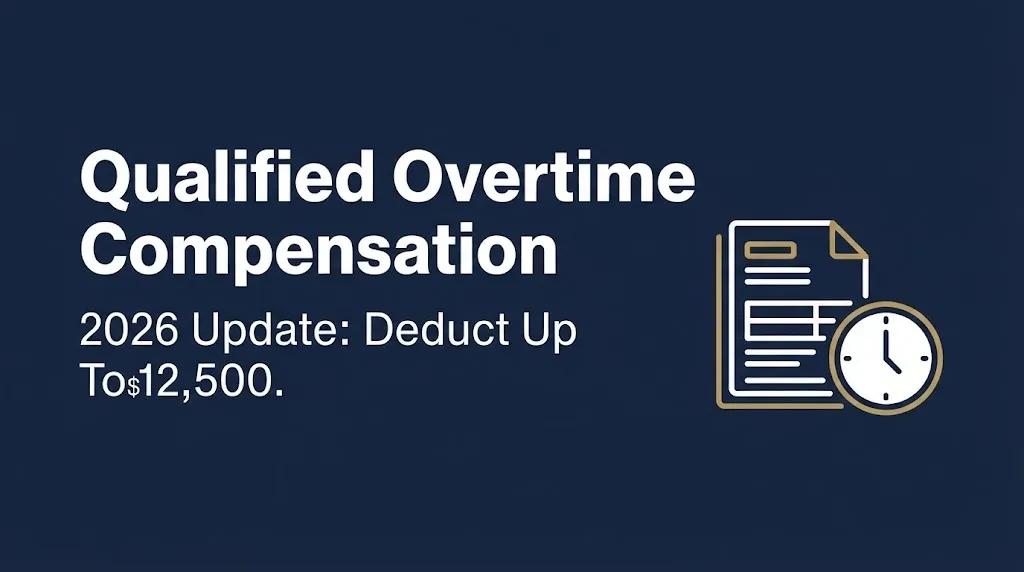
This is not a lawsuit, a class settlement, or a program you apply to. It’s a deduction you claim on your own federal tax return, similar to claiming a mortgage interest deduction, no third party approval required.
Key Takeaway: Qualified overtime compensation is a verified IRS tax deduction under Section 225 of the tax code, not a lawsuit, settlement, or claims program.
What exactly qualifies as qualified overtime compensation? (VERIFY)
Qualified overtime compensation means the overtime premium your employer was legally required to pay under Section 7 of the Fair Labor Standards Act, and only the premium portion above your regular rate.
If you’re paid time and a half, only the “half” counts, not your full overtime paycheck. A worker earning $20 an hour who works overtime at $30 an hour can generally deduct the extra $10 per overtime hour, not the full $30.
- Must be overtime required under FLSA Section 7, not a bonus or discretionary extra pay.
- Only applies to employees covered by the FLSA and not exempt from its overtime rules.
- Independent contractors for tax purposes use different reporting forms but can still qualify if FLSA-covered.
- State-mandated overtime beyond what federal law requires may not automatically count the same way.
Reality Check: No agency, employer, or third party can guarantee you a specific deduction amount before you actually calculate your qualified overtime for the year. Anyone offering to “recover” this deduction for you for an upfront fee is not how this works, you claim it yourself on Schedule 1-A.
How much is the qualified overtime compensation deduction worth? (MONEY)
The maximum deduction is $12,500 for single filers and $25,000 for those filing jointly, and it shrinks as your income rises.
| Filing Status | Maximum Deduction | Phaseout Begins At |
|---|---|---|
| Single | $12,500 | $150,000 MAGI |
| Married filing jointly | $25,000 | $300,000 MAGI |
The deduction is available whether you itemize or take the standard deduction, which sets it apart from many other tax breaks. You’ll still owe Social Security and Medicare payroll taxes on your overtime pay, and possibly state or local income tax, since this is a federal income tax deduction only.
Key Takeaway: The deduction can be worth thousands of dollars, but it only covers the overtime premium itself, and higher earners see it shrink or disappear entirely.
How do you claim the qualified overtime compensation deduction? (ACTION)
You claim this deduction on Schedule 1-A of your federal tax return, using either your W-2 or your own payroll records depending on the tax year.
- Confirm you’re an FLSA-covered employee who isn’t exempt from overtime rules.
- Check your Form W-2 Box 12 for Code TT starting with tax year 2026 returns.
- For your 2025 return, pull your pay stubs or payroll records instead, since 2025 W-2s won’t separately list the amount.
- Calculate the overtime premium portion only, not your full overtime wages.
- Confirm you have a valid Social Security number.
- File jointly if you’re married, this is required to claim the deduction.
- Complete Schedule 1-A and carry the total to your federal return.
- Keep your documentation in case the IRS requests it later.
What if my employer never reported my qualified overtime compensation correctly? (ACTION)
If your employer made an error, they’re required to file a corrected Form W-2c and give you the updated version.
The IRS confirmed this correction process directly in its August 2026 guidance update. Employers must report the full amount of qualified overtime paid, even if income limits mean you personally can’t deduct all of it.
If your employer refuses to correct a clear reporting error, or never paid you the required overtime at all, that’s a separate and more serious problem than a paperwork mistake.
Key Takeaway: A wrong W-2 code is fixable with a W-2c, but unpaid overtime itself is a wage violation, not just a tax form issue.
What if my employer denied me overtime pay entirely? (BACKGROUND)
If your employer misclassified you as exempt or simply refused to pay required overtime, you may have grounds for a separate wage and hour lawsuit under the FLSA, independent of this tax deduction.
Workers who never received legally required overtime lose two things at once: the wages themselves and the tax deduction tied to them. This is where employment lawsuits intersect with the new tax rule directly.
Common misclassification patterns include labeling hourly workers as “salaried managers” with no real managerial duties, or classifying employees as independent contractors when they function as regular staff. The Department of Labor and private attorneys both pursue these claims, often as collective actions covering many workers at once.
Compare it to a store that never gives you your change back. You did the work, the money was legally yours, and the deduction is only the icing on top of wages you were owed regardless.
Can back pay from an overtime lawsuit count as qualified overtime compensation? (BACKGROUND)
This detail is not yet confirmed by the IRS in plain terms, so treat any confident answer elsewhere with caution.
Back overtime pay recovered through a Department of Labor action or a private FLSA lawsuit represents overtime that was legally required under Section 7, which is the core definition the statute uses. Whether it gets reported and treated as qualified overtime compensation in the year received likely depends on how your employer or a settlement administrator codes the payment on your tax forms.
If you receive back overtime pay from a wage claim, ask the paying party directly how they plan to report it, and consider confirming the tax treatment with a licensed tax professional before filing.
Who is not eligible for the qualified overtime compensation deduction? (VERIFY)
Workers who are legally exempt from FLSA overtime requirements, such as many salaried executive, administrative, and professional employees, do not qualify for this deduction.
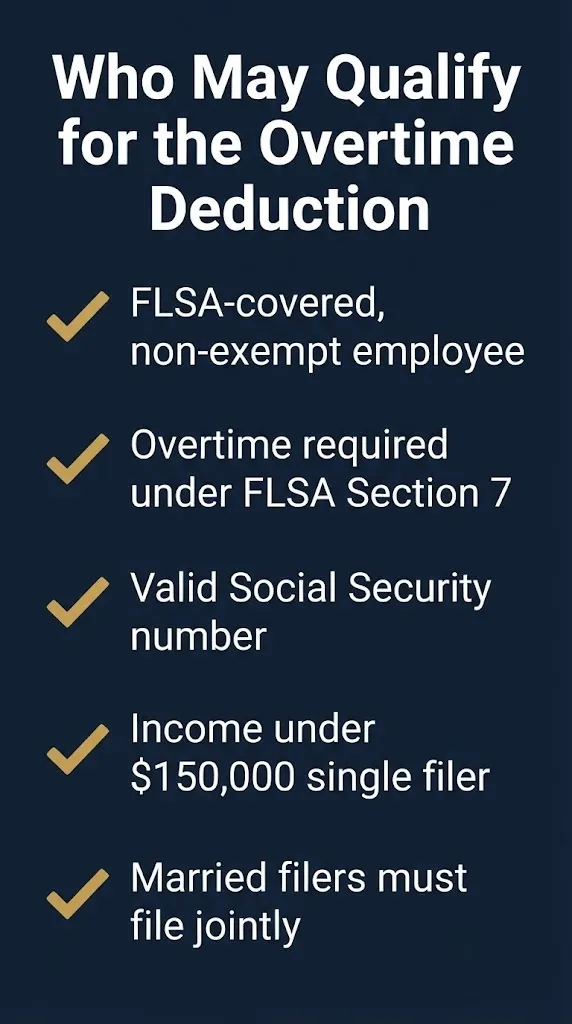
The deduction only covers overtime “required” under FLSA Section 7. If your role is properly classified as exempt under federal law, your extra hours worked don’t count as qualified overtime compensation even if your employer voluntarily pays you more for them.
- High earners above the MAGI phaseout thresholds lose some or all of the deduction.
- Workers without a valid Social Security number cannot claim it.
- Married individuals who file separately instead of jointly are excluded.
- Discretionary bonuses or extra pay not tied to FLSA-required overtime don’t qualify.
When does the qualified overtime compensation deduction expire? (STATUS)
The deduction is currently authorized for tax years 2025 through 2028, based directly on the statutory language in the OBBBA.
That means the 2028 tax year, filed in early 2029, is the last confirmed year under current law. Congress could extend, modify, or end the provision before then, and no extension has been confirmed as of this writing.
- 2025: first year the deduction applies, retroactive to January 1, 2025.
- 2026 through 2028: deduction continues under current law.
- After 2028: expiration under current law unless Congress acts, not yet confirmed either way.
What Happens Next
January 23, 2026: IRS issued Fact Sheet 2026-01 with detailed FAQs on eligibility and reporting.
Filing season 2026: taxpayers file 2025 returns using payroll records since 2025 W-2s don’t separately list the amount.
Tax year 2026 forms (filed in 2027): employers begin reporting qualified overtime compensation in Box 12, Code TT of the W-2.
Expected ongoing: IRS continues updating FAQs and correcting reporting guidance, as it did in its August 2026 update on W-2c corrections.
2028 tax year: current statutory authorization for the deduction ends unless Congress extends it, not yet confirmed either way.
Frequently Asked Questions
What is qualified overtime compensation?
It’s the overtime premium pay required under Section 7 of the Fair Labor Standards Act that now qualifies for a federal tax deduction.
Only the amount above your regular pay rate counts, not your total overtime earnings.
How much can I deduct for qualified overtime compensation?
Up to $12,500 if you’re single or $25,000 if you file jointly, with the amount shrinking above certain income levels.
The phaseout starts at $150,000 MAGI for single filers and $300,000 for joint filers.
Do I need my employer to report this on my W-2?
For tax year 2025, no, you calculate it yourself from payroll records.
Starting with 2026 tax year W-2s, employers must report it in Box 12 using Code TT.
Does everyone who works overtime qualify for this deduction?
No, only overtime legally required under the FLSA counts, so exempt employees are excluded.
Misclassified workers denied required overtime don’t get the deduction on pay they never received.
Can I still owe payroll tax on qualified overtime compensation?
Yes, Social Security and Medicare taxes still apply regardless of the federal income tax deduction.
State and local income taxes may also still apply depending on where you live.
What should I do if my employer denied me overtime pay?
Document your hours and pay, then consider consulting an employment attorney about a potential FLSA wage claim.
This is separate from the tax deduction and involves recovering wages you were legally owed.
How long will the overtime deduction last?
It currently applies to tax years 2025 through 2028 under the law as written.
Any extension beyond 2028 has not been confirmed as of this writing.
Is this deduction available if I take the standard deduction?
Yes, it’s available whether you itemize or take the standard deduction.
This makes it different from deductions that require itemizing to claim.
If you worked overtime in 2025, start pulling your payroll records now so you’re ready for Schedule 1-A. If your employer never paid the overtime you were legally owed, that’s a separate issue worth raising with an employment attorney, since it affects both your wages and this deduction.
The most important date to remember is your federal tax filing deadline for the year you’re claiming, and the deduction itself is authorized only through the 2028 tax year under current law.