What Is a Litigation Paralegal? The 2026 Job, Salary, and Real Requirements
Quick Answer
- A litigation paralegal supports attorneys in lawsuits. Duties run from case intake and discovery to trial prep and settlement.
- No license or certification is legally required. NALA and NFPA credentials are voluntary and help with hiring.
- Average U.S. pay is about $66,317. Entry-level roles start near $46,610, and top pay reaches about $89,000 .
If you searched “what is a litigation paralegal” because you saw a job posting, you are looking at one of the most hands-on roles in a law firm. You are not a lawyer. You do not give legal advice. You keep the case moving.
The job sits inside the litigation process itself. That means deadlines, discovery, exhibits, and trial logistics. It is closer to project management inside a legal fight than to answering phones at a front desk.
This guide covers what the role actually involves in 2026, the verified salary ranges, the education and certification picture, and the steps to get hired. The requirements vary by firm and state, so the honest answer includes what is confirmed and what depends on your market.
The Facts
| Item | Verified Detail |
|---|---|
| Role type | Non-lawyer legal professional supporting litigation attorneys |
| Core duties | Case management, discovery, document review, trial prep, court filings |
| License required | No. No state licenses litigation paralegals |
| Certification | Voluntary. NALA CP/ACP and NFPA CORE/RP are the main routes |
| Average U.S. salary | $66,317 per year |
| Entry-level pay | About $46,610 total compensation |
| Top-end pay | About $89,000 per year |
| Education routes | Associate degree, bachelor’s degree, certificate, or equivalent experience |
What does a litigation paralegal actually do?
A litigation paralegal provides support to a litigation attorney from the pre-discovery stage through trial and settlement . The work is substantive, not clerical, and it carries real responsibility for case outcomes.
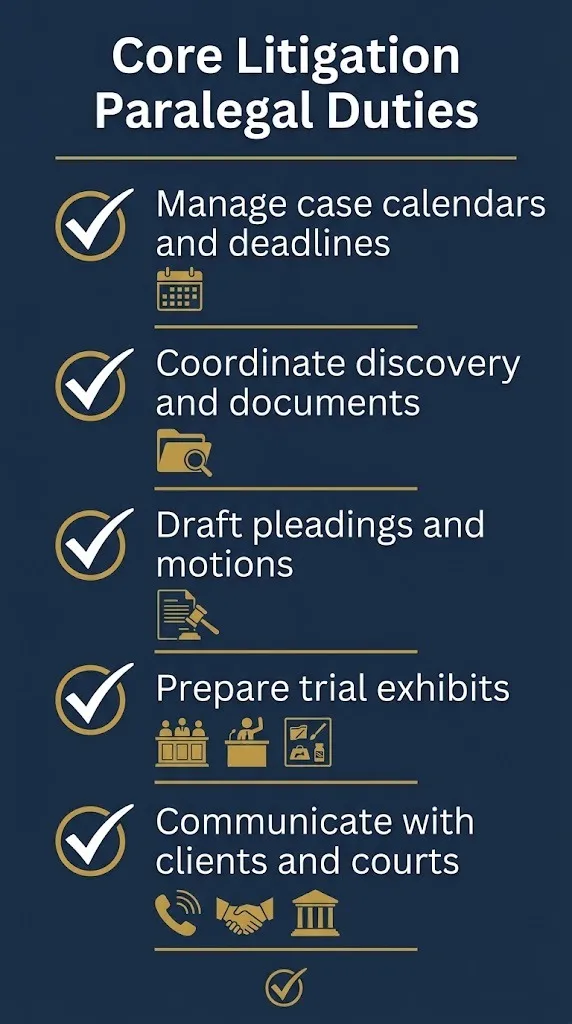
The verified duties from current job postings include:
- Managing case intake, organization, and ongoing administration of litigation matters
- Maintaining litigation calendars and monitoring court deadlines
- Drafting and proofreading pleadings, motions, discovery requests, and subpoenas
- Coordinating all phases of discovery, including document collection and production
- Preparing exhibits, trial notebooks, and courtroom logistics
- Communicating with clients, opposing counsel, court personnel, and experts
The role varies by firm size. At a small firm, you may handle everything from intake to trial. At a large firm, you may specialize in discovery or document management.
How much does a litigation paralegal make in 2026?
The average U.S. salary for a litigation paralegal is $66,317 per year, according to Payscale data updated in 2026 . Total compensation ranges from about $47,000 to $89,000, including bonuses and profit sharing.
Here is the verified pay breakdown:
| Experience Level | Average Total Compensation |
|---|---|
| Entry level (under 1 year) | $46,610 |
| Early career (1 to 4 years) | $59,993 |
| Average across all levels | $66,317 |
| Top of range | $89,000 |
Salary varies by location. A Buffalo, NY posting shows an average of $61,584, about 15% below the national average . A rural Georgia estimate puts the average at $59,002 . Major metro markets and large firms pay more.
Key Takeaway: Litigation paralegal pay is solid but not lawyer-level, with an average around $66,000 and a realistic ceiling near $89,000 before overtime and bonuses.
Do you need a certification to be a litigation paralegal?
No. No state requires a license or certification to work as a litigation paralegal . Certification is voluntary and functions as a credibility signal for employers, not a legal requirement.
The two main national credential bodies are:
- NALA (National Association of Legal Assistants). Offers the Certified Paralegal (CP) credential, examined in two parts, with recertification through continuing education every five years. Its Advanced Certified Paralegal courses include Trial Practice and Discovery .
- NFPA (National Federation of Paralegal Associations). Offers the Paralegal CORE Competency Exam for the CORE Registered Paralegal credential and the Paralegal Advanced Competency Exam for the Registered Paralegal credential .
One current note: NALS, a third certification body, has placed its individual exams on hiatus and is not accepting new registrations while it consolidates its programs . For a new candidate today, NALA and NFPA are the available national routes.
California is the main exception to the “no rules” picture. The state requires paralegals to meet a statutory education or experience standard, but that is a title qualification, not a certification mandate .
What education do you need for a litigation paralegal job?
Most litigation paralegal postings accept one of several education routes rather than a single required degree. A paralegal certificate, an associate degree, or equivalent legal experience are the common entry points .
The verified routes are:
- Associate degree in paralegal studies. The most common entry credential at community colleges.
- Bachelor’s degree. Some firms prefer a bachelor’s in paralegal studies or a related field .
- Paralegal certificate. A post-baccalaureate or standalone certificate program for career changers.
- Equivalent legal experience. Many firms accept work experience in place of a formal credential .
On-the-job training is common. Some firms hire candidates with strong organizational skills and teach the litigation specifics internally .
What is a typical litigation paralegal job description?
A litigation paralegal job description typically lists case management, document drafting, discovery coordination, calendar management, and trial preparation as core responsibilities. The exact mix depends on the firm’s practice area.
A verified sample from a Pennsylvania law firm posting includes these requirements:
- Prior litigation paralegal experience
- Knowledge of state litigation procedures, court rules, and filing requirements
- Proficiency with Microsoft Office and legal case management software
- Paralegal certificate, associate degree, or equivalent legal experience preferred
Larger firms add more specialized expectations. A mid-level posting from Covington & Burling describes document and file management, case calendaring, discovery support, and trial logistics, plus coordination of junior paralegals on case-specific tasks .
How do you become a litigation paralegal in 2026?
The path to a litigation paralegal role follows a predictable sequence. It starts with education or a certificate, moves through entry-level legal work, and builds toward specialized litigation experience.
Here are the steps:
- Choose an education route. Associate degree, bachelor’s degree, or a paralegal certificate program.
- Consider a voluntary certification. NALA’s CP or NFPA’s CORE credential can help with hiring .
- Build relevant skills. Legal research, document management, and court procedure knowledge matter more than general office skills.
- Apply for entry-level legal roles. Paralegal assistant, legal secretary, or intake roles can serve as a bridge.
- Learn litigation software. Case management platforms and e-discovery tools are standard requirements in postings .
- Target litigation-specific experience. Discovery coordination and trial prep experience are the differentiators for higher pay.
What skills separate a good litigation paralegal from an average one?
The skills that matter most are organizational discipline and deadline management, not legal theory. A litigation paralegal who misses a court deadline creates malpractice exposure for the firm.
The verified skill priorities from job postings and training programs are:
- Calendar and deadline management. Missing a filing date is the single most damaging error in the role .
- Discovery coordination. Managing document collection, review, and production is the core of modern litigation support .
- Drafting accuracy. Pleadings, motions, and discovery responses must be clean before they reach the attorney .
- Software fluency. Legal case management and e-discovery platforms are standard tools .
- Client communication. Paralegals are often the main point of contact for clients during litigation .
A delayed tax refund is annoying. A missed statute of limitations because a paralegal calendar entry was wrong is a malpractice claim. The calendar is not clerical work in this role. It is the job.
What happens next in a litigation paralegal career?
The career path moves from support to specialization to potential management. The timeline depends on the firm and your willingness to take on responsibility.
Entry level, 0 to 2 years: Intake, file organization, basic drafting, and calendar support.
Mid level, 3 to 5 years: Independent discovery management, trial prep, and client contact with less attorney oversight.
Senior level, 6 or more years: Case management ownership, mentoring junior paralegals, and specialization in a practice area like complex commercial litigation or personal injury.
Beyond: Paralegal manager, litigation support specialist, or e-discovery consultant roles at larger firms or vendors.
Frequently Asked Questions
What is a litigation paralegal?
A litigation paralegal is a non-lawyer legal professional who supports attorneys through all stages of a lawsuit, from intake and discovery to trial and settlement.
Do you need a certification to be a litigation paralegal?
No. No state requires certification, and no license is needed. NALA and NFPA credentials are voluntary and can help with hiring.
How much does a litigation paralegal make?
The average U.S. salary is about $66,317 per year. Entry-level pay is around $46,610, and top pay reaches about $89,000.
What does a litigation paralegal do daily?
Daily work includes calendar and deadline management, document review, discovery coordination, drafting pleadings, and communicating with clients and courts.
What degree do you need to be a litigation paralegal?
Most postings accept an associate degree, a bachelor’s degree, a paralegal certificate, or equivalent legal experience.
Is litigation paralegal a good career in 2026?
It is a stable career with solid pay and no license barrier. The trade-off is deadline pressure and the risk that a calendar error has serious consequences.
Can a litigation paralegal work remotely?
Some roles offer hybrid schedules, especially in corporate legal departments. Law firm litigation roles are more often on-site because of file access and trial prep needs.
Closing
The litigation paralegal role is a hands-on legal job with real responsibility and no license gate. The average pay is around $66,317, and the path in runs through a certificate, a degree, or equivalent experience.
If you are considering the role, start with a paralegal certificate or associate program, then target litigation-specific experience. The deadline calendar is where the job begins.