Class Action Attorney 2026: How to Find, Vet, and Hire the Right One
Quick Answer
- A class action attorney works on contingency. You pay nothing upfront, and fees come out of any recovery.
- In New Jersey, contingency fees follow Court Rule 1:21-7, a sliding scale that caps at 33.3% of the first $750,000 recovered.
- Federal class actions generally need 100 or more class members and over $5 million at stake under the Class Action Fairness Act.
You searched “class action attorney” because something happened: a data breach notice, a defective product, a paycheck that came up short. Maybe you’re wondering if you even need one, or if you already qualify for a case that’s underway.
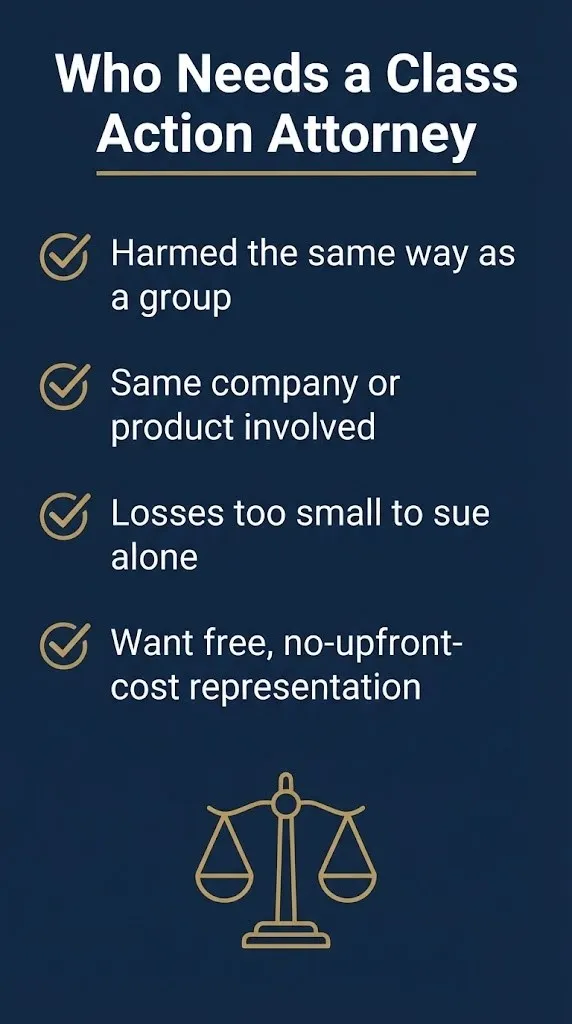
Here’s the direct answer. A class action attorney is a lawyer who represents a group of people harmed the same way by the same company, and they get paid only if the case wins or settles.
This guide walks through the cost, the process, how to vet one near you, and the New Jersey rules that govern fees specifically. One detail most sites skip: federal regulators say only a small fraction of eligible people ever file a claim, even when the money is sitting there waiting.
The Facts
| Item | Detail |
|---|---|
| Typical fee structure | Contingency, no cost to you upfront |
| NJ contingency fee cap | Court Rule 1:21-7 sliding scale |
| Federal filing threshold (CAFA) | 100+ class members, over $5 million at stake, minimal diversity |
| Cost to join an existing class | Free, no charge to submit a claim form |
| Typical claim window once notified | Around 90 to 120 days |
| Where to verify a notice or case | FTC refunds database, court docket, official settlement site |
| Governing rule, federal courts | Federal Rule of Civil Procedure 23 |
| Governing rule, NJ state courts | NJ Court Rule 4:32 |
Is a Class Action Attorney the Same as a Class Action Lawsuit Lawyer?
Yes. “Attorney” and “lawyer” describe the same license and the same job here.
Both terms mean someone admitted to practice law who represents a group, or “class,” of people in a lawsuit against a shared defendant. Search engines just see two different habits of speech.
What matters more than the title is the track record. Ask for actual case names the attorney has certified or settled, not just a list of practice areas on a website.
A quick way to check: your state bar association’s attorney lookup tool. It confirms the license is active and shows any public discipline history.
What Is a Consumer Class Action Attorney?
A consumer class action attorney focuses specifically on cases where a company’s product, service, or billing practice harmed a large group of buyers the same way.
Common triggers include hidden fees, defective products, false advertising, and data breaches that exposed personal information. These claims usually rely on state consumer protection statutes, like New Jersey’s Consumer Fraud Act, or federal statutes tied to privacy and lending.
Key Takeaway: “Class action attorney” and “class action lawyer” are interchangeable titles, and a consumer class action attorney is simply one who specializes in cases against companies, not employers or government bodies.
Consumer cases differ from employment class actions (unpaid wages, misclassification) and mass torts (defective drugs or medical devices), which often use individual case tracks instead of one shared class.
How Do You Know If a Class Action Attorney Is Legitimate?
You can confirm legitimacy through your state’s bar directory, court dockets, and a simple no-upfront-cost rule.
Real class action attorneys never ask for a fee before doing work. Their compensation comes from the settlement or judgment, subject to court approval.
Three checks worth running before you sign anything:
- Search the attorney’s name in your state bar’s public directory.
- Search the firm name plus the word “docket” to find filed cases.
- Ask directly how they get paid, and expect “contingency” as the answer.
A firm that pressures you to pay a “filing fee” or “processing fee” before representation starts is not operating like a legitimate class action practice.
How Much Does a Class Action Attorney Cost?
A class action attorney typically costs you nothing out of pocket. Fees are contingency-based and paid from the settlement fund, not your wallet.
Courts must approve those fees before anyone gets paid. Judges routinely cut proposed fee requests they see as too high relative to what the class actually recovered.
Reality Check: No legitimate class action ever requires you to pay to join, file a claim, or “unlock” your payout. If a text, email, or call asks for a processing fee, gift cards, or your Social Security number before you get paid, that is a scam, not a settlement. Verify any notice against the FTC’s refunds database or the official settlement website before responding.
How Much Can a Class Action Lawsuit Lawyer Take From Your Settlement?
In New Jersey, the answer is capped by a specific formula, not left to negotiation alone.
NJ Court Rule 1:21-7 sets the maximum contingency fee schedule for cases handled that way:
| Amount Recovered | Maximum Fee |
|---|---|
| First $750,000 | 33.3% |
| Next $750,000 | 30% |
| Next $750,000 | 25% |
| Next $750,000 | 20% |
| Above $3 million | Court sets the fee |
Federal class action fees work differently. Judges commonly use a “lodestar” method (hours worked times a reasonable rate) or a percentage of the common fund, whichever the court finds fair.
Key Takeaway: No court, state or federal, lets an attorney set their own class action fee. A judge always reviews it against what the class actually received.
Do You Pay Anything to Join a Class Action?
No. Joining an existing class action, meaning filling out a claim form after a settlement, is always free.
You are not hiring the attorney individually when you file a claim form. The court-appointed class counsel already represents the entire group, and their fee comes out of the settlement fund, not from you directly.
The only time you might personally pay a lawyer is if you want to opt out of the class and pursue your own separate case, which is a different track entirely.
How Do You Find a Class Action Attorney Near You?
Start with your state bar’s lawyer referral service, then cross-check with public court dockets in your area.
Most state bars run a free referral line that connects you to vetted attorneys by practice area. That’s a safer starting point than a random search ad.
Five practical steps for a local search:
- Search “[your state] bar association lawyer referral.”
- Filter for class action or consumer protection practice.
- Pull two or three names and check recent filed cases.
- Call and ask directly about contingency terms.
- Confirm they handle cases in your county or federal district.
How Do You Find Class Action Lawsuit Lawyers Near Me?
The phrase “near me” mostly matters for the initial consultation, not the case itself. Most class actions are filed in federal court and can span an entire state or the whole country.
Even so, a local attorney can be useful for accessibility and for state-specific claims tied to local consumer protection law.
Key Takeaway: Geography matters less than experience once a case is filed nationally, but a nearby attorney is easier to reach for questions and paperwork.
If you already received a settlement notice in the mail, skip the search entirely: the lead counsel’s contact information is printed right on the notice.
What Does a Class Action Attorney Actually Do?
A class action attorney investigates the harm, files the complaint, seeks class certification, and negotiates or litigates toward a resolution.
Certification is the pivotal early step. A judge decides whether the case can proceed as a group claim under Federal Rule of Civil Procedure 23, checking four things: numerosity (enough people), commonality (shared facts), typicality (similar claims), and adequacy (fair representation).
Think of it like a warranty claim that got big enough to need a referee. One person’s broken product becomes everyone’s broken product, and the court decides if the group’s story holds together as one case.
How Do You Hire a Class Action Attorney in New Jersey?
You hire one the same way as elsewhere, but New Jersey layers in its own procedural rule for how class actions run in state court.
NJ Court Rule 4:32 governs class actions filed in New Jersey Superior Court. It closely mirrors the federal Rule 23 framework: numerosity, commonality, typicality, and adequate representation, plus court appointment of class counsel.
New Jersey also allows fee-shifting in specific statutory cases, including claims under the state’s Consumer Fraud Act, where a winning plaintiff can recover attorney’s fees from the defendant on top of damages. Outside those exceptions, New Jersey follows the “American Rule,” meaning each side generally pays its own legal costs unless a statute or rule says otherwise.
Key Takeaway: New Jersey class actions run on Court Rule 4:32 for certification and Court Rule 1:21-7 for fee limits, giving the state some of the more specific consumer protections in the country.
What Questions Should You Ask a Class Action Attorney Before Hiring?
Ask direct questions that expose experience, cost structure, and communication style before you commit.
A short checklist to bring to a first call:
- How many class actions have you certified or settled?
- What percentage do you take if we win, and does it change by outcome size?
- Who covers court costs and expert witness fees if we lose?
- How often will you update me on case status?
- Is there a case similar to mine already filed against this company?
- What’s the realistic timeline for a case like this?
An attorney who answers all six clearly, without pressure or vague deflection, is worth a second conversation.
How Long Does a Class Action Lawsuit Take?
Most class actions take one to several years from filing to final payout, and there is no fixed national timeline.
Certification alone can take a year or more. Add discovery, settlement negotiation, and a final approval hearing, and multi-year timelines are common for larger cases.
Compare it to a delayed tax refund investigation: the review has real steps, and skipping ahead isn’t an option no matter how much you want the money sooner.
What Happens After You Hire a Class Action Attorney?
After you sign a retainer, the attorney investigates the claim, identifies potential co-plaintiffs, and files the complaint in the appropriate court.
From there, the defendant typically responds, both sides exchange evidence during discovery, and the court rules on class certification. Many cases settle after certification rather than going to trial, since the risk profile shifts heavily once a judge confirms the group can sue together.
What Is Required to Start a Class Action Lawsuit?
You need a common injury shared by a defined group, a lead plaintiff willing to represent that group, and a legal theory a court will certify.
Federal Rule of Civil Procedure 23 sets the four-part test again here: enough people involved to make individual suits impractical, shared facts or legal questions, a lead plaintiff whose claim looks like everyone else’s, and lawyers capable of representing the group fairly.
Without all four, a judge can deny certification and the case proceeds, if at all, as individual claims instead.
What’s the Difference Between a Class Action and a Mass Tort?
A class action treats the group as one unified claim, while a mass tort keeps each person’s case individually valued even when cases are coordinated together.
| Feature | Class Action | Mass Tort |
|---|---|---|
| Structure | One combined claim | Individually valued claims |
| Payout | Often equal or formula-based per class member | Varies by individual injury severity |
| Common use | Consumer, data breach, billing cases | Drug, device, environmental injury cases |
| Certification required | Yes, under Rule 23 or state equivalent | No, cases stay individual |
Key Takeaway: If your harm looks identical to everyone else’s, a class action fits. If your damages vary a lot person to person, a mass tort usually fits better.
How Do Federal Courts Decide If a Class Action Belongs There?
The Class Action Fairness Act (CAFA) of 2005 sets the main federal threshold: 100 or more proposed class members, more than $5 million in combined claims, and minimal diversity between at least one plaintiff and one defendant.
CAFA was designed to move large, multi-state cases out of state courts seen as unusually favorable to plaintiffs and into federal court instead. It also lets a single defendant remove a case to federal court without needing every co-defendant to agree.
Not every case clears CAFA’s bar. Smaller, single-state consumer classes often stay in state court under rules like New Jersey’s Rule 4:32.
What Happens Next
- Now: review any notice you received against the official settlement site or the FTC refunds database before responding.
- If you’re considering hiring counsel: schedule two or three consultations and compare fee terms in writing.
- During litigation: expect a certification ruling first, often the single longest wait in the process.
- If a settlement is reached: a claims administrator opens a filing window, typically 90 to 120 days.
- After final approval: payments go out once the court signs off and any appeals period closes.
Frequently Asked Questions
Do class action attorneys really work for free upfront?
Yes.
Class action attorneys work on contingency, meaning they only get paid from a settlement or judgment.
You pay nothing to hire one or to have your claim evaluated.
Can I be part of more than one class action at the same time?
Yes, as long as the claims involve different companies or different harms.
You cannot double-collect for the exact same injury from overlapping classes covering the same conduct.
Each claim form should reflect the specific product or service involved.
What’s the difference between a class action attorney and a personal injury lawyer?
A class action attorney represents a group with a shared harm against one defendant.
A personal injury lawyer typically handles one client’s individual injury claim.
Some firms do both, but the case strategy and fee structure differ.
How do I know if I’m automatically part of a class action?
You’re usually notified by mail, email, or a court-approved notice if you’re an automatic class member.
Some classes require you to file a claim form to receive payment.
Others require action to opt out if you don’t want to be included.
Is it safe to give my Social Security number to a class action claim form?
Sometimes, but verify the source first.
Legitimate settlement administrators may require it for tax reporting on larger payouts.
Never provide it through an unsolicited text or email link; go directly to the official settlement site instead.
What’s a lead plaintiff, and do I need to be one?
A lead plaintiff, or class representative, is the named person who represents the whole group in court.
Most class members never need to testify or appear in court.
You only need to be a lead plaintiff if an attorney asks you to take on that role directly.
How much of my settlement goes to attorney fees?
It depends on the fee arrangement and court approval, and there’s no single national number.
In New Jersey, contingency fees follow the Court Rule 1:21-7 sliding scale.
Federal courts often use a percentage-of-fund or lodestar method, both subject to judicial review.
Why do most eligible people never file a class action claim?
Awareness and skepticism are the two biggest reasons.
Federal regulators have found that only a small share of eligible consumers actually submit claims each year.
Scam notices designed to look like real settlements make some people wary of filing even legitimate ones.
Whether you’re evaluating a lawyer for a new claim or verifying a notice that just landed in your inbox, the fastest safe step is the same: check the official source before you respond to anyone. Bookmark your state bar’s referral tool and the FTC refunds database for whenever the next notice arrives.