What Percentage Does Morgan and Morgan Take From a Settlement in 2026? Fee Breakdown
Quick Answer
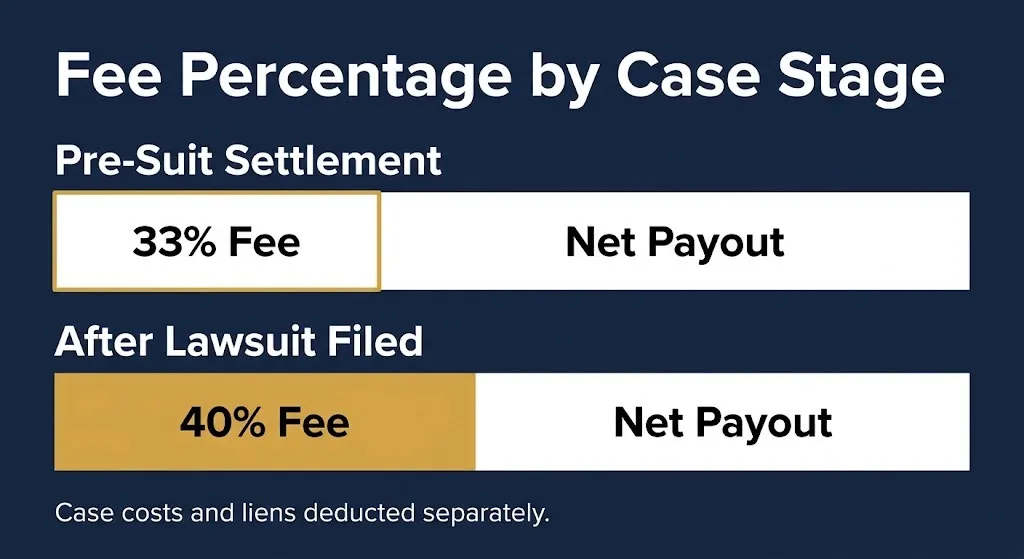
- Morgan and Morgan typically takes 33% of a pre-suit settlement and up to 40% after a lawsuit is filed.
- Case costs (filing fees, experts, medical records) come out separately, so your final check is less than the fee percentage suggests.
- Your signed retainer controls the actual percentage, and Florida Bar rules cap fees at 33⅓% and 40% for Florida injury cases.
Morgan and Morgan’s “no fee unless we win” slogan is accurate about the attorney fee. It says nothing about the percentage, and it says nothing about costs. That gap is where most clients get surprised.
The firm’s own disclosures put the contingency fee at roughly one-third before suit and up to 40% after. But the percentage is only half the math. Case costs come off the top too, and medical liens can take another bite.
This article breaks down the exact fee tiers, how costs interact with the percentage, what Florida Bar rules allow, and the questions you should ask before you sign anything.
The Facts
| Item | Verified Detail |
|---|---|
| Firm | Morgan & Morgan (Orlando headquarters) |
| Fee Structure | Contingency, no upfront attorney fee |
| Pre-Suit Fee | About 33% (one-third) of recovery |
| Post-Suit Fee | Up to 40% of recovery |
| Case Costs | Separate from fee, deducted from recovery |
| Governing Rule | Florida Bar Rule 4-1.5(f)(4)(B) for Florida injury cases |
| Proof Needed | Signed retainer agreement and closing statement |
Is Morgan and Morgan’s 33% fee real or just advertising?
Morgan and Morgan’s 33% pre-suit fee is real and matches the firm’s own published fee explainer, but it is not a fixed number across every case or every state. The firm states the contingency fee is about 33% if your case settles before a lawsuit is filed, rising to as much as 40% if suit is filed or the case goes to trial .

That structure is not unique to Morgan and Morgan. It mirrors the standard contingency ladder used by many personal injury firms. What matters is the trigger point: when exactly does the percentage step up from 33% to 40%?
In Florida, the step-up happens after the defendant answers the lawsuit, not the moment you file. Florida Bar Rule 4-1.5(f)(4)(B) caps fees at 33⅓% of the first $1 million if the case settles before the defendant answers, and 40% after .
If your case is in another state, the cap may differ or not exist at all. Your retainer agreement is the document that controls, not the website.
Key Takeaway: Morgan and Morgan’s 33% to 40% range is real and disclosed, but the exact percentage depends on your state’s rules and the stage at which your case resolves.
How much does Morgan and Morgan actually take after costs and liens?
Morgan and Morgan takes its fee percentage from the gross recovery, and then case costs and medical liens come out of what remains. That means the money you actually keep is smaller than the fee percentage alone suggests.
Here is a worked example using the firm’s disclosed structure. Assume a $100,000 settlement after a lawsuit is filed, a 40% fee, $8,000 in case costs, and $20,000 in medical liens:
| Line Item | Amount |
|---|---|
| Gross Settlement | $100,000 |
| Attorney Fee (40%) | $40,000 |
| Case Costs | $8,000 |
| Medical Liens | $20,000 |
| Net to You | $32,000 |
That is a 32% take-home rate, not 60%. The fee is 40%, but costs and liens eat another 28% of the gross. If the case had settled pre-suit at 33⅓%, the fee would have been $33,333, and your net would have been higher.
Costs are not the same as the fee. Morgan and Morgan advances costs, but they are repaid from your recovery. The firm’s own materials say clients owe nothing if the case is unsuccessful, but the fee arrangement for costs on a loss depends on your specific agreement . Ask explicitly.
Is a 40% contingency fee legal in Florida?
A 40% contingency fee is legal in Florida for personal injury cases after the defendant answers the lawsuit, under Rule 4-1.5(f)(4)(B) of the Rules Regulating The Florida Bar. The rule treats higher percentages as presumptively excessive.
The full Florida schedule works like this:
- 33⅓% of the first $1 million if the case settles before the defendant answers
- 40% of the first $1 million after the defendant answers
- 30% of the next $1 million
- 20% of any amount above $2 million
Morgan and Morgan’s quoted 33% and 40% figures line up with those caps for the first million . For larger recoveries, the percentage on the excess drops.
Other states set their own limits or none at all. If your case is outside Florida, the Florida rule does not apply to you. Check your state bar’s rules and your retainer.
The legal fee cap does not cap costs. Costs can be substantial in complex cases, and they come out before your share is calculated in many agreements. Read the cost provision as carefully as the fee provision.
How do you calculate what you will actually receive from a Morgan and Morgan settlement?
You calculate your net recovery by subtracting the attorney fee, case costs, and medical liens from the gross settlement amount. The order of operations matters, and the closing statement is where every line item appears.
Here is the sequence Morgan and Morgan describes:
- Gross recovery is the total settlement or verdict amount.
- Attorney fee is the agreed percentage of that gross recovery.
- Case costs are deducted, including filing fees, expert fees, medical records, and depositions.
- Medical liens are paid, including health insurance reimbursement and outstanding medical bills.
- Net to you is what remains.
Morgan and Morgan says it prepares a closing statement that lists the award, the fee, and each cost. You and the attorney both sign it, and funds are typically available 7 to 10 business days after signing .
Ask for the settlement statement before you sign the release. Once you sign, the numbers are locked. Reviewing the statement first is like checking a receipt before you leave the store. After you walk out, correcting it is much harder.
What questions should you ask Morgan and Morgan before signing a retainer?
You should ask five specific questions about the fee, costs, and lien handling before you sign a Morgan and Morgan retainer. The answers determine your actual take-home amount, not the advertised “no fee” slogan.
Ask these in writing if possible:
- What is the exact percentage, and what triggers the step-up? Get the specific date or event that moves you from 33% to 40%.
- Are costs deducted before or after the fee is calculated? Taking costs out first lowers the fee. Taking them out after does not.
- Do I owe advanced costs if the case loses? The firm says the fee is free on a loss, but cost repayment terms vary.
- How are medical liens handled? Ask whether the firm negotiates liens and whether that negotiation is included in the fee.
- Is any portion of the fee shared with a referring attorney? A referral should not increase your total fee.
The retainer is a contract. The website and the commercials are marketing. The retainer controls what you actually pay.
Morgan and Morgan’s own FAQ page says the fee is a percentage of the settlement or verdict and that there are no upfront costs . That is accurate as far as it goes. It does not answer the five questions above.
How does Morgan and Morgan’s fee compare to other personal injury firms?
Morgan and Morgan’s 33% to 40% contingency structure is in line with the broader personal injury market, where standard fees range from about 33% pre-suit to 40% at trial. The firm is not an outlier on percentage.
The differences show up in costs, communication, and case selection. Some firms charge lower percentages on large recoveries. Some advance costs more aggressively. Some keep clients with a single attorney rather than rotating case managers.
| Fee Factor | Morgan and Morgan | Typical PI Firm Range |
|---|---|---|
| Pre-suit fee | About 33% | 25% to 33% |
| Post-suit fee | Up to 40% | 33% to 40% |
| Costs | Separate, repaid from recovery | Usually separate |
| Upfront fee | None | Usually none |
| Fee on loss | None (attorney fee) | Usually none |
The percentage is not where you gain or lose the most money. Costs and lien negotiation often matter more. A firm that charges 33% but lets costs balloon can leave you with less than a firm that charges 40% but runs a tight case.
Reality Check: A low percentage is not automatically a better deal. Ask what the firm does about costs and liens, because those line items can swing your net recovery by thousands of dollars.
What happens next: timeline from retainer to closing statement
Day 1: You sign the retainer, which fixes the fee percentage and cost terms in writing.
Pre-suit demand: Your case is investigated and a demand is sent. A settlement at this stage typically uses the ~33% tier.
Lawsuit filed: If no settlement is reached, a complaint is filed. The fee may step up to 40% after the defendant answers, depending on your agreement and state rules.
Settlement or verdict: The gross recovery is established.
Closing statement: The firm prepares an itemized statement showing the fee, costs, liens, and net to you. You sign it before funds are released.
7 to 10 business days after signing: Funds are typically available, according to the firm’s fee guide .
Not yet confirmed: The specific fee percentage and cost terms in your individual retainer, which can vary by state and case type.
Frequently Asked Questions
What percentage does Morgan and Morgan take from a settlement?
Morgan and Morgan takes about 33% if your case settles before a lawsuit is filed, and up to 40% if a lawsuit is filed or the case goes to trial .
Is the 33% fee taken before or after case costs?
The fee is typically calculated on the gross recovery, and case costs are deducted separately. Ask your retainer whether costs come out before or after the fee, because the order changes your net.
Do I owe anything if Morgan and Morgan loses my case?
You do not owe an attorney fee if the case is unsuccessful. Whether you owe advanced case costs depends on your signed agreement, so ask explicitly .
Is a 40% fee normal for personal injury lawyers?
Yes, 40% is within the standard range for cases that go into litigation. Florida Bar rules allow 40% of the first $1 million after the defendant answers the lawsuit .
How long after settlement do I get paid?
Funds are typically available 7 to 10 business days after you sign the closing statement, according to Morgan and Morgan’s fee guide .
Can I negotiate Morgan and Morgan’s fee?
It is possible to ask, especially on high-value or clear-liability cases. The firm may or may not adjust the percentage. Get any change in writing before you sign.
Does Morgan and Morgan charge for the initial consultation?
No. The firm offers free case evaluations and does not charge upfront attorney fees .
What you should do now
Before you sign a Morgan and Morgan retainer, ask for the fee percentage in writing and ask whether costs come out before or after the fee. Those two answers change your net recovery more than the headline percentage.
Ask what happens to advanced costs if the case loses. The “no fee” promise covers the attorney fee, not necessarily the expenses.
The single most important number is not 33% or 40%. It is the net figure on your closing statement. Review that statement before you sign the release, because after you sign, the math is final.