Average Settlement for Malicious Prosecution in 2026: What the Numbers Actually Show
Quick Answer
- Is there an average? No. Malicious prosecution settlements vary too widely for a meaningful national average.
- What’s the range? Verified cases run from $15,000 to $22.5 million, depending on harm, defendant, and evidence.
- What drives the number? Imprisonment, documented economic loss, and clear malice push payouts higher.
If you searched for the average settlement for malicious prosecution, you probably want a number you can plan around. Here is the honest answer: no reliable average exists.
A $15,000 municipal settlement in Mount Vernon, New York, and a $22.5 million county payout in Stanislaus, California, both closed within the past two years . Calling either one “average” would mislead you.
This article breaks down what verified cases actually paid, what factors move the number, and why the most useful figure for you depends on facts no search result can supply.
The Facts
| Item | Verified Detail |
|---|---|
| Claim Type | Civil tort claim, not a class action |
| National Average | Does not exist; no reliable figure published |
| Verified Low End (2026) | $15,000 (Dennis Smith v. City of Mount Vernon) |
| Verified High End (2025) | $22.5 million (Stanislaus County case) |
| Typical Mid-Range | $200,000 to $1 million for job loss or significant harm |
| Key Variable | Imprisonment, economic loss, and proof of malice |
| Deadline | Varies by state; often one year from favorable termination |
| Administrator | None; these are individual lawsuits, not settlement funds |
Is there a real average settlement for malicious prosecution?
No. There is no published national average, and any site that quotes one specific number is oversimplifying.
The reason is structural. Malicious prosecution claims are individual tort lawsuits, not class actions. Each case turns on its own facts: how long you were prosecuted, whether you were jailed, what you lost financially, and whether you can prove the other side acted with malice .
A legal analysis published in 2026 put it bluntly: “There is no meaningful ‘average settlement’ for malicious prosecution” because the variation is too extreme .
What you can use instead is a range. Verified cases cluster into tiers based on harm, and those tiers are more useful than a fake average.
What is the settlement range for malicious prosecution cases?
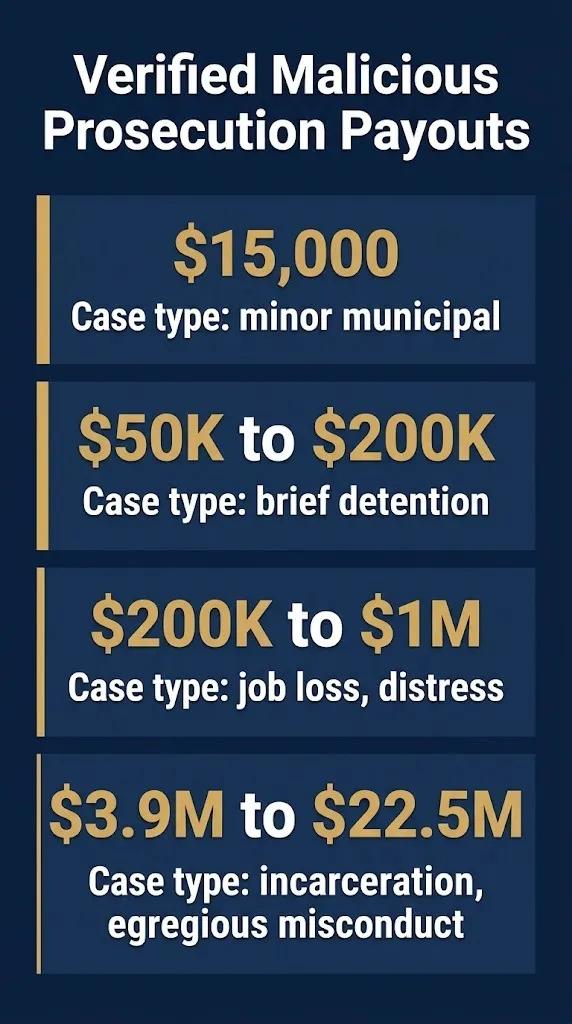
The verified range runs from $15,000 to $22.5 million, with most cases falling somewhere between $50,000 and $1 million.
A 2026 analysis by Lawsuit Talks grouped outcomes into four bands based on case severity :
| Case Tier | Typical Range | What It Reflects |
|---|---|---|
| Minor | $50,000 to $200,000 | Brief detention, limited reputational harm |
| Moderate | $200,000 to $1 million | Job loss, prolonged proceedings, emotional distress |
| Severe | $1 million to $10 million+ | Incarceration, career destruction, egregious misconduct |
| Record | $22.5 million | Mass fabrication of evidence, multiple plaintiffs |
Those bands are estimates drawn from reported outcomes, not guarantees. Your case could land outside them entirely.
Key Takeaway: Malicious prosecution payouts do not follow a formula. The verified spread runs from five figures to eight figures, and the facts of your case determine where you land.
How much did recent malicious prosecution settlements actually pay?
Recent verified payouts show the full spectrum, from a $15,000 municipal settlement to a $22.5 million county payout.
In April 2026, the City of Mount Vernon, New York, authorized a $15,000 settlement in Dennis Smith v. City of Mount Vernon. The payment was scheduled for July 14, 2026 .
In May 2026, a federal jury in New York awarded $2.25 million in Dominguez v. City of New York: $1.5 million in compensatory damages and $250,000 in punitive damages against each of three individual defendants .
In July 2026, Hackensack and Bergen County agencies settled former police chief Charles “Ken” Zisa’s federal lawsuit for $3.9 million. Zisa sought more than $29 million after his convictions were overturned .
In April 2025, Stanislaus County agreed to pay $22.5 million to eight plaintiffs who claimed police and prosecutors fabricated murder charges. It ranks among the largest malicious prosecution payouts in California history .
The lesson is not that one number is “right.” The lesson is that the defendant’s identity, the duration of the harm, and the clarity of the misconduct drive the outcome.
Why is there no standard payout for malicious prosecution?
Because the damages in each case are measured individually. There is no settlement fund to divide, no class list, and no claims administrator.
Compensatory damages in these cases cover economic losses (lost wages, legal fees, lost business), non-economic losses (emotional distress, reputational harm), and sometimes punitive damages when malice is clear .
A person who spent 287 days in pretrial detention and a person who spent 12 years in prison after a wrongful conviction are not in the same damages universe. Courts treat them differently because the harm is different.
The defendant matters too. Municipalities and counties are often self-insured and weigh settlement against the risk of a larger jury verdict. Individual defendants may have no ability to pay a large judgment at all .
What factors increase a malicious prosecution settlement?
The biggest drivers are imprisonment, documented financial loss, and clear evidence of malice. Cases with all three tend to produce the largest payouts.
Here is what moves the number, based on reported cases and legal analysis:
- Incarceration length. Derrick Deacon received $6 million from New York City after serving more than 24 years for a crime he did not commit .
- Documented economic loss. Lost wages, legal fees, and destroyed careers are compensable and easier to prove than emotional harm.
- Proof of malice. Fabricated evidence or personal vendettas create exposure to punitive damages. The Stanislaus case involved claims that prosecutors and investigators framed a defense attorney they disliked .
- Number of plaintiffs. The $22.5 million Stanislaus settlement covered eight plaintiffs, not one .
- Defendant’s resources. A city with insurance and a budget is a different defendant than an individual with no assets.
If your case involves a brief detention and no documented losses, expect the lower end. If it involves years of incarceration and clear misconduct, the ceiling is much higher.
Reality Check: No one texts you a malicious prosecution payout, and no third-party “claim helper” can get you money faster. Malicious prosecution is a lawsuit you file through an attorney, not a settlement fund you claim online. Filing a lawsuit is free; filing a fake claim through a paid service is how people lose money.
How long do malicious prosecution settlements take?
Most take one to three years from filing to resolution, and some take much longer. The Stanislaus case was filed in 2015 and settled in 2025 .
The timeline depends on whether the case settles early or goes to trial. Cases that survive summary judgment and approach trial often settle on the courthouse steps, as Stanislaus did .
A delayed tax refund is a rough comparison: you know money is coming, but the timeline is out of your hands. Malicious prosecution litigation works the same way, except the wait is measured in years, not weeks.
How do I file a malicious prosecution claim?
You file a civil lawsuit, typically in state or federal court, after the underlying criminal or civil case ends in your favor. There is no claim form and no administrator.
Here are the steps:
- Confirm the underlying case ended in your favor. Acquittal, dismissal, or reversal qualifies. A conviction that stands does not.
- Identify the defendant. The person or agency who initiated the prosecution without probable cause.
- Gather evidence of malice. Fabricated evidence, withheld exculpatory material, or documented personal motive.
- Document your losses. Pay stubs, legal bills, medical records, and anything showing reputational harm.
- Check your state’s deadline. Many states require filing within one year of the favorable termination.
- Consult a civil rights or tort attorney. Most take these cases on contingency.
You cannot file a malicious prosecution claim while the underlying case is still pending. The favorable termination must come first.
What is the deadline for filing a malicious prosecution lawsuit?
The deadline varies by state, but one year from the date of favorable termination is common. Missing it usually bars your claim permanently.
Court records from multiple jurisdictions show this pattern. In Pakistan, which follows a similar common-law framework, suits filed years after acquittal were dismissed as time-barred .
In the United States, the limitation period depends on the state and whether the claim is brought under state law or federal civil rights law. A federal Section 1983 malicious prosecution claim may follow the state’s personal injury limitation period, which can be longer.
The practical rule: do not wait. If you were acquitted or your case was dismissed, talk to an attorney before the one-year mark.
What happens next in a malicious prosecution case?
The path from acquittal to payout has predictable stages, though the timing varies widely.
Immediately after favorable termination: The clock starts on your filing deadline. Gather records and consult counsel.
Within the limitation period: Your attorney files the lawsuit. The defendant responds, and discovery begins.
Months to years later: Depositions, motions, and possibly mediation. Many cases settle at this stage.
If no settlement: Trial. A jury decides liability and damages.
After judgment or settlement: Payment follows, sometimes through insurance, sometimes through a government budget allocation.
There is no administrator to check and no claim portal to monitor. Your attorney is your source of information.
Frequently Asked Questions
Is there an average settlement for malicious prosecution?
No. No reliable national average exists. Verified payouts range from $15,000 to $22.5 million, and each case turns on its own facts.
How much can I get for a malicious prosecution claim?
It depends on your harm. Minor cases may settle for $50,000 to $200,000. Cases involving job loss or significant distress can reach $1 million. Incarceration and egregious misconduct push payouts into the millions.
What is the highest malicious prosecution settlement?
One of the largest verified payouts is the $22.5 million Stanislaus County settlement in 2025, covering eight plaintiffs who claimed fabricated murder charges.
Do I need a lawyer to file a malicious prosecution claim?
Yes, in practice. These cases require proof of malice, probable cause, and favorable termination. Most attorneys handle them on contingency, meaning you pay nothing upfront.
How long do I have to file?
It varies by state, but one year from the date your case ended in your favor is common. Missing the deadline usually ends your claim.
Can I sue a prosecutor for malicious prosecution?
Prosecutors generally have absolute immunity for actions within their official duties. You may be able to sue investigators or municipalities instead, depending on the facts.
What if the charges were dropped instead of acquitted?
A dismissal can qualify as a favorable termination, but it depends on the reason. A dismissal “with prejudice” is stronger than one without. Talk to an attorney about your specific outcome.
Is malicious prosecution a class action?
No. It is an individual tort claim. There is no class to join and no settlement fund to claim from.
What Happens Next
Now: If your case ended in your favor, find your favorable termination date. That starts the clock.
Within 30 days: Consult a civil rights or tort attorney in your state. Most consultations are free.
Before your state’s deadline: File the lawsuit. Do not wait for a “settlement” to appear, because none will.
One to three years out: Expect discovery, possible mediation, and either a settlement or trial.
The single most important fact: there is no average, and there is no fund. Your outcome depends on your facts, your proof, and your deadline.