What Is the Primary Feature of a Viatical Settlement in 2026?
Quick Answer
- The primary feature is the sale of a life insurance policy for immediate cash, typically 50% to 85% of face value.
- You must be terminally or chronically ill to qualify, generally with a life expectancy of 24 months or less.
- There is no deadline or claim form. This is a private contract you negotiate with a licensed provider, not a court settlement.
A viatical settlement lets you sell your life insurance policy while you are still alive. You get cash now. The buyer takes over the premiums and collects the death benefit when you die. That is the entire transaction in one sentence. This article breaks down who qualifies, how much you could receive, how the process works, and what risks to watch for in 2026.
Is a Viatical Settlement the Same as a Lawsuit Settlement?
No. A viatical settlement is not a lawsuit settlement or class action payout. It is a private contractual agreement between you and a licensed viatical settlement provider.
The confusion is understandable. Both use the word “settlement.” But they are completely different legal and financial instruments.
| Feature | Viatical Settlement | Lawsuit Settlement |
|---|---|---|
| What it involves | Sale of a life insurance policy | Resolution of a legal claim |
| Who pays | A licensed viatical provider | A defendant or insurer |
| Who receives money | The policyholder (viator) | The plaintiff or class member |
| Is there a court case? | No | Yes |
| Is there a deadline? | No fixed deadline | Usually yes |
| Is there a claim form? | No, you sign a contract | Often yes |
A viatical settlement is regulated under state insurance laws. A lawsuit settlement is governed by court rules and settlement agreements.
Who May Qualify for a Viatical Settlement in 2026?
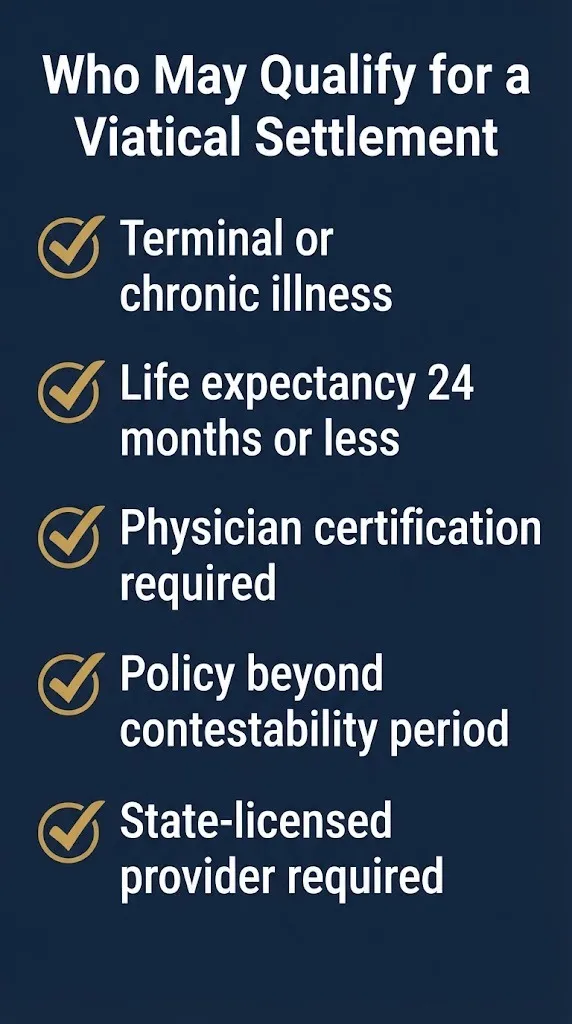
You may qualify for a viatical settlement if a physician certifies that you have a terminal or chronic illness with a life expectancy of 24 months or less. The exact standard depends on your state’s law and the provider’s underwriting .
Illinois law defines a terminal illness as one that a physician certifies is reasonably expected to result in death within 24 months . A chronic illness requires certification that you cannot perform at least two activities of daily living for 90 days, or that you need substantial supervision due to cognitive impairment .
Most providers focus on terminal diagnoses. But some buy policies from people with longer life expectancies. The shorter your life expectancy, the higher the percentage of face value you can typically receive.
Here is what providers look at:
- Your diagnosis and prognosis
- Your age
- The policy’s face value
- The policy type (term, whole, universal)
- The annual premium cost
- Whether the policy is still in its contestability period
Not yet determined: Exact eligibility rules vary by state and by provider. Check with your state insurance department for the licensed providers in your area.
How Much Money Can You Get from a Viatical Settlement?
Viatical settlement providers typically pay between 50% and 85% of the policy’s face value. The exact amount depends on your life expectancy, the policy size, and the premium schedule .
The shorter your life expectancy, the higher the percentage. A person with six months to live might get 80% of face value. Someone with 24 months might get 50% to 60%.
| Life Expectancy | Typical Payout Range |
|---|---|
| Under 12 months | 70% to 85% of face value |
| 12 to 24 months | 50% to 70% of face value |
| Longer (case by case) | Below 50%, varies widely |
On a $500,000 policy with a 12-month life expectancy, you might receive $300,000 to $350,000. The buyer pays the remaining premiums and collects the $500,000 death benefit when you die.
Key Takeaway: The payout percentage is negotiable and depends on your specific medical situation. Get multiple offers before accepting any deal.
Reality Check
No one calls you first with a viatical settlement offer. Legitimate providers do not cold-call terminally ill people. If someone contacts you out of nowhere claiming they can “unlock” your life insurance money for a fee, that is a scam. Viatical settlements are regulated transactions that require medical underwriting and state licensing. You initiate the process, not a stranger on the phone.
How Does the Viatical Settlement Process Work?
The process starts with you contacting a licensed viatical settlement provider or broker. You never pay anything upfront. The provider covers the cost of medical underwriting.
Here is the step-by-step process:
- Contact a licensed provider or broker. Your state insurance department has a list.
- Submit medical records. The provider’s underwriter estimates your life expectancy at no cost to you.
- Receive an offer. The provider quotes a lump sum based on your life expectancy and policy details.
- Accept or decline. You are never obligated to proceed.
- Sign the contract. State-approved documents spell out the full agreement. Both parties sign and notarize.
- Transfer ownership. The provider becomes the policy owner and beneficiary.
- Get paid. You receive your lump sum, usually within days of closing.
- Provider pays premiums. You have no more premium obligations.
The entire process typically takes 30 to 60 days from first contact to payment .
Are Viatical Settlement Proceeds Tax-Free in 2026?
Yes. Viatical settlement proceeds are generally exempt from federal income tax under IRC Section 101(g) when the insured is terminally or chronically ill. This is one of the biggest advantages over a traditional life settlement .
The tax exemption applies when:
- The insured is certified as terminally or chronically ill
- The buyer is a licensed viatical settlement provider
- The transaction meets federal requirements
Life settlements, by contrast, are generally taxable. If you are not terminally or chronically ill and sell your policy, you may owe income or capital gains taxes on the proceeds .
Not yet confirmed: State tax treatment may vary. Consult a tax professional before entering into any settlement.
What Is the Difference Between a Viatical Settlement and a Life Settlement?
A viatical settlement is for terminally or chronically ill people with short life expectancies. A life settlement is for older adults with longer life expectancies. The tax treatment is the main practical difference.
| Feature | Viatical Settlement | Life Settlement |
|---|---|---|
| Who qualifies | Terminally or chronically ill | Typically age 65+, health declined |
| Life expectancy | 24 months or less | 2 to 13 years |
| Tax treatment | Generally tax-free | Generally taxable |
| Payout range | 50% to 85% of face value | 10% to 25% of face value |
| Typical policy size | Any | $100,000+ |
Viatical settlements grew out of the AIDS crisis in the late 1980s. Terminally ill patients sold policies to pay for care. As HIV treatments improved and life expectancies lengthened, the market shifted toward life settlements for older adults .
Both are regulated under state insurance laws. The National Association of Insurance Commissioners has a model regulation that many states follow .
What Are the Risks of a Viatical Settlement?
The biggest risk is that you may receive far less than the policy’s death benefit. Your beneficiaries get nothing. You also lose the ability to change your mind after the sale.
Other risks include:
- You will not get full value. Providers need a profit margin. You receive a discounted lump sum.
- Your beneficiaries lose the death benefit. The buyer collects the full policy payout when you die.
- Premiums are no longer your problem, but also no longer your asset. You give up ownership completely.
- Some states restrict settlements within two years of policy issuance. Illinois, for example, prohibits viatical contracts within two years unless you are terminally or chronically ill .
- Tax rules are complex. While viatical proceeds are generally tax-free, state rules and individual circumstances vary.
If you have other assets or your beneficiaries do not need the death benefit, a viatical settlement can make sense. If your family depends on that money, think carefully.
How Do You Find a Licensed Viatical Settlement Provider?
You find a licensed provider by checking your state insurance department’s list. Every state that regulates viatical settlements maintains a roster of licensed providers and brokers .
Here is what to do:
- Contact your state insurance department and request the licensed provider list.
- Ask each provider for a written disclosure of fees and payout terms.
- Compare offers from at least two or three providers.
- Verify the provider’s license is current and in good standing.
- Read the contract carefully before signing anything.
- Do not pay any upfront fees. Legitimate providers cover underwriting costs.
A viatical settlement broker can shop your policy to multiple providers. Brokers must also be licensed in most states.
What Happens Next If You Are Considering a Viatical Settlement?
The next step is to gather your medical records and contact your state insurance department for a list of licensed providers. Here is the expected timeline:
- Week 1: Contact your state insurance department and request provider lists.
- Week 2 to 4: Submit medical records to two or three providers for life expectancy estimates.
- Week 4 to 6: Receive offers and compare payout percentages.
- Week 6 to 8: Accept an offer, sign contracts, and complete the transfer.
- Days after closing: Receive your lump sum payment.
There is no deadline to act. This is not a class action with a claims bar date. You can take your time and explore alternatives like accelerated death benefits through your insurer.
Frequently Asked Questions
What is the primary feature of a viatical settlement?
The primary feature is the sale of a life insurance policy by a terminally or chronically ill person for a lump-sum cash payment that is less than the death benefit.
How much can you get from a viatical settlement?
Providers typically pay 50% to 85% of the policy’s face value. The exact amount depends on your life expectancy and the policy details.
Do you have to be terminally ill for a viatical settlement?
You generally need a terminal or chronic illness with a life expectancy of 24 months or less. Some states and providers allow longer life expectancies on a case-by-case basis.
Are viatical settlement proceeds taxable?
Viatical settlement proceeds are generally exempt from federal income tax under IRC Section 101(g) when the insured is terminally or chronically ill.
Do you need a lawyer for a viatical settlement?
You do not need a lawyer, but reviewing the contract with a financial advisor or attorney is wise. The transaction is regulated and providers use state-approved documents.
What is the difference between a viatical settlement and an accelerated death benefit?
A viatical settlement involves selling your policy to a third-party provider. An accelerated death benefit is a feature of your own policy that lets you collect part of the death benefit early.
Is there a deadline to apply for a viatical settlement?
No. There is no court deadline or claims bar date. You can initiate the process whenever you choose, subject to your state’s rules.
Can you lose money in a viatical settlement?
No, you cannot lose money in the sense of paying out of pocket. But you may receive significantly less than the policy’s death benefit, and your beneficiaries receive nothing.
What You Should Do Now
If you are facing a terminal or chronic illness and struggling with medical bills, a viatical settlement is one option among several. Check with your life insurance company first about accelerated death benefits. They may offer a better deal with less paperwork. The most important number to remember is 24 months. That is the life expectancy threshold that defines most viatical settlements and unlocks the tax-free treatment under federal law.