Estate Litigation Attorney Near Me 2026: How to Vet One, What It Costs, and the Deadlines That Close Fast
Quick Answer
- Is there a real way to find one? Yes. Use your state bar’s license lookup and certified referral services, not sponsored ads.
- How much does it cost? Hourly rates commonly run $200 to $500 or more, and contingency fees in estate cases often land between 33% and 40% of the recovery.
- What is the deadline? Deadlines vary by state. In California, a will contest generally must be filed before probate is admitted, or within 120 days after admission in some cases.
You searched “estate litigation attorney near me” because a will or trust is being challenged, or because you think it should be. The honest answer is that no government agency ranks estate litigators, and no directory can tell you who will win your family’s dispute.
What you can do is verify the credentials your state actually tracks. Every licensed attorney has a public record. In California, that record lives on the State Bar’s website and shows license status and any discipline. That is your starting point, not the first ad you see.
This article explains how to vet an estate litigator, what the fee structures actually look like, which court deadlines close fastest, and the questions that separate a real trial lawyer from a marketer.
The Facts
| Item | Verified Detail |
| Regulator | State bar associations license attorneys and publish discipline records. |
| Certified Specialty | No state bar certifies a general “estate litigation” specialty. |
| Hourly Rates | Michigan 2026 survey: median $350/hour across all practice types, 25th percentile $275, 75th percentile $465 . |
| Contingency Fees | California estate and trust litigation: generally 33⅓% to 40% of the recovery . |
| Will Contest Deadline (CA) | Generally before probate admission, or within 120 days after admission in some cases . |
| Standing Requirement | You must be an interested person, such as a named beneficiary, legal heir, or creditor . |
Is there a real “estate litigation attorney near me” service that actually verifies lawyers?
No. No court, bar, or government agency ranks estate litigation attorneys, and no “near me” search result is an official endorsement. The only credential a state bar verifies is the license itself, plus any narrow certified specialty, and “estate litigation” is not one.
What you can verify is the license record. In California, the State Bar’s attorney search shows whether an attorney is active, inactive, or disciplined . A suspended attorney cannot legally represent you in an estate dispute.
Certified lawyer referral services are a separate layer. These services are regulated by the state bar and must meet certain standards. They are not ranking services. They are matching services that can connect you with an attorney who handles your issue type.
Key Takeaway: The only credential a state bar actually verifies for an estate litigator is the license and any discipline record, and “estate litigation” is not a certified specialty in most states.
How much does an estate litigation attorney near me cost?
Estate litigation attorneys charge in one of three main ways: hourly, contingency, or a hybrid. The cost depends on your state, the attorney’s experience, and whether the case settles or goes to trial.
Hourly rates vary widely. A 2026 survey of Michigan attorneys found a median hourly rate of $350 across all practice types, with a 25th percentile of $275 and a 75th percentile of $465 . Rates in major metro areas tend to run higher.
| Fee Structure | What It Means for You |
| Hourly | You pay for every call, email, and filing. Common in estate administration disputes and defense work. |
| Contingency | The attorney takes a percentage of what you recover. In California estate and trust litigation, generally 33⅓% to 40% . |
| Hybrid | A reduced hourly rate plus a contingency on the back end. |
| Flat fee | A set price for a defined task, such as a demand letter or a probate petition. |
A contingency fee is not a free lawyer. It is a bet. The attorney advances time and often costs, and gets paid from the recovery. If there is no recovery, you may owe nothing in attorney fees, but you may still owe litigation costs.
Reality Check: No legitimate estate litigation attorney will promise a specific inheritance amount over the phone before reading the will or trust. Any attorney who guarantees a result is either not listening or not being honest. The state bar does not certify case outcomes, only licenses and narrow specialties.
Who qualifies to file an estate lawsuit or will contest?
You can file an estate lawsuit or will contest only if you have standing, meaning a legal right to challenge the document. In California, standing generally requires that you be an interested person, such as a named beneficiary, a legal heir who would inherit if the document were invalid, or a creditor with a financial stake .
Being a family member is not enough by itself. If the current will leaves you nothing and you would inherit nothing under intestacy rules, you likely lack standing. A court will dismiss the case.
The grounds for a contest are also limited. Common grounds include lack of capacity, undue influence, fraud or forgery, and improper execution . Suspicion alone is not a ground.
What are the grounds to contest a will or trust?
You can contest a will or trust on specific legal grounds: lack of capacity, undue influence, fraud or forgery, or improper execution. A court will not invalidate a document because you think it is unfair.
Lack of capacity means the person did not understand what they were signing, what assets they had, or who their natural heirs were . A dementia diagnosis alone is not enough. The question is whether they understood those things at the moment of signing.
Undue influence means someone pressured or manipulated the person into changing their estate plan. Courts look for a confidential relationship, active involvement in drafting, and an unexpected benefit to the influencer .
Fraud or forgery means someone tricked the person into signing, forged a signature, or altered the document. Improper execution means the will was not signed and witnessed according to state law.
How do I find and vet an estate litigation attorney near me?
You find a vetted estate litigator by starting with the state bar license lookup, then using a certified referral service or a direct consultation. Do not start with a paid directory ad.
Here are the steps:
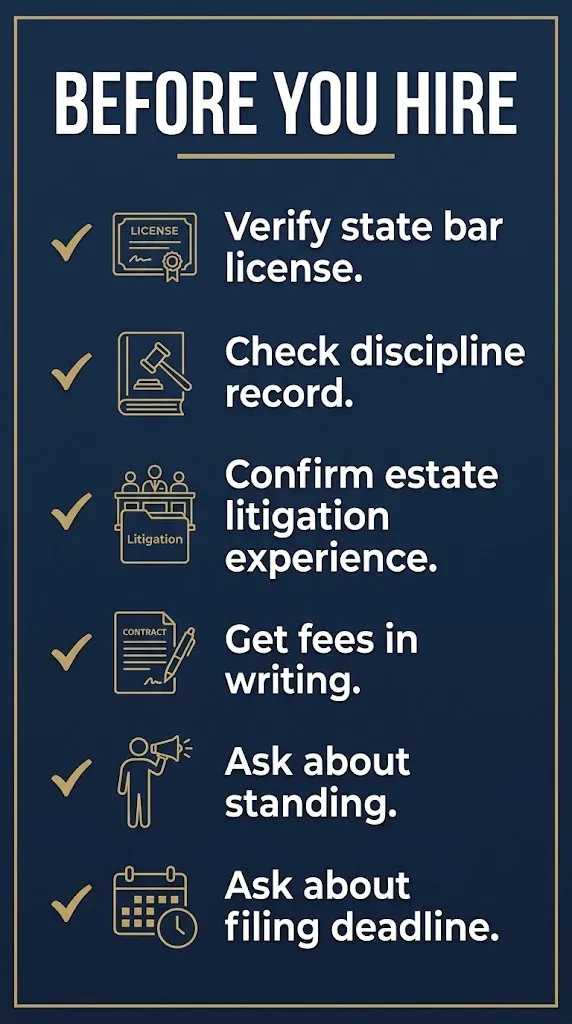
- Search the state bar license lookup. Verify active status and check for discipline.
- Use a certified lawyer referral service. These services are regulated and can match you by practice area.
- Ask about specific estate litigation experience. Probate administration is not the same as litigation.
- Ask who will do the work. The partner you meet may not be the associate drafting your motions.
- Get the fee agreement in writing. Hourly rate, contingency percentage, costs, and who advances expenses.
- Ask about the statute of limitations. Estate deadlines are short and often unforgiving.
- Ask what evidence they need from you. Medical records, prior wills, and financial documents.
A referral is not a retainer. Treat the first consultation as an interview, not a sales pitch.
What is the deadline to file an estate lawsuit?
The deadline to file an estate lawsuit depends on your state and the type of challenge. In California, a will contest generally must be filed before the will is admitted to probate. Once admitted, you typically have 120 days to file a challenge in some circumstances .
Trust challenges have different timelines. The clock may depend on when you received notice of the trust and whether the trustee complied with notice requirements.
| Claim Type | General Deadline (CA) | Notes |
| Will contest | Before probate admission, or within 120 days after admission in some cases | The clock can start when you receive notice . |
| Trust challenge | Varies by notice and compliance | Depends on trustee notice and trust administration rules. |
| Breach of fiduciary duty | Varies by discovery | The clock may start when you knew or should have known. |
Estate deadlines are not like a tax refund you can file late. Miss the deadline and the document stands, no matter how valid your concerns.
What happens after you hire an estate litigation attorney?
After you hire an estate litigator, the first phase is usually a case assessment and evidence gathering. The attorney will review the will or trust, medical records, and financial documents, then advise you on whether to file a contest or negotiate.
The typical sequence looks like this:
- Week 1 to 2: Document review and standing assessment.
- Week 2 to 4: Demand letter or negotiation with the other side.
- Month 1 to 3: Petition or complaint filing, if negotiation fails.
- Month 3 to 12: Discovery, depositions, and mediation.
- Month 12 to 24: Trial, if the case does not settle.
Most estate disputes settle before trial. The threat of a well-pleaded contest and a credible litigator often moves negotiations faster than a courtroom date.
Frequently Asked Questions
How do I find a good estate litigation attorney near me?
Start with your state bar’s license lookup and a certified lawyer referral service. Verify the license and discipline record before booking a consultation.
How much does an estate litigation attorney charge per hour?
Rates vary by market and experience. A 2026 survey found a median hourly rate of $350 across all practice types, with a 25th percentile of $275 and a 75th percentile of $465 .
Can I hire an estate litigation attorney on contingency?
Yes, in some cases. Contingency fees in California estate and trust litigation generally run from 33⅓% to 40% of the recovery . Not every case qualifies.
What is the deadline to contest a will in California?
Generally before the will is admitted to probate, or within 120 days after admission in some cases . The clock can start when you receive notice.
Do I need standing to contest a will?
Yes. You must be an interested person, such as a named beneficiary, a legal heir, or a creditor with a financial stake .
What is the difference between estate planning and estate litigation?
Estate planning is creating wills and trusts. Estate litigation is disputing them in court. Some firms do both, but they are different skill sets.
How long does an estate lawsuit take?
Most estate disputes settle within 6 to 18 months. Cases that go to trial can take two years or more.
What Happens Next
The next stages depend on your state and the type of challenge, but the sequence is predictable.
- Immediately: Verify the attorney’s license and check the deadline for your challenge.
- Within days: Gather the will or trust, medical records, and any prior estate documents.
- Within weeks: Consult an estate litigator and get a written fee agreement.
- Within months: File the contest or negotiate a settlement.
- TBD: Trial date, if the case does not settle.
What You Should Do Now
Start with the state bar license lookup, not a sponsored ad. Verify the license and check the discipline record of any attorney you are considering. Then gather the will or trust and any medical records that might support a challenge.
The one date that matters most is your state’s deadline to contest the document. Ask the attorney about that clock in the first meeting. Miss it and the document stands.