Construction Litigation Lawyer 2026: When to Hire One, Costs, and What to Expect
Quick Answer
- A construction litigation lawyer handles disputes over building defects, contract breaches, payment claims, and site injuries.
- Legal fees vary widely, from $300 to $800 per hour, or contingency fees of 30 to 40 percent for injury claims.
- The most important deadline is your state’s statute of limitations, often 2 to 10 years depending on the claim type.
You are a contractor, a property owner, a developer, or a subcontractor. Something went wrong on a construction project. You are not getting paid. The work is defective. Someone got hurt. You searched for a construction litigation lawyer because you need to know if you have a case and what it will cost to pursue it.
Here is the direct answer. A construction litigation lawyer handles legal disputes arising from construction projects. That includes payment disputes, defect claims, contract breaches, bond claims, and personal injury cases on job sites.
This guide explains what construction litigation is, when you need a lawyer, what it costs, and how these cases unfold. One surprising verified fact: many construction disputes are resolved through arbitration or mediation, not courtroom trials, because most construction contracts include mandatory alternative dispute resolution clauses.
The Facts
| Item | Detail |
|---|---|
| Practice Area | Construction law and litigation |
| Common Disputes | Defects, payment, delays, contract breaches |
| Attorney Fee Range | $300 to $800 per hour |
| Contingency Fee | 30 to 40 percent for injury cases |
| Statute of Limitations | 2 to 10 years depending on claim and state |
| Common Forums | State court, federal court, arbitration |
| Alternative Dispute Resolution | Common; often required by contract |
| Average Case Duration | 12 to 36 months |
What Is a Construction Litigation Lawyer?
A construction litigation lawyer is an attorney who represents clients in legal disputes involving construction projects. The lawyer handles everything from pre-litigation negotiation through trial or arbitration.
Construction litigation is a specialized practice. It requires understanding of construction contracts, building codes, industry standards, insurance policies, and mechanics lien laws. A general litigator may not know the specific rules that govern construction disputes.
The lawyer’s clients include property owners, general contractors, subcontractors, developers, architects, engineers, and suppliers. Any party to a construction project can end up in litigation.
The work includes drafting pleadings, conducting discovery, taking depositions, working with construction experts, and negotiating settlements. If a case cannot settle, the lawyer presents it at trial or arbitration.
When Should You Hire a Construction Litigation Lawyer?
You should hire a construction litigation lawyer when a construction dispute threatens your money, your property, or your business. The earlier you get legal advice, the better.
Common situations that call for a construction litigation lawyer include:
- A contractor refuses to fix defective work
- A property owner refuses to pay for completed work
- A subcontractor files a mechanics lien against your property
- A construction site injury leaves a worker unable to work
- A project delay causes significant financial losses
- A contract dispute arises over scope, changes, or materials
- An insurance company denies coverage for construction-related damage
You do not need a lawyer for every small dispute. A $2,000 disagreement over paint color may not justify legal fees. But a $200,000 dispute over structural defects does.
Key Takeaway: The size of the dispute and the risk to your property or business determine whether hiring a construction litigation lawyer makes sense.
How Much Does a Construction Litigation Lawyer Cost?
A construction litigation lawyer typically charges $300 to $800 per hour, though some cases are handled on contingency or flat fee arrangements.
Hourly billing is the most common fee structure in construction litigation. The exact rate depends on the lawyer’s experience, the firm’s location, and the complexity of the case. A senior partner at a large firm may charge $700 or more per hour. A junior associate may charge $300.
For personal injury cases arising from construction site accidents, lawyers often work on contingency. This means the lawyer receives 30 to 40 percent of the settlement or verdict, and you pay nothing upfront.
Some lawyers offer flat fees for specific tasks, such as drafting a demand letter or reviewing a contract. This is less common in full litigation matters.
What Types of Cases Do Construction Litigation Lawyers Handle?
Construction litigation lawyers handle several categories of disputes. The most common are payment disputes, defect claims, delay claims, and personal injury cases.
Payment disputes arise when one party does not pay for work performed. A contractor may sue a property owner for nonpayment. A subcontractor may file a mechanics lien and then sue to foreclose on it.
Defect claims involve allegations that construction work was performed improperly. A property owner may sue a contractor for defective workmanship. A contractor may sue a subcontractor for defective materials or installation.
Delay claims involve financial losses from project delays. A contractor may seek additional compensation for delays caused by the owner. An owner may seek damages from a contractor who failed to complete work on time.
Personal injury cases involve workers or third parties injured on construction sites. These cases often involve claims against multiple parties, including the general contractor, subcontractors, and property owners.
Key Takeaway: Construction litigation covers payment, defects, delays, and injuries. The type of case determines the applicable law and the likely forum.
What Is the Difference Between Construction Litigation and Arbitration?
Construction litigation happens in court. Arbitration happens outside court, before a private arbitrator or panel. Many construction contracts require arbitration instead of litigation.
Arbitration is generally faster and more private than court. It also tends to be less formal. But arbitration is not always cheaper. You still pay the arbitrator’s fees, which can be substantial.
The key difference is finality. Arbitration awards are difficult to appeal. A court judgment can be appealed through multiple levels. If you lose in arbitration, you are usually stuck with the result.
Before filing any construction dispute, check your contract for an arbitration clause. If one exists, you may be required to arbitrate rather than file a lawsuit.
Reality Check
No legitimate construction litigation lawyer will guarantee an outcome. No legitimate lawyer will tell you a case is a “slam dunk.” Construction cases are document-heavy, expert-dependent, and often turn on details that are not clear until discovery. If a lawyer promises a quick victory or a specific dollar amount before seeing your contract and project records, that is a sales pitch, not legal advice.
What Should You Do Before Hiring a Construction Litigation Lawyer?
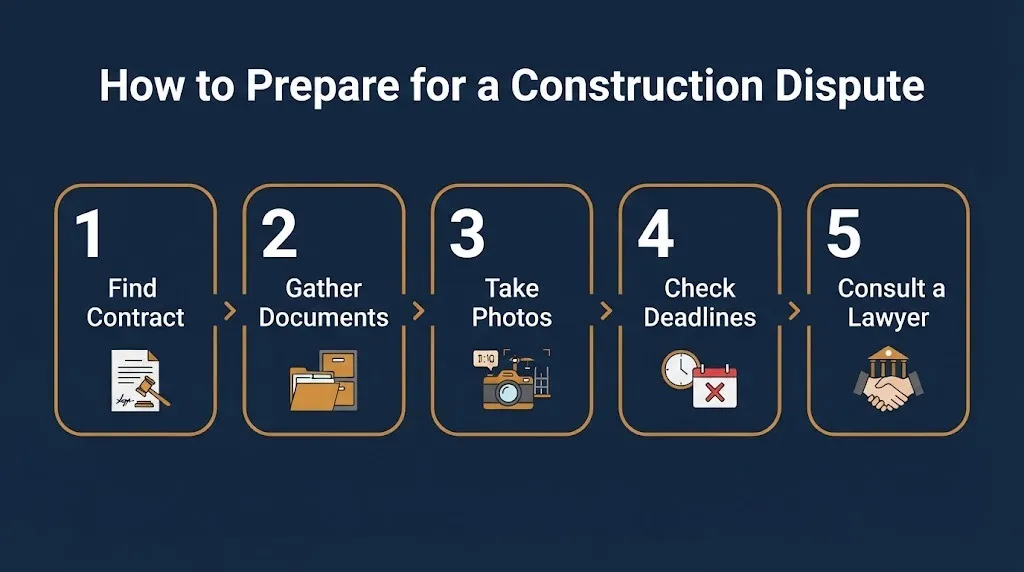
You should gather your documents and understand your contract before hiring a construction litigation lawyer. The lawyer will need specific information to evaluate your case.
Here is a checklist:
- Locate the full signed contract, including all change orders and amendments.
- Gather all correspondence, including emails and text messages about the dispute.
- Collect payment records, invoices, and receipts.
- Take photos of the defective work or site conditions.
- Identify all parties involved, including subcontractors and suppliers.
- Note any deadlines in the contract for claims or notices.
- Check for insurance policies that may cover the dispute.
The more organized you are, the more useful your initial consultation will be.
How Do Construction Litigation Lawyers Evaluate a Case?
A construction litigation lawyer evaluates a case by reviewing the contract, the facts, the damages, and the available evidence. The lawyer looks for liability, causation, and collectability.
Liability means who is legally responsible. The contract often defines liability. A contractor who failed to perform according to specifications may be liable. A property owner who failed to pay may be liable.
Causation means the link between the wrongful act and the harm. A defect claim requires proof that the contractor’s work caused the defect, not that the defect existed before or resulted from owner misuse.
Collectability means whether the responsible party can pay a judgment or settlement. A claim against a bankrupt contractor may not be worth pursuing.
How Long Does Construction Litigation Take?
Construction litigation typically takes 12 to 36 months from filing to resolution. Complex cases with multiple parties can take longer.
The timeline depends on the court’s schedule, the complexity of the technical issues, and the willingness of the parties to settle. Cases involving expert witnesses, multiple defendants, and large document sets move slowly.
Arbitration is often faster, but not always. A complex construction arbitration can still take 12 to 24 months.
The slow pace is one reason many parties try to settle before filing. A negotiated resolution avoids the cost and delay of full litigation.
Key Takeaway: Construction litigation is not fast. Expect 12 to 36 months, and plan your finances accordingly.
Can You Settle a Construction Dispute Without a Lawyer?
Yes, you can settle a construction dispute without a lawyer. Many disputes resolve through direct negotiation, mediation, or a formal demand letter.
If the dispute is small and the facts are clear, you may not need a lawyer. A well-written demand letter that states your position, cites the contract, and requests a specific resolution can produce results.
But if the other side has a lawyer, or if the stakes are high, going without representation puts you at a disadvantage. The other side’s lawyer will know the law better than you do.
Mediation is a middle ground. A neutral mediator helps both sides reach a settlement. Many courts require mediation before trial. You can attend mediation without a lawyer, but having one improves your position.
What Is a Mechanics Lien in Construction Litigation?
A mechanics lien is a legal claim against a property for unpaid construction work. It gives contractors, subcontractors, and suppliers a security interest in the property they improved.
Filing a mechanics lien is a powerful tool. It can prevent the property owner from selling or refinancing the property until the debt is resolved. It can also pressure the owner to pay.
Mechanics lien laws vary by state. The deadlines are strict. In many states, you must file a preliminary notice within a certain number of days after starting work, and you must file the lien itself within a specific window after completing work.
A construction litigation lawyer can help you file a valid mechanics lien and then sue to foreclose on it if necessary.
What Are Common Defenses in Construction Litigation?
Common defenses in construction litigation include claims that the work was performed correctly, that the owner caused the problem, that the claim is barred by the statute of limitations, or that the claimant failed to follow contract procedures.
In a defect case, the contractor may argue that the work met industry standards and the owner’s expectations were unreasonable. The contractor may claim the defect resulted from owner misuse or lack of maintenance.
In a payment case, the owner may argue that the work was incomplete, defective, or not performed according to the contract. The owner may also counterclaim for the cost of fixing defects.
Procedural defenses matter. Many contracts require written notice of a claim within a specific timeframe. Failing to provide that notice can bar the claim.
What Should You Look for in a Construction Litigation Lawyer?
You should look for a construction litigation lawyer with specific experience in construction disputes, a track record of results, and clear communication.
Ask these questions during your consultation:
- How many construction cases have you handled?
- Have you handled cases involving my type of dispute?
- Who will actually work on my case?
- What is your fee structure, and what costs should I expect?
- What is your honest assessment of my case?
- Will my case likely go to arbitration or court?
- How long do you expect the case to take?
A good lawyer answers directly. A bad lawyer gives vague assurances.
Key Takeaway: Experience, honesty, and clear communication matter more than a fancy office or a big advertising budget.
What Happens Next
Here is the typical timeline for a construction litigation matter:
- Weeks 1 to 4: Attorney reviews contract, documents, and evaluates the claim.
- Month 1: Demand letter sent to the opposing party.
- Months 1 to 3: Settlement negotiations or mediation.
- If no settlement: Complaint filed or arbitration initiated.
- Months 3 to 18: Discovery, depositions, and expert reports.
- Months 12 to 24: Pretrial motions and further settlement talks.
- Months 18 to 36: Trial or arbitration hearing, decision issued.
Frequently Asked Questions
Do I need a lawyer for a small construction dispute?
No, you can handle small disputes yourself through negotiation or small claims court.
The threshold for small claims varies by state, typically $3,000 to $12,500.
A lawyer becomes necessary when the stakes exceed that amount.
Can I sue a contractor for defective work?
Yes, you can sue a contractor for defective work if the contractor breached the contract or performed negligently.
You must prove the work was defective and the contractor caused the defect.
Documentation and expert testimony are essential.
What is the statute of limitations for construction defects?
The statute of limitations for construction defects varies by state and claim type.
It is often 2 to 10 years from the date the defect was discovered or should have been discovered.
Check your state’s specific rules immediately.
Can a subcontractor sue a property owner directly?
In some cases, yes. A subcontractor may file a mechanics lien and sue the property owner for nonpayment.
The rules vary by state.
A construction litigation lawyer can explain your rights.
What happens if I lose a construction arbitration?
The arbitration award is binding and difficult to appeal.
You will be required to pay the award.
You cannot relitigate the same dispute in court.
How much does construction litigation cost total?
Total litigation costs range from $50,000 to over $500,000 depending on complexity.
Attorney fees, expert fees, and discovery costs drive the total.
Smaller cases often settle before costs escalate.
Can I recover attorney fees in construction litigation?
You can recover attorney fees only if your contract includes a fee-shifting provision or a statute allows it.
Many construction contracts include clauses awarding fees to the prevailing party.
Check your contract before filing.
Gather Your Contract and Act Before the Deadline
The most important document in any construction dispute is the contract. It defines who owes what, what procedures apply, and often whether you must arbitrate instead of going to court. Find it before you do anything else.
After that, check your deadlines. Statutes of limitations and contract notice requirements move fast. Missing one can cost you the entire case.
The single most important action: consult a construction litigation lawyer before the deadline passes, not after.