Workers Comp NC: Requirements, Benefits, and Claim Rules for 2026
Quick Answer
- North Carolina requires most employers with three or more employees to carry workers compensation insurance.
- Injured workers may qualify for medical benefits and weekly wage replacement at two-thirds of average weekly wage.
- You must report a workplace injury to your employer within 30 days to protect your right to benefits.
If you were hurt on the job in North Carolina, you are likely trying to figure out whether your employer has coverage, how much you might receive, and what deadlines apply. This article gives you verified answers.
The North Carolina Industrial Commission oversees the state’s workers compensation system. It handles disputes, approves settlements, and sets the rules that insurers and employers must follow.
One fact surprises most workers: North Carolina employers with fewer than three employees are generally not required to carry workers compensation insurance. That exemption affects thousands of small business workers across the state.
The Facts
| Case | North Carolina Workers Compensation Act, state system |
| Status | Active, regulated by the North Carolina Industrial Commission |
| Fund Size | No single fund; each insurer maintains reserves |
| Est. Per Person | Two-thirds of average weekly wage, capped at state maximum |
| Claim Deadline | Report within 30 days; file Form 18 within 2 years |
| Administrator | North Carolina Industrial Commission |
| Proof Needed | Medical records, incident report, wage documentation |
Is Workers Compensation Required in North Carolina?
Yes, most North Carolina employers must carry workers compensation insurance. The requirement applies to any employer with three or more regular employees, including part-time workers.
The three-employee threshold is lower than some states and higher than others. A regular employee includes anyone whose work is part of the employer’s normal operations, even if they are part-time or seasonal in some cases.
Certain industries have stricter rules. Agricultural employers must provide coverage if they have 10 or more full-time non-seasonal workers. Domestic workers are generally exempt unless they work a certain number of hours.
If your employer was required to have coverage and did not, you can still file a claim. The North Carolina Industrial Commission may penalize the employer, and you may have access to the state’s Uninsured Employers Fund.
Key Takeaway: North Carolina requires coverage for employers with three or more employees, but exemptions exist for small farms and domestic workers.
What Are the NC Workers Compensation Requirements for Employers?
Employers in North Carolina must obtain workers compensation insurance through a private carrier or become self-insured if they qualify. The insurance must cover all eligible employees from the first day of work.
Employers must post a notice explaining workers compensation rights in a visible location. The notice must include the insurer’s name and contact information.
If an injury occurs, the employer must file a Form 19 with the North Carolina Industrial Commission within five days of learning about the injury. The insurer then has 14 days to accept or deny the claim.
Failure to file the Form 19 or provide coverage can lead to fines, criminal charges, and personal liability for the employer. The Industrial Commission has authority to enforce these penalties.
How Much Does NC Workers Compensation Pay?
North Carolina pays injured workers two-thirds of their average weekly wage, subject to a maximum weekly amount set annually by the Industrial Commission.
The maximum weekly benefit for 2026 is adjusted each year based on the state average weekly wage. In recent years, the maximum has been approximately 1,200 to 1,300 dollars per week. You should check the official Industrial Commission website for the current figure.
There is also a minimum weekly benefit. Workers with very low wages may receive a set minimum amount if the two-thirds calculation falls below it.
Temporary total disability payments begin after a seven-day waiting period. If the disability lasts more than 21 days, the waiting period is paid retroactively.
| Benefit Type | NC Rate | 2026 Cap |
|---|---|---|
| Temporary Total Disability | 66.67% of average weekly wage | Set annually by Industrial Commission |
| Temporary Partial Disability | 66.67% of wage difference | Set annually |
| Permanent Partial Disability | Based on impairment rating | Varies by body part |
| Death Benefits | 66.67% of wage for dependents | Up to 500 weeks |
How Long Do NC Workers Compensation Benefits Last?
Temporary total disability benefits in North Carolina can last until the employee reaches maximum medical improvement or returns to work. There is no arbitrary cap on temporary disability duration.
Permanent partial disability benefits are paid for a set number of weeks based on the body part injured and the impairment rating. The Industrial Commission uses a schedule that assigns specific weeks to each body part.
For example, a 10 percent impairment to the back may result in a specific number of weeks of permanent partial disability benefits. The exact number depends on the rating and the schedule.
Permanent total disability benefits may continue for the employee’s lifetime in the most severe cases, though these are rare and require proof of total incapacity.
Key Takeaway: Temporary benefits last until recovery or maximum medical improvement, while permanent benefits follow a state-set schedule.
What Is the Deadline to Report a Workplace Injury in NC?
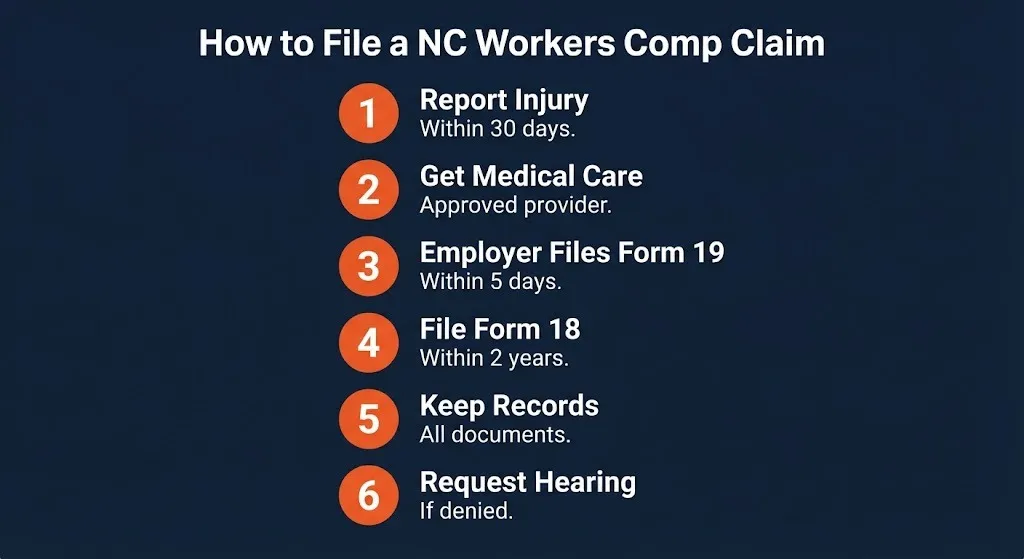
You must report a workplace injury to your employer within 30 days in North Carolina. Failing to report within 30 days can bar your claim entirely, with limited exceptions.
The formal claim, known as Form 18, must be filed with the North Carolina Industrial Commission within two years of the injury date. This is the statute of limitations.
The 30-day reporting rule applies to the initial notice to your employer. You can satisfy it verbally, but written notice is better. The two-year rule applies to filing the formal claim with the commission.
If your injury is an occupational disease that develops over time, the two-year clock starts when you knew or should have known the condition was work-related.
How Do I File a Workers Comp Claim in North Carolina?
Filing correctly is the most important step you control. The process has several steps, and missing one can delay or deny your benefits.
- Report the injury to your supervisor immediately, in writing if possible.
- Seek medical treatment from an approved provider if your employer directs one.
- Confirm that your employer files a Form 19 within five days.
- Complete and submit Form 18 to the North Carolina Industrial Commission.
- Keep copies of every form, medical record, and correspondence.
- Follow all treatment recommendations from your authorized treating physician.
- Contact the Industrial Commission if your claim is denied or benefits stop.
Can My Employer Fire Me for Filing a Workers Comp Claim in NC?
North Carolina law prohibits employers from firing or retaliating against an employee for filing a workers compensation claim. The protection is not absolute, but retaliation is illegal.
If you believe you were fired or demoted because you filed a claim, you may have a separate legal claim. The North Carolina Retaliatory Employment Discrimination Act covers this situation.
Proving retaliation requires showing a connection between your claim and the adverse action. Timing, comments from supervisors, and inconsistent treatment of other injured workers all matter.
A separate lawsuit can seek lost wages, reinstatement, and sometimes additional damages. This claim is distinct from your workers compensation claim and may require a different attorney.
Key Takeaway: North Carolina law protects workers from retaliation for filing claims, but proving retaliation requires evidence of a connection.
What If My NC Workers Comp Claim Is Denied?
If your workers compensation claim is denied in North Carolina, you have the right to request a hearing before the North Carolina Industrial Commission.
The insurer must state the specific reason for denial in writing. Common reasons include disputes over whether the injury is work-related, whether you reported it on time, and whether medical treatment is necessary.
You can file a Form 33 to request a hearing. The Industrial Commission will schedule a mediation or formal hearing before a deputy commissioner.
Many denied claims are settled or reversed at this stage. You have the right to present evidence, call witnesses, and cross-examine the insurer’s witnesses.
If the deputy commissioner’s decision is unfavorable, you can appeal to the full commission and then to the North Carolina Court of Appeals.
Reality Check
No one from the North Carolina Industrial Commission or a legitimate insurer will call you to demand payment or personal information to “process” your benefits. Filing a claim is free. Third-party services that charge a fee to help you file a workers comp claim are unnecessary and often target injured workers with aggressive marketing.
How Are NC Workers Comp Settlements Structured?
North Carolina workers comp settlements can take two forms. A clincher agreement closes all aspects of the claim, including future medical benefits. A compromise settlement agreement, or CSA, resolves disputed issues while leaving some benefits open.
Clinchers pay a lump sum and end the case completely. The insurer has no further obligation, and you cannot reopen the claim later. These are common when the injury is stable and both sides want finality.
Compromise settlement agreements settle part of the dispute, often the wage replacement portion, while leaving medical benefits open. These are common when the insurer disputes the injury severity but agrees to pay some compensation.
All settlements in North Carolina require approval from the Industrial Commission. A deputy commissioner reviews the agreement to ensure it is fair and not the result of fraud or duress.
| Settlement Type | What It Covers | Can It Be Reopened |
|---|---|---|
| Clincher | All benefits, including medical | No |
| Compromise Settlement | Agreed portion only | Partial, depending on terms |
| Form 26A | Full and final | No |
| Form 26 | Partial settlement | Yes, for unaddressed issues |
What Is the NC Workers Comp Waiting Period?
North Carolina has a seven-day waiting period before temporary total disability benefits begin. No benefits are paid for the first seven days of disability.
If your disability lasts more than 21 days, the waiting period is paid retroactively. This means you will receive payment for the first week if you are out of work for at least 22 days total.
The waiting period applies to temporary disability, not medical benefits. Medical treatment is covered from the first day, regardless of the waiting period.
Many workers misunderstand the waiting period. It does not mean you receive nothing for the first week if your injury is serious. It simply delays wage replacement until the eighth day of disability.
What Medical Treatment Is Covered Under NC Workers Comp?
North Carolina covers all reasonable and necessary medical treatment related to your workplace injury. This includes doctor visits, surgery, physical therapy, prescriptions, and medical equipment.
Your employer or their insurer may direct your medical treatment. North Carolina allows employers to choose the treating physician, at least initially.
If you are unhappy with the authorized physician, you can request a change of physician. The Industrial Commission may approve a change if you can show good reason.
There are no copays or deductibles for approved treatment. The insurer pays the provider directly, subject to a fee schedule set by the state.
Key Takeaway: Medical benefits start immediately, but employers control initial treatment choices in North Carolina.
Who Is Covered by NC Workers Compensation?
Most employees in North Carolina are covered, but significant exceptions exist. Independent contractors, sole proprietors, and some agricultural and domestic workers are not automatically covered.
The distinction between employee and independent contractor matters. North Carolina uses a multi-factor test that looks at control, payment method, and the nature of the work relationship.
Some employers misclassify workers as independent contractors to avoid paying workers compensation premiums. If you believe you were misclassified, the Industrial Commission can determine your true status.
Corporate officers and LLC members may opt out of coverage in some circumstances. This is an election made in writing and filed with the Industrial Commission.
What Happens Next
January 2026: Updated maximum weekly benefit rates take effect for injuries occurring on or after January 1.
Ongoing: The North Carolina Industrial Commission continues processing claims and scheduling hearings.
If you have an open claim: Confirm your treating physician’s latest report and check for any scheduled hearings.
If you have not filed yet: Report the injury immediately and submit Form 18 within two years of the injury date.
Frequently Asked Questions
Is workers comp required in North Carolina?
Yes, for employers with three or more regular employees.
Some agricultural and domestic employers have higher thresholds or exemptions.
How much does NC workers comp pay?
It pays two-thirds of your average weekly wage, up to the state maximum.
The maximum weekly amount is set annually by the Industrial Commission.
How long do I have to report a work injury in NC?
You must report the injury to your employer within 30 days.
You must file a formal claim with the Industrial Commission within two years.
Can I choose my own doctor for a NC workers comp injury?
Your employer or insurer may direct your initial medical treatment.
You can request a change of physician through the Industrial Commission.
What if my employer does not have workers comp insurance in NC?
You can still file a claim through the Uninsured Employers Fund.
The employer may face fines and criminal penalties.
Are NC workers comp settlements taxable?
Workers compensation benefits are generally not taxable.
Settlement payments follow the same rule, but consult a tax professional for your specific situation.
How long does a NC workers comp case take?
Simple claims may resolve in a few months.
Contested claims can take a year or more through the hearing process.
Can I sue my employer for a work injury in NC?
Workers compensation is generally your exclusive remedy.
You may sue third parties whose negligence caused your injury.
Your next step depends on where you are in the process. If you have not reported the injury, do it today. If your claim is pending, check the status with the Industrial Commission. If your benefits stopped, file a hearing request immediately.
The North Carolina system is built on deadlines. Miss one, and you may lose benefits you would otherwise receive. The most important date is the 30-day report deadline from your injury date.