How Is Workman’s Compensation Calculated in 2026? The Formula, Rates, and Real Numbers
Quick Answer
- What it is: Workers’ comp pays a percentage of lost wages, usually 66⅔% of your average weekly wage, tax-free.
- How much: Benefits range from $0 to over $1,394/week depending on your state and earnings.
- Key number: Pennsylvania’s 2026 statewide average weekly wage is $1,394, up 3.5% from 2025.
If you got hurt at work, you are probably staring at a benefits letter wondering how they landed on that number. The short answer: workman’s compensation is calculated as a percentage of your average weekly wage, capped at a state maximum that changes every January.
The formula sounds simple, but the math behind it is where cases get won and lost. Insurance carriers run their own wage calculations, and errors that shrink your weekly check are common. Understanding how your state computes AWW and applies its rate tiers tells you whether the offer on the table is fair.
This article breaks down the exact formula states use, walks through real 2026 rate schedules, and explains what “average weekly wage” actually includes.
The Facts
| System | State-regulated no-fault workers’ compensation |
|---|---|
| Status | Active in all 50 states, rates updated January 1, 2026 |
| Base Formula | 66⅔% of average weekly wage (AWW) |
| PA 2026 Maximum | $1,394 per week |
| National Avg Settlement | $21,800 to $47,300 depending on source |
| Claim Deadline | Varies by state, typically 2 to 3 years from injury |
| Administrator | State workers’ comp board or commission |
| Proof Needed | Medical records, wage statements, incident report |
Is Workman’s Compensation Calculated the Same in Every State?
No. Workman’s compensation is calculated differently in every state, though most follow a similar structure. The core formula is a percentage of your average weekly wage, usually 66⅔%, but the caps, tiers, and what counts as “wages” vary widely.

States set their own maximum weekly benefit based on a statewide average weekly wage (SAWW). That maximum resets every January 1. Some states use a flat percentage, others use tiered schedules.
Pennsylvania, for example, uses a four-tier system for 2026:
| Your Average Weekly Wage | Your Weekly Benefit |
|---|---|
| Over $2,091/week | $1,394/week (state maximum) |
| $1,045.51 to $2,091/week | 66⅔% of AWW |
| $774.44 to $1,045.50/week | $697/week (flat rate) |
| $774.43/week or less | 90% of AWW |
This tiered approach means lower-wage workers get a higher replacement percentage. That design keeps benefits livable for people earning less.
Other states use simpler formulas. Some pay 66⅔% across the board with a single cap. A few pay 80% of after-tax wages. The common thread: there is always a maximum, and it is always tied to the state’s average wage data.
How Is Your Average Weekly Wage Calculated?
Your average weekly wage is the foundation of every workman’s compensation calculation. It is not just your last paycheck. It is a computed figure based on your earnings history before the injury.
States calculate AWW differently, but the most common method looks at your gross earnings over the 52 weeks before your injury. Pennsylvania divides those 52 weeks into four 13-week quarters and averages the highest three. This approach accounts for seasonal work, overtime fluctuations, and gaps in employment.
What counts as wages matters too:
- Base salary or hourly pay
- Overtime
- Bonuses and commissions
- Tips you reported to the IRS
- Vacation pay
- Board and lodging provided by your employer
- Wages from a second job held at the time of injury
That last one catches people off guard. If you worked two jobs when you got hurt, both income streams can count toward your AWW. The insurer may not volunteer that information. You have to document it.
If you received the same amount every week, your AWW is straightforward. For hourly workers with variable schedules, the calculation gets more complex. The burden falls on you to provide accurate wage records.
How Much Does Workers’ Comp Pay in 2026?
Workers’ comp pays 66⅔% of your average weekly wage in most states, up to a state-specific maximum. In Pennsylvania, the 2026 maximum is $1,394 per week. That is up 3.5% from $1,347 in 2025.
Nationally, settlement amounts vary widely. The average total incurred cost per workers’ comp claim is approximately $47,300, combining medical expenses and disability payments. More conservative estimates put the median lump-sum settlement around $21,800, with most claims falling between $2,000 and $20,000.
Here is what that looks like across common scenarios:
| Scenario | AWW | Weekly Benefit (PA 2026) |
|---|---|---|
| Warehouse worker, $18/hour | $720 | $648 (90% tier) |
| Office worker, $50,000/year | $961.54 | $697 (flat rate) |
| Construction worker, $75,000/year | $1,442.31 | $961.51 (66⅔% tier) |
| Truck driver, $120,000/year | $2,307.69 | $1,394 (maximum) |
The differences matter. A worker earning $75,000 gets $961.51 per week, tax-free. That is roughly $50,000 annually, close to their original take-home pay after taxes. A worker earning $120,000 hits the cap at $1,394 per week, about $72,500 annually. High earners feel the ceiling.
Key Takeaway: Your weekly benefit is a percentage of your wage history, not your job title, and high earners always hit the state maximum.
What Is a Workers’ Comp Settlement and How Is It Calculated?
A workers’ comp settlement is a one-time lump sum that closes your case permanently. It is formally called a Compromise & Release (C&R) in most states. When you sign one, you waive future rights to wage loss, medical treatment, and impairment benefits for that injury.
Settlement amounts are built from four components:
- Lost wages (TTD): The weekly benefits you have been receiving or would receive
- Permanent impairment: A doctor’s impairment rating multiplied by your state’s scheduled weeks
- Medical expenses: Past bills plus capitalized future medical costs
- Loss of earning capacity: The difference if you cannot return to your prior job at the same wage
The formula most carriers and attorneys use looks like this:
Lump Sum = (Remaining Weekly Benefit × Disability Weeks) + Future Medical Cost + Permanent Impairment Value
Here is how that plays out in a real example from Colorado:
- Remaining weekly benefit: $600 × 75 weeks = $45,000
- Future medical cost estimate: $20,000
- Permanent impairment value: 25% × 400 weeks × 0.6667 × $900 = $60,000
- Pre-negotiation value: $125,000
- Typical settlement range: 40% to 90% of that value
Insurers typically open at 50% to 70% of true case value. Workers represented by attorneys historically recover three to five times what unrepresented claimants accept.
Reality Check: Your Workers’ Comp Check Is Not Taxable
Reality Check: Workers’ comp benefits are not subject to federal income tax. You do not owe Social Security or Medicare tax on them either. If someone tells you your $1,394 weekly check is “really $1,100 after taxes,” they are wrong. The 66⅔% replacement rate looks low on paper, but the after-tax comparison is much closer to your regular paycheck.
How Do You Calculate Overtime and Bonuses in Workers’ Comp Payroll?
Overtime and bonuses count toward your workers’ comp payroll calculation, but with a twist. Most states exclude the overtime premium, the extra half-time pay, from the premium calculation. Only the straight-time portion counts.
Here is how it works. If you earn $20 per hour and work 45 hours in a week, your gross pay includes $100 in overtime premium. For workers’ comp premium purposes, the insurer charges on $900 (45 hours × $20), not $1,000. The rationale is simple: the extra pay for overtime does not create extra injury risk.
Bonuses are different. Most states include bonuses in the AWW calculation. Commissions count. Tips you reported count. The goal is to capture your true earning picture, not just your base rate.
For employers, tracking this correctly during payroll processing matters for premium audits. Class codes split payroll by risk category, and overtime must be separated. When auditors find sloppy records, they recalculate. Sometimes that means a higher premium.
How Do You File a Workers’ Compensation Claim?
Filing a workers’ comp claim starts with reporting your injury to your employer, usually within 30 days. Waiting too long can cost you benefits.
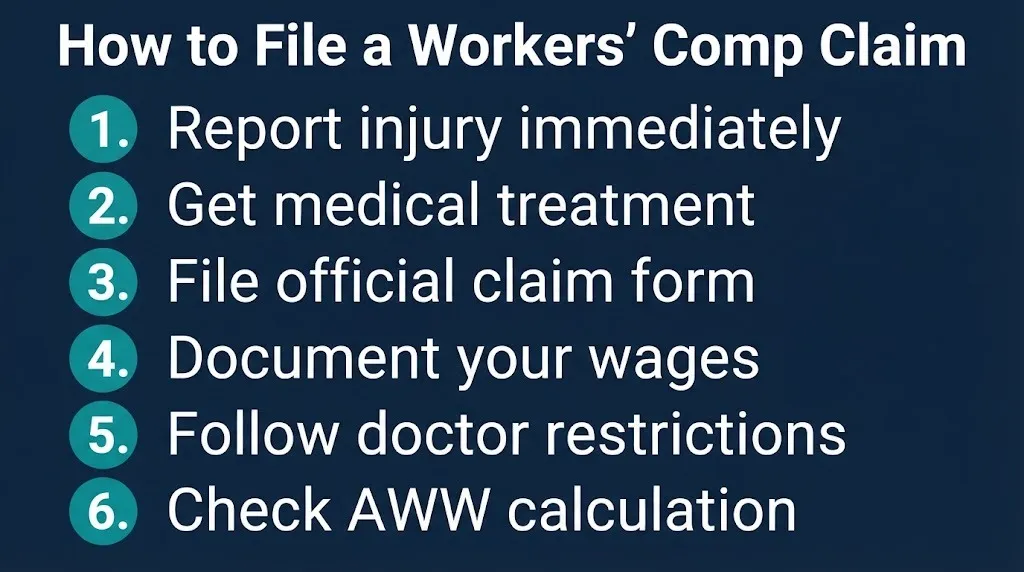
Here are the steps:
- Report the injury immediately. Tell your supervisor and fill out an incident report.
- Get medical treatment. See a doctor, preferably one approved by your employer or state.
- File the official claim form. Each state has its own form, filed with the workers’ comp board.
- Document your wages. Gather pay stubs, tax returns, and records of any second job.
- Follow your doctor’s restrictions. Returning to modified duty can affect your benefits.
- Check your AWW calculation. The insurer’s number is not always right.
- Appeal if denied. You have the right to challenge a denial.
The whole process is a bit like filing a warranty claim, except the stakes are your income. You would not accept a warranty denial without checking the terms. Do not accept a wage calculation without verifying the math.
What Is Workers’ Compensation Payroll and How Does It Work?
Workers’ compensation payroll is the mechanism employers use to calculate premiums and track wages for insurance purposes. It is not your paycheck. It is the data your employer reports to the insurance carrier.
Premiums are calculated by class code, which reflects the risk level of a job. Clerical workers get one rate. Roofers get another. The formula is:
Premium = (Payroll ÷ 100) × Manual Rate × Experience Mod
A company’s experience mod reflects its claims history compared to similar businesses. A clean safety record lowers the mod. Frequent claims raise it.
Payroll audits happen after the policy period ends. Auditors compare reported payroll to actual payroll records. Discrepancies trigger adjustments. Overtime must be separated. Corporate officer payroll often has caps. Misclassification leads to higher premiums.
For employees, this matters indirectly. If your employer misclassifies your job, your workers’ comp coverage could be affected. You want your work to be classified correctly.
What Happens After You File a Workers’ Comp Claim?
Immediate: Your employer reports the injury to its carrier. The carrier opens a claim and assigns an adjuster.
Within days to weeks: You receive a Notice of Compensation Payable or a denial. If approved, benefits begin.
Ongoing: You receive weekly checks based on your AWW calculation. Medical treatment continues.
At maximum medical improvement (MMI): Your doctor assigns an impairment rating. This determines permanent disability benefits.
Settlement talks: If you have permanent restrictions, the carrier may offer a lump sum.
Resolution: You either accept a settlement, continue receiving structured benefits, or litigate disputed issues.
Frequently Asked Questions
How is workman’s compensation calculated?
Workers’ comp is calculated as a percentage of your average weekly wage, usually 66⅔%, capped at a state maximum that updates each year.
What is included in average weekly wage?
AWW includes base pay, overtime, bonuses, commissions, tips reported to the IRS, vacation pay, and wages from a second job held at the time of injury.
Are workers’ comp benefits taxable?
No. Workers’ compensation benefits are not subject to federal income tax, Social Security tax, or Medicare tax.
What is the maximum workers’ comp benefit in 2026?
Maximums vary by state. Pennsylvania’s 2026 maximum is $1,394 per week, up 3.5% from 2025.
How is a workers’ comp settlement calculated?
Settlement values combine remaining weekly benefits, future medical costs, and permanent impairment value, then negotiate from that baseline.
Can I get workers’ comp from two jobs?
Yes. If you held two jobs at the time of injury, wages from both may count toward your AWW calculation.
What if my workers’ comp check is wrong?
You can challenge the wage calculation. Gather your pay records and request a review or hearing before the state workers’ comp board.
How long does workers’ comp last?
Temporary benefits last until you reach maximum medical improvement or return to work. Permanent benefits depend on your impairment rating and state rules.
What You Should Do Next
Check your most recent pay stubs and tax returns. Calculate your own average weekly wage before accepting the insurer’s number. Errors in AWW calculations are common and they directly reduce your weekly check.
The single most important fact: your weekly benefit is capped by state law, and Pennsylvania’s 2026 cap is $1,394. If you earned more than $2,091 per week before your injury, that cap applies to you.