Workers Compensation Ghost Policy 2026: What It Is, When It’s Legal, and When It’s Fraud
Quick Answer
- What is it? A ghost policy gives you a certificate of insurance but covers zero workers. It’s for owner-only businesses with no employees.
- Is it legal? Legal in many states for true sole proprietors. Banned in at least 23 states, including Colorado and West Virginia.
- Key risk? Using a ghost policy while you actually have employees or subcontractors is insurance fraud and leaves you personally liable for injuries.
If you run a one-person contracting business, you’ve probably hit this wall. A general contractor or client demands a certificate of workers compensation insurance before they’ll let you on the job site. But you have no employees. You’re the only person who works there. Paying full workers comp premiums for coverage that doesn’t cover anyone feels like burning money.
That’s where a workers compensation ghost policy comes in. It’s a real insurance product designed for exactly this situation. But it’s also one of the most misunderstood and abused tools in the construction insurance world. Some states ban it outright. Some insurers sell it legitimately. And some operations use it to commit fraud.
This article explains exactly what a ghost policy is, when it’s legal, when it crosses into fraud, and how to verify you’re not buying a worthless piece of paper.
The Facts
| Product Type | Minimum-premium workers compensation policy |
|---|---|
| Who It’s For | Sole proprietors, independent contractors with zero employees |
| What It Covers | No one. The owner is excluded. No injury or wage benefits. |
| Typical Cost | Minimum premium, often $500 to $1,500 annually |
| Legal Status | Legal in many states, banned in at least 23 states |
| Banned States | Colorado, West Virginia, and others |
| Key Risk | Fraud charges if used to hide employees or subcontractors |
What Is a Workers Compensation Ghost Policy?
A workers compensation ghost policy is a minimum-premium insurance policy that provides a certificate of insurance without actually covering any workers . The “ghost” name refers to the absence of anyone covered under the policy. You’re buying the paperwork, not the protection.
The policy is designed for sole proprietors and independent contractors who have no employees and never plan to hire any . In many states, these one-person operations are exempt from mandatory workers comp requirements. But clients and general contractors still demand proof of coverage before awarding contracts. A ghost policy solves that paperwork problem at a fraction of the cost of a full policy.
Here’s the critical limitation: a ghost policy covers no one. Not your employees, because you don’t have any. Not you, because the owner is explicitly excluded from coverage . If you get hurt on the job, the ghost policy pays nothing. No medical bills. No lost wages. No disability benefits.
Key Takeaway: A ghost policy gives you a certificate of insurance, not actual coverage. If you get hurt, you pay out of pocket.
Who Can Legally Get a Ghost Policy?
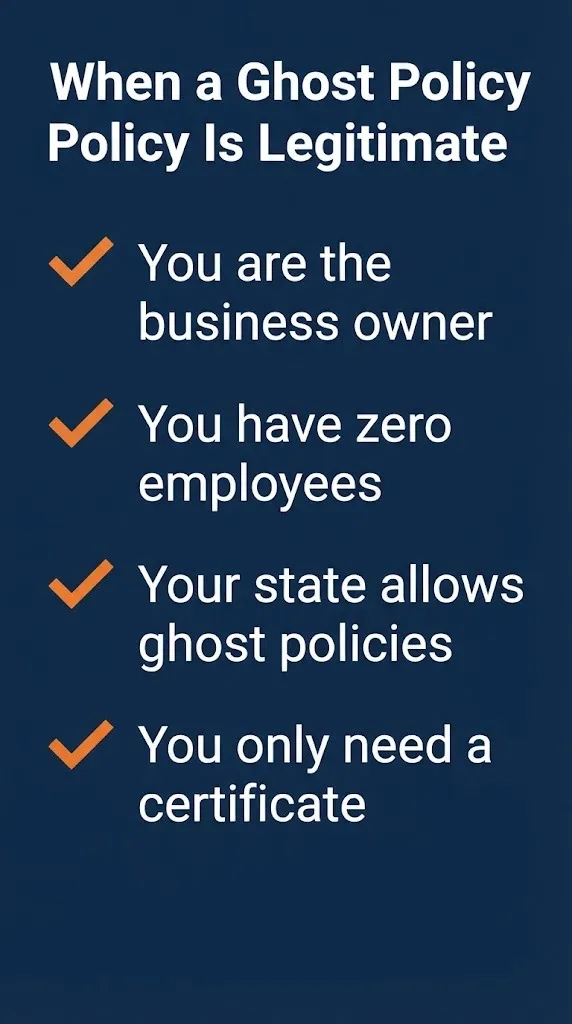
You can legally get a ghost policy only if you meet two strict requirements: you must be the business owner, and you must have zero employees . Both conditions must be true.
The policy is built for specific situations:
- Sole proprietors in states requiring proof of coverage. Some states require all construction businesses, even one-person operations, to carry workers comp .
- Independent contractors bidding on jobs. General contractors often require subcontractors to provide their own certificates of insurance .
- Single-member LLCs and S-corps. Business structures where the owner is the only worker can qualify for owner exclusions .
If you have even one employee, a ghost policy is not for you. The moment you hire someone, you need a standard workers comp policy that actually covers them. Using a ghost policy to cover employees is not a gray area. It’s fraud.
When Does a Ghost Policy Become Insurance Fraud?
A ghost policy becomes fraud the moment you use it to hide employees or misrepresent your payroll. The policy itself may be legal. Using it dishonestly is a crime.
The most common fraud scenario involves subcontractors. A contractor buys a ghost policy that covers “if any” employees. Then the contractor hires workers but keeps them off the books . The workers comp carrier thinks the business has zero payroll. The contractor pays minimum premium. If a worker gets hurt, the policy denies the claim because the worker was never declared.
Federal prosecutors in Florida dismantled a scheme exactly like this in 2025. Three Orlando residents pleaded guilty to a $58 million fraud that used shell companies and ghost policies to hide over $146 million in payroll . The scheme caused nearly $13 million in unpaid premiums and more than $36 million in unpaid employment taxes. The defendants face up to 25 years in prison.
A 2012 investigation in North Carolina found that of roughly 140,000 workers comp policies written annually in the state, just over 16,000 were ghost policies targeted at high-risk employers . One contractor lost his business when a worker classified as an independent contractor suffered a paralyzing injury. The ghost policy covered nothing. The contractor paid everything.
Which States Ban Workers Compensation Ghost Policies?
At least 23 U.S. states have banned ghost policies due to fraud and coverage gaps . The bans reflect a policy judgment that a policy covering no one is worse than no policy at all.
Colorado is one of the banned states. The legislature enacted the ban because ghost policies were being used to skirt mandatory coverage requirements . Colorado fines employers up to $500 per day for operating without proper workers comp coverage.
West Virginia has a statute declaring ghost policies “against public policy and null and void.” Insurers who issue them face misdemeanor charges and fines up to $10,000 .
In states where ghost policies remain legal, the rules vary. Some allow them only for specific business types. Others restrict them to owner-only operations with strict audit requirements. You need to verify your state’s rules before buying one.
How Do You Verify a Ghost Policy Is Legitimate?
You verify a ghost policy by confirming the carrier is licensed in your state and the policy is real. Fake certificates are a growing problem.
Here’s what to check:
- Verify the carrier. Contact your state insurance department or use the NAIC database to confirm the insurer is authorized to write workers comp in your state .
- Check the policy number. Call the carrier directly using a phone number from their official website, not from the certificate .
- Confirm the agent’s license. Look up the agent or broker through your state insurance department.
- Watch for red flags. Suspiciously low premiums, pressure to pay quickly, payment requests via wire or crypto, and certificates that fail verification are all warning signs .
If a quote is dramatically lower than others you’ve received, treat it as a verification trigger. Legitimate carriers have minimum premium requirements set by state regulators. A policy under $200 annually for a construction trade is almost certainly not real .
Reality Check: No one texts you settlement money first. Filing any claim is always free. Third-party “claim helpers” charging fees to fix ghost policy problems are unnecessary. The real remedy runs through your state insurance department and a licensed broker.
What Happens If You Get Caught Using a Ghost Policy Fraudulently?
If you get caught using a ghost policy to hide employees, you face financial ruin and criminal charges. The consequences escalate quickly.
Insurance carrier penalties. When an audit reveals undeclared employees, the carrier charges back premiums for the entire policy period, often with interest and penalties . A contractor who paid $1,000 for a ghost policy could owe $50,000 or more in back premiums.
State fines and stop-work orders. Many states impose daily fines for non-compliance. Colorado’s fine reaches $500 per day . State agencies can shut down your operations until you obtain proper coverage .
Criminal charges. In states like West Virginia, issuing or using a ghost policy is a misdemeanor with fines up to $10,000 . Federal fraud charges carry prison time. The Orlando defendants face up to 25 years combined .
Personal liability for injuries. If an undeclared worker gets hurt, the ghost policy denies the claim. You pay medical bills, lost wages, and disability out of pocket. A serious injury can exceed $40,000 in lost-time costs alone, with permanent disability claims reaching hundreds of thousands or millions .
What Are the Legitimate Alternatives to a Ghost Policy?
If you need proof of coverage but a ghost policy feels risky, several legitimate alternatives provide real protection.
Pay-as-you-go workers comp. This option calculates premiums based on actual payroll each pay period. You pay for what you use, not an annual estimate. For businesses with fluctuating work, it can be cheaper than a traditional policy .
State workers compensation funds. Many states operate their own insurance funds that accept businesses private carriers reject. These funds offer state-backed coverage with predictable rates .
Professional Employer Organizations (PEOs). If you occasionally hire workers, a PEO becomes the employer of record for those workers. The PEO handles payroll, benefits, and workers comp. You get proper coverage without the complications of a ghost policy .
Occupational accident insurance. In states where workers comp isn’t mandatory for owners, this coverage can fill the gap. It pays medical expenses and lost income for work-related injuries .
What Happens Next with Ghost Policy Enforcement?
Ongoing: State insurance departments continue audits and enforcement against fraudulent ghost policies.
Ongoing: Federal prosecutors pursue criminal charges in large-scale payroll fraud schemes involving ghost policies .
No deadlines: There is no claim process or settlement fund related to ghost policies. Enforcement is regulatory and criminal, not consumer compensation.
Frequently Asked Questions
What is a workers compensation ghost policy?
A ghost policy is a minimum-premium workers comp policy that provides a certificate of insurance but covers zero workers. It’s for sole proprietors with no employees.
Is a ghost policy legal?
It’s legal in many states for true owner-only businesses. At least 23 states have banned ghost policies entirely.
What happens if I get hurt with a ghost policy?
The policy pays nothing. You are personally responsible for all medical bills and lost wages. The owner is excluded from coverage .
Can I use a ghost policy if I have subcontractors?
No. Using a ghost policy while paying subcontractors who don’t have their own coverage is fraud. Those workers are treated as your employees for workers comp purposes.
How much does a ghost policy cost?
Minimum premium, typically $500 to $1,500 annually depending on your state and classification. If a quote is under $200, it’s likely fake .
What are the red flags of a fake ghost policy?
Unrealistically low premiums, pressure to pay quickly, wire or crypto payment requests, unlicensed carriers, and certificates that fail verification .
What are the alternatives to a ghost policy?
Pay-as-you-go workers comp, state workers comp funds, PEO arrangements, and occupational accident insurance .
What happens if I’m caught using a ghost policy fraudulently?
Back premiums with penalties, state fines up to $500 per day, stop-work orders, criminal charges, and personal liability for any worker injuries .