Workers Compensation Insurance for Contractors 2026: Requirements, Costs, Exemptions, and Legal Risks
Quick Answer:
- Most states require workers compensation insurance for contractors who have employees. Independent contractors are generally exempt but only if they are legitimately classified.
- Costs vary by trade and state. Roofers may pay $15 to $25 per $100 of payroll. Carpenters may pay $5 to $12.
- The biggest financial risk is misclassification. Penalties can reach $25,000 per worker and general contractors can be held liable for uninsured subcontractors.
You searched this because you are a general contractor wondering if you need coverage for your crew, or a self-employed tradesperson trying to figure out if the law applies to you at all. Maybe a client just asked for your certificate of insurance, or maybe a subcontractor got hurt on your job site and you are trying to understand who pays. The answer is not a simple yes or no. It depends on your state, your business structure, and whether the people working for you are legally employees or independent contractors.
This matters because getting it wrong can bankrupt a contracting business. A single uninsured injury on a job site can generate hundreds of thousands in medical bills and lost wages. If you do not have coverage, you pay that out of pocket. If you misclassified an employee as an independent contractor, you pay penalties on top of the medical costs. In 2026, state and federal enforcement of misclassification rules has intensified, and the fines now start where many contractors’ entire project profit margins end.
This article covers everything contractors need to know about workers compensation insurance in 2026: who needs it, how much it costs, how to get it, what happens if you skip it, the difference between covering employees and subcontractors, and how states are cracking down on misclassification. One fact that surprises most contractors: in several states, including California and New York, a general contractor can be held 100 percent liable for the workers compensation benefits of an uninsured subcontractor’s employee. You did not hire the worker. You still pay the claim.
The Facts
| Detail | Information |
|---|---|
| Who Needs It | Employers with 1+ employees (most states). Sole proprietors and true independent contractors are typically exempt but must verify status |
| General Contractor Liability | In most states, GCs are liable for workers comp benefits of uninsured subcontractors and their employees |
| Average Cost 2026 | $5 to $25 per $100 of payroll depending on trade classification. Roofing and steel erection pay the highest rates |
| Self-Employed Coverage | Optional in most states. Recommended for anyone working on general contractor job sites to avoid disputes |
| Misclassification Penalties 2026 | Civil penalties up to $25,000 per misclassified worker. Criminal penalties possible for willful violations |
| State Funds / Assigned Risk | Available in all states for contractors who cannot find private coverage |
| Certificate of Insurance | Always required before starting work. Verify directly with the insurer, not just the paper |
Do Independent Contractors Need Workers Compensation Insurance?
Independent contractors generally do not need workers compensation insurance, but only if they are legitimately independent contractors under state law. This is the single most important distinction in the entire contractor insurance space. Calling someone an independent contractor does not make them one. State law determines classification, and most states use a multi-factor test that looks at control, independence, and whether the worker operates a separate business.
If you are a legitimate independent contractor, a sole proprietor with your own tools, your own clients, your own business structure, and true independence from any single hiring entity, you are probably exempt from mandatory workers compensation coverage. But you also cannot collect workers compensation benefits if you get hurt. The system does not cover you because you are an employer of yourself, not an employee of someone else. If you want coverage, you must buy a policy voluntarily or see if your state allows self-employed individuals to opt into the system.
If you are labeled an independent contractor but function like an employee, working for one general contractor, using their tools, following their schedule, and earning your entire income from them, your classification is probably wrong. In that case, the contractor who hired you should be carrying workers compensation coverage for you, and if you get hurt and they do not, you can file a claim and the state will investigate. The consequences for the employer are severe. The consequences for you are that you get benefits despite what your 1099 says.
Reality Check: A 1099 form does not determine your employment status. State law does. If a general contractor hands you a 1099 and tells you that means you do not need workers compensation, that general contractor is either misinformed or hoping you are. The legal test looks at the actual working relationship, not the tax paperwork. In 2026, at least 25 states have joint task forces specifically targeting construction industry misclassification.
What Does Workers Comp Insurance for Contractors Cover?
Workers compensation insurance for contractors covers three things: medical treatment for work-related injuries, wage-loss benefits while the injured worker recovers, and liability protection for the employer. If a framing carpenter falls off a ladder and breaks a leg, workers comp pays the emergency room bill, the surgery, the physical therapy, and a portion of the lost wages during recovery. It also protects the contractor from being sued by the injured worker. In nearly all states, workers compensation is the exclusive remedy, meaning the worker gets benefits regardless of fault but cannot sue the employer for pain and suffering.
The coverage applies to injuries that arise out of and in the course of employment. A roofer who gets heat stroke on a July afternoon is covered. An electrician who slips on a wet floor at the job site is covered. A drywall installer who develops repetitive stress injuries over years of lifting is covered, though the proof requirements for occupational disease claims are higher than for acute injuries. The system is no-fault. The worker does not need to prove the employer was negligent. The employer does not escape liability by blaming the worker.
Coverage follows the employer. If a contractor based in Texas sends a crew to work on a project in Oklahoma, the policy must cover Oklahoma claims or the contractor needs a separate policy. Multi-state contractors must ensure their coverage complies with each state where they have employees working. This is a recurring trap for contractors who expand across state lines without updating their insurance. A claim in a state where the policy does not apply is an uninsured claim, and the contractor pays out of pocket.
How Much Does Workers Comp for Contractors Cost in 2026?
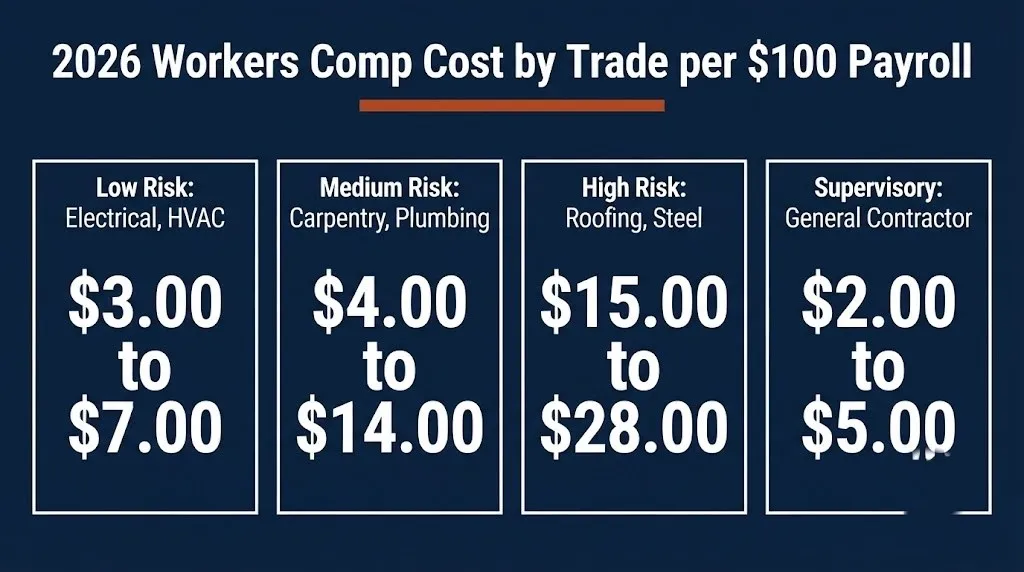
Workers compensation insurance for contractors costs between $3 and $25 per $100 of payroll in 2026, depending on the trade classification, the contractor’s claims history, and the state where the work is performed. Low-risk trades like electrical work or HVAC pay rates at the lower end. High-risk trades like roofing, structural steel, and tree trimming pay at the high end. The cost difference reflects the injury risk. A roofing contractor’s employees are statistically far more likely to suffer serious injury than an HVAC technician’s employees.
The premium calculation works like this. The insurer assigns a class code based on the type of work. Each class code has a base rate, typically expressed as dollars per $100 of payroll. That base rate is multiplied by your payroll divided by 100, then adjusted by your experience modification rating or ex-mod. An ex-mod below 1.00 means your claims history is better than average for your trade, and you pay less. An ex-mod above 1.00 means worse than average, and you pay more. New contractors start at 1.00.
Here are typical 2026 rates for common contracting trades, based on national averages compiled from workers compensation rating bureau data:
| Trade Classification | Typical 2026 Rate per $100 Payroll | Annual Cost for $60K Employee |
|---|---|---|
| Electrical Wiring | $3.00 to $6.00 | $1,800 to $3,600 |
| HVAC Installation | $3.50 to $7.00 | $2,100 to $4,200 |
| Carpentry | $7.00 to $14.00 | $4,200 to $8,400 |
| Plumbing | $4.00 to $8.00 | $2,400 to $4,800 |
| Painting | $5.00 to $10.00 | $3,000 to $6,000 |
| Roofing | $15.00 to $25.00 | $9,000 to $15,000 |
| Structural Steel | $18.00 to $28.00 | $10,800 to $16,800 |
| Tree Trimming | $12.00 to $22.00 | $7,200 to $13,200 |
| Drywall Installation | $6.00 to $12.00 | $3,600 to $7,200 |
| General Contractor (supervisory) | $2.00 to $5.00 | $1,200 to $3,000 |
Key Takeaway: Rates vary dramatically by trade, and misclassifying a roofer as a general laborer to get a lower rate is a form of premium fraud that insurers and state regulators actively pursue.
How Does Workers Comp Work for General Contractors and Subcontractors?
General contractors face a specific and often misunderstood liability: they can be held responsible for the workers compensation claims of subcontractors who do not carry their own coverage. In most states, if a subcontractor’s employee gets hurt on the job site and the subcontractor has no workers comp policy, the general contractor’s policy pays the claim, or the general contractor pays out of pocket if uninsured. The legal doctrine is called statutory employer or contractor-under. It exists to prevent general contractors from insulating themselves from liability by subcontracting dangerous work to uninsured subs.
The practical consequence is that general contractors must verify that every subcontractor on the job carries workers compensation insurance. Asking for a certificate of insurance is not enough. Certificates can be forged, canceled, or inaccurate. The general contractor should contact the insurer directly to confirm the policy is active and covers the specific work being performed. If the sub is a sole proprietor with no employees, the general contractor should confirm that the sub’s status is legitimate under state law and that the sub has elected coverage if the state allows self-employed opt-in.
If a sub’s employee gets hurt and the sub is uninsured, the general contractor’s insurer will pay the claim and then typically seek reimbursement from the sub. But the insurer cannot get blood from a stone. If the sub is a limited liability company with no assets, the general contractor’s policy absorbs the loss and the general contractor’s experience modification rises, increasing future premiums. This is the hidden cost of cutting corners on subcontractor verification.
Can a Self-Employed Contractor Get Workers Comp for Themselves?
Yes, self-employed contractors can get workers compensation insurance for themselves in most states, but it is optional, not mandatory. Sole proprietors, partners, and certain LLC members are not required to carry coverage on themselves. They can choose to. Some do it because general contractors require proof of coverage before allowing them on site. Some do it because they want the protection: if a self-employed carpenter shatters a wrist and cannot work for three months, workers comp provides wage replacement and medical benefits. Without coverage, the carpenter pays the medical bills and earns nothing during recovery.
The process for getting coverage as a self-employed contractor is the same as for any small business: contact an insurance agent who specializes in workers compensation, get quotes from multiple carriers, and buy a policy. The premium is based on your estimated annual payroll, even though you are the only person on payroll. You report your actual earnings at the end of the policy period, and the premium is adjusted up or down. Some states allow self-employed individuals to buy coverage through the state workers compensation fund directly.
Several states allow self-employed contractors to opt into the state workers compensation system without buying a full commercial policy. This option typically requires filing an election form with the state workers compensation board and paying a premium based on estimated earnings. The election is binding. Once you opt in, you are covered, but you are also subject to the exclusive remedy rule, meaning you give up the right to sue a third party for your injury in most circumstances.
What Are the Penalties for Not Having Workers Comp as a Contractor?
The penalties for operating without workers compensation insurance as a contractor range from civil fines to criminal prosecution, and in 2026 the enforcement climate is harsher than at any point in the last two decades. State penalties vary but share a common structure: daily fines for each day of noncompliance, stop-work orders that shut down job sites, and personal liability for the owner or officers of the contracting business.
Civil penalties typically start at $500 to $1,000 per day and can escalate to $2,500 or more per day for willful violations. Several states, including California and New York, have increased minimum penalties in response to construction industry noncompliance. A stop-work order halts all operations on a job site until proof of coverage is provided. The contractor cannot work, cannot bill, and cannot pay workers. The economic leverage of a stop-work order often exceeds the fine itself.
Beyond state penalties, the uninsured contractor faces unlimited civil liability. An injured worker can sue the contractor directly in tort. The contractor loses the standard defenses of contributory negligence and assumption of risk. The worker only needs to prove the injury occurred in the course of employment. Damages are not capped by the workers compensation benefit schedule. Pain and suffering, which the workers comp system excludes, becomes recoverable. A single serious injury can result in a judgment that exceeds the value of the entire business.
How Can Contractors Get Workers Comp Insurance in 2026?
Contractors can get workers compensation insurance through private insurance carriers, state workers compensation funds, or assigned risk pools. The path depends on the contractor’s claims history, trade classification, and state of operation. Here is how to get covered, step by step:
- Determine whether your state requires coverage. Almost all states require it for any employer with employees.
- Classify your workforce correctly. Assign each employee to the correct class code based on actual job duties.
- Calculate estimated annual payroll for each class code.
- Contact an independent insurance agent who specializes in construction coverage and obtain quotes.
- If private carriers decline to quote due to claims history or high-risk classification, apply through the state assigned risk pool.
- Provide certificates of insurance to every general contractor you work for before stepping onto the job site.
- Audit your policy annually. Report actual payroll. Adjust premiums to avoid a surprise balance due.
Contractors with poor claims histories may find private coverage unavailable or prohibitively expensive. Every state maintains an assigned risk pool, sometimes called the residual market, that guarantees coverage for employers who cannot find it elsewhere. The premiums in the assigned risk pool are typically higher than voluntary market rates. The coverage is identical in scope. It exists to ensure no employer who wants to comply with the law is denied the ability to do so.
Key Takeaway: You cannot be denied workers compensation insurance. The assigned risk pool exists in every state as a backstop. It may cost more, but it guarantees compliance and protects your business from the catastrophic financial consequences of an uninsured injury.
How Are States Cracking Down on Contractor Misclassification in 2026?
States are cracking down on contractor misclassification in 2026 through multi-agency task forces, increased audits, and harsher penalties that apply across workers compensation, unemployment insurance, and tax enforcement simultaneously. The coordinated approach means a finding of misclassification by one agency triggers referrals to the others. A worker found to be misclassified for workers comp purposes is also reported to the state tax department and unemployment agency, multiplying the financial consequences.
Construction is the primary target. At least 25 states have dedicated construction industry misclassification units. These units use data analytics to identify contractors with suspiciously low workers comp premiums relative to their reported project volume. They cross-reference 1099 filings with insurance policy data. They conduct on-site sweeps of construction projects, interviewing workers about their relationship with the contractor. The days of relying on a signed independent contractor agreement as a shield are over.
California, New York, New Jersey, Massachusetts, and Illinois have the most aggressive enforcement regimes. But smaller states are following. The Uniform Law Commission has developed model legislation for misclassification enforcement that several states adopted in 2025. The trend line is unmistakable: the legal and financial risk of misclassifying employees as independent contractors in the construction industry is higher in 2026 than it has ever been.
What Is a Workers Comp Ghost Policy and Why Should Contractors Avoid It?
A workers compensation ghost policy is a policy that appears to provide coverage but contains a sole proprietor, partner, or officer exclusion that removes all actual coverage. It is sold to contractors who need a certificate of insurance to satisfy a general contractor or licensing board but do not want to pay premiums for actual employee coverage. The policy says workers compensation on the declarations page. The exclusion buried in the endorsements says no one is actually covered.
Ghost policies are legal in the narrow sense that an insurer can issue a policy that covers employees but excludes the owners, and if the business truly has no employees, the exclusion is accurate. The problem arises when the contractor does have workers who are classified as employees under state law, regardless of what the contractor calls them. If an employee gets hurt and the policy excludes everyone, the contractor has no coverage. The certificate of insurance was worthless. The general contractor who relied on it is now exposed.
General contractors in 2026 are increasingly sophisticated about detecting ghost policies. They demand not just certificates but policy language confirmations from the insurer. They verify that the policy covers the subcontractor’s actual workforce, not just the corporate entity. A subcontractor who presents a ghost policy when employees are on the job is committing fraud. The general contractor who accepts it without verification is assuming liability it may not be able to afford.
Key Takeaway: A certificate of insurance is a piece of paper that is only as good as the policy behind it. Verify coverage directly with the insurer. Every time. On every project. Without exception.
Do Contractors Need Workers Comp If They Have General Liability Insurance?
Yes, contractors need workers compensation insurance even if they have general liability insurance. The two coverages are completely different and do not overlap. General liability covers third-party claims for property damage and bodily injury to non-employees. If a contractor drops a hammer off a scaffold and it hits a pedestrian, general liability covers the pedestrian’s injury. If the contractor’s employee falls off the scaffold and breaks an arm, general liability does not cover it. That is a workers compensation claim.
Many contractors mistakenly believe general liability covers employee injuries. It does not. The standard commercial general liability policy contains an employer’s liability exclusion that eliminates coverage for injuries to employees and anyone who should have been covered by workers compensation. This exclusion is absolute. There is no loophole. If the injured person is an employee under state law, the CGL policy will not respond.
The dual coverage requirement is one reason contracting is an expensive industry to insure. Contractors must carry general liability for third-party risks, workers compensation for employee injuries, and often commercial auto, tools and equipment, and professional liability or errors and omissions coverage. Bundling through a business owner’s policy or a package policy from a single carrier can reduce costs but does not eliminate the need for separate workers compensation coverage.
What Happens Next
The workers compensation regulatory environment for contractors will likely continue tightening in late 2026 and into 2027. Here is what to expect:
Ongoing 2026: Multi-state misclassification task forces continue coordinated enforcement sweeps. Data-sharing agreements between state agencies expand.
Late 2026: Several states expected to announce increased penalty structures for construction industry violations, with minimum fines rising from $1,000 to $2,500 per violation.
2027: Possible federal action on a uniform misclassification standard for workers compensation, driven by the Department of Labor’s interest in aligning workers comp and unemployment tax classification tests.
Watch for: Any state that adopts the ABC test for workers compensation. This test, already used for unemployment in several states, makes it substantially harder to classify a worker as an independent contractor.
Frequently Asked Questions
Do I Need Workers Comp as a Solo Contractor With No Employees?
In most states, no. Sole proprietors with no employees are typically exempt from mandatory coverage.
However, many general contractors will require you to carry coverage or sign a waiver before you can work on their job sites.
You may also want coverage voluntarily to protect yourself from lost income and medical bills if you get injured.
How Much Is Workers Comp for a One-Person Contractor?
Coverage for a sole proprietor typically costs $500 to $3,000 per year depending on trade and payroll.
High-risk trades like roofing pay significantly more than low-risk trades like consulting or estimating.
Your premium is based on your estimated annual earnings and adjusts after audit.
Can a General Contractor Be Sued If a Subcontractor’s Employee Gets Hurt?
Yes. If the subcontractor does not have workers compensation insurance, the general contractor’s policy, or the general contractor personally, pays the claim.
This is called statutory employer liability and applies in most states.
Verifying subcontractor coverage before work begins is not optional. It is the single most important risk management step a GC takes.
What Is the Difference Between a 1099 Worker and an Employee for Workers Comp?
A legitimate 1099 independent contractor is not covered by the hiring entity’s workers comp policy and cannot collect benefits from it.
An employee, regardless of what tax form they receive, is covered and must be insured by the employer.
State law, not IRS classification, determines employment status for workers comp purposes, and states increasingly use strict multi-factor tests.
Can I Get Workers Comp If I Am Self-Employed?
Yes, in most states you can voluntarily purchase workers compensation insurance for yourself.
You can buy a commercial policy or, in some states, file an election form to opt into the state system.
Once you opt in, you are covered for work injuries but give up the right to sue third parties in most cases.
Does Workers Comp Cover Independent Contractors Who Get Hurt?
No. Legitimate independent contractors are not employees and cannot collect workers compensation benefits from the hiring entity’s policy.
If you are an independent contractor and get hurt, you pay your own medical bills unless you carried your own coverage.
If you are misclassified and should be an employee, you may be able to file a claim despite the 1099 status.
What If My Subcontractor Gives Me a Fake Certificate of Insurance?
You may still be liable if the certificate was fraudulent and the subcontractor’s employee gets hurt.
Always verify certificates directly with the insurer by calling the phone number on the certificate or using the insurer’s online verification tool.
A forged certificate is a crime, but that does not protect you from civil liability for the injured worker’s claim.
How Do I Prove I Am an Independent Contractor for Workers Comp?
You need documentation showing you operate an independent business: multiple clients, your own tools, your own insurance, a business license, and control over your work methods and schedule.
A written independent contractor agreement helps but is not dispositive under state law.
The more you look like an employee in practice, the less your contract language matters.
Your next move is practical. If you are a contractor with employees, confirm your coverage is active and your class codes are correct. If you use subcontractors, implement a verification system that goes beyond collecting certificates. Call insurers. Confirm coverage. Document everything. If you are self-employed and unsure of your classification, get a legal opinion from a construction law attorney in your state. The cost of that consultation is a fraction of the cost of a misclassification penalty.
Workers compensation is not a line item you can skip to make a bid more competitive. It is the cost of doing business legally, and the price of noncompliance is higher in 2026 than it has ever been.