Get Workers Compensation Insurance 2026: Costs, Requirements, and How to Buy a Policy
Quick Answer
- Who needs it: Most states require coverage as soon as you hire your first employee, with exceptions in Texas and South Dakota.
- How much: Small businesses pay a median of $54 monthly, but rates range from $34 to $127 depending on the state.
- Key deadline: You must obtain coverage before your first employee starts work. Retroactive liability applies for gaps.
If you are hiring your first employee or expanding a small business, workers’ compensation insurance is not optional in most of the country. It pays for medical care and partial lost wages if a worker gets hurt on the job. It also protects you from being sued directly by an injured employee.
The system is state-regulated, which means the rules, rates, and purchasing options change every time you cross a state line. Some states have competitive private markets. Four states operate monopoly funds where the state is the only seller. Texas and South Dakota let most private employers skip coverage entirely.
This article covers what the verified data shows as of September 2026: who must buy coverage, what it costs by state, the difference between private carriers and state funds, how to calculate your premium, and the penalties for operating without insurance.
What is workers compensation insurance and who needs it?
Workers’ compensation insurance is a state-mandated program that pays medical bills and partial lost wages for employees injured on the job. It also provides death benefits to surviving family members and protects employers from most injury-related lawsuits.
Most states require coverage as soon as you hire your first employee . The thresholds and exemptions vary. Some states exclude agricultural workers, domestic workers, or independent contractors who meet specific tests.
Texas and South Dakota are the only states where private employers can legally opt out of workers’ compensation coverage . Even in those states, many businesses buy voluntary coverage because it provides lawsuit immunity and covers the owner’s own medical costs if injured on the job.
Key Takeaway: Buying workers’ comp is not just about complying with state law. It buys you immunity from injury lawsuits that can exceed your policy limits and threaten your personal assets.
How much does workers compensation insurance cost in 2026?
Workers’ compensation insurance costs an average of $54 per month, or $643 annually, for small businesses. The median policy purchased by Insureon customers in 2026 falls in that range .
Here is the verified cost picture by state:
| Cost Category | Monthly Premium Range |
|---|---|
| Lowest-cost states | $34 to $52 per month |
| Middle-tier states | $54 to $75 per month |
| Highest-cost state (Alabama) | $127 per month |
The lowest average costs cluster between $34 and $52 per month in states with lower benefit levels and lower healthcare costs . The highest average is Alabama at $127 per month, followed by several states in the $77 to $88 range .
Nearly half of small businesses pay less than $50 per month. About 24 percent pay between $50 and $100 per month .
These figures are medians from actual policies purchased. Your rate depends on your industry classification, payroll size, claims history, and the state where you operate.
What factors determine your workers compensation premium?
Your workers’ compensation premium is calculated by multiplying your payroll by a class code rate, then adjusting for your experience modification rating. The formula is set by state rating bureaus, most of which use the National Council on Compensation Insurance (NCCI) .
The core factors are:
- Industry classification code. Office work, retail, and professional services carry lower rates. Construction, manufacturing, and trucking carry higher rates .
- Payroll. Premiums are calculated per $100 of payroll. Higher payroll means higher premium.
- Experience modification rating (EMR). This number reflects your claims history compared to other businesses in your class. A clean record lowers your rate. Claims raise it.
- State rate level. Each state sets its own baseline. A state with high benefit levels and medical costs will have higher rates across all industries.
- Deductibles and limits. Choosing a higher deductible lowers your premium. Lower employer’s liability limits also reduce cost.
The class code matters more than most business owners realize. A clerical worker and a roofer can have the same payroll but radically different premiums because their injury risk is different.
Which states have monopoly workers compensation funds?
Four states require businesses to buy workers’ compensation insurance through a state-operated monopoly fund: North Dakota, Ohio, Washington, and Wyoming . In those states, private carriers are not allowed to sell coverage.
The remaining states use competitive markets. Most allow you to choose between private insurance carriers and a state fund if one exists. Competitive state funds operate in about 18 states as of 2026, down from a higher number a decade ago as states have privatized their funds .
Missouri privatized its state fund in early 2025. The direct combined ratio for fully privatized states has outperformed competitive state fund states in eight of the last ten years .
If you operate in a monopoly state, your only option is the state fund. If you operate in a competitive state, you can shop between private carriers, a state fund, and sometimes a assigned risk pool for high-risk businesses.
What are the largest workers compensation insurance carriers in 2026?
Hartford Insurance Group is the largest workers’ compensation carrier in the United States as of 2025, with $3.73 billion in direct premiums written. It surpassed Travelers Group, which held the top spot previously .
Here are the top five carriers by 2025 direct premiums written:
| Rank | Carrier | Direct Premiums Written (2025) |
|---|---|---|
| 1 | Hartford Insurance Group | $3.73 billion |
| 2 | Travelers Group | $3.69 billion |
| 3 | AmTrust Group | $3.52 billion |
| 4 | Zurich Insurance US PC Group | $2.79 billion |
| 5 | Chubb INA Group | $2.41 billion |
The overall U.S. workers’ compensation sector saw direct premiums written decline 2.4 percent to $56.18 billion in 2025. The top 25 carriers accounted for 67.7 percent of the market .
The market has become more competitive over the last decade. The Herfindahl-Hirschman Index, a measure of market concentration, has dropped, meaning no single carrier dominates . That is good news for buyers because it means more carriers are competing for your business.
How do you buy a workers compensation policy?
Buying a workers’ compensation policy follows a standard process. You can buy directly from a carrier, through an independent agent, or from a state fund depending on your state.
Here is the step-by-step process:
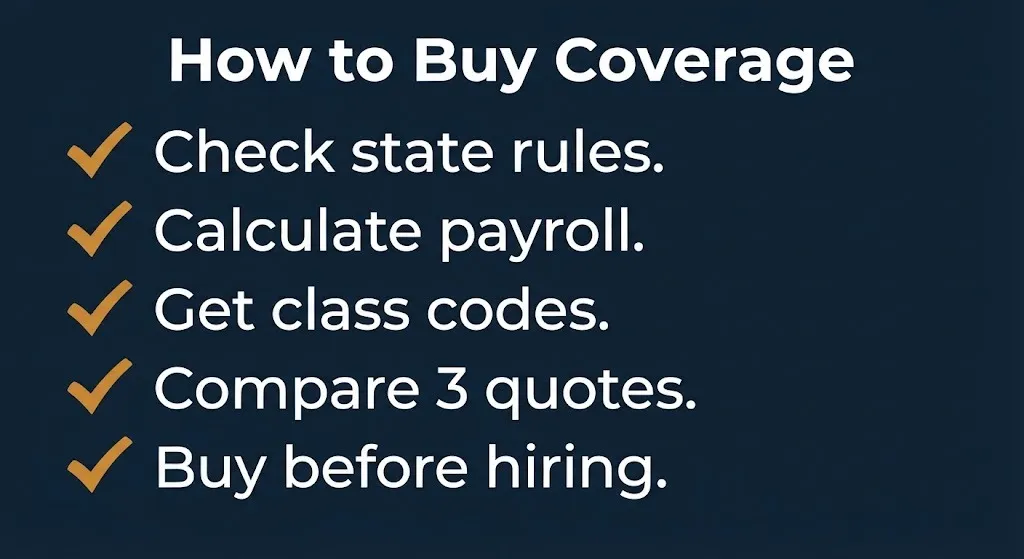
- Determine your state’s requirements. Check whether coverage is mandatory, optional, or monopoly-only in your state .
- Calculate your payroll. Add up annual gross wages for all employees who need coverage.
- Identify your class codes. Your agent or carrier will assign codes based on your industry and job duties.
- Gather your claims history. If you have prior coverage, your experience modification rating will factor into pricing.
- Request quotes from multiple carriers. In competitive states, comparing at least three quotes is standard.
- Review coverage limits and deductibles. Employer’s liability limits and deductible levels affect both price and protection.
- Purchase the policy before your first employee starts work. Retroactive liability applies for coverage gaps.
- Post the required notices. Most states require you to display proof of coverage in the workplace.
Reality Check: Workers’ compensation insurance is not a scam, but some brokers charge fees that inflate the cost. You can buy directly from carriers like biBERK, Berkshire Hathaway’s direct-to-business arm, and save roughly 20 percent by cutting out the middleman . Always compare direct and broker pricing.
What happens if you operate without workers compensation insurance?
Operating without required workers’ compensation insurance triggers severe penalties, including criminal charges in some states, civil fines, stop-work orders, and direct lawsuits from injured employees .
The specific consequences include:
- Retroactive liability. You owe all premiums you should have paid, often with penalty multipliers.
- Criminal penalties. Some states classify willful non-compliance as a misdemeanor or felony, with potential jail time for corporate officers.
- Stop-work orders. Many states shut down operations until you obtain coverage.
- Employee lawsuits. You lose lawsuit immunity. Injured workers can sue for full medical costs, lost wages, pain and suffering, and punitive damages.
A single serious injury lawsuit can exceed the cost of decades of premiums. The immunity that workers’ compensation provides is the primary financial protection for most small businesses.
What happens next after you get a workers compensation policy?
Once you have a policy in place, you have ongoing obligations to maintain coverage, report payroll accurately, and manage claims. Here is the expected sequence after purchase.
Immediately: Post the required proof-of-coverage notice in your workplace.
Monthly or quarterly: Report payroll to your carrier. Premiums are usually adjustable based on actual payroll.
Annually: Your policy renews. The carrier reviews your payroll and claims history to set the next year’s premium.
If an injury occurs: Report the claim to your carrier within the state’s required timeframe. The carrier handles medical payments and wage replacement.
Ongoing: Maintain a safe workplace. Fewer claims mean a better experience modification rating and lower premiums at renewal.
The $54 monthly median cost for small businesses means coverage is often less expensive than owners assume. The financial protection from a single avoided lawsuit typically outweighs the annual premium.
Frequently Asked Questions
Is workers compensation insurance required in all states?
No. Most states require it as soon as you hire your first employee. Texas and South Dakota are the only states where private employers can opt out .
How much does workers compensation insurance cost for a small business?
The median cost is $54 per month, or $643 annually. About 47 percent of small businesses pay less than $50 per month .
Can I buy workers compensation insurance directly from a carrier?
Yes, in competitive states. Some carriers like biBERK sell directly to small businesses without a broker, saving about 20 percent .
What is the cheapest state for workers compensation insurance?
Several states have average monthly costs between $34 and $52. The exact ranking depends on industry mix and benefit levels .
What happens if I don’t have workers compensation insurance?
Penalties include retroactive premium liability, civil fines, stop-work orders, and criminal charges in some states. You also lose immunity from employee injury lawsuits .
Do I need workers compensation for independent contractors?
Generally no, if the worker meets your state’s independent contractor test. Misclassification can trigger retroactive liability and lawsuits. Some states offer safe harbor for proper classification .
Which states have monopoly workers compensation funds?
North Dakota, Ohio, Washington, and Wyoming require businesses to buy from a state-operated fund. Private carriers cannot sell coverage in those states .
The Bottom Line for Buying Workers Compensation Insurance
Workers’ compensation insurance is mandatory in most states and costs an average of $54 per month for small businesses. The protection it provides, lawsuit immunity and coverage for employee injuries, is worth far more than the premium for most employers.
Texas and South Dakota are the only states where coverage is optional. North Dakota, Ohio, Washington, and Wyoming require you to buy from a state fund. Everywhere else, you can compare quotes from private carriers like Hartford, Travelers, and AmTrust.
The single most important step is obtaining coverage before your first employee starts work. Retroactive liability for coverage gaps can exceed years of premiums in a single penalty assessment.