Las Vegas Workers Compensation Lawyer 2026: Settlements, Fees, and How to Choose the Right Attorney
Quick Answer
- What it is: A lawyer who represents injured workers in claims against employers and insurers under Nevada’s no-fault workers’ comp system.
- How much: Settlements depend on disability rating, age, and wage. Permanent Partial Disability benefits are paid as monthly installments until age 70.
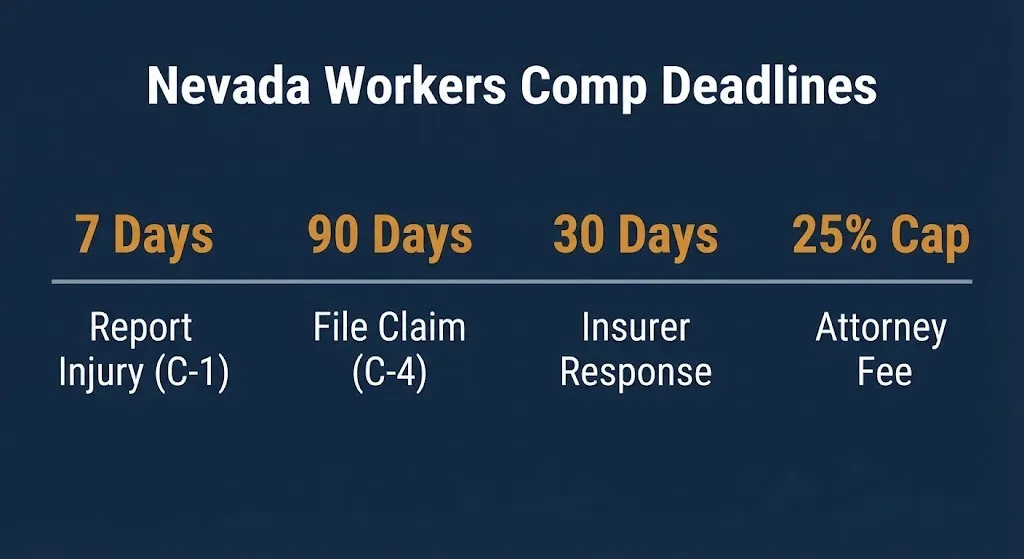
- Key deadline: Report the injury using Form C-1 within 7 days. File the formal C-4 claim within 90 days.
If you were hurt on the job in Las Vegas, the clock is already running. Nevada’s workers’ compensation system has one of the tightest filing timelines in the country, and missing the 90-day deadline can end your claim permanently regardless of how serious your injury is.
The system is supposed to work without a lawyer. You report the injury, the insurer pays medical bills and partial wages, and you recover. In practice, claims get denied, disability ratings get understated, and settlement offers come in far below what the law allows. A Las Vegas workers’ compensation lawyer exists to close that gap.
This article covers what is verified as of September 2026: how Nevada’s benefit structure works, the factors that drive settlement value, the strict deadlines that apply, how attorney fees are regulated, the difference between suing your employer and suing a third party, and how to evaluate a workers’ comp attorney in Las Vegas.
What does a Las Vegas workers compensation lawyer actually do?
A Las Vegas workers’ compensation lawyer represents injured workers in claims against employers and their insurance carriers under Nevada’s no-fault system. The attorney handles everything from filing the initial claim to challenging a low disability rating or negotiating a lump sum settlement.

The system is administrative, not a traditional lawsuit. Claims are processed by insurers and disputed claims go before Hearing Officers and Appeals Officers within the Nevada Division of Industrial Relations. Your lawyer is not filing a complaint in District Court. They are building an administrative record and arguing your case within that structure.
The most common problems an attorney solves are denial of the claim, underpayment of temporary disability benefits, an unfairly low Permanent Partial Disability rating, and pressure to settle before you have reached Maximum Medical Improvement.
A lawyer can also challenge the Average Monthly Wage your employer reported. Under NAC 616C.435, Nevada uses a 12-week earnings history to calculate your wage. If your employer underreported hours or wages, your benefits are reduced for the life of the claim.
How much is a workers compensation settlement worth in Las Vegas?
There is no single average settlement figure for Nevada workers’ compensation cases. Value depends on your disability rating, your average monthly wage, your age, and whether future medical care is included in the settlement.
The primary settlement for permanent injuries is Permanent Partial Disability (PPD). Under Nevada law, PPD benefits are calculated based on your disability percentage, your age, and your wage . PPD benefits are paid by default as monthly installments until you reach age 70 .
Here is how settlement structure works by disability rating:
| Disability Rating | Lump Sum Option | Payment Structure |
|---|---|---|
| 30% or less | Full lump sum allowed | Present value of entire award |
| Over 30% | Up to 30% as lump sum | Remainder paid in monthly installments |
The 30% threshold comes from NRS 616C.495 . If your rating exceeds 30%, you cannot take the full award as a lump sum. The law limits the upfront payment to the present value of a 30% award, and the rest must be paid monthly . This structure exists to protect severely injured workers from depleting their benefits too quickly .
A real example from a Justia question shows a total settlement of $35,034.87 for a PPD case, with an attorney fee of $11,678.28 at 33.3335% . That fee rate is above the standard cap, and the attorney would need special approval from the state to charge it .
Key Takeaway: The 30% disability rating threshold is the single biggest structural limit on your settlement. Below it, you can take the full award as cash. Above it, Nevada forces the remainder into monthly payments to protect you from spending it too fast.
What factors determine your workers comp settlement value in Las Vegas?
Nevada insurers weigh several specific factors when they calculate what your claim is worth. Understanding these factors helps you spot an offer that does not match the law.
Your disability rating. This is the most significant driver. A rating physician evaluates your permanent impairment using the AMA Guides to the Evaluation of Permanent Impairment, 5th Edition . Each percentage point directly increases compensation. If you believe your PPD rating is too low, you can challenge it .
Your average monthly wage. Nevada uses a 12-week earnings history to calculate your wage under NAC 616C.435 . The wage figure on your C-3 form determines temporary and permanent disability benefit amounts. If your employer underreported hours, your benefits are reduced . The maximum average monthly wage used for calculations is $5,630.43 for fiscal year 2025 .
Your age. Younger workers may receive larger PPD settlements because benefits can continue until age 70 or for five years after the rating, whichever is longer . A 40-year-old with a 10% rating receives more total value than a 60-year-old with the same rating because the payment period is longer.
Injury type and future medical needs. A soft-tissue strain settles for far less than a traumatic brain injury or a condition requiring surgery . Injuries that prevent you from returning to your previous occupation carry higher settlement values .
Whether you settle before or after Maximum Medical Improvement. Settling before you reach MMI means neither you nor your doctors fully understand your permanent limitations, and the insurance company may offer far less than your claim is worth .
What are the key deadlines for a Las Vegas workers compensation claim?
Nevada has two separate deadlines that both matter, and they are significantly shorter than the deadlines in most other states. Missing either one can jeopardize your claim.
The 7-day reporting deadline. Under NRS 616C.015, you must provide written notice of your injury to your employer as soon as practicable, but generally within 7 days of the incident . This report uses Form C-1, the Notice of Injury or Occupational Disease .
The 90-day claim deadline. Under NRS 616C.020, you must file the formal claim for compensation within 90 days of the accident . This is done using Form C-4, the Employee’s Claim for Compensation, which the treating physician or chiropractor completes and submits .
The C-4 form is where many claims quietly fail. Workers sometimes assume that telling a supervisor is enough, but verbal notice does not replace the formal C-4 filing . Because courts and administrative bodies interpret these deadlines strictly, treating both steps as mandatory is the safest approach .
Nevada’s 90-day deadline ranks among the shortest in the nation . For comparison, a typical negligence lawsuit in Nevada allows two years to file suit, while the workers’ comp filing deadline is measured in days and weeks .
Reality Check: No one from the insurance company is going to remind you that your C-4 deadline is approaching. The adjuster’s job is to close claims for as little as possible. If you are waiting to see whether your injury gets better before filing, you may be waiting past the deadline. Report the injury in writing immediately, even if you think it is minor.
How are attorney fees calculated in Nevada workers compensation cases?
Nevada regulates workers’ compensation attorney fees, and for PPD settlements, the standard cap is 25% of the benefits recovered unless the Nevada Department of Administration approves a higher fee for good cause .
This is different from many other states where attorneys can charge whatever they negotiate. A fee of 33.3335% is higher than the standard cap and raises the question of whether the attorney obtained special approval . If you never signed a fee agreement at a higher percentage or were never told the attorney sought state approval, you are entitled to ask for clarification .
You can request a copy of your signed fee agreement and any approval orders from the Department of Administration . You can also contact the Nevada Workers’ Compensation Section to confirm whether the attorney’s fee complied with the rules .
Most Nevada workers’ comp attorneys work on a contingency basis. You pay nothing upfront, and the fee comes out of the settlement or benefits awarded. Case expenses are typically advanced by the firm.
Can you sue your employer for a work injury in Las Vegas?
You cannot sue your employer directly for a workplace injury in Nevada if the employer carries workers’ compensation coverage. The exclusive remedy rule protects employers from injury lawsuits in exchange for providing no-fault benefits .
This is the fundamental tradeoff of the workers’ compensation system. You give up the right to sue your employer in civil court, and in exchange, you receive guaranteed benefits without having to prove the employer was negligent . You only need to show that the accident or injury arose while working .
However, there is a major exception. If your employer does not carry workers’ compensation insurance, the exclusive remedy rule does not apply. Under NRS 616C.220, you may file a claim through the Uninsured Employers’ Claim Account, and you may also have the right to file a civil lawsuit in court to recover damages . An uninsured employer is violating Nevada law, and that violation opens the door to a civil claim .
Employers must provide coverage for all employees, including part-time workers, minors, and undocumented workers . Independent contractors and subcontractors are generally excluded, but if the employer fails to verify that a contractor has its own coverage, the employer may be liable for providing it .
Can you sue a third party for a work injury in Las Vegas?
You can sue a third party if someone other than your employer caused your work injury. The exclusive remedy rule only protects your employer, not everyone else involved in the accident .
Common third-party defendants in work injury cases include:
- Other drivers. If you were working and another driver caused the car accident, you can file a claim against that driver’s insurance .
- Subcontractors. If an electrician, plumber, or other subcontractor’s negligence caused your injury, they can be held responsible .
- Product manufacturers. If a defective product or piece of equipment caused your injury, you may sue the manufacturer for defective design, manufacturing, or lack of safety warnings .
- Property owners. If you were working at a location not owned by your employer and unsafe conditions caused your injury, the property owner may be liable .
- Maintenance and service companies. If a maintenance company failed to do its job or caused an unsafe condition, they can be sued .
In a third-party lawsuit, you can recover damages that workers’ compensation does not cover, including pain and suffering, full lost wages, and punitive damages. The burden of proof is on you to show the third party owed a duty of care, violated that duty, and caused your injury .
Key Takeaway: The exclusive remedy rule blocks you from suing your employer, but it does not protect anyone else. If a third party contributed to your injury, a civil lawsuit may be available in addition to your workers’ comp claim.
How do you choose the right Las Vegas workers compensation lawyer?
Choosing the right attorney means looking for specific experience with Nevada’s administrative system, not just a familiar billboard. Workers’ comp is a specialized area, and not every personal injury firm handles these claims effectively.
Here is what to look for:
- Nevada workers’ comp focus. Ask how many workers’ comp cases the firm handles per year and whether they appear regularly before Hearing Officers.
- Familiarity with the AMA Guides. Your PPD rating comes from the AMA Guides, 5th Edition . An attorney who understands how ratings are calculated can challenge a low number.
- Experience with the Uninsured Employers’ Claim Account. If your employer lacked coverage, the process is different and more complex .
- Fee transparency. The 25% cap applies to PPD settlements, but ask about case expenses and whether the firm has ever sought approval for a higher fee .
- Communication. You should know who is handling your case and how to reach them. Delays can cost you the 90-day deadline.
- Free consultation. Most Las Vegas workers’ comp lawyers offer a free initial case review.
- Trial and hearing capability. Even if your case settles, the insurer needs to know your attorney can take it to a hearing.
Las Vegas has experienced workers’ comp attorneys, including Javier A. Arguello at Carter Cullen, who leads the firm’s workers’ compensation department and previously worked on behalf of insurers and employers . That background gives him insight into how insurance companies evaluate and defend claims . Cory Santos in Reno is certified as a specialist in workers’ compensation by both the Nevada Supreme Court and the Nevada State Bar .
What should you do after a workplace injury in Las Vegas?
What you do in the first week after a workplace injury often determines whether your claim succeeds. The documentation you create now is the foundation of your case.
Here are the steps to protect your claim:
- Report the injury in writing within 7 days. File Form C-1 with your employer. Keep a copy .
- Seek medical treatment immediately. The C-4 form is generated at the doctor’s office, so waiting to see a physician can push you past the 90-day window .
- File Form C-4 within 90 days. The treating physician completes and submits this form .
- Keep copies of every form. Ask for a copy of every form you or your doctor submits, including the C-1 and C-4, and write down the date .
- Gather wage records. Collect pay stubs from the 12 weeks before your injury. The insurer uses these to calculate your average monthly wage .
- Do not give a recorded statement to the insurer without legal advice. What you say can be used to reduce or deny benefits.
- Consult an attorney before accepting any settlement offer. The initial offer rarely reflects the full value of your claim.
A clean paper trail is often the strongest response to an insurer that later claims your report was late .
What happens next in a Las Vegas workers compensation case?
The timeline for a Nevada workers’ compensation case depends on whether the claim is accepted or disputed. Most accepted claims resolve within a few months. Disputed claims that go to a hearing can take much longer.
Here is the expected sequence:
Day 0: Injury occurs. Report using Form C-1 within 7 days.
Day 1-90: Seek medical treatment. File Form C-4 within 90 days. The insurer must accept or deny the claim within 30 days of receiving the C-4 .
Month 2-6: Ongoing treatment. Temporary Total Disability pays 66⅔% of your average monthly wage bi-weekly while you cannot work .
At MMI: Doctor determines you have reached Maximum Medical Improvement. A rating physician assigns your Permanent Partial Disability percentage.
After rating: If rating is 30% or less, you can elect a full lump sum. If over 30%, only up to 30% can be taken as a lump sum, with the remainder paid monthly .
If disputed: Hearing before a Hearing Officer. Appeals go to an Appeals Officer.
Nevada grants injured workers the right to reopen their claims for life if their condition worsens, but only if you have not signed away that right in a full claim settlement .
Frequently Asked Questions
How much does a Las Vegas workers compensation lawyer cost?
Nevada caps attorney fees for PPD settlements at 25% of the benefits recovered, unless the Department of Administration approves a higher fee for good cause . Most attorneys work on contingency and charge nothing upfront.
What is the deadline to file a workers comp claim in Nevada?
You must report the injury to your employer within 7 days using Form C-1 . You must file the formal C-4 claim within 90 days of the accident .
Can I sue my employer for a work injury in Las Vegas?
No. The exclusive remedy rule prevents you from suing your employer if they carry workers’ compensation coverage . You can sue a third party whose negligence caused your injury .
What is the average workers comp settlement in Nevada?
There is no single average. Settlement value depends on your disability rating, average monthly wage, age, and whether future medical care is included . PPD benefits are typically paid as monthly installments until age 70 .
What happens if my PPD rating is over 30% in Nevada?
You can only take up to 30% of the award as a lump sum. The remainder must be paid in monthly installments . This rule is designed to protect severely injured workers from depleting their benefits too quickly .
What if my employer doesn’t have workers compensation insurance in Nevada?
You may file a claim through the Uninsured Employers’ Claim Account under NRS 616C.220 . You may also have the right to file a civil lawsuit against your employer in court .
Can I choose my own doctor for a workers comp injury in Las Vegas?
Nevada law allows injured workers to seek treatment from a treating physician or chiropractor who completes the C-4 form . The system uses managed care organizations and preferred provider organizations, so there may be network restrictions.
How long can I receive temporary disability benefits in Nevada?
Temporary Total Disability pays 66⅔% of your average monthly wage while you cannot work . Temporary Partial Disability benefits are capped at 24 months . TTD ends when you reach maximum medical improvement or are released to gainful employment .
The Bottom Line for Las Vegas Workers Compensation Claims
A Las Vegas workers compensation lawyer can make the difference between a denied claim and full benefits. Nevada’s 7-day reporting requirement and 90-day filing deadline are among the shortest in the country, and missing either one can end your claim permanently.
The 25% attorney fee cap means the cost of representation is predictable. Most firms charge nothing upfront and only get paid if you recover. The 30% disability threshold limits how much of a PPD settlement you can take as a lump sum, but it does not limit the total value of your claim.
The single most important action is filing Form C-4 within 90 days. The second is gathering your 12-week wage history. If your claim is denied or your rating feels too low, consult an attorney before accepting any settlement offer.