Workers’ Comp Neck Fusion Settlement 2026: Payout Ranges, Factors, and What to Expect
Quick Answer
- A neck fusion workers’ comp settlement covers medical costs, lost wages, and permanent impairment, with single-level fusions typically settling between $85,000 and $200,000.
- Multi-level fusions and cases with permanent work restrictions push settlements higher, often exceeding $300,000.
- Workers represented by attorneys historically recover three to five times more than unrepresented claimants.
Workers’ comp neck fusion settlements vary widely because no two injuries are the same. A single-level cervical fusion with a successful recovery and return to light-duty work looks nothing like a failed two-level fusion with permanent lifting restrictions. The settlement amount reflects that difference.
The average workers’ comp neck injury settlement sits at $68,749 across all severity levels, according to National Safety Council data . But cervical fusion claims specifically push well above that average. Single-level fusions commonly reach six figures, and multi-level procedures can double or triple the baseline.
If you are researching this topic, you likely had neck surgery after a work injury and are trying to figure out what your claim is worth. Or you have been offered a settlement and want to know if it is fair. This article breaks down the verified ranges, the four components that build your settlement, and the state law differences that can swing your payout by tens of thousands of dollars. One number that stands out: insurers typically open with offers at 50 to 70 percent of a claim’s true value .
The Facts
| Case | Workers’ Comp Neck Fusion Settlement (claim type) |
|---|---|
| Status | Active claims process, settlements vary by state and injury severity |
| Fund Size | Not applicable |
| Est. Per Person | $85,000 to $200,000 single-level; $150,000 to $350,000 multi-level |
| Claim Deadline | State-specific statute of limitations, typically 1 to 3 years |
| Administrator | State workers’ compensation board or commission |
| Proof Needed | Medical records, surgical reports, impairment rating, wage documentation |
Is a Workers’ Comp Neck Fusion Settlement Legit or a Scam Risk?
A workers’ comp neck fusion settlement is a legitimate, legally protected claim. If you suffered a neck injury at work that required cervical fusion surgery, you are entitled to benefits under your state’s workers’ compensation system. That right applies regardless of your immigration status .
The scam risk runs toward “claim helpers” who charge upfront fees to negotiate settlements. Workers’ compensation attorneys work on contingency in most states. They get paid only if you recover. You do not pay upfront for representation.
Another risk is settling too early. Once you sign a settlement agreement, you typically waive your right to future benefits unless the agreement specifically preserves medical care. If you settle before reaching Maximum Medical Improvement (MMI), you may leave money on the table for complications or future surgeries that have not yet happened .
Key Takeaway: Workers’ comp neck fusion claims are legitimate. The real risks are settling before MMI and paying upfront fees to unlicensed “helpers.”
How Much Is a Workers’ Comp Neck Fusion Settlement?
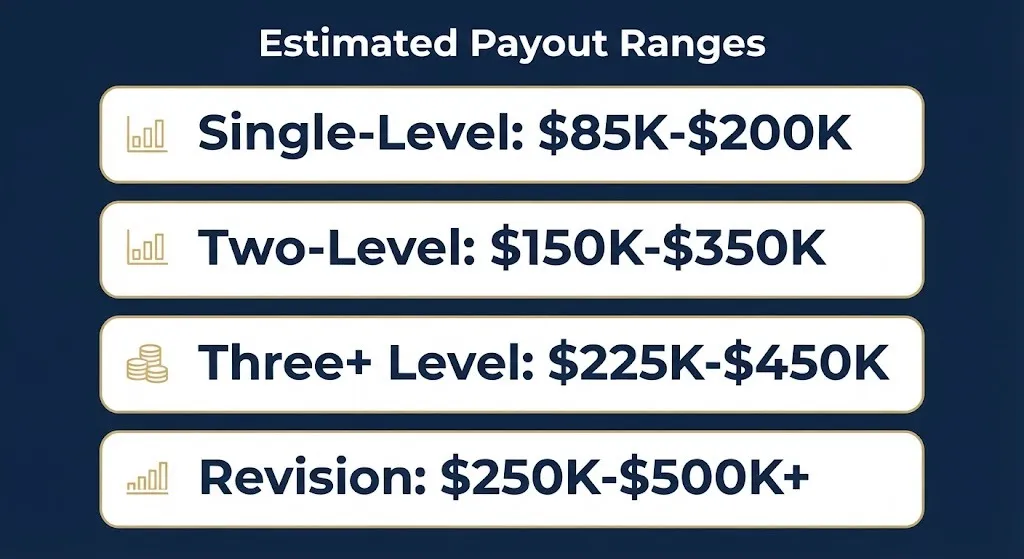
A workers’ comp neck fusion settlement ranges from $85,000 to $200,000 for a single-level cervical fusion, according to National Safety Council and state workers’ comp board data . Multi-level fusions settle between $150,000 and $350,000. Revision surgeries and cases with permanent total disability can exceed $500,000 .
Here is the verified payout range by fusion type:
| Fusion Type | Typical Settlement Range |
|---|---|
| Single-Level Cervical Fusion | $85,000 to $200,000 |
| Two-Level Cervical Fusion | $150,000 to $350,000 |
| Three+ Level Fusion | $225,000 to $450,000 |
| Revision Fusion / Hardware Failure | $250,000 to $500,000+ |
A separate data source puts the average spinal fusion settlement at $185,000 nationally . The average neck injury settlement across all severity levels is $68,749, but that figure includes minor strains and whiplash cases that resolve without surgery .
The $85,000 to $200,000 single-level range reflects cases with a successful fusion and return to work. Cases with failed fusion, chronic pain, or permanent work restrictions settle at the higher end or above .
Key Takeaway: Single-level cervical fusion settlements typically land between $85,000 and $200,000. Multi-level fusions regularly exceed $300,000.
What Factors Increase a Neck Fusion Settlement?
Permanent disability and impairment ratings are the biggest drivers of higher settlements. After you reach Maximum Medical Improvement, a doctor assigns an impairment rating using the AMA Guides to the Evaluation of Permanent Impairment . A two-level fusion inevitably reduces your neck’s range of motion, producing a higher rating than a single-level procedure.
Medical expenses also push settlements upward. A two-level fusion often exceeds $80,000 to $150,000 for hospital stays, surgical hardware, and anesthesia . The claim must also address future medical needs. Having two discs fused increases mechanical stress on adjacent segments, a condition called adjacent segment disease. If your doctor notes you will likely need ongoing MRIs, injections, or revision surgery, those future bills get capitalized into the settlement .
Lost future earning capacity matters when you cannot return to your prior occupation. If your job involved heavy lifting, overhead work, or commercial driving, permanent restrictions can mean a career-ending injury. The gap between your pre-injury earnings and what you can earn now dramatically boosts settlement value .
Here is what can lower a settlement:
- Pre-existing arthritis or degenerative changes in the neck
- A successful fusion with full return to prior job at prior wage
- Minimal complications during recovery
- Short duration of temporary disability benefits
How Do State Laws Affect Neck Fusion Settlements?
State workers’ compensation laws change the calculation significantly because each state has its own formula for permanent disability benefits. Illinois uses a “person as a whole” calculation for spinal fusion injuries, with a 20% person-as-whole rating worth approximately $104,592 at the 2025 maximum PPD rate .
In Georgia, the neck is an unscheduled injury rated against the body as a whole, worth up to 300 weeks of benefits. The permanent-disability payment equals your impairment percentage multiplied by those 300 weeks, paid at two-thirds of your average weekly wage .
California uses a different system. The state limits an injured worker’s ability to sue their employer directly but guarantees medical treatment and partial wage replacement. Permanent disability is calculated using Whole Person Impairment (WPI) scores, and future medical care can be included in settlements or retained as an open benefit .
Colorado has a specific apportionment rule for spinal conditions. If you have a pre-existing cervical condition, the state may subtract the prior impairment rating from your current rating. For a prior cervical fusion, the maximum apportionable range of motion impairment is 14% .
Key Takeaway: State law changes the math. A 20% impairment rating in Illinois translates to roughly $104,592 at max PPD rate, while Georgia calculates it differently.
Reality Check: A workers’ comp settlement does not include pain and suffering. Unlike a personal injury lawsuit, workers’ compensation is a no-fault system that pays medical bills, lost wages, and permanent impairment, but not emotional distress or punitive damages . If someone promises you pain and suffering damages in a workers’ comp claim, they do not understand the system.
How Do You Calculate a Neck Fusion Settlement?
A neck fusion settlement is built from four components: lost wages, permanent impairment, medical expenses, and vocational loss . Adding them together produces the total settlement value, though the final number is also shaped by negotiation and state law.
Here is how each component works:
- Lost wages (Temporary Total Disability). Most states pay 66.67% of your average weekly wage while you are off work, capped at a state maximum .
- Permanent impairment. After MMI, a doctor assigns a 0-100% impairment rating. That rating multiplied by your state’s scheduled weeks produces the PPD portion .
- Medical expenses. Past medical bills plus reasonable future medical care for the neck injury. In lump-sum settlements, future care is capitalized into the total .
- Vocational / loss-of-earning-capacity. If you cannot return to your prior job at the same wage, the difference increases the settlement value .
A separate analysis of Illinois settlements shows how impairment ratings translate to dollars. At the 2025 maximum PPD rate of $1,045.92 per week, a 10% person-as-whole rating equals 50 weeks of compensation, or $52,296. A 20% rating equals 100 weeks, or $104,592. A 30% rating equals 150 weeks, or $156,888 .
How Long Does It Take to Get a Neck Fusion Settlement?
A workers’ comp neck fusion settlement typically takes 12 to 18 months from surgery to settlement because most cases do not settle until you reach Maximum Medical Improvement . Reaching MMI after spinal fusion usually takes 12 to 18 months post-surgery .
The timeline follows a predictable sequence. You report the injury, file a claim, undergo surgery, complete post-operative rehabilitation, reach MMI, receive an impairment rating, and then negotiate settlement. Delays happen when medical records are incomplete, the insurer disputes causation, or an independent medical examination is scheduled .
Settlement timing also depends on whether you hire an attorney. Represented claimants often settle faster because the attorney manages documentation and negotiations. Unrepresented claimants may face more back-and-forth with the adjuster .
What Happens Next
Immediately: Report your injury to your employer and file a workers’ comp claim with the state board. Do not delay. Deadlines vary by state.
During recovery: Document everything. Keep medical records, surgical reports, therapy notes, and wage statements. This documentation builds your settlement case.
At MMI: Your doctor assigns an impairment rating. This rating is the foundation of your permanent disability award.
Before settlement: Consult a workers’ compensation attorney. Most work on contingency and offer free consultations.
At settlement: Review the agreement carefully. Understand whether you are waiving future medical rights or preserving them.
Frequently Asked Questions
How much is a workers’ comp settlement for a neck fusion?
A single-level cervical fusion typically settles between $85,000 and $200,000. Multi-level fusions reach $150,000 to $350,000. Revision surgeries and permanent total disability cases can exceed $500,000.
How long does it take to settle a neck fusion workers’ comp claim?
Most cases settle 12 to 18 months after surgery, once you reach Maximum Medical Improvement. Delays happen when medical records are incomplete or the insurer disputes the claim.
Can I get a lump sum for a neck fusion settlement?
Yes. Workers’ comp settlements are often paid as a lump sum that closes the claim. Some settlements preserve future medical benefits as an open provision.
What is MMI in a workers’ comp neck fusion case?
MMI stands for Maximum Medical Improvement. It is the point where your condition has stabilized and further treatment will not improve it. Your impairment rating and settlement value are determined at MMI.
Does a neck fusion qualify for permanent disability?
Yes. A two-level cervical fusion almost always qualifies for permanent partial disability benefits because the surgery permanently reduces neck range of motion .
Can I settle my workers’ comp claim before surgery?
It is rarely advisable to settle before surgery. Waiting until you reach MMI ensures a more accurate valuation of your long-term needs and prevents you from waiving rights to future care .
Do I need a lawyer for a neck fusion workers’ comp claim?
Strongly recommended. Spinal fusion cases are high-value and heavily contested. Represented claimants historically recover three to five times more than unrepresented claimants .
What happens if I need future surgery after settling?
If you waived future medical rights in your settlement, you are responsible for those costs. Some settlements preserve medical benefits as an open provision. Review the agreement carefully before signing.