Workers Compensation Utah: 2026 Guide to Benefits, Insurance, and Claim Deadlines
Quick Answer:
- Utah workers compensation is mandatory for most employers and pays medical bills plus wage replacement.
- Benefits replace two-thirds of your average weekly wage, subject to state maximums updated each year.
- You must report your injury within 180 days, but sooner is better for protecting your claim.
Workers compensation in Utah is a no-fault system. If you got hurt on the job, you do not have to prove your employer was negligent. You do have to prove the injury happened at work and report it fast.
The state’s workers compensation framework is built around two main paths: private insurance carriers and the Workers Compensation Fund of Utah, a quasi-public insurer that covers a large share of Utah employers.
This article explains how the Utah system works, what benefits pay, how to file a claim, and the deadlines that can end your case before it starts. One fact most workers miss: Utah gives you 180 days to report an injury, but waiting that long often triggers a denial.
The Facts
| Item | Detail |
|---|---|
| System | Utah Workers Compensation Act |
| Administrator | Utah Labor Commission |
| Status | Active, claims processed daily |
| Wage Replacement | Two-thirds of average weekly wage, capped |
| Report Deadline | 180 days from injury, sooner strongly advised |
| Filing Deadline | Generally 6 years from injury for most claims |
| Primary Insurer | Workers Compensation Fund of Utah |
Is Workers Compensation in Utah Legit?
Yes, Utah workers compensation is a real, state-mandated system. It is not optional for most employers and it is not a scam.
The Utah Labor Commission oversees the system. It handles disputes, approves settlements, and sets the procedural rules for every claim filed in the state. The Utah Workers Compensation Act is the governing statute.
Employers with one or more employees must carry workers compensation insurance, with limited exceptions for certain agricultural or domestic workers. The requirement is enforced through state audits and penalties.
Key Takeaway: The system is real and mandatory. The challenge is not whether it exists. The challenge is whether your specific claim gets approved.
How Does Workers Compensation Insurance Work in Utah?
Workers compensation insurance in Utah pays for medical care and wage replacement when an employee is injured on the job. The employer purchases the policy, and the insurer pays approved claims.
The Workers Compensation Fund of Utah, often called WCF, is the largest carrier in the state. It operates as a quasi-public insurer and writes policies for a significant portion of Utah employers, from small businesses to large industrial operations.
Private carriers also compete in the Utah market. The insurer, whether WCF or a private company, handles the claim from the first report through settlement or denial.
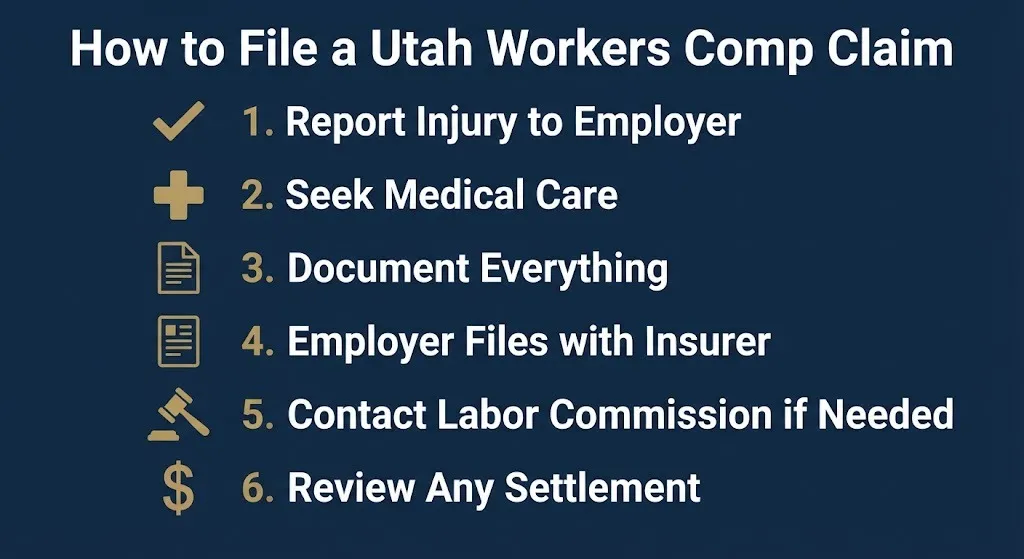
- You report the injury to your employer.
- Your employer files a claim with its workers compensation insurer.
- The insurer investigates and accepts or denies the claim.
- If accepted, medical bills and wage benefits begin.
- If denied, you can appeal to the Utah Labor Commission.
What Is the Workers Compensation Fund of Utah?
The Workers Compensation Fund of Utah is a quasi-public insurance company that writes workers compensation policies for Utah employers. It is not a state agency, but it operates under state oversight.
WCF was created by the Utah legislature to ensure that every employer could obtain workers compensation coverage, even if private insurers would not write the policy. Over time, it became the dominant carrier in the state.
For injured workers, WCF functions like any other insurer. It accepts or denies claims, pays benefits, and negotiates settlements. The difference is its market share and its statutory foundation.
How Much Does Workers Compensation Pay in Utah?
Utah workers compensation pays two-thirds of your average weekly wage, up to a state maximum that changes annually. The maximum is tied to the state’s average weekly wage.
For 2026, the specific maximum benefit rate is set by the Utah Labor Commission based on prior year wage data. You should verify the current figure before assuming any payout amount.
Medical benefits are paid separately and have no cap. Your approved medical care, including surgeries, medications, and physical therapy, is covered for as long as the treatment is related to your work injury.
| Benefit Type | What It Pays |
|---|---|
| Temporary total disability | Two-thirds of average weekly wage while unable to work |
| Temporary partial disability | Difference between old and new wages if you return to lighter duty |
| Permanent partial disability | Scheduled benefit based on impairment rating |
| Permanent total disability | Long-term benefit subject to statutory limits |
| Medical benefits | Full coverage for approved treatment, no cap |
Reality Check: No insurer writes you a check the day you get hurt. The process takes weeks. Delays are normal, but a denial without a stated reason is a red flag.
What Is the Workers Compensation Claim Deadline in Utah?
Utah gives you 180 days to report a work injury to your employer. The statute of limitations for filing a formal claim is generally six years from the date of injury.
The 180-day reporting window is not the same as the six-year filing window. If you miss the 180 days, you may still file within six years, but your claim faces immediate scrutiny. Insurers often deny late-reported injuries unless you have strong evidence.
For occupational diseases that develop over time, the deadline may run from the date you knew or should have known the condition was work-related, not the date of first exposure.
- Report any work injury the same day it happens.
- Seek medical care and tell the provider it is work-related.
- Confirm your employer filed a claim with its insurer.
- File a formal claim with the Utah Labor Commission if you get no response.
- Do not wait until day 180. Late reports invite denials.
Key Takeaway: The 180-day deadline is a maximum, not a target. The sooner you report, the harder it is for the insurer to deny your claim.
What Are the Most Common Workers Compensation Injuries in Utah?
The most common Utah workers compensation injuries include back injuries, falls, machinery accidents, repetitive motion injuries, and occupational illnesses.
Utah’s economy drives the injury mix. Construction, manufacturing, transportation, healthcare, and mining all produce significant claims. Back injuries from lifting and pulling are the single most frequent claim type.
Repetitive motion injuries, like carpal tunnel syndrome, are harder to prove because there is no single accident. You need medical evidence linking the condition to your job duties over time.
| Industry | Common Injury |
|---|---|
| Construction | Falls, struck-by injuries, back strain |
| Manufacturing | Machinery accidents, repetitive motion |
| Healthcare | Patient lifting injuries, slips |
| Transportation | Vehicle accidents, loading injuries |
| Mining | Equipment accidents, respiratory conditions |
What Is the Role of the Utah Labor Commission?
The Utah Labor Commission is the state agency that administers workers compensation claims. It handles disputes, approves settlements, and sets procedural rules.
If your claim is denied, you can request a hearing before an administrative law judge at the Labor Commission. The judge hears evidence and issues a decision. You can appeal to the Commission’s appeals board and then to state court.
The Labor Commission also monitors insurer compliance and runs the uninsured employer fund for cases where an employer failed to carry required coverage.
What Happens If My Utah Workers Compensation Claim Is Denied?
A denial is not the end of your claim. You have the right to appeal through the Utah Labor Commission.
Common denial reasons include late reporting, disputes over whether the injury happened at work, pre-existing condition defenses, or insufficient medical evidence. Each reason requires a specific response.
An attorney can help you request a hearing, gather additional medical records, and present your case. Many denials are reversed when the worker presents complete documentation.
- Read the denial letter and note the stated reason.
- Check the appeal deadline. It is usually short.
- Gather additional medical records and witness statements.
- Request a hearing before the Utah Labor Commission.
- Present your evidence to the administrative law judge.
- Appeal to the Commission’s appeals board if needed.
What Is the Utah Workers Compensation Settlement Process?
A Utah workers compensation settlement is a lump sum or structured payment that closes your claim. It typically covers your past and future disability benefits plus some medical exposure.
The settlement must be approved by the Utah Labor Commission. The Commission reviews the terms to ensure the worker understands what they are giving up.
You should never accept a settlement without understanding the full scope of the release. An attorney can review the offer and explain whether it is fair for your injury and wage loss.
- Review the full settlement agreement.
- Confirm what the lump sum includes and excludes.
- Ask whether future medical care is covered or waived.
- Compare the offer to your impairment rating and wage loss.
- Sign only after the Utah Labor Commission approves the terms.
Key Takeaway: A settlement is a trade. You get cash now. You give up future benefits. Understand the trade before you sign.
What Is the Difference Between Temporary and Permanent Disability in Utah?
Temporary disability means you are expected to recover and return to work. Permanent disability means your injury will not fully heal.
Temporary total disability pays two-thirds of your wage while you cannot work at all. Temporary partial disability pays the difference if you return to lighter duty at lower pay.
Permanent partial disability is a scheduled benefit based on a doctor’s impairment rating. Permanent total disability pays long-term benefits for workers who cannot return to any gainful employment.
| Disability Type | What It Means |
|---|---|
| Temporary total | Cannot work, expected to recover |
| Temporary partial | Working but earning less due to injury |
| Permanent partial | Permanent impairment, scheduled benefit |
| Permanent total | Cannot work at all, long-term benefit |
What Is the Utah Workers Compensation Uninsured Employer Fund?
The Uninsured Employer Fund is a state program that pays benefits to workers whose employers failed to carry required workers compensation insurance. It is funded by penalties and assessments.
If your employer did not have workers compensation coverage, you may still be entitled to benefits. The fund steps in to pay what the employer should have provided.
The process is more complicated than a standard claim. You need to prove the injury, prove the employer was uninsured, and file through the Utah Labor Commission.
How Does Workers Compensation Utah Compare to Other States?
Utah’s workers compensation system is generally considered middle-of-the-road in terms of benefit generosity. The two-thirds wage replacement formula is standard. The six-year statute of limitations is longer than many states.
Some states cap total disability benefits at 500 weeks. Utah has its own caps and exceptions for permanent total disability. The specific rules matter for anyone with a serious injury.
The biggest difference in Utah is the dominance of the Workers Compensation Fund. In many states, private insurers compete more evenly. In Utah, WCF’s market share shapes the claims experience.
What Should You Do Right Now If You Were Hurt at Work in Utah?
Report the injury, get medical care, and document everything. Do not wait to see if it gets better on its own.
If your employer or insurer pushes back, do not argue. File the formal claim and gather your records. The process rewards documentation, not confrontation.
- Report the injury to your employer in writing.
- Seek medical care and say it is work-related.
- Keep copies of every medical record and work restriction.
- Track your missed workdays and wages.
- Contact the Utah Labor Commission if your claim stalls.
- Consult a workers compensation attorney for denials or serious injuries.
Reality Check: No one calls you out of the blue to offer a workers compensation settlement. If you get a cold call about a claim you did not file, it is likely a scam or a lead generator.
What Happens Next With Your Utah Workers Compensation Claim?
First 30 days: You report the injury and begin medical care. The insurer opens a file.
Next 90 days: The insurer accepts or denies the claim. Denials trigger appeal deadlines.
Next 6 to 12 months: Treatment continues. Wage benefits flow if you cannot work.
Next 12 to 24 months: Settlement negotiations or a hearing before the Labor Commission.
Beyond: Appeals resolve and final payments issue.
These timelines are typical. Your case may move faster or slower.
Frequently Asked Questions
Is workers compensation mandatory in Utah?
Yes, most employers with one or more employees must carry workers compensation insurance.
How much does Utah workers compensation pay?
It pays two-thirds of your average weekly wage, up to a state maximum, plus medical care.
What is the Workers Compensation Fund of Utah?
It is a quasi-public insurance company that is the largest workers compensation carrier in Utah.
How long do I have to report a work injury in Utah?
You have 180 days, but reporting immediately is strongly advised.
Can I choose my own doctor for a Utah workers compensation claim?
Utah allows employer-directed medical care initially, but you may have options after a certain period.
What if my employer does not have workers compensation insurance?
You may be covered by the Uninsured Employer Fund through the Utah Labor Commission.
Is a Utah workers compensation settlement taxable?
Most workers compensation settlements are not taxable as income.
Do I need a lawyer for a Utah workers compensation claim?
Not for simple claims, but a lawyer is recommended for denials, serious injuries, or settlement offers.
Utah workers compensation is a real system with real money, but the process is not automatic. Report early, document everything, and do not sign anything you do not understand.
The single most important date is the day you report your injury. Do it the same day it happens.