PFAS Lawsuit Update Today 2026: Settlement Amounts Per Person, Claim Deadlines, and Water Contamination Cases
Quick Answer:
- PFAS lawsuits are real, multidistrict litigation in federal court involving thousands of water utilities, firefighter unions, and individuals exposed to toxic forever chemicals.
- Water utility settlements are paying now. Personal injury settlements have not yet been finalized, and per-person amounts remain unconfirmed.
- The most important deadlines vary by case type. Water utility claims have staggered deadlines. Personal injury claims are still being accepted through the MDL process.
You searched this because you heard about PFAS settlements, maybe through a news alert, a social media post, or a law firm advertisement, and you want to know if you are owed money. The short answer: billions of dollars in settlements have been reached, but who gets paid and how much depends on whether you are a water utility, a firefighter, or an individual with a personal injury claim. The checks are not going out to everyone who drank tap water. The largest settlements are flowing to public water systems, not individuals.
This affects you if you live in a community where PFAS contamination has been detected in drinking water, if you worked as a firefighter and used PFAS-containing foam, or if you have been diagnosed with a health condition linked to PFAS exposure such as kidney cancer or testicular cancer. Millions of Americans fall into at least one of these categories. Few will receive direct payments without filing a claim or joining a lawsuit.
This article covers the latest PFAS lawsuit updates as of July 27, 2026, including the 3M and DuPont settlement amounts, what individuals can realistically expect to receive, who qualifies for compensation, how to file a claim, and what the 2026 bellwether trials mean for future payouts. One fact that surprises most people: the $10.3 billion 3M settlement goes almost entirely to public water systems, not individuals. The personal injury settlements are a separate, less advanced track of litigation with no confirmed per-person payout yet.
The Facts
| Detail | Information |
|---|---|
| Cases | In re Aqueous Film-Forming Foams Products Liability Litigation (MDL No. 2873); multiple state AG lawsuits; individual personal injury and water contamination cases |
| Court | U.S. District Court, District of South Carolina (MDL); various state courts |
| Current Status | Water utility settlements: approved and paying. Personal injury: bellwether trials scheduled for late 2026. State AG cases: ongoing |
| Total Settlement Funds | Over $16 billion combined: 3M ($10.3B), DuPont/Chemours/Corteva ($1.18B), Tyco ($750M), BASF ($312M), others |
| Est. Per Person (Personal Injury) | Not yet confirmed. Bellwether outcomes expected to establish ranges in 2026 to 2027 |
| Water Utility Claims | Paying now. Amounts vary by system size and contamination levels |
| Claim Deadlines | Water utility: staggered by settlement phase. Personal injury: no global settlement, no global deadline. Individual cases accepted on rolling basis |
| Administrator | Various court-appointed special masters and claims administrators |
Is the PFAS Class Action Lawsuit Legitimate?
Yes, the PFAS litigation is legitimate. It is one of the largest and most complex multidistrict litigations in U.S. history, consolidated in federal court in South Carolina under Judge Richard Gergel. The cases involve thousands of plaintiffs, including public water systems, state attorneys general, firefighter unions, and individuals alleging personal injury from PFAS exposure. Major defendants include 3M, DuPont, Chemours, Corteva, Tyco, BASF, and other manufacturers of PFAS chemicals and PFAS-containing products such as aqueous film-forming foam used in firefighting.
The water utility settlements are court-approved and paying. 3M agreed to pay $10.3 billion over 13 years to public water systems that detected PFAS in their drinking water supplies. DuPont, Chemours, and Corteva agreed to pay $1.18 billion. Tyco agreed to $750 million. BASF agreed to $312 million. These funds are being distributed to water utilities based on contamination levels and system size, not to individual residents. If your local water utility received settlement funds, the money goes toward PFAS remediation, filtration, and testing, not to your personal bank account.
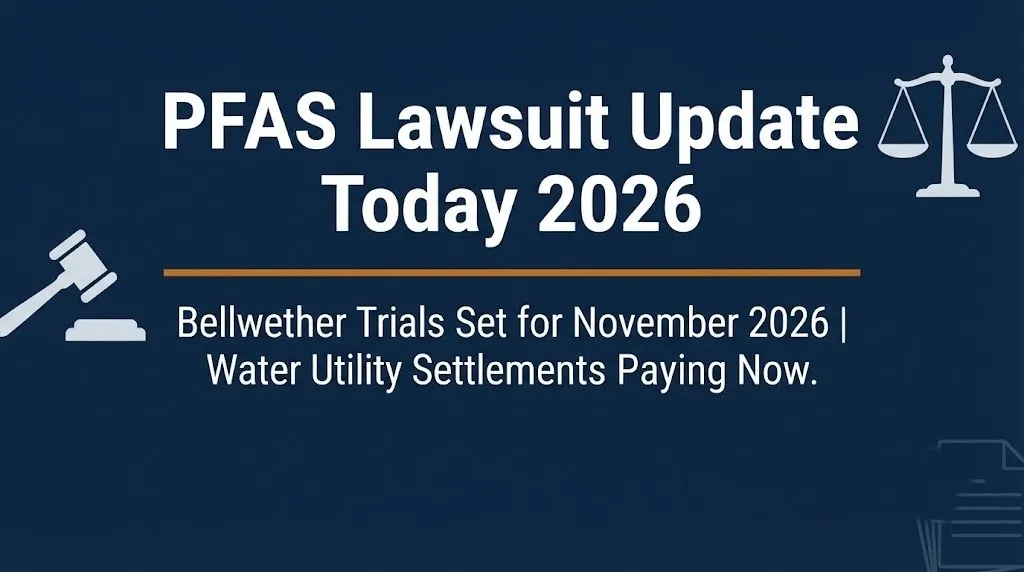
The personal injury track of the MDL is separate. These are individual lawsuits by people who allege that PFAS exposure caused specific health conditions, including kidney cancer, testicular cancer, ulcerative colitis, thyroid disease, and other illnesses. No global personal injury settlement has been reached. Bellwether trials, test cases selected to establish settlement values, are scheduled for late 2026. The outcomes of those trials will influence whether and for how much the remaining cases settle.
Key Takeaway: The PFAS water utility settlements are real and paying. The personal injury litigation is real but unsettled. Anyone offering to file a personal injury PFAS claim for a guaranteed payout is lying. No per-person payout has been confirmed.
How Much Are PFAS Settlement Amounts Per Person?
PFAS settlement amounts per person for personal injury claims have not yet been confirmed because no global personal injury settlement exists. The water utility settlements pay public water systems, not individuals. If you are an individual seeking compensation for a health condition linked to PFAS exposure, your case is part of the personal injury track of the MDL or a separate state-court filing. The value of your claim depends on bellwether trial outcomes expected in late 2026 and 2027.
For water utilities, the settlement amounts are calculated based on a complex allocation formula that considers the level of PFAS detected, the population served, and the cost of remediation. Larger systems with higher contamination levels receive larger payments. A major municipal water system serving 500,000 people might receive tens of millions of dollars. A small rural water district might receive thousands. These funds are not distributed to individual ratepayers. They are used for water treatment and infrastructure.
For personal injury plaintiffs, settlement values will likely fall into tiers based on the diagnosed condition, the strength of the causation evidence, and the plaintiff’s exposure history. Based on analogous mass torts such as asbestos and Roundup litigation, potential settlement ranges might look like this, though these are projections, not confirmed numbers:
| Injury Tier | Projected Settlement Range | Status |
|---|---|---|
| Kidney Cancer | Not yet confirmed. Bellwether trials pending | Unsettled |
| Testicular Cancer | Not yet confirmed. Bellwether trials pending | Unsettled |
| Ulcerative Colitis | Not yet confirmed. Bellwether trials pending | Unsettled |
| Thyroid Disease | Not yet confirmed. Bellwether trials pending | Unsettled |
| Elevated Blood Levels (No Disease) | Likely lower tier or medical monitoring only | Unsettled |
Reality Check: Do not believe any website, social media post, or law firm advertisement that promises a specific dollar amount for a PFAS personal injury claim in 2026. No settlement amounts have been established. The bellwether trials have not happened. The settlement grid does not exist. Anyone quoting you a number is speculating or marketing.
What Is the Latest PFAS Lawsuit Update Today?
As of July 27, 2026, the most significant PFAS lawsuit update is that the water utility settlement payments are flowing, and the personal injury bellwether trials have been scheduled for November 2026. Judge Gergel has selected a group of test cases representing different injury types, exposure levels, and defendant configurations. These trials will be the first personal injury PFAS cases to go to a jury. The verdicts and any post-trial settlements will set the benchmark for thousands of pending cases.
3M’s $10.3 billion settlement is in the early years of its 13-year payout schedule. The first tranche of payments has been distributed to qualifying water systems. Systems that missed the initial claim deadlines may still have opportunities to participate in later phases, depending on the specific settlement terms. The claims process is administered through court-appointed special masters and claims resolution professionals, not through a typical consumer class action administrator.
The EPA’s 2024 designation of PFOA and PFOS as hazardous substances under CERCLA has accelerated litigation by giving water utilities and state governments a clearer legal path to recover cleanup costs. The 2026 election cycle has also brought increased political attention to PFAS, with several candidates making PFAS contamination a campaign issue, which could influence the regulatory environment and settlement dynamics.
What Are PFAS and Why Are They Being Sued Over?
PFAS, or per- and polyfluoroalkyl substances, are a class of thousands of synthetic chemicals used since the 1940s in nonstick cookware, waterproof clothing, food packaging, firefighting foam, and industrial manufacturing. They are called “forever chemicals” because they do not break down in the environment and accumulate in the human body over time. The CDC has detected PFAS in the blood of nearly every American tested.
The lawsuits allege that manufacturers including 3M, DuPont, Chemours, and others knew for decades that PFAS were toxic, that they accumulated in human blood and organs, and that exposure was linked to serious health conditions including cancer. Internal corporate documents, some of which have been unsealed in the litigation, suggest that companies studied PFAS toxicity internally while publicly representing the chemicals as safe. This pattern, knowledge of harm followed by public denial, is the core of the plaintiffs’ case.
The contamination is widespread. PFAS have been detected in drinking water serving more than 200 million Americans, according to Environmental Working Group data. Military bases are particularly affected because the Department of Defense used PFAS-containing firefighting foam for decades. Communities near manufacturing plants, airports, and training facilities often have the highest contamination levels and the highest rates of litigation.
Who Qualifies for PFAS Compensation?
Qualifying for PFAS compensation depends on whether you are a water utility, a firefighter, or an individual with a personal injury claim. The eligibility criteria differ for each track. Water utilities qualify if they detected PFAS in their drinking water supplies during the class period and filed timely claims under the applicable settlement. Firefighters and other occupational users of firefighting foam may qualify through separate litigation tracks alleging exposure-related injury.
Individuals may qualify for personal injury compensation if they can establish three things: significant PFAS exposure, a diagnosed medical condition linked to PFAS, and a credible causal connection between the two. Exposure is typically established through residence in a contaminated area, occupational exposure, or documented blood levels. The qualifying medical conditions are those with the strongest epidemiological evidence linking them to PFAS, primarily kidney cancer, testicular cancer, and ulcerative colitis. Other conditions, including thyroid disease, liver damage, and immune system effects, have weaker but developing scientific support.
The C8 Science Panel, established as part of an earlier DuPont settlement in West Virginia, found probable links between PFOA exposure and six diseases: kidney cancer, testicular cancer, ulcerative colitis, thyroid disease, preeclampsia, and high cholesterol. This panel’s findings form the scientific backbone of much of the current PFAS litigation. If you have one of these conditions and lived in a documented PFAS-contaminated area, you may have a viable claim.
How Do I File a PFAS Lawsuit Claim?
Filing a PFAS claim depends on what type of claim you are bringing. For water utilities, the settlement claim deadlines have largely passed for the initial phases, though later phases may have different deadlines. Utilities should consult the court-appointed claims administrator or special master for their specific settlement to determine current filing status.
For individuals with personal injury claims, there is no court-approved settlement, no class action claim form, and no filing deadline for the general litigation. The process is not like a consumer class action where you fill out a short online form and wait for a check. PFAS personal injury litigation is individual mass tort representation. Here is how the process works in 2026:
- Determine whether you have a qualifying diagnosis supported by medical records.
- Document your PFAS exposure: where you lived, where you worked, whether your water was contaminated.
- Consult a law firm handling PFAS personal injury cases. Most offer free case evaluations.
- The law firm evaluates your claim based on diagnosis, exposure history, and the current state of the litigation.
- If the firm accepts your case, you sign a retainer agreement, typically on a contingency fee basis.
- The firm files your case in the appropriate court or adds it to the MDL docket.
- Your case proceeds through discovery and either settles or goes to trial, a process that can take years.
Do not pay upfront fees to a law firm for a PFAS case. Legitimate PFAS personal injury representation is on contingency. The firm is paid from any recovery. If a firm asks for money before filing your case, consult a different firm.
When Will PFAS Settlement Checks Be Mailed?
PFAS settlement checks for water utilities are being mailed now, on the schedule established by each settlement agreement. The 3M settlement pays out over 13 years. Early-phase payments have been distributed. Systems that qualified for later phases will receive payments according to the settlement timetable. The exact payment date for a specific water system depends on its phase and the claims administrator’s processing schedule.
For personal injury plaintiffs, no settlement checks are being mailed because no global personal injury settlement exists. Individual cases may settle individually before the bellwether trials, and those settlements would result in payments on whatever timeline the parties negotiate. Those individual settlements are confidential. Their amounts do not become public, and they do not establish a per-person payout for the broader litigation.
The bellwether trials scheduled for late 2026 are the key to the personal injury settlement timeline. If the plaintiffs win significant verdicts, the defendants may move toward a global settlement in 2027. If the defendants win or damages are modest, settlement values will reflect that. Payment timing after a global settlement follows the standard mass tort pattern: 6 to 18 months after final approval for claims processing and distribution.
What Is the Difference Between the Water Utility and Personal Injury PFAS Cases?
The PFAS water utility cases seek compensation for the cost of testing, filtering, and remediating PFAS-contaminated public drinking water supplies. The plaintiffs are municipal water systems, water districts, and other public entities. The claims are based on contamination of natural resources and the expense of providing safe drinking water to the public. These are not personal injury claims. The settlement funds go to the utility, not to individual ratepayers.
The personal injury cases seek compensation for individuals who allege that PFAS exposure caused specific health conditions. The plaintiffs are individuals. The claims are based on bodily injury. The damages sought include medical expenses, lost income, pain and suffering, and in some cases punitive damages. These cases are separate from the water utility settlements and are proceeding on a different timeline through the MDL’s personal injury track.
The confusion between the two tracks is the single biggest source of misinformation about PFAS settlements. Social media posts and low-quality news articles often report the $10.3 billion 3M settlement as if it means every American will get a check. It does not. The water utility settlements fund water treatment. The personal injury litigation funds individuals. The two are connected through the same court and the same defendants, but they serve different plaintiffs and different purposes.
Key Takeaway: If you heard about a multibillion-dollar PFAS settlement, it is the water utility settlement. It does not pay individuals. The personal injury track that does pay individuals is still in litigation with no settlement yet.
What Are PFAS Bellwether Trials and Why Do They Matter?
PFAS bellwether trials are test cases selected by the MDL court to go to trial first. Their purpose is to establish settlement values for the thousands of similar cases waiting behind them. A bellwether is a lead sheep with a bell around its neck that the flock follows. In mass tort litigation, bellwether trials are the lead cases that show both sides what juries think the claims are worth.
Judge Gergel has selected a group of bellwether cases representing different injury types, different exposure scenarios, and different defendants. The first of these trials is scheduled for November 2026. If plaintiffs win large verdicts, the defendants will feel pressure to settle the remaining cases rather than face thousands of individual trials. If defendants win or damages are modest, plaintiffs will face pressure to settle for less.
Bellwether outcomes do not bind other cases legally. Each plaintiff retains the right to try their own case. But as a practical matter, bellwether verdicts function as a pricing mechanism for the entire litigation. A $50 million kidney cancer verdict in a bellwether trial will raise the settlement value of similar kidney cancer cases across the docket. A defense verdict will reduce those values. The bellwether process is the mechanism by which mass tort litigation moves from thousands of individual claims to a global settlement framework.
What Happens Next
The PFAS litigation in late 2026 and into 2027 will be shaped by the bellwether trials and continued regulatory developments. Here is the expected timeline:
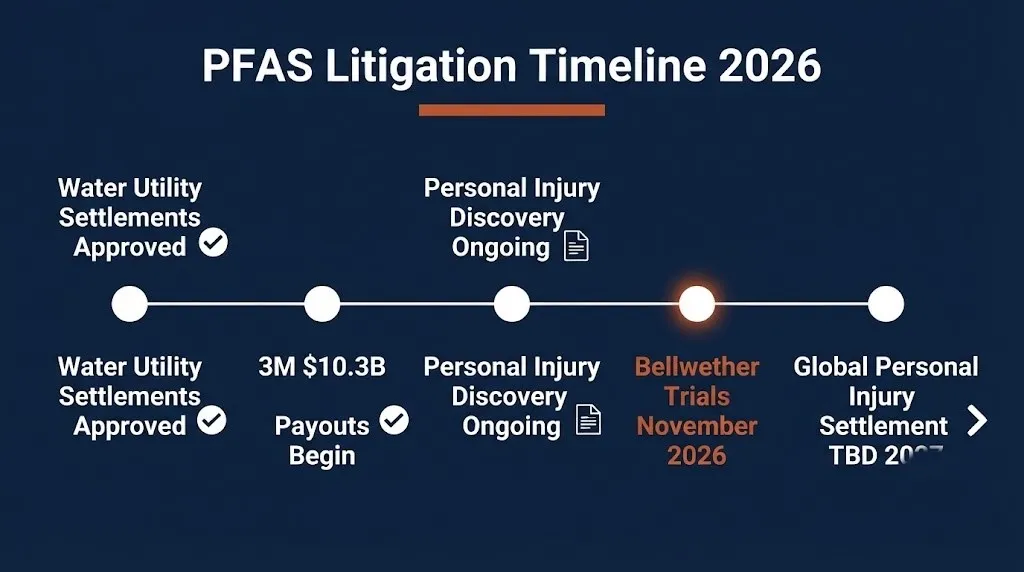
November 2026: First PFAS personal injury bellwether trials begin in the District of South Carolina. These are the first cases to reach a jury.
Late 2026 to Early 2027: Post-trial motions and potential appeals in bellwether cases. Settlement negotiations likely intensify after verdicts.
2027: Possible global personal injury settlement framework announced if bellwether outcomes create pressure for resolution.
Ongoing: Water utility settlement payments continue on their established schedules. The 3M 13-year payout continues.
Watch for: Any EPA rulemaking that strengthens or weakens the scientific basis for PFAS injury claims, which will affect settlement values across the litigation.
Frequently Asked Questions
Is There a PFAS Class Action Settlement in 2026?
Yes, for water utilities. No, for individuals with personal injury claims.
The $16 billion in settlements is almost entirely for water systems, not individuals.
Personal injury litigation is ongoing with bellwether trials in late 2026.
How Much Will I Get From the PFAS Settlement?
If you are an individual, no amount has been confirmed because no personal injury settlement exists.
Water utility settlements pay public water systems, not individuals.
Personal injury settlement values depend on bellwether trial outcomes expected in late 2026.
Can I Sue for PFAS Exposure?
Yes, if you have a qualifying diagnosis, documented PFAS exposure, and can establish a credible causal connection.
Consult a law firm handling PFAS personal injury litigation for a free case evaluation.
These are individual mass tort claims, not a class action with a simple claim form.
What Cancers Are Linked to PFAS?
Kidney cancer and testicular cancer have the strongest epidemiological evidence.
Ulcerative colitis, thyroid disease, and other conditions have been identified by the C8 Science Panel as having probable links.
The scientific understanding of PFAS health effects continues to evolve.
Do Water Utility Settlements Pay Individuals?
No. Water utility settlements fund water treatment, filtration, and remediation.
The money goes to your local water system, not to your personal bank account.
Your water rates may not decrease, but the water quality may improve.
How Do I Know If My Water Has PFAS?
Check your local water utility’s annual water quality report, which is required to be publicly available.
The EPA requires testing for certain PFAS compounds. Your utility’s report will show detection levels.
You can also search the Environmental Working Group’s PFAS contamination map for your area.
Is PFAS in My Blood?
Probably. The CDC has detected PFAS in the blood of nearly every American tested.
The presence of PFAS in your blood does not, by itself, mean you have a compensable legal claim.
A personal injury claim requires a diagnosed medical condition, not just PFAS blood levels.
How Long Does a PFAS Lawsuit Take?
Water utility settlements are paying now on established schedules.
Personal injury cases may take 2 to 4 years from filing to resolution depending on bellwether outcomes.
Cases that settle individually before a global settlement may resolve faster.
Your next move depends on your situation. If you are a water utility representative, check with the MDL claims administrator or special master for your settlement phase and payment schedule. If you are an individual with a qualifying diagnosis, consult a law firm with experience in PFAS personal injury litigation. Do not pay upfront fees. Do not expect a quick payout. The personal injury track is a multi-year process, and the settlement values will not be known until the bellwether trials produce verdicts.
The PFAS litigation is the largest environmental tort in American history. The water utility settlements are a done deal. The personal injury cases are just now reaching their inflection point. The bellwether trials in late 2026 will tell us what these cases are worth.