How Can I Protect My Settlement Money From SSI in 2026: Trusts, Spend-Downs, and ABLE Accounts
Quick Answer
- A car accident settlement can suspend or terminate SSI because the program caps countable resources at $2,000.
- A Special Needs Trust, ABLE account, or a same-month spend-down can preserve eligibility if arranged before the money lands.
- The most important deadline: report any settlement to the Social Security Administration within 10 days after the end of the month received.
If you are on Supplemental Security Income and a personal injury settlement is coming, you are facing a trap that catches thousands of people every year. The money is meant to help you rebuild, but if it hits your bank account as a lump sum, it can knock you off SSI and Medicaid entirely. The program is means-tested, and the resource cap is brutally low: $2,000 for a single person .
The good news is that federal law recognizes several legal ways to hold and use settlement funds without losing your benefits. The bad news is that most of them only work if you set them up before you receive the money. Once a check is deposited in your name, your options shrink and the cost of fixing the problem grows . This guide explains the rules, the deadlines, and the tools that actually protect you.
The Facts
Program | Supplemental Security Income (SSI)
Resource Limit | $2,000 individual / $3,000 couple (not inflation-adjusted)
Income Treatment | Lump sum counted as unearned income in the month received
Resource Treatment | Countable resource beginning the month after receipt
Reporting Deadline | 10 days after the end of the month in which you receive it
Key Protection Tool | First-Party Special Needs Trust (SNT)
Alternative Tool | ABLE Account (up to $100,000 protected for SSI)
Timing Rule | Trust must be established before you receive the funds
Why does a car accident settlement affect SSI?
A car accident settlement affects SSI because SSI is a needs-based program, and the Social Security Administration counts settlement money as both income and a resource. SSI is designed as a program of last resort for people with limited income and assets. It is not an earned benefit like Social Security Disability Insurance (SSDI), which is based on your work history and is not affected by a settlement .
When you receive a settlement, the SSA treats it as unearned income in the month you get it. That can wipe out your SSI payment for that month. If you still have any of the money in your account on the first day of the next month, it becomes a countable resource . If that resource exceeds $2,000 for an individual, your SSI benefits can be suspended or terminated.
The SSA does not care whether the settlement was meant for medical bills, lost wages, or pain and suffering. The entire lump sum counts unless a specific exclusion applies. The agency’s own rules allow deductions for medical and legal expenses essential to obtaining the award, but the remainder is countable .
Key Takeaway: SSI counts a settlement as income in the month received and as a resource the next month, and the $2,000 cap applies immediately once the money is yours.
What happens if you receive a settlement while on SSI?
If you receive a settlement while on SSI, your benefits can be reduced, suspended, or terminated depending on the amount and what you do with it. The most common outcome for a significant lump sum is a suspension, followed by termination if the suspension lasts 12 consecutive months .
The timeline looks like this:
- Month of receipt: The settlement is unearned income. Your SSI payment for that month may be reduced to zero.
- Following month: Any remaining funds are a countable resource. If they exceed $2,000, you are ineligible for SSI.
- Months 2 through 12: You remain ineligible as long as the resource is over the limit. Your case stays open in suspension status.
- Month 13: If you are still over the limit, your SSI eligibility terminates. You must file a brand new application to get back on .
You are also required to report the settlement to the SSA within 10 days after the end of the month in which you receive it. Failing to report can trigger penalties of $25 to $100 per occurrence, on top of an overpayment demand for any benefits you should not have received .
Reality Check: The SSA will find out about your settlement. Insurers report settlements to Medicare under federal data-sharing rules, the SSA reviews bank accounts during redeterminations, and the IRS and state Medicaid agencies share data . Hiding the money is not a strategy. It is a path to overpayment demands and penalties.
How can a Special Needs Trust protect your settlement from SSI?
A Special Needs Trust (SNT) protects your settlement from SSI by holding the funds in a trust that you do not legally own or control. Because the trust is the legal owner of the assets, the SSA does not count the money inside it as your countable resource . This is the single most effective tool for protecting a large settlement while preserving SSI eligibility.
For settlement money that belongs to you, the correct type is a First-Party Special Needs Trust. It is funded with your own assets, including a personal injury settlement, and it must be established by a court, a parent, a grandparent, a legal guardian, or yourself (if you are your own guardian, the trust must be court-approved) .
A trustee manages the funds and makes distributions for your supplemental needs, meaning things that SSI and Medicaid do not cover. Examples include :
- Therapy not covered by insurance
- Accessible transportation or vehicle modifications
- Technology and communication devices
- Home modifications
- Education and vocational training
- Recreation and travel
One important caveat: a first-party SNT generally includes a Medicaid payback provision. When you die, any remaining funds in the trust must first reimburse Medicaid for benefits it paid on your behalf. Only after that can the remainder go to other beneficiaries .
The timing rule is strict. The trust must be established before the settlement funds are distributed to you. If the money lands in your name first, it becomes a countable resource, and setting up the trust afterward is harder and more expensive .
Can an ABLE account protect settlement money from SSI?
An ABLE account can protect up to $100,000 of settlement money from SSI’s resource limit, and Medicaid generally disregards the entire account balance regardless of size . ABLE accounts are tax-advantaged savings accounts for people whose disability began before age 26, though some proposals have sought to expand that age threshold .
To open an ABLE account, you must meet Social Security’s disability criteria or already receive SSI or SSDI . The account allows you to save and spend money on Qualified Disability Expenses, which include housing, transportation, healthcare, education, employment support, and assistive technology .
The 2026 annual contribution limit is $20,000 . Family and friends can also contribute. If you work, you can contribute more under ABLE to Work rules .
The SSI resource exclusion for ABLE accounts is capped at $100,000. If your ABLE account balance exceeds that amount, the excess counts as a resource and can affect your SSI eligibility . For Medicaid, there is generally no cap, and the entire balance is disregarded .
ABLE accounts work best for modest settlements or in combination with a Special Needs Trust for larger amounts. The account is simpler and cheaper to set up than a trust, but the $100,000 SSI protection cap means it cannot shield a very large settlement on its own .
How does a spend-down protect your SSI eligibility?
A spend-down protects your SSI eligibility by converting settlement funds into resources that the SSA does not count, all within the same month you receive the money. If you spend the settlement down to under $2,000 before the first day of the next month, you never hold a countable resource over the limit .
The SSA allows you to spend settlement money on a wide range of goods and services without penalty, as long as you receive fair market value. You cannot give the money away or sell assets for less than they are worth .
Approved spend-down categories include :
- Medical expenses not covered by Medicaid or Medicare
- Dental expenses, eyeglasses, physical therapy
- A home or home repairs and modifications
- Furniture and appliances for your home
- Education expenses, including computers and books
- A vehicle, including registration and insurance
- Paying off debts
- Pre-paid burial arrangements
- Clothing and personal care items
You can also set aside up to $2,000 for a single person or $3,000 for a couple in non-exempt resources like a savings account .
The spend-down strategy is most practical for smaller settlements. If you receive $5,000, you can pay outstanding medical bills, buy needed household items, and keep the remainder under the cap. For larger settlements, a trust or ABLE account is usually necessary because spending six figures in one month is not realistic.
What is the reporting deadline for a settlement while on SSI?
The reporting deadline for a settlement while on SSI is 10 days after the end of the month in which you receive the funds. This rule applies to all changes in income and resources, including personal injury settlements, inheritances, and gifts .
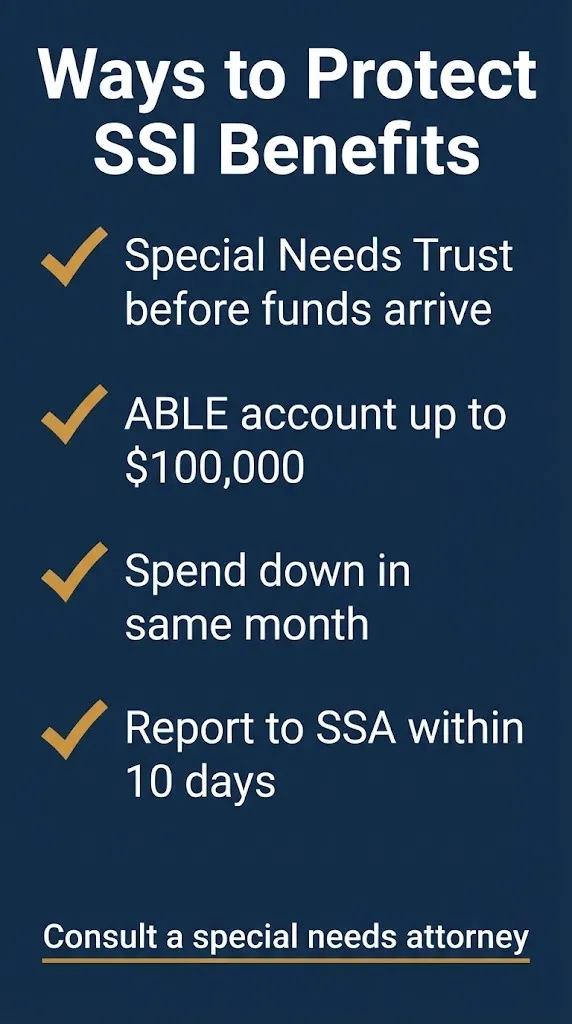
Reporting late or not at all carries consequences. The SSA can impose penalties of $25 to $100 each time you fail to report a change on time . More seriously, if you receive SSI benefits you were not eligible for because of the settlement, the SSA will demand an overpayment and require you to pay it back.
The overpayment can be substantial. If you are over the resource limit for several months before the SSA discovers it, you could owe thousands of dollars. The agency can recover overpayments by reducing future SSI payments, or by other collection methods.
You should report the settlement to the SSA before you spend or move the money. That gives the agency a chance to tell you how it will affect your benefits and what steps you need to take. Reporting after the fact does not erase the obligation to repay benefits you should not have received.
What happens next in your SSI settlement planning?
The next stages depend on the size of your settlement and whether you have already received the money.
Before settlement: Consult a special needs attorney and a personal injury attorney together. Establish a First-Party Special Needs Trust or open an ABLE account before the funds are distributed .
At settlement: Ensure the settlement agreement directs funds into the trust or ABLE account, not to you personally. If you are spending down, plan the purchases in advance.
Within 10 days after the month ends: Report the settlement to the SSA. Provide documentation of the trust, ABLE account, or spend-down plan .
Ongoing: The trustee or you (for ABLE) must keep records of all distributions and ensure funds are used only for approved purposes. Report any changes to the SSA as they occur.
If benefits are suspended: Work with the SSA to requalify. If the suspension lasts 12 months, you will need to reapply .
Frequently Asked Questions
Will a car accident settlement affect my SSI?
Yes, a settlement can reduce, suspend, or terminate SSI benefits because SSI has a $2,000 resource limit .
How much settlement money can I have on SSI?
You can have up to $2,000 in countable resources as an individual or $3,000 as a couple .
What is the best way to protect a settlement from SSI?
A First-Party Special Needs Trust is the most effective tool for large settlements. An ABLE account protects up to $100,000 .
Can I put my settlement in a trust to keep SSI?
Yes, but the trust must be established before you receive the funds. A First-Party Special Needs Trust does not count as your resource .
Do I have to report a settlement to Social Security?
Yes, you must report it within 10 days after the end of the month in which you receive it .
What happens if I don’t report a settlement to SSI?
You can face penalties of $25 to $100 and be required to repay any overpaid benefits .
Can I spend down a settlement to keep SSI?
Yes, if you spend the funds in the same month you receive them on approved expenses and keep under $2,000 by the next month .
What is the difference between SSDI and SSI for settlements?
SSDI is not means-tested, so a settlement does not affect it. SSI is means-tested, so a settlement can suspend or terminate benefits .
The Bottom Line
A car accident settlement can protect your future or destroy your SSI benefits, and the difference is planning. The $2,000 resource limit is unforgiving, and the 10-day reporting rule is strict. If a settlement is coming, talk to a special needs attorney before you sign anything. A First-Party Special Needs Trust, an ABLE account, or a carefully timed spend-down can preserve the benefits you depend on while still letting you use your recovery. Once the money is in your name, your options disappear.