Top Class Action Lawsuits 2026: Open Settlements, Claim Deadlines, and Verified Payouts
Quick Answer
- Several class action settlements are accepting claims in 2026 across consumer, data privacy, and product cases.
- Per-person payouts vary widely, from a few dollars to hundreds depending on the case and proof.
- Each settlement has its own deadline. Check the official settlement website for your specific case.
You searched for “top class action lawsuit” because you want to know what is open, what pays, and whether you qualify. Maybe you got a postcard. Maybe you saw an ad. Maybe you just want to check the list and see if free money is waiting.
Here is what matters. Class action settlements are real. Some pay real money. But the per-person amounts are usually modest, and the deadlines are strict. The only way to get paid is to file a valid claim before the cutoff.
This article covers the most active verified class action settlements in 2026, how to find open claims, what proof you need, how much you might get, and how to avoid the scams that surround settlement lists.
| The Facts | |
|---|---|
| Open Settlements | Multiple across consumer, privacy, and product categories |
| Per-Person Range | Varies by case, typically $5 to $500 for consumer claims |
| Claim Deadlines | Case-specific, set by each settlement |
| Administrators | Case-specific, usually a court-appointed firm |
| Proof Needed | Varies from none to receipts or account records |
| Source | Official settlement websites and court dockets |
Are class action lawsuits worth filing?
Class action lawsuits are worth filing if you meet the eligibility criteria and the settlement is verified. The claim form is usually short. The payment is usually small. But the time cost is low.
A typical consumer class action pays between $5 and $50 per person. Some data privacy settlements pay less. Some product defect settlements pay more, especially if you have receipts.
Here is a realistic table of payout ranges by category.
| Category | Typical Per-Person Payout |
|---|---|
| Data privacy | $5 to $50 |
| Product defect | $20 to $200 |
| Consumer fraud | $10 to $100 |
| Employment | $50 to $500 |
| Antitrust | $10 to $500 |
These ranges are illustrative. Your payment depends on the fund size, the number of claims, and your proof.
How do I find open class action settlements?
You find open class action settlements by checking official settlement websites, court dockets, and trusted legal news sources. Do not rely on random social media posts or ads.
Here are the reliable sources.
- Official settlement administrator websites
- Federal court PACER dockets
- State attorney general consumer pages
- Established legal news sites
- The FTC and CFPB for regulatory settlements
The best list is one you build yourself from primary sources. Lists from legal marketing sites are useful as leads, but you must verify every case before entering personal information.
What are the biggest class action settlements in 2026?
The biggest class action settlements in 2026 are not a single published list. The cases change as courts approve new settlements and close old ones. What is “top” depends on fund size, claimant count, and recency.
Here are categories with active cases.
| Category | Example Case Types |
|---|---|
| Data privacy | Video streaming, app tracking, biometric data |
| Consumer products | Defective appliances, contaminated goods |
| Financial services | Fee disputes, overdraft practices |
| Employment | Wage and hour, misclassification |
| Pharmaceuticals | Product liability, false marketing |
The verified status of any specific case must be checked on the official settlement website. Do not assume an old case is still open.
Key Takeaway: The top class action list changes monthly. A case open in January may close in March. Always check the current deadline.
What is the average class action settlement payout per person?
The average class action settlement payout per person is small. Most consumer cases pay under $50. Some pay under $10. The cases that make headlines for millions of dollars pay little per person because millions of people file claims.
Here is the math. A $10 million settlement with 1 million valid claims pays $10 per person before deductions. Attorney fees, administration costs, and named plaintiff awards reduce the fund further.
The cases that pay more are usually employment or product defect cases with fewer claimants and stronger documentation. A wage and hour case with 500 class members may pay thousands per person. A data privacy case with 10 million class members may pay pennies.
How much can I get from a class action lawsuit?
You can get from a few dollars to a few hundred in most class action lawsuits. Some cases pay more if you have documented losses. The settlement notice will state the estimated payment range.
Here are the variables that determine your amount.
- Total settlement fund size
- Number of valid claims filed
- Claim type and tier
- Proof of purchase or loss
- Attorney fees and costs
- Named plaintiff service awards
Do not expect a windfall. Class actions are designed to resolve many small claims efficiently, not to make individuals rich.
How do I file a class action claim?
Filing a class action claim is a simple process. You go to the official settlement website, fill out the form, and submit it before the deadline.
Here are the steps.
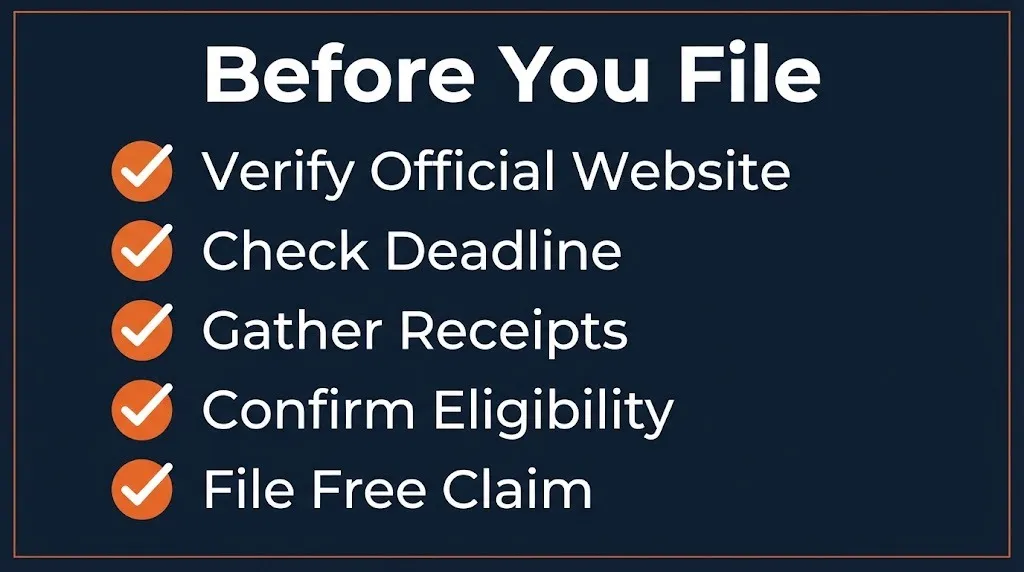
- Verify the settlement is real on the official website.
- Read the eligibility criteria carefully.
- Gather any required proof, like receipts or account numbers.
- Complete the claim form online or by mail.
- Enter your payment preference, usually check or digital payment.
- Submit before the deadline.
- Save your confirmation number.
Filing is free. You never pay to file a class action claim.
What proof do I need for a class action claim?
The proof you need for a class action claim depends on the settlement. Some cases require no proof at all. You just fill out the form and submit.
Other cases require documentation. A product defect case may ask for a receipt. An employment case may ask for pay stubs. A data privacy case may ask for the email address you used.
Here is a general evidence checklist.
- Receipts or order confirmations
- Account numbers or usernames
- Email addresses associated with the account
- Pay stubs or employment records
- Product photos or serial numbers
- Any correspondence about the issue
Keep digital copies. They are easier to submit and store.
Key Takeaway: Class action claims are usually simple. The hard part is finding the real settlement and meeting the deadline.
Reality Check: No legitimate class action settlement asks you to pay a filing fee. No one texts you out of nowhere about a settlement you never heard of. Third-party “claim helpers” are unnecessary. The claim form is always free.
What are the most common class action lawsuit types?
The most common class action lawsuit types are consumer fraud, data privacy, employment, antitrust, and product liability. Each has different eligibility and payout patterns.
Here is a breakdown.
| Type | Common Claim |
|---|---|
| Consumer fraud | False advertising, hidden fees |
| Data privacy | Unauthorized data sharing, breaches |
| Employment | Unpaid wages, misclassification |
| Antitrust | Price fixing, monopolization |
| Product liability | Defective products, contamination |
The cases that affect the most people are usually consumer and privacy cases. The cases that pay the most per person are usually employment and product liability.
How do I know if a class action settlement is legit?
You know a class action settlement is legit if it appears on an official settlement website, is approved by a court, and has a named administrator. You can verify the case on PACER or through the court’s public docket.
Here are the red flags of a fake settlement.
- A text or email asking for your bank password
- A request for payment to file a claim
- A deadline measured in hours, not days
- A website that does not name a court or administrator
- Promises of guaranteed payouts before a court approves anything
Legitimate settlements are boring. They have court names, case numbers, administrators, and clear deadlines.
What is a class action settlement administrator?
A class action settlement administrator is a court-appointed firm that handles notice, claims processing, and payment distribution. The administrator is neutral. It does not represent the plaintiffs or the defendant.
The administrator builds the settlement website, processes claim forms, verifies eligibility, and issues payments. It also answers claimant questions through a toll-free number or email.
Some large administrators include Epiq, Kroll, Angeion Group, and JND Legal Administration. The administrator is named in the settlement notice.
How long do class action settlements take to pay?
Class action settlements take months or years to pay. The timeline from filing to final approval to payment distribution is long.
Here is a typical timeline.
| Stage | Timing |
|---|---|
| Settlement announced | Month 0 |
| Preliminary approval | Months 1 to 3 |
| Notice and claims period | Months 3 to 9 |
| Final approval hearing | Months 9 to 15 |
| Payments distributed | Months 15 to 24 |
Appeals can add years. A settlement approved in 2026 may not pay until 2027 or later.
What happens if I miss a class action deadline?
If you miss a class action deadline, you usually cannot file a late claim. The court sets the deadline for fairness. Late claims are rarely accepted.
Some settlements allow late claims with a showing of good cause. But good cause is a high bar. Forgetting the deadline is not good cause.
The opt-out deadline is also strict. If you miss it, you are bound by the settlement and cannot sue separately.
Treat every class action deadline like a tax deadline. Miss it and you lose the benefit.
What is the difference between a class action and a mass tort?
A class action is a single lawsuit representing a group of people with similar claims. A mass tort is many individual lawsuits consolidated for pretrial proceedings.
In a class action, you are usually a passive class member unless you opt out. In a mass tort, you are an individual plaintiff with your own case.
Class action settlements pay through a claims process. Mass tort settlements often require individual case evaluation. The per-person amounts in mass torts are usually higher because the claims are more serious.
Here is a comparison.
| Feature | Class Action | Mass Tort |
|---|---|---|
| Claim structure | One case, many members | Many individual cases |
| Payout method | Claims process | Individual settlement |
| Per-person amount | Usually small | Usually higher |
| Opt-out right | Yes | Not applicable |
| Proof required | Varies | Extensive |
What are the top data privacy class actions in 2026?
The top data privacy class actions in 2026 involve video streaming services, social media platforms, and app tracking. These cases often settle because the Video Privacy Protection Act and state privacy laws create real liability.
The per-person payouts in data privacy cases are usually small. The classes are enormous. But the claims process is usually simple, requiring only an email address or account identifier.
If you used a streaming service or a major app in recent years, you may be in a data privacy class. Watch for notices and check official settlement websites.
What are the top consumer product class actions in 2026?
The top consumer product class actions in 2026 involve defective appliances, contaminated food, and mislabeled products. These cases may require proof of purchase for a meaningful payout.
Product defect cases often have higher per-person payouts than privacy cases because fewer people file claims and the harm is more concrete. A defective appliance that cost $500 may qualify for a $200 payment with a receipt.
Keep your receipts for major purchases. They are your evidence if a class action is filed.
What are the top employment class actions in 2026?
The top employment class actions in 2026 involve unpaid wages, misclassification, and overtime violations. These cases pay more per person than consumer cases because the damages are calculable.
An employment class action may pay thousands per class member. The proof is usually pay stubs and employment records. The class is smaller than a consumer case, so the per-person share is larger.
If you were misclassified as exempt or denied overtime, you may be in a wage and hour class. Watch for notices from your former employer.
Key Takeaway: Employment and product cases pay more per person. Privacy and consumer cases pay less but are easier to file.
How do I avoid class action scams?
You avoid class action scams by only using official settlement websites, never paying a fee, and verifying every case on a court docket.
Here is a scam prevention checklist.
- Never pay to file a claim.
- Never share your bank password or full Social Security number.
- Verify the administrator name on the court docket.
- Check the settlement website URL carefully.
- Ignore unsolicited texts about settlements.
- Use only the contact information in the court-approved notice.
Scammers exploit the hope of free money. The real claims process is free and public.
What is the best class action settlement website?
The best class action settlement website is the official site for the specific case you are checking. There is no single best site for all settlements.
Official settlement sites are named in the court-approved notice. They usually include the case name and are operated by the administrator.
Legal news sites and consumer advocacy sites list open settlements. But you should always verify the deadline and eligibility on the official site before filing.
What Happens Next
This week: Check any settlement notice you received against the official website.
If you qualify: File before the deadline. It takes minutes.
If you are unsure: Search the case name on the court docket.
Keep receipts: They are your proof for future product and consumer cases.
The single most important fact about class actions in 2026 is that deadlines are strict and payouts are modest. File early, verify everything, and expect a check, not a fortune.