Risks of Joining Class Action Lawsuit in 2026: Payouts, Fees, and Taxes
Quick Answer
- The main risk: unless you opt out, you usually give up the right to sue separately.
- Average payout: one CFPB-based figure is $32.35 per class member, but your amount depends on your settlement.
- Deadlines: each notice sets its own opt-out and claim dates, and missing them can still bind you.
The core risk of joining a class action lawsuit is simple. Unless you opt out, a court judgment can bind you, and you can lose the right to sue the company on your own over the same claims.
That trade can be fair when each claim is tiny. It looks worse when the check is $20, the wait stretches to two years, and lawyers’ fees come out first.
This guide covers payouts, fees, taxes, opt-outs, and scams. One surprising detail: the FTC found only 0.01 percent of notice recipients opted out.
| The Facts | |
|---|---|
| Case | No single case: a general guide to federal class actions |
| Status | Ongoing; each settlement has its own court schedule |
| Fund Size | Varies by case; the ten largest 2025 settlements totaled about $79 billion |
| Est. Per Person | Not yet determined for any one case; one CFPB-based average is $32.35 |
| Claim Deadline | Set by each settlement notice |
| Administrator | Named in each notice |
| Proof Needed | Varies; check the claim form |
Is joining a class action lawsuit risky?
Joining a class action lawsuit carries real but manageable risks, and the biggest one is losing your right to sue alone.
Most people never formally “join.” If you fit the class definition, you get notice and stay in unless you request exclusion. That’s how most damages class actions work.
The risks that matter most:
- Release of claims: you can be bound even if you never file a claim.
- Small checks: some consumer settlements pay about $10 or $20 per person.
- Slow payment: in settled cases the CFPB studied, payment took up to two years.
- Fees first: lawyers’ fees and administration costs come out of the fund.
- Taxes: many settlement payments count as taxable income.
- Scams: fake notices copy real ones to steal your data.
The benefits are real too. Staying in a class generally doesn’t require your own lawyer or hourly bills. For claims worth less than a lawsuit would cost, a class action may be your only practical route.
Is a class action settlement notice a scam?
A class action notice can be real, but scammers copy them, so verify the details before you click or share data.
Legitimate notices name the case, the court, the law firms, who qualifies, and the deadlines. They point to an official settlement website. They never ask you to pay to collect.
Watch for these red flags:
- A fee to “release” or “process” your settlement money.
- A request for your full Social Security number or bank login.
- Pressure to act today or lose everything.
- A text or email with no case name or court.
Consumer-protection warnings describe scammers posing as administrators who ask for Social Security numbers, bank details, or advance fees. A South Carolina consumer agency flagged this pattern years ago, and it hasn’t gone away.
Search the case name yourself instead of tapping the link in the message. If you already shared data, freeze your credit, change passwords, and report it to the FTC.
What is the average class action lawsuit payout per person?
No official 2026 average exists, and the best public figure is $32.35 per class member, from a federal study of consumer finance cases.
That number traces to the Consumer Financial Protection Bureau’s 2015 arbitration study. It covers cases that settled, which was about 13 percent of the class actions studied by most counts. By the same counts, about 87 percent gave class members no relief.
Treat it with care. It’s old, it leans toward banking cases, and industry-side lawyers did the long division that made it famous. The CFPB’s later proposed rule confirmed roughly $32 per class member.
Public Citizen pushed back on one use of the figure. Class actions often cover claims far below $1,000, so comparing them with arbitration wins isn’t apples to apples.
| Metric | Figure | Source |
|---|---|---|
| Average recovery per class member (settled cases) | $32.35 | CFPB 2015 arbitration study |
| Resolved cases with no class relief | 87% | CFPB study, as counted by analysts |
| Median claims rate | 9% | FTC 2019 staff report |
| Weighted mean claims rate | 4% | FTC 2019 staff report |
| Average participation, 2010 to 2018 consumer settlements | 6.99% | Study cited in Colorado legislative materials |
| Average share of settlement reaching the class | 23% | Same study |
Your check depends on the fund size, the class size, fees, administration costs, and how many people file. Amounts depend on each settlement.
Key Takeaway: Treat any single average payout as a rough anchor, because your check depends on your settlement’s fund, class size, and claims.
Why do so few class members ever get paid?
Most eligible people never file, because claims rates in studied settlements fell below 10 percent.
The FTC’s 2019 staff report reviewed 149 consumer settlements. The median claims rate was 9 percent, and the weighted mean was 4 percent. Mailed packets with claim forms reached about 10 percent, postcards 6 percent, and email notices 3 percent.
Confusion is part of it. Fewer than half of surveyed people understood that a settlement email wasn’t promotional. Proof requirements hurt too, and one analysis of CFPB data said claims rates fell nearly 90 percent when documents were required.
Filing pays off when you do it. The median claim approval rate was 93 percent. It works like a mail-in rebate: most people skip the form, and the money stays put.
Unclaimed money can be split among filers, return to the company, or go to a cy pres charity. The settlement terms decide which.
Reality Check: A class action isn’t a lottery ticket. Filing is free, no real administrator charges a fee to pay you, and nobody can promise your amount before the court approves the settlement. A “claim helper” asking for money is selling you something you don’t need.
How much do class action lawyers take from the settlement?
Class counsel commonly asks for about a quarter of the settlement fund, and the judge sets the final award.
Some courts treat 25 percent as a benchmark. The Ninth Circuit does. The Tenth Circuit has said it hasn’t adopted a bright-line benchmark.
One review put typical awards between 20 and 30 percent. Consumer cases ran near 28.7 percent in one cited dataset. At 25 percent, a $1,000,000 fund loses $250,000 to fees before costs, an illustration rather than a real case.
Analyses of the CFPB data said attorneys’ fees averaged over $1 million per studied case. Named plaintiffs can also receive a service award from the fund.
Judges must review the request, not rubber-stamp it. Under Rule 23(e), courts weigh the relief, the distribution method, proposed fees, and equal treatment of class members. You can object to fees if you stay in the class.
Are class action settlement payments taxable?
Many class action payments are taxable income unless a specific exception applies, such as certain physical-injury settlements.
The IRS looks at what the payment replaces. Its Publication 4345 covers settlement taxability. Interest on a settlement is generally taxable, even when another part of the payment isn’t.
| Payment type | Usual treatment |
|---|---|
| Consumer or privacy cash payment | Often taxable |
| Physical injury or sickness | May be excluded under IRC Section 104 |
| Interest on the settlement | Generally taxable |
| Property loss in value | Generally not taxable up to your basis |
Payers generally issue a Form 1099 unless an exception applies. For payments made after December 31, 2025, the reporting threshold for many 1099-MISC payments rose from $600 to $2,000.
That threshold governs paperwork, not tax. A $75 check with no form can still be taxable. Check Publication 4345 or ask a tax preparer.
Key Takeaway: Fees, claims rates, and taxes all shrink the check, so your real net payout is usually far below the headline fund.
How do you file a class action claim step by step?
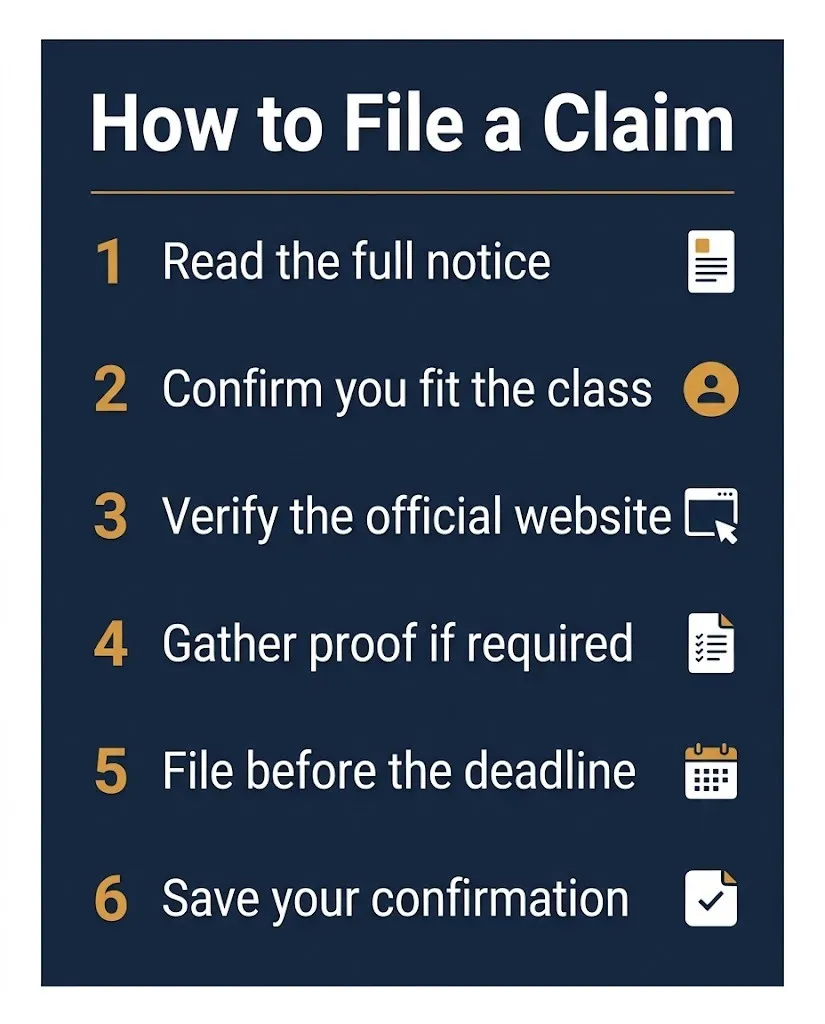
You file by completing the claim form named in your notice before the claim deadline, and it should cost nothing.
- Read the full notice before you do anything else.
- Confirm you fit the class definition.
- Find the official settlement website named in the notice.
- Gather receipts or account records if proof is required.
- Submit the claim form before the claim deadline.
- Choose a payment method and double-check your address.
- Save your confirmation number and your records.
Some settlements pay class members automatically, with no claim form. Your notice says which type you have. If it asks for a fee, stop and re-read the red flags above.
Can you opt out of a class action lawsuit?
Yes, in most damages class actions you can opt out by the deadline in your notice.
Federal Rule 23(b)(3) classes give members that right. The notice must explain how to request exclusion and what the judgment means for you. If you opt out, the settlement doesn’t bind you. You get no payment, and you keep your right to sue.
Your own filing deadlines still apply, and you’d carry your own legal costs. Opting out makes sense when your individual claim is large. Large opt-out groups are routine in antitrust cases.
It rarely makes sense for a $20 claim. Few people use the right at all: the FTC found 0.01 percent of recipients opted out.
What happens if you ignore a class action notice?
If you do nothing, you usually stay in the class and stay bound by the release.
A notice gives you four options: file a claim, do nothing, opt out, or object. Doing nothing is the costly one in a claims-made settlement. You collect no money, yet the judgment still resolves your claims.
Courts enforce this. In the 2005 WorldCom securities litigation, a federal court held a class member to the release after it skipped the opt-out deadline. That blocked its separate arbitration claims against a financial firm.
It works like a warranty claim window. Miss the date and the offer expires, but the fine print still applies.
Key Takeaway: Doing nothing isn’t neutral, because the court’s judgment can bind you whether or not you ever file a claim.
Are class action lawsuits still worth joining in 2026?
Yes for small, low-effort claims, but record settlement totals don’t mean bigger personal checks.
Duane Morris, a defense-side firm, reports the ten largest 2025 settlements totaled $79 billion. There were eight billion-dollar settlements that year. Plaintiffs filed more than 13,000 federal class actions, about 36 a day.
Judges granted 68 percent of certification motions in 2025. Data privacy class actions topped 1,800, up more than 25 percent from 2024. The firm’s mid-year 2026 report says settlement numbers are running even stronger this year.
Big totals come from a handful of mega-deals. They show companies pay, not what you’ll get. Divide a huge fund by millions of people, subtract fees, and the check shrinks fast.
Do you lose control of your case in a class action?
Yes, you hand decisions to the named plaintiffs and class counsel, and a judge approves any settlement.
Law firms that handle these cases list lost control as a core drawback. You can’t negotiate your own terms. Every class member generally gets the same settlement terms.
Rule 23(e) requires court approval of a settlement that binds a certified class. The judge checks whether the relief is adequate and whether members are treated equitably.
You keep three levers. You can object, you can opt out, or you can hire your own lawyer to pursue a larger claim. Each has a deadline in your notice.
Does joining a class action cost you money?
Usually no, because class counsel is paid from the settlement and not billed to you hourly.
Remaining in a class generally doesn’t require hiring separate counsel. The notice should explain what you must do and by when. Fees and costs come out of the fund or are paid under the settlement terms.
Your real costs are different. Time is one. Settled cases the CFPB studied took up to two years to pay, like a delayed tax refund you can’t speed up.
Taxes are another. The claims you release are the third. If you hire your own lawyer to opt out or object, that bill is yours.
Key Takeaway: Joining usually costs no cash up front; your real costs are time, taxes, and the claims you release.
Should you object to a class action settlement instead of opting out?
Object if you want the settlement improved, and opt out if you want to leave the class entirely.
Objecting means you stay in the class and tell the court why the deal, the fees, or the distribution is unfair. Your notice sets the deadline and the filing steps. People confuse the two tools all the time.
Objections are rare. The FTC found 0.0003 percent of recipients objected. Still, they can matter: in one Tenth Circuit case, a single class member’s objection to fees reached the appeals court.
If you object, you remain bound by the final judgment. That’s the trade for keeping your seat at the hearing.
Are there class actions you can’t opt out of?
Yes, classes certified under Rule 23(b)(1) or (b)(2) generally give you no opt-out right, so you’re bound regardless.
Rule 23(b)(2) classes typically seek court orders changing a company’s conduct, not individual damages. Rule 23(b)(3) is the damages class, and it carries the opt-out right. Your notice should show which type applies.
Courts sometimes offer a second chance to opt out at the settlement stage. That depends on the judge and the case. Never assume it.
What happens next after you get a class action notice?
Most notices follow the same path, and your own paperwork sets every real date.
Date in your notice: You receive notice by mail, email, or postcard explaining the case and your options.
Date in your notice: The opt-out and objection deadline arrives; after it passes, you’re bound unless you excluded yourself.
Date in your notice: The claim deadline closes, so file before it with any required proof.
Date in your notice: A judge holds a final approval hearing to review fairness, fees, and distribution.
Expected after approval and any appeals: Payments go out; in settled cases the CFPB studied, this took up to two years.
Frequently Asked Questions
What are the biggest risks of joining a class action lawsuit?
The biggest risk is losing your right to sue separately if you stay in the class.
Small payouts, slow payment, fees, and taxes come next.
Fake notices are a practical danger too.
Is it worth joining a class action lawsuit for $20?
Often yes, if the claim takes a few minutes and you have no larger claim.
Filing costs nothing, and the FTC found a median claim approval rate of 93 percent.
Skip it only if you plan to sue alone, and then opt out before the deadline.
Can I sue separately after a class action settlement?
Not if you stayed in the class and the settlement released your claims.
Opting out before the deadline is what preserves your right to sue.
Check the release language in your notice.
Do I need a lawyer to join a class action lawsuit?
Usually no, because staying in a class doesn’t require separate counsel.
You file a claim form or simply remain in the class, as the notice directs.
A lawyer matters mainly if you plan to opt out or object.
How long does it take to get paid from a class action settlement?
Payment took up to two years in the settled cases the CFPB studied.
Timing depends on court approval, appeals, and claims processing.
Watch the official settlement website for payment updates.
Is the average class action payout really $32?
It’s the best public per-person figure, but it comes from a 2015 CFPB study of consumer finance cases.
No official 2026 average exists.
Your fund size, class size, and claims rate set your amount.
How can I tell if a class action notice is real?
Check for the case name, court, law firms, eligibility rules, and deadlines.
Find the official settlement website by searching the case name yourself.
Never pay a fee to collect settlement money.
Before you act, read your notice from start to finish. Find three things: the opt-out deadline, the claim deadline, and the official settlement website.
Calendar both dates today and keep your receipts. The opt-out deadline is the one date you can’t recover once it passes.