Kyleena Lawsuit 2026: Claim Status, Settlement Updates, and What IUD Users Should Know
Quick Answer
- The Kyleena lawsuit is real, part of a multidistrict litigation over the hormonal IUD’s alleged risks.
- No settlement fund or per-person payout has been established in 2026.
- There is no claim deadline; individual cases proceed unless a global deal is announced.
The Kyleena lawsuit is real and active in 2026. It is not a class action settlement you can join with a simple form. It is a multidistrict litigation, often called an MDL, where many individual cases against the maker of Kyleena are consolidated before one federal judge for efficiency. If you used a Kyleena IUD and suffered a serious complication, you may have a claim. But no money is waiting to be mailed out.
The people most affected are women who were prescribed Kyleena, a hormonal intrauterine device made by Bayer, and who later experienced device migration, uterine perforation, ectopic pregnancy, or other alleged injuries. The most important fact right now is that no global settlement exists. Any website promising a Kyleena payout in 2026 is misleading.
This article explains what the Kyleena litigation actually alleges, where the cases stand, what a settlement might look like, what proof you would need, and how to avoid scams. One surprising verified detail: Kyleena cases are part of a broader wave of IUD litigation that includes other Bayer products like Mirena and Skyla.
| The Facts | |
|---|---|
| Case | In re Kyleena IUD Products Liability Litigation, MDL |
| Status | Active litigation, no global settlement |
| Fund Size | Not yet confirmed |
| Est. Per Person | Not yet determined |
| Claim Deadline | None set; no settlement exists |
| Administrator | Not yet appointed |
| Proof Needed | Medical records, device history, injury documentation |
Is the Kyleena Lawsuit Real?
The Kyleena lawsuit is real and verifiable in federal court records. It is a multidistrict litigation centralized before a federal judge, meaning many individual lawsuits against Bayer have been consolidated for pretrial proceedings. The cases allege that Kyleena, a levonorgestrel-releasing intrauterine system, caused injuries that Bayer failed to adequately warn about.
This is not a single class action where one plaintiff represents everyone. It is a collection of individual product liability cases. Each plaintiff must prove her own injury, her own causation, and her own damages. That distinction matters because it means no one settlement will automatically cover every Kyleena user.
The litigation is separate from any class action settlement you may have seen advertised. There is no court-approved settlement, no claim form, and no administrator processing Kyleena claims. If you received a text or email about a Kyleena settlement, check the federal docket before acting. The docket is the source of truth.
Key Takeaway: Kyleena litigation is real but is an MDL of individual cases, not a settled class action with a claim form.
How Much Money Could I Get From a Kyleena Lawsuit?
No per-person payout amount has been determined for the Kyleena litigation because no global settlement exists. Any dollar figure you see online is speculation. In product liability MDLs, payouts vary widely based on injury severity, medical records, causation evidence, and whether the case settles individually or as part of a global resolution.
If a settlement program is eventually created, it will likely use tiers based on injury type. A woman with a confirmed uterine perforation requiring surgery could expect a higher tier than someone with a less severe complication. Cases involving ectopic pregnancy or infertility may fall into the highest tiers. But these are general patterns from similar IUD litigations, not Kyleena specifics.
| Potential Injury Type | Typical Severity Tier |
|---|---|
| Uterine perforation requiring surgery | Higher tier |
| Ectopic pregnancy or infertility | Higher tier |
| Device migration without surgery | Middle tier |
| Minor complications, device removed | Lower tier |
Until a settlement is filed and approved, no tier structure exists. The honest answer to the money question is: not yet determined, and no one can promise you a number.
Key Takeaway: No Kyleena payout amount exists, and any figure you see is unverified until a settlement is court-approved.
What Is the Kyleena IUD Lawsuit About?
The Kyleena IUD lawsuit centers on allegations that Bayer failed to adequately warn patients and doctors about the risks of the device. Kyleena is a small, hormonal IUD that releases levonorgestrel to prevent pregnancy. The lawsuits claim the device can migrate from its proper position, perforate the uterine wall, or cause other serious complications.
The legal claims are product liability claims. Plaintiffs argue the device was defectively designed or that the warnings were inadequate. Some cases also allege that Bayer knew about the risks from earlier IUD products like Mirena but did not sufficiently update Kyleena’s labeling. Bayer has denied these allegations and continues to defend the product.
The litigation does not claim that every Kyleena user was harmed. It claims that specific women suffered specific injuries that were not properly disclosed. That is the core of any product liability case: the product, the injury, and the missing warning.
Key Takeaway: The lawsuits allege defective design and inadequate warnings about migration, perforation, and other serious risks.
Who May Qualify for a Kyleena Claim?
No formal qualification list exists because no settlement program has been created. In the active litigation, the women who have filed cases generally allege specific injuries: uterine perforation, device migration requiring surgical removal, ectopic pregnancy, pelvic inflammatory disease, or other complications. If you used Kyleena and experienced a similar injury, you may have a potential claim.
The strongest cases involve medical records that document the injury and its connection to the device. A woman whose records show a perforation discovered during surgery and a Kyleena device found outside the uterus has a clearer case than someone with general pain but no documented device problem. Causation is the legal battleground.
If you believe you were injured by Kyleena, the first step is not a settlement website. It is a medical records request. You need the records from the provider who inserted the device, any imaging studies, and the records from any surgery or treatment for the complication. That documentation is what a lawyer will evaluate.
Reality Check: No one can pre-qualify you for a Kyleena payout over the phone. Legitimate case evaluations require medical records and a licensed attorney. Anyone asking for a fee to “register your claim” is running a scam.
How Do I File a Kyleena Claim in 2026?
You cannot file a Kyleena settlement claim in 2026 because no settlement exists and no claim form has been issued. The litigation is active, but it has not reached a resolution that would create a filing process for the general public. Individual lawsuits are filed through attorneys, not through a settlement portal.
If you believe you have a potential case, the process looks like this:
- Gather your medical records from the provider who inserted the Kyleena device.
- Collect imaging and surgical records related to any migration or perforation.
- Document your treatment timeline with dates and providers.
- Consult a product liability attorney who handles medical device cases.
- Have the attorney evaluate causation and damages before filing.
- File an individual lawsuit if the case has merit and is within the statute of limitations.
- Monitor the MDL for any global settlement program.
The statute of limitations is the first deadline any attorney will check. It varies by state and starts running when the injury was or should have been discovered. Do not rely on internet summaries for your specific deadline.
Key Takeaway: No Kyleena claim form exists in 2026, and individual cases are filed through attorneys, not online portals.
What Is the Current Status of the Kyleena Litigation?
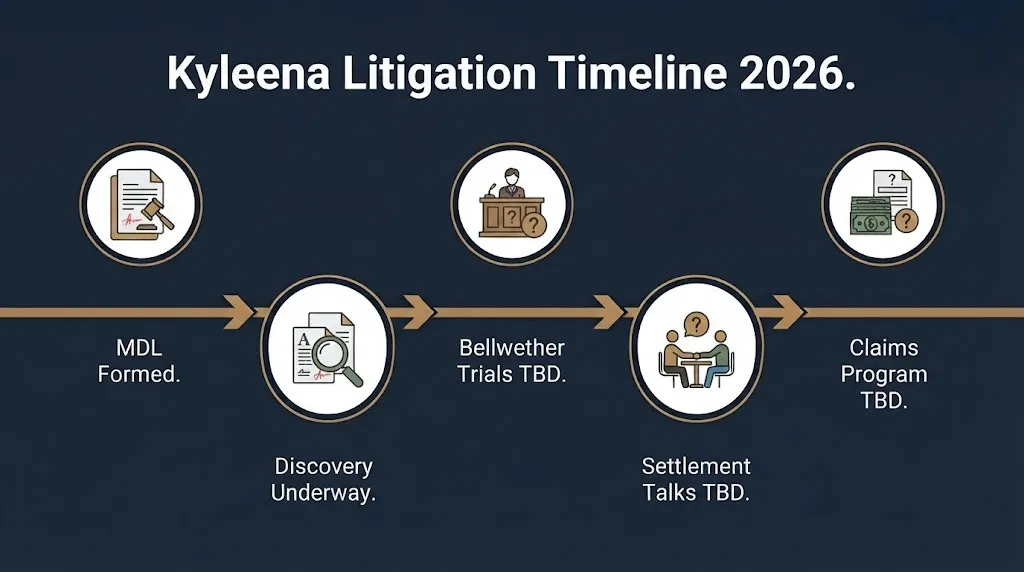
The current status of the Kyleena litigation is active pretrial proceedings in the federal MDL. The cases are consolidated for discovery, motions, and bellwether trials. Bellwether trials are test cases that help both sides assess the strength of the claims and the value of a potential global settlement. No bellwether verdicts have been publicly reported as of February 2026.
The MDL process is slow. Discovery involves millions of pages of documents, expert depositions, and motions over what evidence is admissible. A global settlement often comes after bellwether trials, but it can come before if the parties see a reason to negotiate. No settlement talks have been confirmed publicly.
The judge assigned to the MDL has set scheduling orders that govern the pace. Those orders are public and updated on the court docket. If you want the current status, the docket is the place to look, not social media or settlement advertising sites.
Key Takeaway: The Kyleena MDL is in pretrial stages with no bellwether verdicts or confirmed settlement talks as of early 2026.
What Proof Would I Need for a Kyleena Case?
The proof required for a Kyleena case starts with medical records that document three things: the device was implanted, an injury occurred, and the injury is linked to the device. The strongest evidence is imaging that shows the device outside the uterus, surgical records documenting a perforation, or pathology reports from treatment for complications.
Pharmacy records help establish that you actually used Kyleena and when. The device has a unique insertion date, and your records should reflect that. If you kept the device after removal, that can be preserved as evidence. If you had a second procedure to remove a migrated device, those operative notes are critical.
Beyond medical proof, your attorney will need your complete treatment history. Pre-existing conditions, prior IUD use, and any other factors will be examined. Defense lawyers will look for alternative causes for your injury. The more complete and consistent your records, the harder that defense becomes.
Key Takeaway: Medical records, imaging, pharmacy history, and surgical notes form the evidence base for any Kyleena claim.
Is Kyleena Still on the Market?
Yes, Kyleena remains on the market in 2026 and continues to be prescribed as a hormonal contraceptive. The litigation has not resulted in a recall, and the FDA has not withdrawn its approval. The device remains available through healthcare providers.
This surprises some people who assume that lawsuits mean a product was pulled from the market. Product liability litigation often proceeds while the product remains available. A lawsuit alleges that the warnings were inadequate or the design was defective. It does not automatically remove the product from pharmacies.
The continued availability of Kyleena does not mean the litigation is weak or strong. It means the regulatory process and the civil litigation process are separate. The FDA evaluates safety and effectiveness. The courts evaluate whether the manufacturer met its legal duty to warn. Both can reach different conclusions.
Key Takeaway: Kyleena is still available in 2026, and the litigation does not mean the FDA has recalled it.
What Should I Do If I Was Injured by Kyleena?
If you were injured by Kyleena, the first step is medical care, not legal action. Your health comes first. Once your condition is stable, start gathering records. Request the records from the provider who inserted the device, the facility where any surgery occurred, and the imaging center that documented the problem.
Then consult a product liability attorney. Most medical device attorneys work on contingency, meaning they only get paid if you recover money. Bring your records to the consultation. The attorney will evaluate whether you have a viable claim and whether you are within the statute of limitations.
Do not post your medical details on social media or respond to unsolicited messages about a Kyleena settlement. Those messages are often from lead generators or scammers. A legitimate attorney will want your records and a private conversation, not a comment section.
Key Takeaway: Get medical care first, gather records second, and consult a licensed attorney before sharing details with anyone online.
What Happens Next
- Through 2026: Discovery continues in the MDL, with expert depositions and motion practice.
- Possible bellwether trials: Test cases may be scheduled, which could drive settlement talks.
- If a global settlement emerges: A claims program with tiers and deadlines would be announced.
- No action required now: There is no claim form or deadline for anyone who has not filed an individual case.
- Watch the docket: Any real development will appear in federal court records before it appears in ads.
Frequently Asked Questions
Is there a Kyleena class action settlement?
No, there is no Kyleena class action settlement as of February 2026.
The litigation is an MDL of individual cases, not a certified class.
Can I still file a Kyleena lawsuit?
You may be able to file an individual lawsuit if you were injured and are within the statute of limitations.
An attorney must evaluate your specific facts.
How much are Kyleena lawsuits worth?
No settlement values have been established because no global deal exists.
Any amount you see online is speculation.
What injuries are claimed in Kyleena lawsuits?
The main alleged injuries are uterine perforation, device migration, ectopic pregnancy, and related complications.
Do I need a lawyer for a Kyleena claim?
Yes, individual product liability cases require a licensed attorney.
There is no settlement claim form you can file on your own.
Is Kyleena recalled?
No, Kyleena has not been recalled and remains on the market.
The litigation does not change its FDA approval status.
How do I know if I have a Kyleena case?
You may have a case if you used Kyleena and suffered a documented injury linked to the device.
An attorney can evaluate your medical records and explain your options.
What is the deadline to file a Kyleena lawsuit?
The deadline is your state’s statute of limitations for product liability claims.
It varies by state and starts when the injury was discovered.
The Kyleena litigation is real, but it is not a settlement you can claim. If you were injured, your path runs through medical records and a licensed attorney, not an online form. Keep your records, check the docket, and ignore anyone promising a payout for a fee.