Patent Litigation 2026: How Infringement Cases Work, What They Cost, and Current Trends
Quick Answer
- Patent litigation is real, involving federal lawsuits over unauthorized use of patented inventions.
- Damages in infringement cases can reach millions, but most cases settle before trial.
- The most important deadline is the patent’s expiration date, which limits the damages period.
Patent litigation is not a single settlement or a class action you can join. It is a category of federal lawsuits where a patent owner accuses someone else of making, using, or selling an invention without permission. These cases are filed in U.S. district courts, and they are expensive, technical, and slow. If you are searching this term, you probably either received a demand letter, are considering enforcing a patent, or want to understand a headline about a big verdict.
The people most affected are inventors, startup founders, product companies, and anyone who received a cease-and-desist letter claiming patent infringement. The number that matters most is the patent’s expiration date. A utility patent lasts 20 years from its filing date, and damages can only cover infringement during that window.
This article explains what patent litigation is, what it costs, how damages work, what the process looks like, and what 2026 trends matter. One surprising verified fact: the median cost of a patent case through trial can exceed $3 million for each side, which is why most cases settle.
| The Facts | |
|---|---|
| Case | No single case; applies to all U.S. patent infringement lawsuits |
| Status | Active federal litigation across multiple districts |
| Fund Size | No settlement fund; damages are case-specific |
| Est. Per Person | Varies widely, from nuisance settlements to nine-figure verdicts |
| Claim Deadline | Statute of limitations is six years from infringement |
| Administrator | No administrator; federal courts handle each case |
| Proof Needed | Patent registration, claim charts, evidence of infringement |
Is Patent Litigation Real or Just a Threat?
Patent litigation is real and happens in federal courts across the country. When a patent owner believes someone is infringing, they can file a lawsuit in U.S. district court. The court has the power to order the infringer to stop and to award money damages. These are not arbitration proceedings or administrative hearings. They are full federal civil lawsuits.
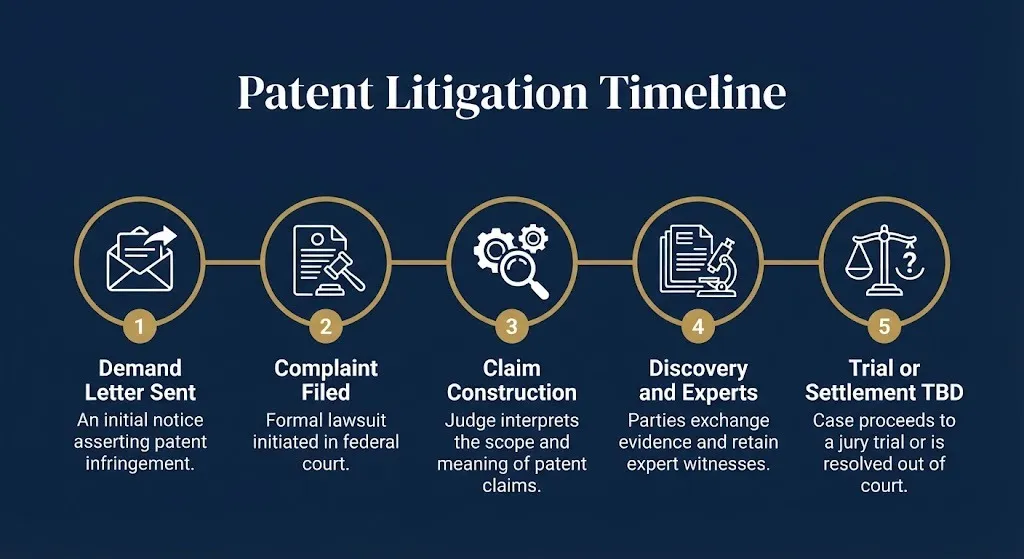
The threat of patent litigation is also real, and sometimes the threat is the point. Some patent owners send demand letters hoping for a quick licensing fee without ever filing a case. That does not mean the threat is empty. If the recipient ignores the letter, the patent owner may follow through and sue. The demand letter is often the first step, not the whole strategy.
The distinction matters for anyone who receives one. A demand letter is not a lawsuit. But it is not junk mail either. It is a legal document that says the sender believes you are infringing and wants money or a license. Treat it seriously, but do not assume a lawsuit has been filed until you see a case number and a court name.
Key Takeaway: Patent litigation is real and federal, but a demand letter is not a lawsuit, and the threat can be real even before a case is filed.
How Much Does Patent Litigation Cost?
Patent litigation is among the most expensive types of civil litigation. The median cost for a case with $1 million to $10 million at stake can run between $1 million and $3 million per side through trial. Larger cases cost much more. Discovery, expert witnesses, and claim construction are the main cost drivers.
The expense is not just attorney fees. Expert witnesses in patent cases charge hundreds of thousands of dollars. Depositions, document production, and technical analysis add more. Even a small case can burn through six figures before trial. That cost pressure forces settlements, because both sides are watching the meter run.
| Case Stage | Typical Cost Range |
|---|---|
| Pre-filing investigation | $10,000 to $50,000 |
| Through discovery | $500,000 to $1.5 million |
| Through claim construction | $750,000 to $2 million |
| Through trial | $1 million to $3 million or more |
| Appeal | $250,000 to $750,000 additional |
These are medians from legal industry surveys, not guarantees. Your case could cost less or much more. The point is that patent litigation is not a cheap path to a payout. It is a high-stakes, high-cost fight.
Key Takeaway: Patent litigation often costs millions per side through trial, which is why most cases settle long before a verdict.
How Are Patent Damages Calculated?
Patent damages are calculated using one of two main methods: lost profits or a reasonable royalty. Lost profits are what the patent owner would have earned if the infringement had not happened. A reasonable royalty is what the infringer would have paid for a license in a hypothetical negotiation. Courts and juries use one or both depending on the facts.
Lost profits require proof that the patent owner lost sales because of the infringement. That usually means showing the parties competed in the same market and customers bought the infringing product instead. Reasonable royalty is more common when the patent owner does not sell a competing product or cannot prove lost sales.
In some cases, damages are enhanced. If the infringement is found to be willful, a court can increase damages up to three times the base amount. Willfulness usually means the infringer knew about the patent and ignored it. That is why demand letters matter. A documented pattern of ignoring warnings can turn a routine case into a treble damages risk.
Key Takeaway: Damages are lost profits or reasonable royalties, and willful infringement can multiply the final number.
What Is the Patent Litigation Process?
The patent litigation process follows a defined sequence in federal court. It starts with the complaint, where the patent owner identifies the patent and the accused product. The defendant answers, often with counterclaims that the patent is invalid or not infringed. Then discovery begins, and both sides exchange documents, technical details, and expert reports.
The most important early phase is claim construction, sometimes called a Markman hearing. The judge interprets the meaning of the patent claims. That ruling often decides the case, because the meaning of a single word can determine whether a product infringes. After claim construction, summary judgment motions may dispose of the case or narrow the issues.
If the case survives, it goes to trial. A jury or judge decides infringement and damages. Appeals go to the U.S. Court of Appeals for the Federal Circuit, which handles all patent appeals. The entire process can take two to five years or more.
Key Takeaway: Patent litigation follows a federal process where claim construction often decides the outcome before trial.
What Is Patent Infringement Litigation?
Patent infringement litigation is a lawsuit alleging that someone made, used, sold, offered to sell, or imported a patented invention without authorization. The patent owner must prove the accused product or process falls within the scope of at least one patent claim. The defendant can argue non-infringement, invalidity, or unenforceability.
Infringement comes in two main forms. Direct infringement means the defendant itself performs every element of a claim. Indirect infringement means the defendant induced someone else to infringe or contributed to infringement by supplying a key component. Both can create liability, but the proof differs.
The patent claims, not the product description, define what is protected. A patent may describe a chair, but the claims might only cover a specific hinge mechanism. The accused product must match the claims, element by element. That matching process is the technical core of every infringement case.
Key Takeaway: Infringement litigation is about matching an accused product to patent claims, element by element, not about general similarity.
What Is the Statute of Limitations for Patent Infringement?
The statute of limitations for patent infringement is six years under U.S. law. A patent owner can recover damages for infringement that occurred up to six years before the lawsuit was filed. Infringement before that window is not recoverable. The clock starts when the infringement happens, not when the patent owner discovers it.
This is different from many other legal claims where the clock starts at discovery. Patent law uses a fixed six-year lookback. That means delay costs money. Every year a patent owner waits, one year of damages falls out of the window. The six-year limit is set by federal statute, specifically 35 U.S.C. Section 286.
There is also a separate doctrine called laches, which can bar a claim entirely if the patent owner waited so long that the delay was unreasonable and prejudiced the defendant. Laches is harder to prove than the statute of limitations but exists as a defense.
Key Takeaway: Patent damages are limited to the six years before filing, and waiting costs a year of recovery for each year of delay.
Where Are Patent Lawsuits Filed in 2026?
Patent lawsuits in 2026 are concentrated in a small number of federal districts. The Western District of Texas and the District of Delaware handle a large share of filings. Both courts have developed deep experience with patent cases, predictable scheduling, and patent-savvy judges. The choice of forum matters because some districts are seen as friendlier to patent owners, while others favor defendants.
The U.S. International Trade Commission is another venue, though it is not a court. The ITC can block imports of infringing products through exclusion orders. Companies that face both a district court case and an ITC investigation must fight on two fronts. The ITC moves faster than district court, which adds pressure.
Venue rules changed in recent years. A patent owner cannot file anywhere it likes. The defendant must reside in the district or have a regular place of business there. That rule, from the Supreme Court’s TC Heartland decision, reduced forum shopping but did not eliminate concentration in favored districts.
Key Takeaway: Patent cases cluster in Western Texas and Delaware, and the ITC adds a separate, faster import-focused forum.
What Happens If I Receive a Patent Demand Letter?
If you receive a patent demand letter, the first step is not to ignore it and not to panic. Read the letter carefully. It should identify the patent number, the accused product or process, and what the sender wants. Sometimes it asks for a licensing fee. Sometimes it just threatens litigation. Either way, the letter starts a clock, because your response matters.
The wrong response is to immediately pay. Some demand letters are vague or assert weak patents. An attorney can evaluate whether the patent is valid, whether your product actually infringes, and what the realistic exposure is. That evaluation costs money but less than a settlement you did not need to pay.
The other wrong response is silence. If the patent owner files suit and later proves willful infringement, your failure to respond to the letter can support enhanced damages. Documenting a good-faith investigation and a reasoned response protects you. This is not a do-it-yourself moment.
Key Takeaway: Treat a demand letter seriously, get a patent attorney to evaluate it, and document your response to avoid willfulness risk.
Can You Fight a Patent Infringement Claim Without Going to Trial?
Yes, most patent infringement claims never reach trial. Settlement is the most common outcome. Many cases also end through summary judgment, where the court decides the case on legal and factual grounds without a jury. Inter partes review at the Patent Trial and Appeal Board offers another route to challenge a patent’s validity outside district court.
Inter partes review, called IPR, allows a defendant to ask the patent office to cancel patent claims. IPR is faster and cheaper than district court litigation. If the patent claims are canceled, the infringement case collapses. IPR has become a standard defense tool, though its availability depends on timing and procedural rules.
Settlement is usually a business decision. A defendant may pay a small license fee to avoid millions in legal costs. A patent owner may accept less than the theoretical damages to avoid trial risk. Both sides are making the same calculation: what is certainty worth.
Key Takeaway: Most patent cases settle or end on pretrial motions, and IPR offers a faster way to attack patent validity.
What Are the Biggest Patent Litigation Trends in 2026?
The biggest patent litigation trends in 2026 include the continued role of non-practicing entities, the impact of artificial intelligence on patent eligibility, and the growing use of litigation funding. Non-practicing entities, sometimes called patent trolls, acquire patents not to make products but to demand licenses. They file a significant share of cases.
Artificial intelligence has created new legal questions. Courts and the patent office are wrestling with whether AI-generated inventions can be patented and whether AI-related software patents are valid. Those fights are producing new precedent that affects all patent litigation.
Litigation funding has changed the economics. Third-party funders now back patent cases in exchange for a share of the recovery. That has made it easier for small patent owners to bring cases against larger defendants, shifting some power dynamics. It has also drawn scrutiny from courts and Congress.
Key Takeaway: Non-practicing entities, AI eligibility fights, and litigation funding are shaping patent litigation in 2026.
What Happens Next
- Through 2026: Patent filings continue to concentrate in Western Texas and Delaware.
- AI patent rulings: Courts and the Federal Circuit issue more decisions on AI-related patent eligibility.
- ITC activity: Import-based patent investigations increase as global supply chains shift.
- If a settlement occurs: Most cases resolve quietly, with confidential terms and no public payout fund.
- No claim form exists: Patent litigation is not a class action, and there is no administrator or deadline for the public.
Frequently Asked Questions
What is patent litigation?
Patent litigation is a federal lawsuit over unauthorized use of a patented invention.
It involves infringement, damages, and often validity challenges.
How long does a patent case take?
Most patent cases take two to five years from filing to trial or settlement.
Appeals can add another year or more.
How much does it cost to sue for patent infringement?
Costs typically range from one to three million dollars or more per side through trial.
Smaller cases cost less but rarely under six figures.
What damages can I recover in a patent case?
You can recover lost profits or a reasonable royalty, and sometimes enhanced damages for willfulness.
The damages period is limited to six years before filing.
Can I fight a patent claim without a lawyer?
No, patent litigation is federal and technical, and self-representation is not realistic.
You need a registered patent attorney.
What is a demand letter?
A demand letter is a notice claiming infringement and asking for payment or a license.
It is not a lawsuit, but it can lead to one.
What is inter partes review?
Inter partes review is a patent office proceeding that can cancel patent claims.
It is a faster, cheaper alternative to district court validity challenges.
What is the statute of limitations for patent infringement?
The statute of limitations is six years for damages recovery.
Infringement before that window is not compensable.
Patent litigation is a high-cost, high-stakes federal process, not a consumer settlement or a claim form. If you are involved in one, the right move is a registered patent attorney, a clear-eyed damages calculation, and a strategy that accounts for the six-year damages clock.