Foreclosure Litigation 2026: FAPA, Mandatory Mediation, and What Homeowners Need to Know
Quick Answer
- Foreclosure litigation is a court process where a lender sues to take your home, but you have legal defenses and rights.
- New York’s FAPA prevents lenders from resetting the six-year statute of limitations by voluntarily dropping cases.
- The most important step is attending your mandatory CPLR 3408 settlement conference, where you can negotiate a loan modification.
Foreclosure litigation is not a death sentence for your home. It is a lawsuit, and like any lawsuit, it has rules the other side must follow. In New York, those rules changed dramatically in December 2022 when the Foreclosure Abuse Prevention Act became law. Lenders can no longer file a foreclosure, walk away, and start the clock over years later. The state’s highest court confirmed that in late 2025.
If you received a foreclosure summons, you are in litigation whether you respond or not. Ignoring it guarantees a default judgment. Showing up, understanding your defenses, and using the mandatory settlement conference can change the outcome. This guide explains what foreclosure litigation is, how FAPA protects you, and what steps to take when the bank sues.
The Facts
Key Statute | Foreclosure Abuse Prevention Act (FAPA), effective December 30, 2022
Statute of Limitations | 6 years from acceleration or maturity of the loan
Mandatory Conference | CPLR 3408 settlement conference within 60 days of service
Grace Period | 30 days to file a late answer if you appear at the settlement conference
Key Defense | FAPA estoppel: lender cannot claim prior action didn’t accelerate the debt
Proof Needed | Payment records, correspondence, prior foreclosure filings
What is foreclosure litigation and how does it work?
Foreclosure litigation is a court action filed by a lender to enforce a mortgage lien and sell the property to satisfy the debt. In New York, it is a judicial process, meaning the lender must sue you in court and prove its case. You have the right to defend yourself, assert counterclaims, and negotiate a resolution.
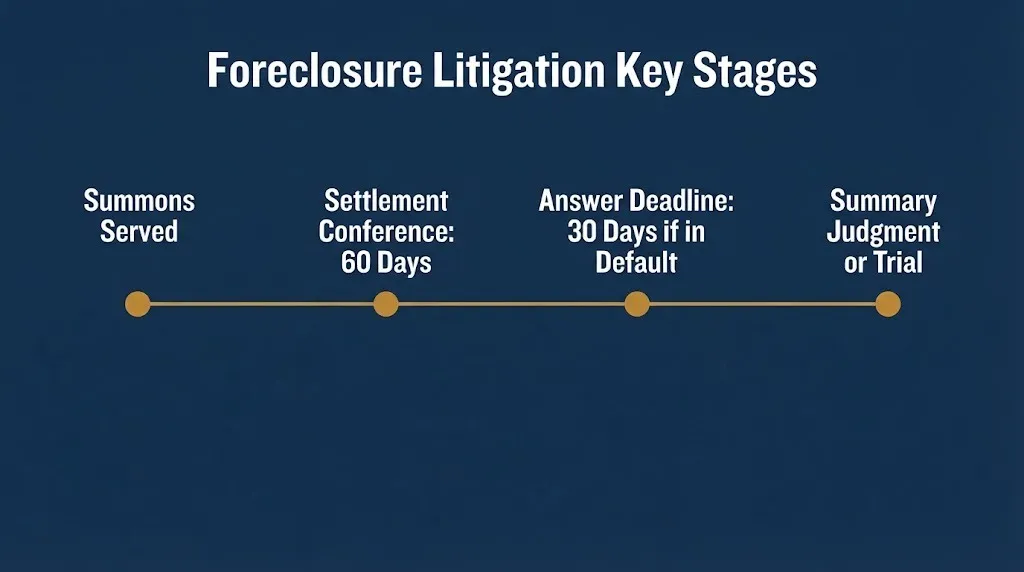
The process typically follows this sequence:
Pre-foreclosure notices. Before filing, the lender must send notices required by RPAPL 1304 and other statutes. Missing these notices can be a defense.
Summons and complaint. The lender files the foreclosure action in the county where the property is located. You must be served with the papers.
Request for Judicial Intervention (RJI). The lender files this to trigger the mandatory settlement conference under CPLR 3408 .
Settlement conference. A court-mandated meeting where you and the lender discuss loan modification, short sale, or other resolutions.
Discovery and motions. Both sides exchange evidence. You can file motions to dismiss if the lender failed to follow the rules.
Summary judgment or trial. If the case is not resolved, the lender may move for summary judgment. If granted, a judgment of foreclosure and sale is entered.
Foreclosure sale. The property is sold at auction.
You are in litigation from the moment the summons is served. Responding is not optional if you want to protect your rights.
What is the Foreclosure Abuse Prevention Act (FAPA)?
The Foreclosure Abuse Prevention Act (FAPA) is a New York law enacted on December 30, 2022, that prevents lenders from manipulating the statute of limitations in foreclosure cases. Before FAPA, lenders could file a foreclosure, voluntarily discontinue it, and later argue the discontinuance “de-accelerated” the loan, resetting the six-year clock. Courts accepted that argument in cases like Freedom Mtge. Corp. v Engel.
FAPA closed that loophole. Under the amended CPLR 203(h), once a cause of action on a mortgage note has accrued, no party may “unilaterally waive, postpone, cancel, toll, revive, or reset the accrual thereof” unless a statute expressly allows it . The voluntary discontinuance of a foreclosure action does not reset the limitations period .
The practical effect is significant. If a lender filed a foreclosure in 2011 and discontinued it, the six-year clock kept running. By 2017, the claim expired. A new foreclosure filed in 2023 is time-barred . Thousands of old cases became vulnerable to dismissal.
FAPA applies retroactively to foreclosure actions where a final judgment of foreclosure and sale has not been enforced . The New York Court of Appeals upheld this retroactive application against constitutional challenges in November 2025, finding that lenders had no vested right to manipulate the limitations period .
Key Takeaway: FAPA prevents lenders from resetting the six-year statute of limitations by voluntarily dropping and refiling foreclosure cases. If your lender filed a prior foreclosure that was discontinued, your current case may be time-barred.
How does the six-year statute of limitations work in foreclosure?
The statute of limitations for a mortgage foreclosure action in New York is six years. The clock starts when the loan is accelerated. Acceleration occurs when the lender demands the full amount due, most commonly by filing a foreclosure complaint that calls due the entire debt .
Once accelerated, the entire mortgage debt becomes due, and the six-year clock begins running on the whole amount. Under FAPA, nothing the lender does after acceleration can unilaterally reset that clock. Discontinuing the case, sending a “de-acceleration letter,” or filing a new action does not revive the expired limitations period .
A concrete example: A lender filed foreclosure in September 2011. That accelerated the loan. The six-year statute expired in September 2017. If the lender files a new foreclosure in 2023, the court must dismiss it as time-barred, even if the prior case was discontinued .
The law also amended RPAPL 1301(3) to prevent lenders from using the “leave of court” requirement as a tolling mechanism. Under FAPA, the time during which a lender must seek leave to file a second action does not toll the statute of limitations .
If you believe your foreclosure is time-barred, you must raise it as an affirmative defense in your answer. Failure to assert the statute of limitations can waive it. An attorney can evaluate your case and file a motion to dismiss under CPLR 3211(a)(5).
What is the mandatory CPLR 3408 settlement conference?
The CPLR 3408 settlement conference is a mandatory court appearance in residential foreclosure cases where the lender and homeowner meet to negotiate a resolution. The court schedules it within 60 days after the lender files a Request for Judicial Intervention .
The purpose is to determine whether you can reach a mutually agreeable resolution to avoid losing your home. Possible outcomes include loan modification, short sale, deed in lieu of foreclosure, or a payment plan .
You must attend. The lender’s attorney must attend with full authority to settle. If you appear pro se (without a lawyer), the court may appoint counsel for you if you qualify as a poor person .
The conference suspends the litigation. Motions are held in abeyance while settlement discussions are ongoing . If you failed to file a timely answer but show up at the conference, the law presumes you have a reasonable excuse for the default. You get 30 days to file an answer, and no defenses are waived .
The conference is not a formality. It is your best opportunity to negotiate a modification and stay in your home. Attending without preparation wastes that opportunity. Bring your financial documents, know your income and expenses, and be ready to discuss what you can afford.
Key Takeaway: The CPLR 3408 settlement conference is mandatory, suspends the litigation, and gives you a chance to negotiate a loan modification. If you missed your answer deadline, attending the conference automatically gives you 30 days to file one.
What happens if you miss the settlement conference?
If you miss the CPLR 3408 settlement conference, you risk losing the protections it provides and face a faster path to default judgment. The conference is mandatory for homeowner-defendants in residential foreclosure actions. Non-appearance weakens your position.
The grace period under CPLR 3408(m) applies only to defendants who appear. If you do not show up, you do not get the automatic 30-day extension to file an answer. The lender can proceed toward default judgment .
The settlement conference also suspends motion practice. If the case is removed from the conference calendar, the lender can file dispositive motions. A missed conference can accelerate that timeline.
Residential foreclosure actions in New York require the lender to file an RJI, which triggers the conference. Courts send notice of the conference date to all parties . If you receive that notice and do not attend, you have no one to blame but yourself.
If you cannot attend on the scheduled date, contact the court immediately. Adjournments are sometimes available for good cause. But do not simply skip it. The cost of missing a mandatory conference can be your home.
What evidence do you need in foreclosure litigation?
You need evidence that challenges the lender’s right to foreclose, proves your defenses, and supports your request for a loan modification. Foreclosure litigation is document-intensive. The lender must prove it owns the note and mortgage and that you defaulted.
The table below shows what to gather and why it matters.
| Evidence Type | Why It Matters |
|---|---|
| Payment records | Shows your payment history and the alleged default |
| Correspondence with lender | Reveals notices, modification applications, and responses |
| Prior foreclosure filings | Proves acceleration and triggers FAPA defense |
| Mortgage and note | Confirms the terms and the lender’s standing |
| RPAPL 1304 notices | Missing or defective notices are defenses |
| Financial documents | Required for loan modification negotiation |
| Proof of residence | Confirms eligibility for CPLR 3408 protections |
Standing is a common defense. The lender must prove it owns the note and mortgage at the time the foreclosure is filed. If the note was transferred through a securitization trust or endorsement chain, the paperwork must be traceable. Missing assignments or endorsements can defeat standing.
FAPA also amends CPLR 213(4) to estop lenders from arguing that a prior foreclosure action did not validly accelerate the loan. Unless the prior action was dismissed based on a judicial determination that the loan was not validly accelerated, the lender is estopped from making that argument .
Reality Check: No one calls you offering to “save your home” for an upfront fee. Free housing counseling is available through HUD-approved agencies and New York’s foreclosure prevention programs. If a company promises to stop your foreclosure for a fee before doing any work, that is a red flag.
How do you stop a foreclosure in New York?
You stop a foreclosure in New York by filing an answer, asserting defenses, attending the settlement conference, and negotiating a resolution. A foreclosure is a lawsuit, and lawsuits can be won, settled, or dismissed.
Here are the steps:
- Respond to the summons. File an answer with the court and serve a copy on the lender’s attorney. Do not ignore it.
- Assert your defenses. Include statute of limitations, lack of standing, defective notices, and any other applicable defenses.
- Attend the CPLR 3408 settlement conference. Bring financial documents and be ready to negotiate.
- Apply for loan modification. Submit a complete application through your servicer’s loss mitigation department.
- Consider bankruptcy. Chapter 13 can stop foreclosure and give you time to catch up.
- Negotiate a short sale or deed in lieu. If keeping the home is not feasible, these options avoid a deficiency judgment.
- Hire a foreclosure defense attorney. The stakes are high, and the rules are complex.
What happens next in a foreclosure case?
The next stages depend on whether you respond and how the settlement conference proceeds.
Within 60 days of RJI: The court schedules the CPLR 3408 settlement conference .
During the conference: Motions are held in abeyance. Negotiations focus on loan modification or other resolutions .
If no resolution: The case returns to the regular foreclosure calendar. The lender may move for summary judgment.
If summary judgment is granted: A judgment of foreclosure and sale is entered. The property is scheduled for auction.
If you file bankruptcy: An automatic stay stops the foreclosure. You get time to reorganize or negotiate.
If FAPA applies: You may move to dismiss as time-barred. This can end the case entirely.
Frequently Asked Questions
What is foreclosure litigation?
Foreclosure litigation is a court action filed by a lender to take your home and sell it to satisfy a mortgage debt. In New York, it is a judicial process with mandatory settlement conferences.
What is the Foreclosure Abuse Prevention Act?
FAPA is a New York law enacted in December 2022 that prevents lenders from resetting the six-year statute of limitations by voluntarily discontinuing foreclosure actions.
How long does a foreclosure take in New York?
The timeline varies. The settlement conference is scheduled within 60 days of the RJI. If unresolved, the case can take a year or more before judgment and sale.
Can I stop a foreclosure in New York?
Yes. Filing an answer, attending the settlement conference, negotiating a modification, or filing bankruptcy can stop or delay the foreclosure.
What is the CPLR 3408 settlement conference?
It is a mandatory court appearance in residential foreclosure cases where you and the lender discuss loan modification, short sale, or other resolutions.
What happens if I miss the settlement conference?
You lose the automatic 30-day grace period to file a late answer and the suspension of motion practice. The lender can proceed toward default judgment.
What is the statute of limitations for foreclosure in New York?
Six years from the date the loan is accelerated, typically by the filing of a foreclosure complaint.
Can a foreclosure be dismissed as time-barred?
Yes. Under FAPA, if the lender filed a prior foreclosure that accelerated the debt more than six years ago, a new foreclosure can be dismissed as time-barred.
The Bottom Line
Foreclosure litigation is a fight you can win or settle, but not if you ignore it. New York’s FAPA gives homeowners a powerful defense against lenders that try to reset the clock. The CPLR 3408 settlement conference gives you a seat at the table to negotiate a modification. Respond to the summons, show up to the conference, and assert your defenses. The six-year statute of limitations and the FAPA estoppel rule are the two most important legal concepts in your case.