How to File a Wrongful Death Lawsuit in 2026: Deadlines, Steps, and Who Can Sue
Quick Answer
- A wrongful death lawsuit is a civil claim filed when negligence or a wrongful act causes a death.
- Payout: not yet determined. No fund exists, and amounts depend on state law, evidence, and damages.
- Deadline: typically two years from death in most states, but the range runs from one to five years.
To file a wrongful death lawsuit, the right person submits a written complaint to the proper court before the state deadline. That person is usually the estate’s representative or a close family member, depending on your state.
Most families have about two years from the date of death. Missing that window usually ends the case.
This guide covers who can sue, the filing steps, evidence, government claims, and a 2026 California change. One surprise: a federal claim isn’t “filed” when you mail it. It counts when the agency receives it.
| The Facts | |
|---|---|
| Case | Not a single case. A civil claim type governed by state law |
| Status | Rules in effect as of October 20, 2026 |
| Fund Size | Not applicable. No settlement fund exists |
| Est. Per Person | Not yet determined. Depends on your case |
| Claim Deadline | Typically two years from death in many states. Confirm yours |
| Administrator | None. The court supervises the case |
| Proof Needed | Evidence of fault, evidence of losses, proof of your relationship |
What is a wrongful death lawsuit?
A wrongful death lawsuit is a civil case filed when someone dies because of another person’s negligence or intentional act. It asks a court to hold the responsible party accountable and to award money to the survivors.
Common causes include car and truck crashes, medical malpractice, workplace accidents, and defective products. Property owner negligence and pedestrian or bicycle accidents show up often too.
Here’s the part many people miss. These claims exist because of state statute. In some places courts recognized a right to recover at common law, while in others no claim existed until a wrongful death statute passed.
That history is why the rules differ so much from state to state. You’re not suing to punish anyone. You’re asking a civil court to measure what your family lost.
- Filed in civil court, not criminal court
- Brought by a representative or a statutory beneficiary
- Governed by your state’s wrongful death statute
- Often resolved by settlement before trial
Is an unlawful death lawsuit the same as a wrongful death lawsuit?
In everyday searches, yes. People type “unlawful death lawsuit” when they mean a wrongful death lawsuit, the civil claim described above.
Statutes, courts, and attorneys use the phrase “wrongful death.” California’s statute, for example, is Code of Civil Procedure section 377.60, and it uses that wording.
The word “unlawful” sounds criminal, but the civil claim isn’t. If you’re hunting for forms, court clerks, or attorneys, search “wrongful death” and your state. Searching “unlawful death” may send you toward criminal homicide pages instead.
Related terms you’ll see for the same civil claim:
- Wrongful death claim
- Wrongful death action
- Wrongful death suit
A survival action is different. It’s a separate claim, covered further down.
Is a wrongful death lawsuit separate from a criminal case?
Yes. A wrongful death claim is a civil claim, separate from and independent of any criminal prosecution.
A criminal case is brought by the state to punish. A wrongful death case is brought by the family or estate to recover losses. Different court rules, different goals, different burdens.
Here’s a real example from federal court records. One family sued the United States for wrongful death while the Air Force sergeant accused of the murders was still awaiting his own trial, according to the family’s complaint.
So you don’t have to wait for a criminal verdict to explore a civil claim. Your deadline keeps running either way.
Key Takeaway: A wrongful death lawsuit is a civil claim under your state’s statute, separate from any criminal case, and “unlawful death” is just a common search variant of the same thing.
How much can you get in a wrongful death lawsuit?
Not yet determined is the only honest answer, because no set payout, fund, or formula exists for wrongful death lawsuits.
Every case is its own. A lawyer’s two main questions are how responsible the other party was and how much money fairly compensates the family. Jury verdicts can award varying damages, and some states cap certain categories.
Be skeptical of any site quoting an “average wrongful death payout” without naming a state, a cause, and a year. That number is a guess dressed up as data. Here’s what actually moves the figure:
| Factor | Why it matters |
|---|---|
| Proof of fault | Weak evidence of negligence lowers leverage |
| Who the survivors are | State law decides who may recover |
| Income and support lost | Economic loss is often the largest measurable piece |
| State damages rules | Some states restrict or cap categories |
| Settlement or trial | A trial verdict can differ from a negotiated deal |
What damages can a wrongful death lawsuit cover?
Wrongful death damages aim at the family’s loss after the death, including lost income, lost support, loss of companionship, and funeral costs.
Which items are open depends on your state. Damages generally fall into economic losses you can price and non-economic losses you can’t.
| Category | Typical examples |
|---|---|
| Economic | Lost income and support, funeral expenses |
| Non-economic | Loss of companionship |
| Estate or survival items | Depends on state. See the survival action section below |
California shows how much state law matters. There, the wrongful death claim doesn’t cover the deceased person’s own pain and suffering. Punitive damages don’t run through the wrongful death claim either. They run through the separate survival action.
Check your state’s damages list before you assume anything is or isn’t recoverable.
Do you have to pay a lawyer upfront to file a wrongful death lawsuit?
Usually no. Most attorneys take wrongful death cases on a contingency basis, meaning no upfront fee. The lawyer takes a percentage of the money at the end.
That setup aligns your interests with the lawyer’s. You both want the case valued as high as the evidence supports.
The percentage varies, and it isn’t confirmed here. Get it in writing. Many cases also need expert witnesses, and those costs can add up, so ask how they’re handled.
Questions worth asking before you sign:
- What percentage do you take, and is it before or after costs?
- Who pays expert and filing costs if we don’t win?
- Who will actually handle my case day to day?
- Do you offer a free case review first?
Reality Check: Nobody texts you wrongful death money first, and no stranger can “release” funds for a processing fee. Be wary of any claim helper or lead site that quotes a payout before reviewing your records. Free case reviews exist. Guaranteed amounts don’t.
Key Takeaway: No one can honestly quote your payout in advance, because value depends on your state’s damages rules, the evidence, and who the survivors are.
How do you file a wrongful death lawsuit?
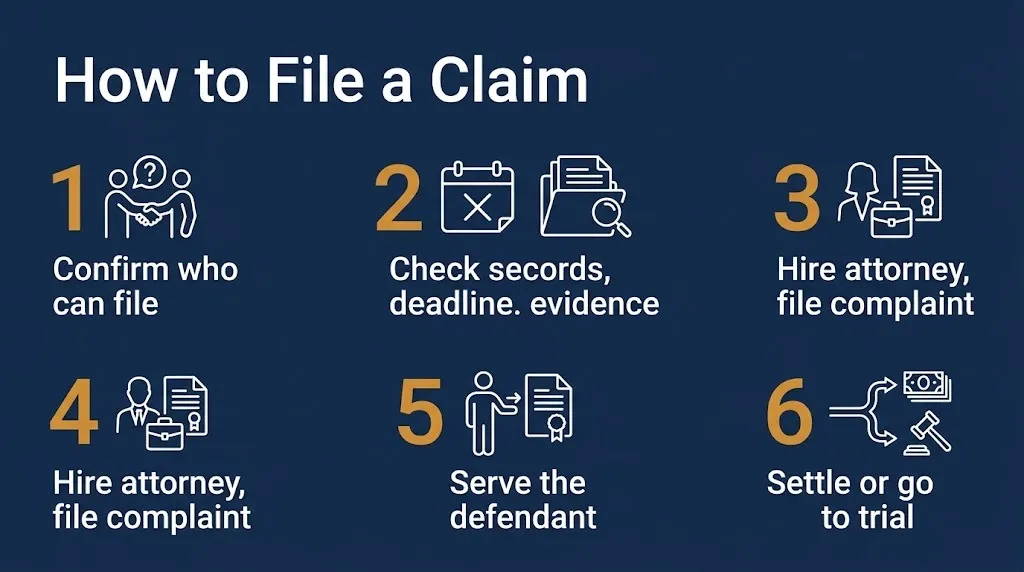
You file a wrongful death lawsuit by submitting a written complaint to the proper court, usually through an attorney, before your state’s deadline.
The complaint is the most important document. It lays out the alleged wrongdoing and how it led to the death. The steps below follow the common order, but your state may add rules.
- Confirm you have legal standing under your state’s statute.
- Check your state deadline and any shorter notice rule.
- Gather the death certificate, records, and evidence of fault.
- Open the estate if your state routes the claim through it.
- Have an attorney investigate and notify the responsible parties.
- File the complaint in the proper court.
- Serve the defendant, who then has a set time to respond.
- Negotiate a settlement, or prepare for trial.
Some responsible parties negotiate before a suit is filed. If they won’t, or the offer falls short, you may still file.
Who can file a wrongful death lawsuit?
Only people your state’s statute names can file, and that’s usually the deceased person’s representative or close family.
The representative files the complaint with the court. The statute also sets a priority order among beneficiaries. That order differs by state, so don’t assume a sibling or parent can file just because they’re close.
In California, surviving spouses or domestic partners, surviving children, and people who depended on the deceased may generally file. Other states name different relatives.
Minors have a special rule. A person under 18 can’t bring a lawsuit alone, so the court appoints a guardian ad litem.
If you’re unsure whether you qualify, ask a licensed attorney in your state. Standing is the first gate, and a mistake here can sink the case.
What is the deadline to file a wrongful death lawsuit?
Most states give about two years from the date of death, but state deadlines range from one year to five years.
Missing the deadline usually ends your right to sue entirely. A court will likely dismiss a late case no matter how strong it is.
| State | Reported deadline |
|---|---|
| California | 2 years from death |
| Pennsylvania | 2 years from death |
| Arizona | 2 years, starting at death (not the accident) |
| Illinois | 2 years for most claims |
| North Carolina | 2 years, with possible exceptions |
| Oregon | 3 years for many claims |
| Montana | 3 years from death |
Think of it like a store return window. Show up a day late and the answer’s usually no, however good your reason.
Exceptions exist. A discovery rule, a minor claimant, or defendant concealment can extend time in some states. Don’t plan around an exception.
Find your real deadline:
- Identify the state where the death or incident occurred.
- Look up that state’s wrongful death statute.
- Check for shorter rules for government or medical defendants.
- Note any exception that might apply.
- Calendar a date well before the deadline.
Key Takeaway: Your deadline is set by state and by who you’re suing, so confirm it first, because missing it usually ends the claim.
What documents and evidence do you need?
You need evidence on two points: that the other party is liable, and that your family suffered measurable losses.
The strength of your case often hinges on that proof. Your attorney will request documents and question the responsible party during the litigation phase. Attorneys on each side may also take depositions from witnesses.
Start gathering now, before records get harder to find. Expert witnesses are common in complex cases, but those come later.
Your starting checklist:
- Death certificate and any autopsy or coroner report
- Medical records and bills, if medical care was involved
- Police, workplace, or incident reports
- Photos, video, and witness names and numbers
- Proof of the person’s income and the support they provided
- Funeral bills and proof of your relationship
Keep originals safe and give your attorney copies. Write down dates while memories are fresh.
Can you file a wrongful death lawsuit without a lawyer?
Yes, you can file on your own, a format called “pro per,” but the risks are real. Wrongful death law is a creature of state statute, and procedural mistakes can cost you the claim.
One California firm argues that defendants see a self-represented family and value the case lower. That’s a law firm’s view, so weigh it accordingly. Still, the procedural traps are well documented.
Many wrongful death cases also involve technical issues, such as expert witnesses and government notice rules. A self-represented family has to handle all of it.
Your realistic options:
- Hire an attorney on contingency, which means no upfront fee
- Request a free case review before deciding
- File pro per, accepting the risks above
If a minor is involved, you’ll need a guardian ad litem either way.
How do you file a wrongful death claim against a government agency?
A claim against a government body usually requires written notice before any lawsuit, and that notice deadline is often much shorter than the normal statute of limitations.
Federal claims run through the Federal Tort Claims Act. The claim must be presented to the right federal agency within two years after it accrues, and courts treat that as a jurisdictional rule. “Presented” means the agency receives it.
One family in a federal appeals case mailed the form one day before the second anniversary of the death. The agency received it four days later and denied it as untimely. The appeals court sided with the family on when the clock began, but only on that case’s facts. Don’t count on that.
State and local governments set their own notice rules.
- Identify which agency or government body is responsible.
- Find that body’s written notice deadline immediately.
- Submit the claim, and confirm in writing that it was received.
- Wait for the agency’s decision or the period the law sets.
- File suit only after the required steps are done.
Key Takeaway: Government claims usually need written notice first, often on a shorter clock, and a federal agency must receive it, not just have it mailed.
What changed in 2026 for California survival actions?
As of January 1, 2026, California no longer allows damages for a deceased person’s pain, suffering, or disfigurement in survival actions.
Here’s the backstory. California’s SB 447 temporarily allowed those damages for actions filed on or after January 1, 2022, and before January 1, 2026. A bill to extend it, SB 29, died at the close of the legislative session.
The wrongful death claim itself is unchanged. California Code of Civil Procedure section 377.60 still governs it.
| Filed before Jan. 1, 2026 | Filed on or after Jan. 1, 2026 | |
|---|---|---|
| Decedent’s pre-death pain, suffering | Yes, under the sunset rule | No |
DLA Piper reported in March 2026 that plaintiffs can’t dodge the cutoff by amending a wrongful death complaint to add survival claims after December 31, 2025. It cited a federal ruling holding that a new survival claim doesn’t relate back to the original complaint.
Other states set their own survival rules. Ask which claims your lawyer is filing and why.
What if the death involved medical malpractice?
If a death involved medical care, the statute of limitations for medical malpractice may apply instead of the general wrongful death deadline, and it can be shorter or longer.
That’s a trap. A family can calendar the wrong deadline and lose the claim. Ask early which clock controls.
Medical cases often need expert testimony to prove the standard of care was breached. Check whether your state adds notice or screening steps before filing.
Timing can also turn on when the family learned the cause. A death first ruled an accident is one scenario that can raise timing questions.
If the care happened at a federally operated facility, such as a military hospital or a federally supported clinic, Federal Tort Claims Act rules apply. That means the two-year written claim to the federal agency.
Consider it like a warranty claim with a manufacturer. You have to follow the maker’s process first, and the court only sees you after.
What happens after you file a wrongful death lawsuit?
After you file, the defendant must respond within a set time, and then both sides exchange evidence in a process called discovery.
During discovery, attorneys can take depositions of witnesses. Most wrongful death cases end in settlement before trial. If neither side agrees on a number, the court sets a trial date, often before a jury.
How long it takes: not yet confirmed. No reliable national timeline exists, because courts and cases vary widely.
| Stage | What happens |
|---|---|
| Service | The defendant is formally notified |
| Response | The defendant answers within a set time |
| Discovery | Both sides gather evidence and take depositions |
| Settlement talks | Many cases resolve here |
| Trial | Held only if no agreement is reached |
Plan for months at minimum, and expect delays. Ask your attorney for a realistic estimate for your court.
Key Takeaway: In 2026, California survival actions lost pain-and-suffering damages while wrongful death claims stayed intact, so confirm which claim your lawyer is actually filing.
What is the difference between a wrongful death claim and a survival action?
A wrongful death claim recovers the survivors’ own losses, while a survival action pursues the claim the deceased person had before dying.
In a wrongful death claim, heirs seek compensation for their own losses, such as lost financial support, household services, and companionship. In a survival action, the personal representative or successor in interest carries on the deceased person’s own claim.
Each state decides whether it has a separate survival statute. The two claims can have different plaintiffs, different damages, and different rules.
California shows the split clearly. Punitive or exemplary damages, where allowed, run through the survival action rather than the wrongful death claim.
Don’t assume one lawsuit covers both. Ask your attorney in writing which claims are being filed and which damages each one allows.
Who can you sue in a wrongful death case?
You can sue an individual, a business, a government entity, or several parties at once, depending on who caused the death.
Depending on the circumstances, you may need to sue more than one party. A crash might involve a driver and an employer. A hospital death might involve a doctor and the facility.
Legal theories vary too. Wrongful death cases can rest on negligence, recklessness, intentional acts, or product defects.
Common defendants include:
- Drivers and trucking companies
- Employers in workplace accidents
- Manufacturers of defective products
- Property owners
- Medical providers and hospitals
- Government agencies, which require notice first
Your attorney will investigate before naming anyone. Naming the wrong party wastes time you may not have.
What Happens Next
- Now: Confirm your state’s filing deadline and who has legal standing.
- Expected early stage: Gather records, investigate, and notify the responsible parties.
- Before your state deadline (often two years from death): File the complaint, or file the government notice first.
- After service, on a court-set schedule: The defendant responds and discovery begins.
- Expected later stage: Settlement talks, or a jury trial date if no deal is reached.
Frequently Asked Questions
How long do I have to file a wrongful death lawsuit?
Most states give about two years from the date of death.
Some states allow one year, and some allow up to five.
Confirm your state’s exact rule before you plan anything.
Who can file a wrongful death lawsuit?
Usually the deceased person’s representative or close family, as your state’s statute defines.
California, for example, generally allows spouses, domestic partners, children, and dependents.
Priority order differs by state.
Can I file a wrongful death lawsuit without a lawyer?
Yes, filing pro per is allowed.
The procedural risks are real, especially with government notice rules and expert witnesses.
Many attorneys offer free case reviews.
How much does it cost to file a wrongful death lawsuit?
Most attorneys work on contingency, so there’s usually no upfront fee.
Court filing fees and expert costs aren’t confirmed here.
Ask how those costs are handled before you sign.
Is an unlawful death lawsuit the same as a wrongful death lawsuit?
In everyday searches, yes.
The civil claim is called wrongful death in statutes and courts.
It’s separate from any criminal case.
Do I need a criminal conviction before filing?
No. A wrongful death claim is separate from and independent of a criminal prosecution.
Your civil deadline keeps running while a criminal case is pending.
Does the 2026 California change affect my wrongful death claim?
The wrongful death claim itself is unchanged.
The change hit survival actions filed on or after January 1, 2026, which lost pain-and-suffering damages.
What if the death happened in another state?
Your two key questions are which state or states you can sue in, and that state’s deadline.
Statutes of limitations are controlled by state law.
Ask an attorney early.
Start with two checks today: confirm who has legal standing, and find your state’s deadline. If a government agency may be responsible, ask about written notice right away.
Write the date on a calendar you’ll see. For many families, the deadline that matters is two years from the date of death, but your state decides.