Slip and Fall Settlement Amounts in 2026: What the Data Actually Shows
Quick Answer
- Most slip and fall settlements fall between $10,000 and $50,000, with an average near $30,000 for cases without surgery.
- Represented claimants receive substantially more than unrepresented ones, roughly $77,600 versus $17,600 on average for personal injury claims broadly.
- There is no fixed payout amount, since your specific settlement depends on injury severity, documented damages, and proof of the property owner’s negligence.
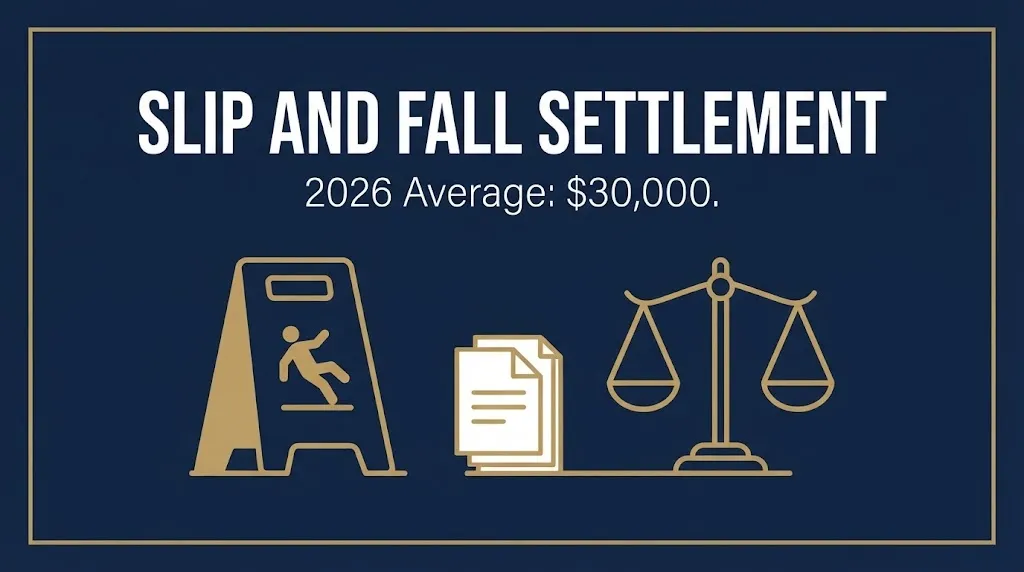
You slipped, fell, got hurt, and now you’re searching for a number to compare against whatever offer shows up. Here’s the direct answer: the average slip and fall settlement runs around $30,000, but that single figure hides a range so wide it’s almost misleading on its own.
This matters because averages get quoted constantly and rarely explain themselves. A soft tissue sprain and a surgical hip fracture both fall under “slip and fall settlement” data, yet one might resolve for $10,000 and the other for $200,000 or more.
This guide breaks down what the actual settlement data shows for slip and fall cases and personal injury claims generally in 2026, how those numbers get calculated, and what changes them. One detail worth knowing upfront: insurance companies’ first offers run 40% to 60% below what claimants typically receive after negotiating, according to industry settlement data.
The Facts
| Category | What’s Verified from 2026 Data |
|---|---|
| Average slip and fall settlement | Approximately $30,000 (ConsumerShield, April 2026 data) |
| Common slip and fall range | $10,000 to $50,000 for cases without surgery |
| Surgical slip and fall cases | Often exceed $100,000 |
| National personal injury median | Approximately $31,000 (Insurance Research Council, auto claims) |
| Represented vs. unrepresented average | $77,600 versus $17,600 (Insurance Research Council) |
| First insurance offers | Typically 40% to 60% below eventual settlement value |
| Cases resolving for $24,000 or less | About half of all personal injury cases |
| Overall PI settlement average (2026) | $40,500 across four reporting law firms (ConsumerShield, June 2026) |
Every number above is an aggregate statistic, not a prediction for any individual case. Your own settlement depends on facts these averages can’t capture.
Is a slip and fall settlement the same as compensation?
Yes, a slip and fall settlement is the compensation paid to resolve a premises liability claim, whether it comes through negotiation or a court judgment. The two terms describe the same outcome from different angles: “settlement” describes the resolution process, “compensation” describes the money itself.
A slip and fall settlement typically compensates for medical expenses, lost wages, pain and suffering, and sometimes future care costs tied to the injury. It resolves the claim without requiring a full trial, which is how the vast majority of these cases actually end.
What a typical slip and fall settlement can include:
- Medical bills already incurred
- Future medical costs, if injuries require ongoing treatment
- Lost wages from missed work
- Pain and suffering damages
- Property damage, in rare applicable cases
Not every slip and fall incident results in a payout. You generally need to show the property owner was negligent, meaning they knew or should have known about the hazard and failed to fix it or warn you.
What is the average slip and fall settlement amount in 2026?
The average slip and fall settlement is approximately $30,000, based on April 2026 data compiled from multiple law firms reporting settlement ranges. Most sources place the common range between $10,000 and $50,000 for cases that don’t involve surgery.
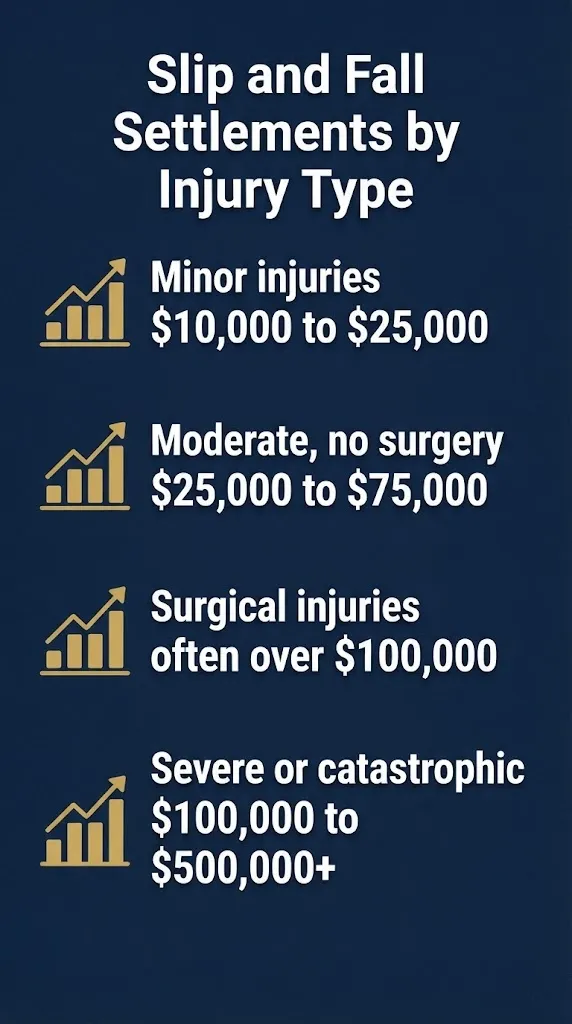
Slip and fall settlement ranges by severity, based on 2026 data:
| Injury Severity | Typical Settlement Range |
|---|---|
| Minor (sprains, bruising) | $10,000 to $25,000 |
| Moderate (fractures without surgery) | $25,000 to $75,000 |
| Surgical injuries | Often exceeds $100,000 |
| Severe (spinal damage, traumatic brain injury) | $100,000 to $500,000+ |
| Catastrophic (permanent disability) | $500,000 to seven figures |
These figures come from aggregated law firm data and state-specific guides, not a single national database, so treat them as directional ranges rather than exact benchmarks. Your specific case could fall well outside any of these bands depending on the facts.
What is the average personal injury settlement amount in 2026?
The national median personal injury settlement is approximately $31,000, according to Insurance Research Council data on auto accident claims, the most common personal injury case type. A separate June 2026 analysis across multiple law firms put the overall average closer to $40,500.
Why the numbers differ depending on the source:
- Medians tend to run lower than averages, since a small number of catastrophic cases pull the average upward.
- About half of all personal injury cases resolve for $24,000 or less, per Forbes settlement analysis data.
- Averages that include catastrophic injury cases, sometimes in the millions, skew the overall mean significantly higher than what a typical claimant actually receives.
Reality Check: No insurance company or claims adjuster texts you a settlement offer out of nowhere, and no legitimate claim requires you to pay a fee upfront to receive compensation you’re owed. If someone contacts you demanding payment to “release” your settlement, that is not how any real claims process works.
How much is a slip and fall settlement worth by injury type?
Settlement value scales directly with injury severity, and surgery is consistently the single biggest factor that pushes a case into six figures. This pattern holds true across nearly every state-specific dataset examined.
Typical settlement patterns by injury type, based on 2026 regional data:
| Injury Type | Typical Range |
|---|---|
| Soft tissue / sprains | $10,000 to $25,000 |
| Simple fractures, no surgery | $25,000 to $75,000 |
| Knee, shoulder, or hip surgery | $100,000 to $250,000+ |
| Spinal cord injury or TBI | $500,000 to $1 million+ |
| Wrongful death | Often seven figures |
Key Takeaway: Whether your injury required surgery is one of the clearest predictors of settlement value across nearly every state and injury dataset reviewed for 2026.
Do slip and fall settlements pay more with a lawyer?
Yes, represented claimants receive substantially higher settlements on average than those who negotiate alone, according to Insurance Research Council data. Across personal injury claims broadly, represented claimants averaged $77,600 compared to $17,600 for unrepresented claimants, a difference described as roughly 340% more.
Why representation tends to increase settlement value:
- Attorneys typically know how to fully document damages, including future medical needs.
- About 73% of unrepresented claimants accept the insurer’s first offer, according to industry data.
- First offers from insurers run 40% to 60% below what claimants ultimately receive after negotiation.
This is worth thinking about the way you’d think of a store return without a receipt. You might still get something back on your own, but having documentation and someone who knows the process tends to get you a fairer outcome.
What is the average personal injury lawsuit settlement by case type?
Settlement averages vary significantly by case type, with medical malpractice claims running highest and slip and fall claims often landing among the lowest categories. This variation comes from differences in how easily liability can be proven and how severe injuries tend to be within each category.
| Case Type | Reported Average (Regional Data) |
|---|---|
| Slip and fall | $28,400 to $30,000 |
| Auto accident | $31,000 (national median), $287,000 average in some states |
| Soft tissue / whiplash | Around $12,000 |
| Spinal cord injury | Over $1.1 million |
| Medical malpractice | $565,077 average in one state-specific dataset |
These figures come from different regional and national datasets, so direct comparisons across categories should be treated cautiously. A slip and fall case in a high cost-of-living state can settle well above the national average shown here.
How is a slip and fall settlement amount calculated?
Settlement value is generally calculated by adding documented economic damages, like medical bills and lost wages, to a non-economic damages estimate for pain and suffering. Attorneys and insurance adjusters often use a multiplier method, applying a factor to economic damages to estimate the non-economic portion.
Core components that build a settlement calculation:
- Total medical expenses, past and estimated future costs
- Lost wages from missed work during recovery
- A pain and suffering estimate, often calculated as a multiple of economic damages
- Property damage, if applicable
- Available insurance policy limits, which can cap the maximum recoverable amount
Key Takeaway: Documented economic damages form the foundation of any settlement calculation, and thin documentation is one of the fastest ways to end up with a lowball offer.
How do you file a slip and fall claim to get compensation?
You file a slip and fall claim by documenting the accident scene, seeking medical treatment, and formally notifying the property owner or their insurer of your injury. Missing any of these early steps can weaken your claim significantly.
Steps to file a slip and fall claim:
- Seek medical attention immediately, even for injuries that seem minor at first.
- Photograph the accident scene, including the hazard that caused the fall.
- Get contact information from any witnesses present.
- Report the incident to the property owner or manager in writing.
- Request an incident report if one is generated.
- Keep all medical bills, receipts, and documentation of missed work.
- Contact the property owner’s insurance carrier to open a claim.
- Consult an attorney before accepting any settlement offer.
Prompt documentation matters because a delayed report gives the property owner room to dispute that the hazard existed or that you were actually injured on their property.
What proof do you need for a slip and fall settlement?
You generally need evidence showing the hazard existed, the property owner knew or should have known about it, and that it directly caused your injury. This is often called establishing “notice,” and it’s frequently the most contested part of a slip and fall claim.
Common types of proof in a slip and fall claim:
- Photos or video of the hazardous condition
- Incident reports filed with the property owner
- Witness statements
- Medical records connecting the injury to the fall
- Maintenance or inspection logs, if obtainable, showing how long the hazard existed
Some states have specific notice statutes that affect how this proof gets evaluated. Florida, for example, has a codified notice rule under its premises liability statute that shapes how claimants must demonstrate the property owner’s knowledge of the hazard.
How long does a slip and fall settlement take?
Slip and fall settlements can take anywhere from a few months to over a year, depending on injury severity, the complexity of liability disputes, and whether the case requires litigation. Cases resolved through direct negotiation with an insurer typically move faster than those requiring a lawsuit.
General timeline factors:
- Cases with clear liability and moderate injuries often resolve in a few months.
- Cases requiring surgery generally wait until the claimant reaches maximum medical improvement before settling.
- Litigated cases involving formal lawsuits can extend well beyond a year.
- Mediation, when used, often resolves disputes in weeks rather than the 12 to 24 months typical of fully litigated cases.
Waiting until you’ve reached maximum medical improvement, the point where your condition has stabilized, is a common recommendation before accepting any settlement, since it ensures the full scope of your damages is known before you sign anything.
Should you accept the first slip and fall settlement offer?
Generally no, first offers from insurance companies typically run 40% to 60% below what claimants receive after negotiating further. Accepting quickly, especially before reaching maximum medical improvement, often means leaving real compensation on the table.
Why early offers tend to be low:
- Insurers often make an initial offer before the full extent of injuries is known.
- About 73% of unrepresented claimants accept that first offer, according to industry data.
- Once you accept and sign a release, you generally cannot go back for more money later, even if your injury turns out to be worse than initially assessed.
This is similar to a delayed tax refund situation: taking the fastest available number isn’t always the smartest move if a more accurate figure is coming with a little more time and documentation.
What’s the deadline to file a slip and fall lawsuit?
Deadlines vary significantly by state, and missing yours generally bars you from recovering compensation through a lawsuit entirely. There is no single national deadline for premises liability claims.
Not yet confirmed for your specific state: the exact statute of limitations that applies to your slip and fall claim, since this figure varies by state and sometimes by the type of property owner involved (government entities often have shorter, separate deadlines).
General guidance that applies broadly:
- Most states set a specific number of years from the date of injury to file a lawsuit.
- Claims against government-owned property often carry much shorter notice deadlines, sometimes just months.
- Consulting an attorney early helps confirm the exact deadline that applies to your situation and location.
What factors increase a slip and fall settlement amount?
Surgery, clear liability evidence, and strong documentation of lost wages and future medical needs are the factors most consistently linked to higher settlement values. These patterns repeat across nearly every regional dataset reviewed for 2026.
Factors that tend to raise settlement value:
- Injuries requiring surgery or long-term treatment
- Clear evidence the property owner knew about the hazard
- Documented lost wages and reduced future earning capacity
- Available insurance policy limits sufficient to cover the claim
- Strong photographic or video evidence of the hazard
Factors that tend to lower settlement value:
- Delayed medical treatment after the fall
- Minimal documentation of the hazard or the incident
- Shared fault, where the claimant partly contributed to the fall
- Low available insurance coverage limits
What is comparative negligence in a slip and fall case?
Comparative negligence is a legal rule that reduces your compensation by the percentage you were personally at fault for the fall. Most states apply some version of this rule, though the specific thresholds differ.
Some states bar recovery entirely if you’re found more than 50% or 51% at fault, a rule sometimes called a modified comparative fault bar. Other states allow reduced recovery even if you were mostly at fault, under a pure comparative negligence system.
Example of how comparative negligence affects payout:
- Total damages calculated: $50,000
- Claimant found 20% at fault
- Adjusted settlement: $40,000 (reduced by the fault percentage)
Not every state applies the same threshold or formula, so how comparative negligence affects your specific claim depends on where the incident occurred.
Are slip and fall settlements taxable?
Generally no, compensation for physical injuries in a slip and fall settlement is excluded from federal income tax under IRC Section 104(a)(2). This covers the core injury-related portion of most settlements.
Exceptions that can remain taxable even in a physical injury settlement:
- Punitive damages, which are always taxable
- Interest that accrued on the settlement
- Any portion reimbursing medical expenses you already deducted and received a tax benefit from in a prior year
Property damage compensation, up to the property’s adjusted value, is also typically excluded from taxable income under the same general framework.
What’s changing with personal injury settlement values in 2026?
Rising healthcare costs and larger jury verdicts are pushing settlement values upward across injury categories in 2026, according to mediation industry data. This trend affects negotiated settlements as well as litigated outcomes.
Not yet confirmed: whether this upward trend will continue consistently through the remainder of 2026, since settlement data updates continuously and regional legal changes can shift outcomes.
What’s driving reported increases:
- Higher medical treatment costs, which raise the economic damages baseline in every calculation.
- Larger jury verdicts in some jurisdictions, which influence settlement negotiations even in cases that never reach trial.
- State-specific legal changes, like Florida’s comparative fault threshold under HB 837, which can significantly affect claim outcomes depending on the jurisdiction.
What happens next
Immediately after any slip and fall injury: Document the scene and seek medical treatment right away.
Within the first few weeks: Report the incident formally and begin gathering medical and wage documentation.
Before accepting any offer: Wait until you’ve reached maximum medical improvement so your full damages are known.
If litigation becomes necessary: Confirm your state’s specific statute of limitations before that deadline passes.
Frequently Asked Questions
What is the average slip and fall settlement amount?
The average is approximately $30,000, based on 2026 data, with most cases ranging from $10,000 to $50,000.
Cases requiring surgery commonly exceed $100,000.
Severe or catastrophic injuries can settle well into six or seven figures.
What is the average personal injury settlement in 2026?
The national median is approximately $31,000, based on Insurance Research Council auto claim data.
A broader 2026 analysis across multiple law firms found an overall average closer to $40,500.
About half of all personal injury cases resolve for $24,000 or less.
Does hiring a lawyer increase your slip and fall settlement?
Yes, represented claimants average significantly more than unrepresented ones in personal injury claims broadly.
Reported figures show roughly $77,600 for represented claimants versus $17,600 for unrepresented claimants.
This gap comes largely from stronger documentation and negotiation against low first offers.
Should I accept the first settlement offer from an insurance company?
Generally no, first offers typically run 40% to 60% below what claimants receive after negotiating.
Accepting before reaching maximum medical improvement can mean settling before your full damages are known.
Once you sign a release, you generally cannot seek more money later.
How long does it take to get a slip and fall settlement?
Timelines range from a few months to over a year, depending on injury severity and liability disputes.
Cases requiring surgery often wait until the claimant stabilizes medically before settling.
Litigated cases can extend well beyond a year compared to direct negotiation.
Are slip and fall settlements taxable income?
Generally no, compensation for physical injuries is excluded from federal income tax.
Punitive damages and interest on the settlement remain taxable even in an otherwise excluded case.
Property damage reimbursement up to adjusted value is also typically excluded.
What factors most affect how much a slip and fall settlement is worth?
Injury severity, especially whether surgery was required, is the strongest predictor of settlement value.
Strong documentation of the hazard and clear evidence of the property owner’s negligence also raise value significantly.
Shared fault under comparative negligence rules can reduce your final compensation.
What is comparative negligence and how does it affect my settlement?
It’s a rule that reduces your compensation based on your own percentage of fault for the fall.
Some states bar recovery entirely if you’re found more than 50% or 51% at fault.
The exact threshold and formula depend on the state where the incident occurred.
Document everything as soon as possible after a slip and fall, since thin evidence is one of the fastest ways to end up with a lowball offer. The figure worth remembering: the average slip and fall settlement runs near $30,000, but injury severity and documentation quality can move that number by hundreds of thousands of dollars in either direction.