3 Epidural Injection Settlement 2026: Why the Number Is Rarely Public and What Catastrophic Cases Actually Pay
Quick Answer
- There is no published average settlement for exactly three epidural injections. Settlement values depend on the injury, not the injection count.
- Catastrophic epidural injury cases have resolved for $2.4 million to $14.9 million. Minor complications may resolve for far less, or not at all.
- The deadline that matters most is your state’s medical malpractice statute of limitations. Many states allow two to three years from the injury or discovery date.
A “3 epidural injection settlement” is not a standard legal category. It is a search phrase from someone trying to put a number on a medical malpractice claim. The honest answer is that no verified database tracks settlements by injection count. What exists are individual cases with individual facts.
This matters if you or someone you love was hurt during or after a series of epidural steroid injections. The injection count is one fact among many. The severity of the injury, the standard of care that was breached, and the state where you file drive the value far more.
This article covers the verified settlement data that does exist, the difference between a catastrophic spinal cord injury and a treatable complication, the statute of limitations rules by state, the medical records that decide a case, and the questions to ask before hiring a lawyer. One detail worth knowing upfront: one of the largest publicly reported epidural injection settlements, $14.9 million, involved a steroid that the manufacturer had already labeled “not for epidural use.”
The Facts
| Item | Verified Detail |
|---|---|
| Standard Settlement Figure | None published for “3 injections” specifically |
| Catastrophic Injury Range | $2.4M to $14.9M in publicly reported cases |
| $14M Quadriplegia Case | 37-year-old woman, cervical epidural at C5-C6 |
| $14.9M Paraplegia Case | Colorado woman, Kenalog labeled “not for epidural use” |
| Common Limitations Period | 2 to 3 years in many states, with discovery rule exceptions |
| Key Medical Record | Anesthesia record, medication record, imaging, neurology notes |
Is the 3 epidural injection settlement real or just a search phrase?
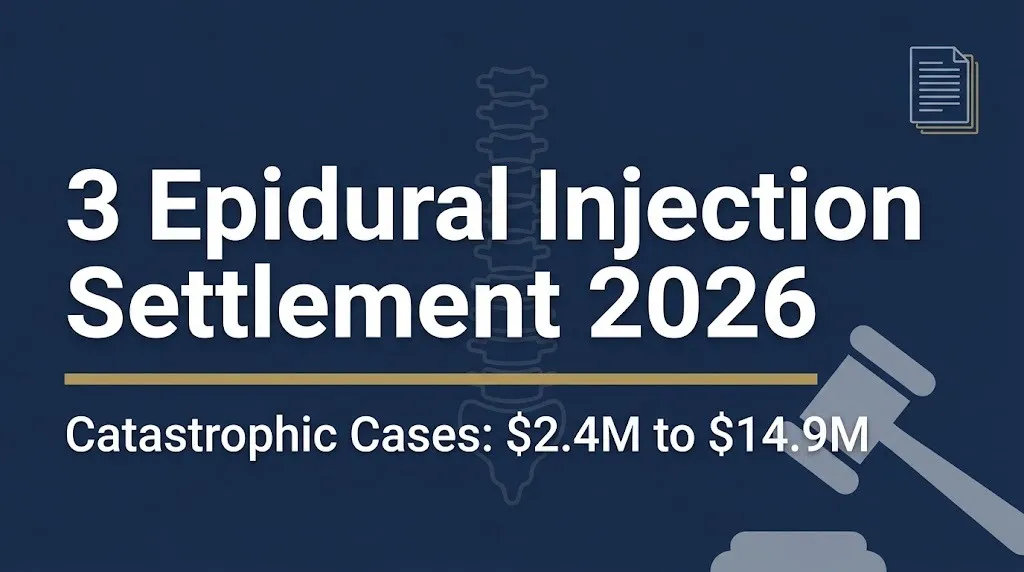
The phrase “3 epidural injection settlement” is a search phrase, not a legal category. No court, agency, or settlement administrator publishes a standard figure for three injections. Real settlements are individual agreements tied to individual injuries.
The confusion comes from how people search. Someone who had three injections and now has lasting pain wants to know what a case is worth. That is understandable. But the number of injections is not how lawyers or insurers value a claim.
What matters is what went wrong. A needle placed too deep, a steroid injected into the spinal cord, a delayed diagnosis of a hematoma, or a failure to warn about a known risk. Each of those is a different claim with a different value.
Key Takeaway: There is no standard “3 injection” settlement. The phrase describes a search query, not a verified payout category. Injury severity and liability drive the number.
How much do catastrophic epidural injection settlements actually pay?
Catastrophic epidural injury settlements have resolved for $2.4 million to $14.9 million in publicly reported cases. These are the cases where the patient suffered paralysis, quadriplegia, or permanent spinal cord damage.
Here is the verified public data:
| Case Type | Reported Amount | Injury | Source Detail |
|---|---|---|---|
| Quadriplegia after cervical ESI | $14,000,000 | Quadriplegia, C4 Asia-C | 37-year-old woman, C5-C6 injection |
| Paraplegia after Kenalog injection | $14,900,000 jury verdict | Paraplegia from waist down | Steroid labeled “not for epidural use” |
| Spinal cord injury during epidural | $2,400,000 | Spinal cord injury | Illinois litigation data, 2023 |
| Epidural hematoma settlements | Average $2,432,272 | Hematoma, neurological damage | Retrospective analysis of 101 cases |
The $14 million settlement involved a single mother of two who worked until the day of her injection. The injection was meant to treat cervical radiculopathy. She became a C4 quadriplegic and now requires nursing care. The settlement allowed her to buy an accessible home and avoid a long-term care facility .
The $14.9 million verdict involved a woman who received Kenalog, a steroid that the manufacturer had labeled “not for epidural use” two years before her injection. She was paralyzed immediately .
Key Takeaway: The public numbers are for catastrophic injuries, not routine complications. A $2.4 million case involved spinal cord injury. A $14 million case involved quadriplegia.
What is the difference between a 2 and 3 epidural injection settlement?
There is no verified difference between a 2 and 3 epidural injection settlement in public data. The number of injections does not appear in any reported settlement as the deciding factor. What appears is the injury and the breach of care.
Some patients receive a series of injections over weeks or months. The series is a treatment protocol. If the third injection causes a spinal cord infarction, the third injection is the injury event. The first two are background.
If you had two injections and suffered an injury, or three injections and suffered an injury, the legal analysis is the same. Did the provider deviate from the standard of care? Did that deviation cause harm?
A retrospective study of epidural hematoma malpractice cases found that settlements averaged about $2.4 million while plaintiff verdicts averaged about $3.6 million . The study did not break down results by injection count.
Key Takeaway: The 2 versus 3 distinction is not a legal category. It is a search pattern. The injury event and the breach of care determine whether you have a claim.
What medical errors lead to epidural injection settlements?
Epidural injection settlements typically follow a specific type of error: the needle goes too deep, the steroid enters the spinal cord, a hematoma is missed, or a known risk is not disclosed. These are not random complications. They are deviations from accepted practice.
Here are the error patterns from verified cases:
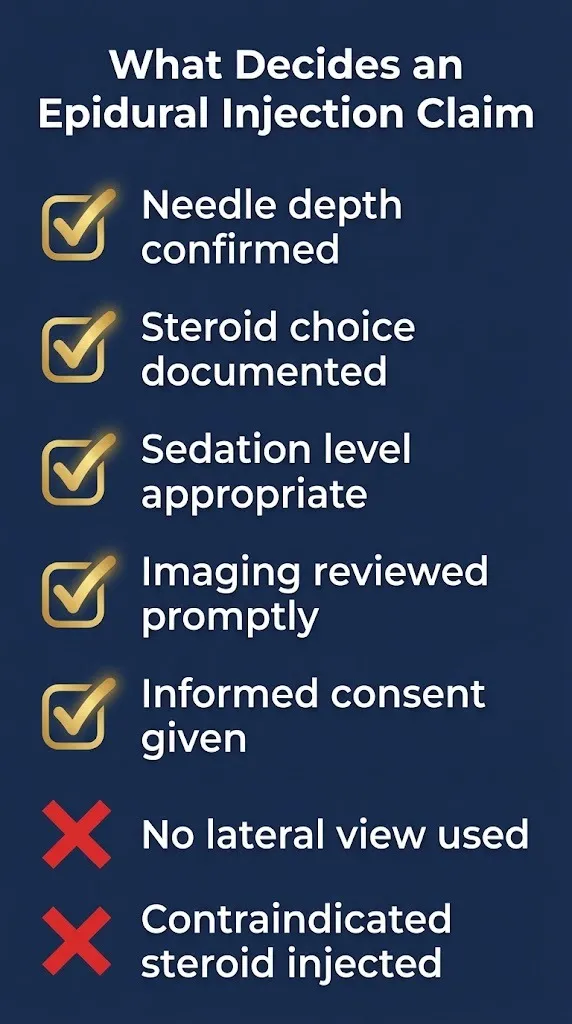
- Needle depth not confirmed: One case involved a doctor who used only an AP fluoroscopic image without a lateral view to confirm needle depth. Contrast and steroid were injected directly into the cervical spinal cord .
- Deep sedation preventing feedback: The same case involved deep sedation that left the patient unable to report pain or paresthesia during the injection, violating ASA guidelines .
- Use of a contraindicated steroid: The $14.9 million case involved Kenalog, which the manufacturer had labeled “not for epidural use” before the injection .
- Failure to use non-particulate steroids: Medical literature notes that particulate steroids carry a risk of spinal cord infarction and quadriplegia. Non-particulate steroids like dexamethasone are considered safer alternatives .
- Delayed diagnosis of hematoma: A retrospective analysis found that epidural hematomas after injections can cause permanent damage if not treated promptly .
Not every bad outcome is malpractice. Epidural injections carry known risks, including infection, bleeding, nerve damage, and paralysis . The legal question is whether the provider followed the standard of care for preventing or managing those risks.
Key Takeaway: The settlements follow preventable errors, not unavoidable complications. Needle depth, steroid choice, sedation level, and prompt diagnosis are the recurring issues.
Do you have to file a claim to get an epidural injection settlement?
You have to file a medical malpractice lawsuit to pursue a settlement. There is no class action, no settlement fund, and no claim form for epidural injection injuries. Each case is an individual legal claim against the provider or facility.
Here are the steps:
- Get immediate medical care. Your health comes first. Document the injury and the treatment.
- Request your medical records. The anesthesia record, medication administration record, imaging, and neurology notes are the core evidence .
- Calculate your deadline. Most states give you two to three years from the injury or discovery. Some are shorter.
- Consult a medical malpractice attorney. Most offer free consultations. The fee is typically a contingency percentage of the recovery.
- File the lawsuit. Your attorney will file in the appropriate court after investigating the standard of care.
- Complete discovery. Expert witnesses will review the records and testify about the breach.
- Negotiate or go to trial. Most cases settle. Some go to verdict.
Reality Check: No one calls you to offer an epidural injection settlement. There is no fund waiting for you to claim. If someone contacts you claiming you are owed money from an injection and asks for a fee, that is a scam. Real claims start with your medical records and a lawyer you hire, not a stranger who found your number.
What is the statute of limitations for an epidural injection lawsuit?
The statute of limitations for an epidural injection lawsuit is typically two to three years from the date of injury, but the rules vary significantly by state. Some states use a discovery rule that extends the deadline if you could not reasonably have known about the injury.
Here are verified examples:
| State | Deadline | Detail |
|---|---|---|
| Indiana | 2 years | From the date of malpractice, with narrow discovery exceptions |
| Maryland | 3 years from discovery or 5 years from injury | Whichever comes first |
| California | 1 year from discovery or 3 years from injury | Whichever comes first |
| England and Wales | 3 years | From the negligence or date of knowledge |
The Maryland rule is unusual because it gives a longer outer limit, but the discovery rule can shorten it. The California rule is strict. A Justia answer from April 2026 told a questioner that a February 2023 injection was likely already time-barred in California because the three-year outer limit had run .
If you are considering a claim, the deadline is the first thing to verify. Missing it usually ends the case regardless of how clear the malpractice was.
Key Takeaway: The statute of limitations is the hardest deadline in the case. Most states give two to three years, but some are shorter. Check your state’s rule immediately.
What happens next if you are considering an epidural injection claim?
Here is the timeline of steps to take:
- Now: Request your complete medical records, including the anesthesia record and imaging.
- Within days: Write down everything you remember about the injection, the symptoms, and the timeline.
- Before the deadline: Consult a medical malpractice attorney. Most consultations are free.
- During the investigation: Your attorney will hire medical experts to review the standard of care.
- If a lawsuit is filed: Expect discovery, expert depositions, and possibly mediation.
- If a settlement is reached: The terms are typically confidential unless a public filing reveals the amount.
Frequently Asked Questions
Is there a standard settlement for 3 epidural injections?
No. There is no published standard settlement for three epidural injections. Settlement values depend on the injury, the breach of care, and the jurisdiction.
How much can you get from an epidural injection lawsuit?
Catastrophic injury cases have resolved for $2.4 million to $14.9 million. Minor complications may result in smaller settlements or no claim at all. The amount depends on the specific facts.
What is the average settlement for an epidural hematoma?
A retrospective analysis of 101 epidural hematoma malpractice cases found an average settlement payment of about $2,432,272 . Plaintiff verdicts averaged about $3,621,590.
Can you sue for pain after an epidural injection?
You can sue if you can prove that a provider deviated from the standard of care and caused your pain. Increased pain alone is a known risk of the procedure . Malpractice requires a breach of the standard of care.
How long do I have to file an epidural injection lawsuit?
Most states allow two to three years from the injury or discovery date. Some states are shorter. Check your state’s medical malpractice statute of limitations immediately.
Do I need a lawyer for an epidural injection claim?
Medical malpractice cases are complex and require expert medical testimony. A lawyer is strongly recommended. Most work on contingency, so you pay nothing upfront.
What records prove an epidural injection error?
The anesthesia record, medication administration record, imaging studies, and neurology consult notes are the core evidence . The anesthesia record shows needle placement and monitoring.
Is the $14 million epidural settlement real?
Yes. Feldman Shepherd reported a $14 million settlement for a 37-year-old woman who became quadriplegic after a cervical epidural steroid injection at C5-C6 . The case is publicly reported by the law firm that handled it.
The number of injections is not the number that matters. The injury is. Request your medical records, check your state’s deadline, and talk to a malpractice attorney before the statute of limitations runs. The public settlements in catastrophic cases show what is possible when the error is provable. They do not promise what your case is worth.