Riverhead Workers Compensation Lawyer in 2026: How to Choose Counsel and What Benefits You Can Recover
Quick Answer
- A Riverhead workers compensation lawyer helps you file claims, challenge denials, and secure benefits under New York’s no-fault system. You do not need one for a simple claim, but representation helps when disputes arise.
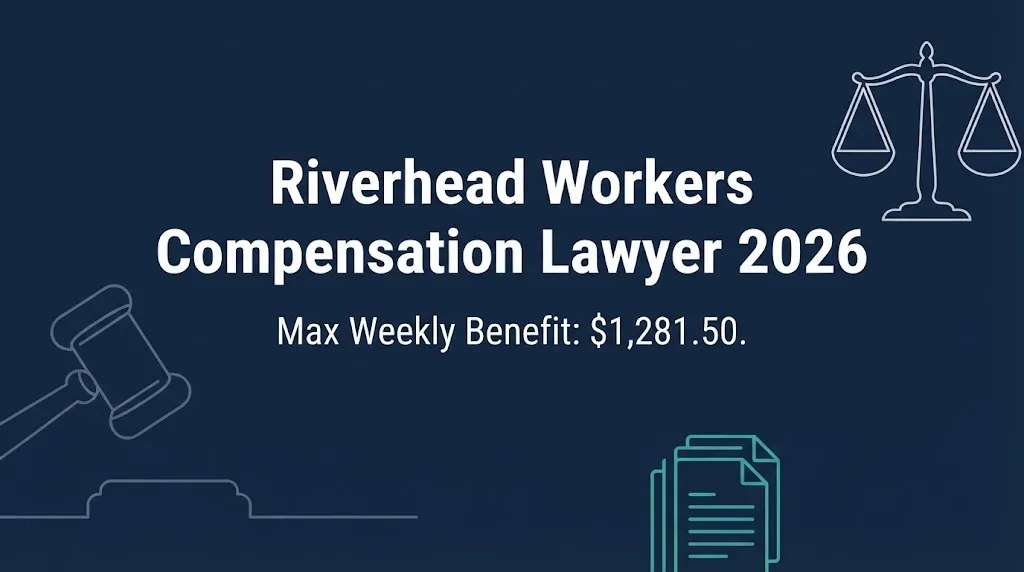
- The maximum weekly lost wage benefit in New York for injuries occurring July 1, 2026 through June 30, 2027 is $1,281.50, and the minimum is $384.45 .
- You must file a claim with the Workers’ Compensation Board within two years of the accident, but written notice to your employer is due within 30 days .
A Riverhead workers compensation lawyer handles claims under New York’s no-fault system, which pays medical bills and partial lost wages regardless of who caused the injury. The system is supposed to be simple, but insurers deny claims, dispute causation, and delay payments more often than the statute suggests.
If you were hurt on the job in or near Riverhead, you may qualify for lifetime medical care, weekly lost wage benefits, and potentially a Schedule Loss of Use award if your injury leaves permanent impairment. You generally do not need a lawyer to file a simple claim, but you may want one if your claim is denied or your benefits stop.
This article explains what a Riverhead workers compensation lawyer does, how benefits are calculated, what deadlines apply, and how to choose counsel. You will also see verified benefit rates for 2026 and red flags to avoid when hiring any attorney.
Is a Riverhead workers compensation lawyer necessary, or can you handle it yourself?
A Riverhead workers compensation lawyer is not required to file a claim, but representation helps when your claim is denied, your benefits are disputed, or your injury may leave permanent impairment. New York’s workers compensation system is designed to work without attorneys, yet the Board receives tens of thousands of contested cases each year.
You can file a simple claim on your own. The Board’s forms are available online, and unrepresented claimants appear at hearings regularly. The system does not require a lawyer for routine matters.
Where representation matters is when the insurer files a notice of controversy denying your claim. That triggers a pre-hearing conference and likely a formal hearing before a Workers’ Compensation Law judge . At that point, you are arguing against the carrier’s lawyers about causation, degree of disability, and medical evidence.
The insurer’s goal is to minimize what it pays. Having a lawyer who knows the Board’s procedures and the local judges makes a difference, just like having someone who knows the tax code file your return instead of guessing.
Key Takeaway: You can file a simple workers compensation claim without a lawyer, but representation matters most when the insurer denies your claim or disputes how disabled you are.
How much does a Riverhead workers compensation lawyer cost?
Most Riverhead workers compensation lawyers offer free initial consultations and work on a contingency or statutory fee basis, meaning you pay nothing upfront and fees come out of your award. New York caps attorney fees in workers compensation cases at 15% of the award, subject to Board approval.
The standard fee structure works like this. You pay nothing to start. If you win benefits, the lawyer’s fee is deducted from the award and must be approved by the Workers’ Compensation Board. If you recover nothing, you owe nothing for fees.
Many Riverhead firms emphasize free consultations as a way to evaluate cases without cost . That means you can meet with a lawyer, explain what happened, and get a realistic assessment before deciding whether to hire anyone.
Some attorneys charge a flat fee for specific tasks like preparing a Section 32 waiver agreement, which is a settlement that closes out future benefits. Those fees are usually disclosed upfront.
Key Takeaway: You should never pay upfront for workers compensation representation in New York, and any attorney who asks for a retainer before reviewing your case is not following the standard model.
What is the Reality Check on workers compensation lawyer promises?
Reality Check: No lawyer can promise you a specific payout or that your claim will be approved. Workers compensation benefits are set by statute, and the Board decides what you receive. If an attorney guarantees a dollar amount before seeing your medical records, that is a sales pitch. Also, workers compensation does not pay pain and suffering. If someone promises you compensation for pain and suffering through a comp claim, they are confusing it with a personal injury lawsuit, which is a separate case.
What benefits can a Riverhead workers compensation lawyer help you recover?
A Riverhead workers compensation lawyer can help you recover medical treatment, weekly lost wage benefits, and a Schedule Loss of Use award if your injury leaves permanent impairment. The system does not pay pain and suffering.
Here is what New York workers compensation covers:
| Benefit | What It Pays |
|---|---|
| Medical treatment | Lifetime care from Board-authorized providers, no copays |
| Lost wage benefits | Two-thirds of your average weekly wage, tax-free |
| Schedule Loss of Use | Lump sum for permanent impairment of a body part |
| Mileage reimbursement | Travel costs for treatment |
| Vocational rehabilitation | Retraining if you cannot return to your job |
Lost wage benefits are calculated as two-thirds of your average weekly wage multiplied by your degree of disability . If you earn $900 per week and are 50% disabled, your benefit is $300 per week.
The maximum weekly benefit for injuries from July 1, 2026 through June 30, 2027 is $1,281.50 . The minimum is $384.45 for that same period.
Key Takeaway: Workers compensation covers medical care and partial lost wages, but it does not pay for pain and suffering, and the maximum weekly benefit in 2026 is $1,281.50.
How is your workers compensation weekly benefit calculated in New York?
Your weekly workers compensation benefit is two-thirds of your average weekly wage multiplied by your degree of disability, subject to a maximum and minimum set by the state. The benefit is tax-free.
The formula is: (2/3) × AWW × % disability = weekly benefit .
Your average weekly wage is based on your gross earnings, including overtime, for the 52 weeks before your injury. If you worked overtime regularly, that counts.
The maximum weekly benefit for the period July 1, 2026 through June 30, 2027 is $1,281.50 . The minimum is $384.45, which is one-fifth of the New York State Average Weekly Wage .
Your benefit rate is set by the date of your injury. It does not increase if the state raises the maximum later .
Key Takeaway: Your weekly benefit is two-thirds of your average weekly wage, capped at $1,281.50 for injuries occurring in the 2026-2027 period.
What deadlines apply to Riverhead workers compensation claims?
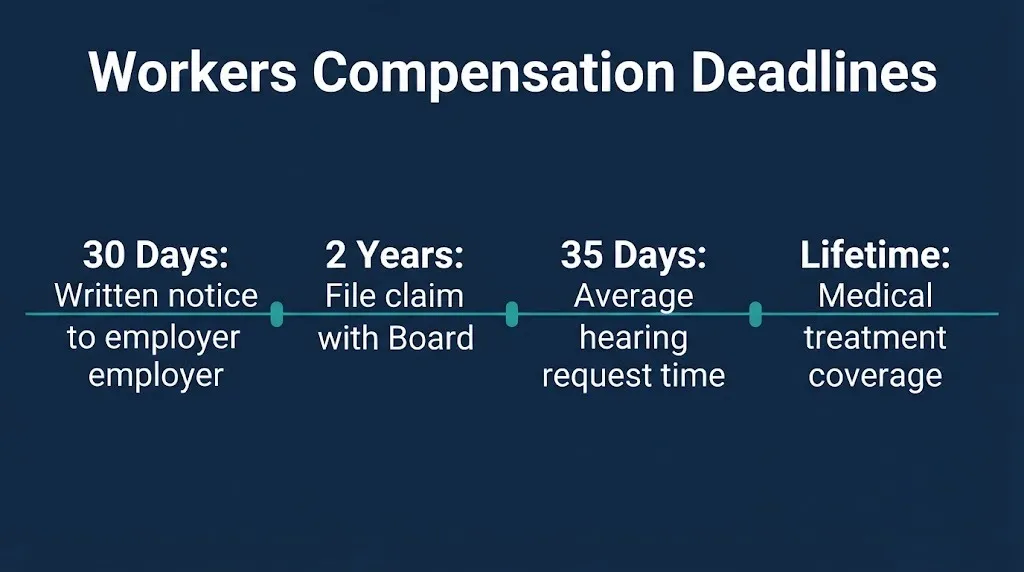
You must report your injury to your employer in writing within 30 days and file a formal claim with the Workers’ Compensation Board within two years of the accident. Missing either deadline can bar your claim.
The 30-day notice requirement is strict. You must tell your employer about the injury in writing, though the Board may excuse late notice in some cases if the employer was not prejudiced .
The two-year filing deadline is set by Workers’ Compensation Law Section 28 . The Board has held that a timely claim can be amended later to include consequential injuries, so the original filing protects your rights even if new conditions develop .
If your injury is an occupational disease rather than an accident, the timeline runs from when you knew or should have known the disease was work-related .
Key Takeaway: Report your injury in writing within 30 days and file your claim with the Board within two years, or you risk losing benefits entirely.
What is the process for a contested workers compensation claim in Riverhead?
A contested workers compensation claim goes through a pre-hearing conference, then a formal hearing before a Workers’ Compensation Law judge, with appeals available to the Board Panel and Full Board. The process is designed to resolve disputes without going to court.
The insurer files a notice of controversy when it denies your claim. That triggers a pre-hearing conference before a judge or conciliator, usually within 30 days .
If the dispute is not resolved, a formal hearing follows. Both sides present evidence, and you may testify about how the injury happened, your symptoms, and your limitations .
The judge issues a decision. If either side disagrees, they can appeal to a Board Panel of three Commissioners. Further appeals go to the Full Board, and in rare cases to the Appellate Division .
The Board has reduced wait times for hearings to an average of 35 days from request to hearing date as of 2026 .
Key Takeaway: Contested claims go through a hearing process where you testify and present evidence, and the judge decides whether you receive benefits.
How do you choose a Riverhead workers compensation lawyer?
You choose a Riverhead workers compensation lawyer by verifying their experience with the Workers’ Compensation Board, checking their bar status, and asking about their fee structure and who will handle your case. Free consultations let you compare multiple attorneys before deciding.
Here is what to look for:
- Experience with the Board. Ask how many workers compensation cases they handle per year and whether they appear at hearings in your area.
- Bar standing. Check the attorney’s license status on the New York State Unified Court System website.
- Fee transparency. Confirm the 15% statutory fee cap and ask whether there are any additional costs.
- Who handles your case. Some firms assign paralegals or licensed representatives to routine matters. Ask if an attorney will handle yours.
- Communication. Ask how often you will receive updates and who you can call with questions.
Several firms maintain Riverhead offices, including McIntyre, Donohue, Accardi, Salmonson & Riordan, LLP, which lists workers compensation among its practice areas and offers free consultations .
Key Takeaway: The right lawyer for your case is one who handles Board hearings regularly, explains fees clearly, and gives you a realistic assessment rather than a guaranteed outcome.
What happens next after you hire a workers compensation lawyer?
After you hire a workers compensation lawyer, the next steps depend on whether your claim is accepted or denied. If accepted, your lawyer monitors your benefits and ensures the insurer pays correctly. If denied, your lawyer prepares for hearings and appeals.
The typical flow looks like this:
If your claim is accepted: Your lawyer reviews the benefit rate, confirms medical treatment is authorized, and addresses any issues that arise.
If your claim is denied: Your lawyer requests a hearing, prepares evidence, and represents you before the Workers’ Compensation Law judge .
If benefits are disputed later: Your lawyer can file for a hearing on any issue, from degree of disability to medical necessity.
If you receive a settlement offer: Your lawyer reviews any Section 32 agreement to ensure it protects your interests, especially regarding future medical care.
TBD: Most cases resolve at the Board level. Appeals to the Appellate Division are rare .
Frequently Asked Questions
Do I need a lawyer for a workers compensation claim in Riverhead?
You do not need a lawyer for a simple claim, but representation helps if your claim is denied, your benefits are disputed, or your injury may leave permanent impairment.
How much does a Riverhead workers compensation lawyer cost?
Most lawyers work on contingency or statutory fee arrangements, meaning you pay nothing upfront and fees come out of your award. New York caps fees at 15% of the award.
What is the maximum weekly workers compensation benefit in New York?
The maximum weekly benefit for injuries occurring July 1, 2026 through June 30, 2027 is $1,281.50.
How long do I have to file a workers compensation claim in New York?
You must file a claim with the Workers’ Compensation Board within two years of the accident. You must notify your employer in writing within 30 days.
What can I recover through workers compensation in New York?
You can recover medical treatment, partial lost wage benefits, and a Schedule Loss of Use award for permanent impairment. Workers compensation does not pay pain and suffering.
What happens if my workers compensation claim is denied?
If your claim is denied, you can request a hearing before a Workers’ Compensation Law judge. Your lawyer presents evidence, and you may testify about the injury and its impact.
Can I sue my employer for a work injury in New York?
In most cases, workers compensation is your exclusive remedy against your employer. You may have a separate personal injury claim if a third party caused the accident.
Do workers compensation benefits cover future medical treatment?
Yes. New York workers compensation provides lifetime medical treatment for work-related injuries, provided by Board-authorized providers.
Your next step
Call the New York State Workers’ Compensation Board at (877) 632-4996 or visit their website to confirm your claim filing deadline. Then gather your medical records, the incident report, and any correspondence from the insurer. If your claim is denied or your benefits stop, schedule a free consultation with a Riverhead workers compensation lawyer before the two-year deadline passes.