Honey Pot Lawsuit 2026: The “Plant-Derived” Label Fight, Not a Payout You Can Claim
Quick Answer
- Is it legit? Yes. A real class action, Tucker v. The Honey Pot Company, is pending in federal court over “plant-derived” labeling.
- How much? Not yet determined. No settlement fund exists, and no payout tiers have been approved.
- Key deadline? No claim deadline is set. The case is in early procedural stages.
If you bought Honey Pot feminine care products because the label said “plant-derived,” you are probably wondering one thing: where do I file. The honest answer for October 2026 is that there is nowhere to file yet. The case is real, the allegations are specific, and the courtroom fight is ongoing.
A class action filed in November 2024 in the U.S. District Court for the Northern District of California claims the company misled consumers about the plant origins of its ingredients. The case number is 4:24-cv-07973, and Judge Yvonne Gonzalez Rogers is assigned. No settlement has been reached.
This article covers what the lawsuit actually alleges, who may qualify if a settlement happens, what happened to a separate earlier case against the same company, and the traps to avoid while you wait.
The Facts
| Case | Tucker v. The Honey Pot Company, LLC |
|---|---|
| Status | Active, pending in the Northern District of California |
| Fund Size | Not yet confirmed |
| Est. Per Person | Not yet determined |
| Claim Deadline | TBD, watch the official case docket |
| Administrator | Not yet appointed |
| Proof Needed | Check the claim form if one is ever issued |
Is the Honey Pot Lawsuit Real or a Scam?
The Honey Pot lawsuit is real. It is a pending federal class action filed in November 2024, not a viral rumor or a phishing trap. The case names The Honey Pot Company, LLC as the defendant and is assigned to Judge Yvonne Gonzalez Rogers in the Northern District of California, Eastern Division.
The lead plaintiffs are Tucker and Rabinowitz, who filed on behalf of a proposed nationwide class of consumers who bought products labeled “plant-derived.” The claims include violations of California’s Unfair Competition Law and Consumers Legal Remedies Act, plus common law claims for fraud and breach of warranty.
What makes this one worth watching is the regulatory gray zone at the center of it. The FDA regulates menstrual products as medical devices, but its oversight focuses on safety, not marketing claims about ingredients. The FTC has authority over advertising, but it has issued limited specific guidance on what “plant-derived” actually means for personal care products. That ambiguity is exactly what the lawsuit exploits.
Key Takeaway: The case is real, active, and unresolved, but there is no money to claim right now.
How Much Could You Get From the Honey Pot Lawsuit?
There is no confirmed payout amount, and any source that gives you a dollar figure is guessing. The case has not settled. No settlement fund has been established. No claims administrator has been appointed.
What the plaintiffs are seeking, according to the complaint, includes:
- Restitution and damages for consumers who overpaid for products they believed were naturally sourced
- Injunctive relief to stop the “plant-derived” labeling
- Corrective advertising to inform the public about the actual nature of ingredients
- Attorney’s fees and costs
If a settlement is reached, the payout structure would depend on how many class members file claims and how the fund is divided. In similar false-advertising class actions, per-person payouts often land between $5 and $50, sometimes as a percentage of verified purchases. But that is a pattern, not a promise. For this case, the answer is: Not yet determined.
Who May Qualify for the Honey Pot Class Action?
You may be a potential class member if you bought Honey Pot feminine care products labeled “plant-derived” and relied on that label when making your purchase. The proposed class is nationwide.
The products at issue are pads, liners, wipes, and washes marketed with plant-derived claims. The named plaintiff in the original complaint was later voluntarily dismissed, but class-level claims remained unresolved.
A separate but related case, Senior v. The Honey Pot Company (DE), LLC, was filed in March 2026 in the Southern District of New York, raising a different legal theory under the Americans with Disabilities Act. That case is separate from the “plant-derived” false advertising fight.
To be clear: no court has yet certified a class. Until a judge does, there is no defined group of people with guaranteed rights to participate in any future settlement.
What Is the Honey Pot “Plant-Derived” Labeling Lawsuit About?
The lawsuit alleges that The Honey Pot Company marketed its feminine care products as “plant-derived” when the products contained synthetic ingredients. That is the core claim.
The complaint argues that reasonable consumers understand “plant-derived” to mean ingredients come from plants, and that the company’s labeling overstated the natural sourcing of its products. The plaintiffs say they paid a premium based on that belief.
The legal theory rests on a simple consumer protection principle: if a front-label claim creates an expectation, burying qualifying language on the back does not automatically fix the deception. Courts evaluating natural-labeling cases have generally held that it is not unreasonable for a consumer to expect a product labeled “natural” or “plant-derived” to actually be that.
The Honey Pot Company has not filed a formal public response to the current complaint as of the sources checked for this article. The company is represented by Venable LLP, according to the filings.
Reality Check: No One Texts You Settlement Money First
Reality Check: If you get a text, email, or DM saying you are owed money from the Honey Pot lawsuit right now, it is a scam. No settlement exists, no claims administrator has been appointed, and no legitimate notice has gone out. Filing a claim in a real class action is always free. Anyone charging you a fee to “process” a Honey Pot claim before a settlement exists is taking your money for nothing.
Did an Earlier Honey Pot Lawsuit Get Dismissed?
Yes. A separate 2023 case, McAuley v. The Honey Pot Company, LLC, was dismissed in March 2024. That case alleged the company’s feminine care foaming washes were unsafe for vulvar use because gynecologists advise against using soap in that area.
Judge Analisa Torres dismissed the case in the Southern District of New York, finding the plaintiffs failed to adequately demonstrate that the company’s safety claims were likely to deceive a reasonable consumer. That dismissal does not kill the current “plant-derived” case because the legal theories are different. The safety case was about whether the products caused harm. The labeling case is about whether the marketing language misled buyers.
That distinction matters if you are trying to figure out whether this lawsuit has teeth. The earlier dismissal shows that courts scrutinize whether claims genuinely mislead. The current case has survived the initial filing stage and is moving through the Northern District of California.
How Do You File a Claim in the Honey Pot Lawsuit?
You cannot file a claim yet. There is no settlement, no claim form, and no deadline. Here is what to do instead:
- Save your receipts. If you bought Honey Pot products, keep proof of purchase if you have it.
- Screenshot the labels. If you still have the packaging, photograph the “plant-derived” claim.
- Watch the docket. Follow the case in the Northern District of California, Case No. 4:24-cv-07973.
- Check the official settlement website once one exists. It will be the only legitimate place to file.
- Ignore third-party “claim helpers.” They cannot speed up a process that has not started.
- Do not pay anyone. Filing a class action claim is free.
- Calendar nothing yet. There is no deadline to miss right now.
When Will the Honey Pot Lawsuit Settle?
No one knows, and anyone who gives you a date is guessing. Class action timelines vary widely. The case has been pending since November 2024 and remains in early procedural stages as of October 2026.
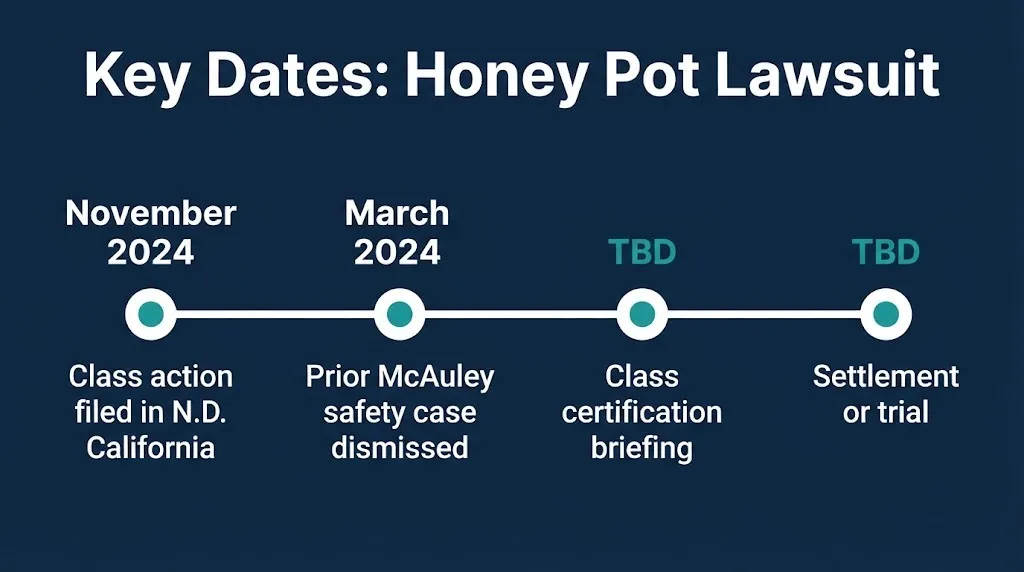
Possible next steps include:
- Class certification briefing, where the judge decides whether the case can proceed as a class action
- Summary judgment motions, where either side asks the judge to rule without trial
- Settlement talks, which can happen at any time
- Trial, if no resolution is reached
Key Takeaway: The case is moving slowly, and no settlement date has been announced.
What Happens Next in the Honey Pot Lawsuit?
Expected late 2026: Class certification briefing and discovery. The parties will exchange evidence and argue over whether the proposed class meets legal requirements.
Expected 2027: Possible summary judgment motions or settlement talks. If the judge certifies the class, the case gains leverage for a resolution.
TBD: Final approval hearing, if a settlement is reached. This is when a judge would approve the fund and set a claim deadline.
TBD: Claims period. If approved, this is when you would file. No dates exist yet.
Frequently Asked Questions
Is the Honey Pot lawsuit a real class action?
Yes. Tucker v. The Honey Pot Company is a pending federal class action in the Northern District of California over “plant-derived” labeling claims.
How much will each person get from the Honey Pot settlement?
Not yet determined. No settlement fund exists, so no per-person amount has been set or approved.
When is the deadline to file a Honey Pot claim?
No deadline is set. The case has not settled, and no claim form has been issued.
Do I need a receipt to file a Honey Pot claim?
Unknown. If a settlement is reached, the proof requirements will be defined in the claim form. Many class actions allow claims without receipts for low-value purchases.
Was the Honey Pot lawsuit dismissed?
A separate 2023 safety case, McAuley, was dismissed in 2024. The current “plant-derived” case, Tucker, is still active.
What products are covered by the Honey Pot lawsuit?
Pads, liners, wipes, and washes labeled as “plant-derived.” The proposed class is nationwide.
Is this the same as the Alexis Wilkins “honeypot” lawsuit?
No. The Alexis Wilkins case is a defamation lawsuit over political rumors. This article covers a consumer class action against a feminine care brand. The terms sound similar but describe completely different cases.
Where can I check the status of the Honey Pot lawsuit?
The official court docket for Case No. 4:24-cv-07973 in the Northern District of California, or the official settlement website if one is created.
What You Should Do Right Now
Check whether you still have Honey Pot products labeled “plant-derived.” Save the packaging or a photo of it. Keep any receipts you can find.
The case has not settled, so there is nothing to file. When a settlement is announced, it will appear on the official court docket and a claims website will be created. That is when you act. Until then, ignore anyone asking for money to “help” you claim a payout that does not exist yet.
The single most important fact: no claim deadline exists as of October 2026, which means no one can legitimately tell you that you are running out of time.